


Pilot Qualification in India: The Complete Beginner's Checklist
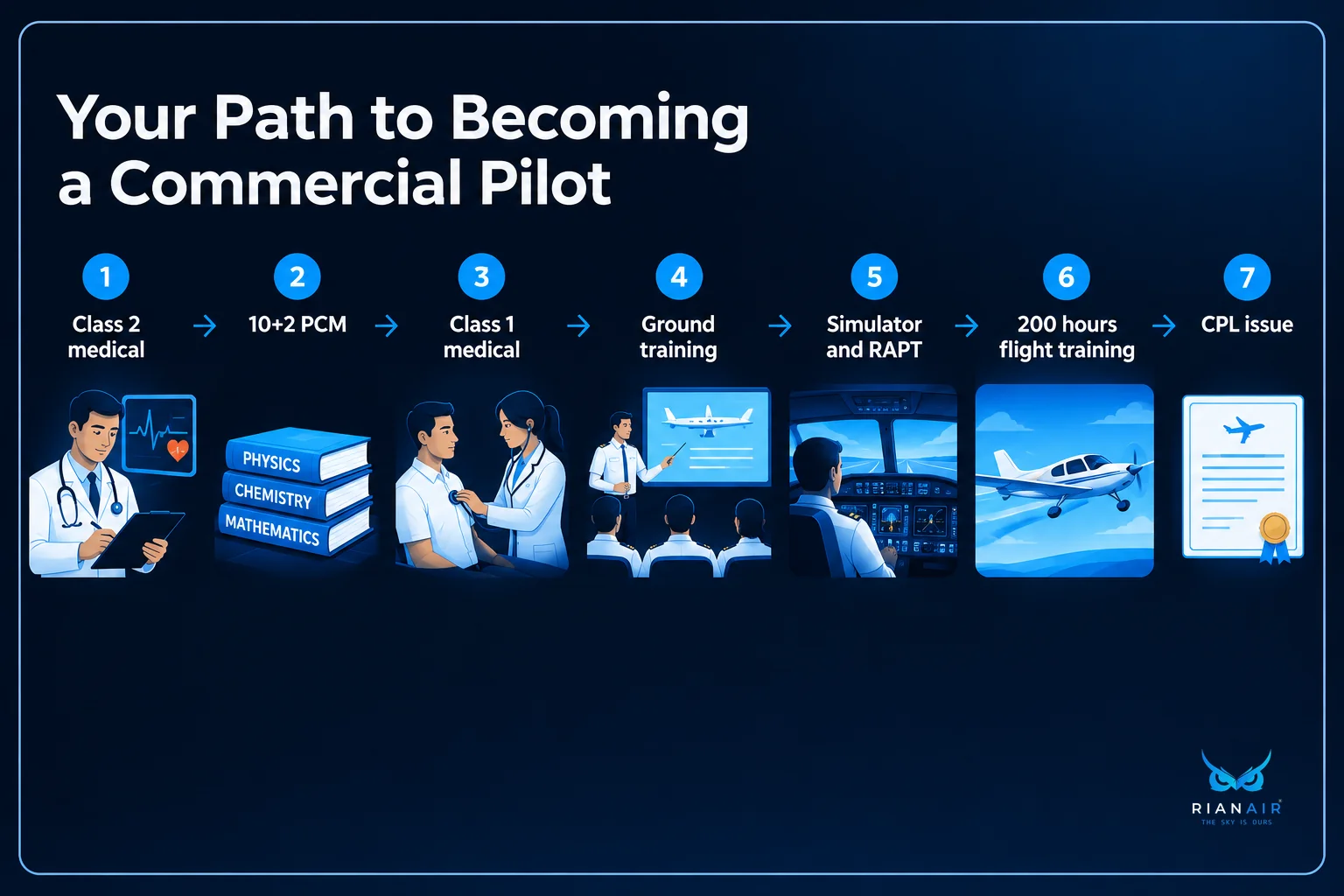
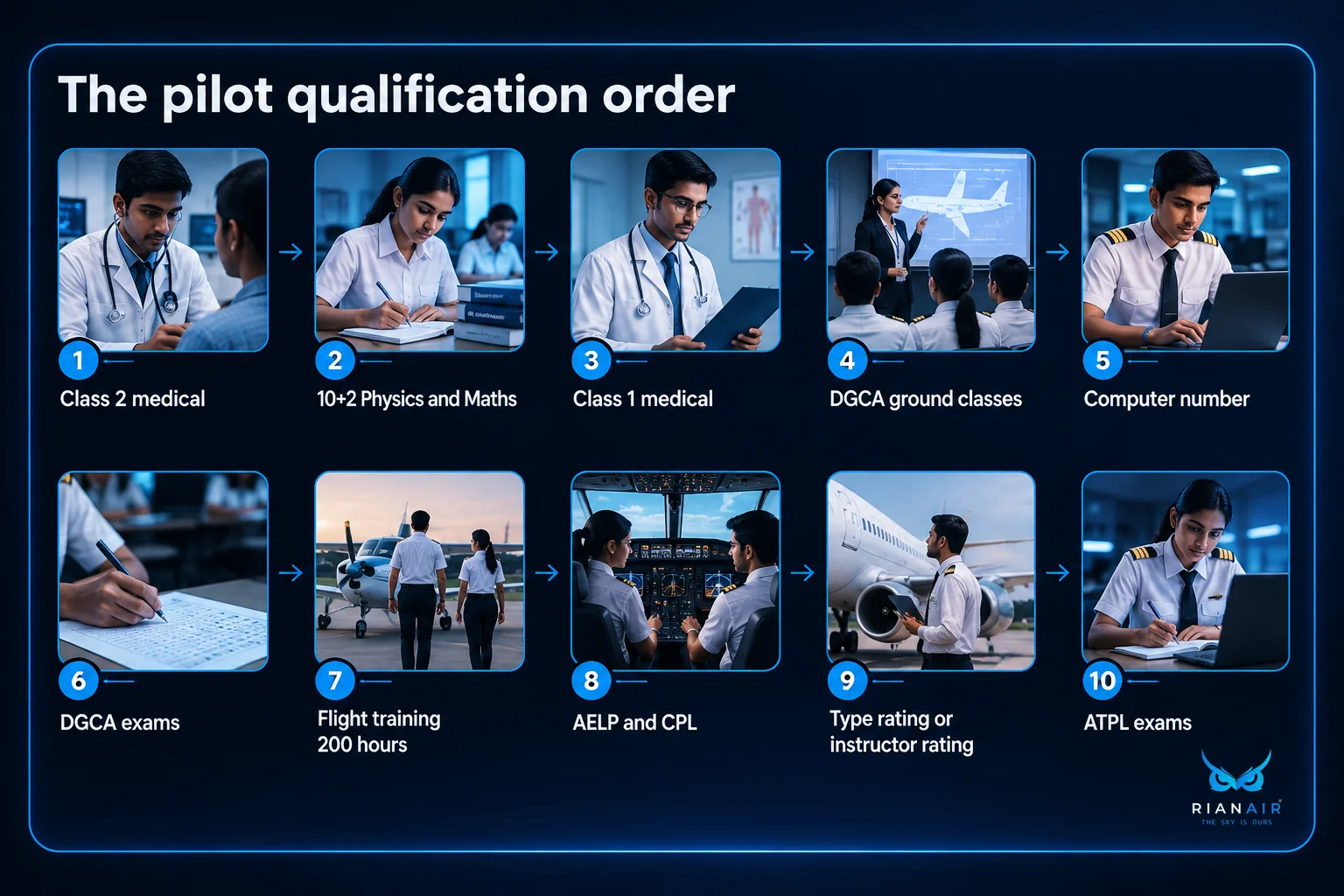
Pilot qualification in India follows ten checkpoints in a fixed order: a Class 2 medical after Class 10, 10+2 with Physics and Mathematics, a Class 1 medical, DGCA ground classes, a computer number, DGCA exams, 200 actual flight hours, English proficiency testing (AELP) with CPL issue, a type rating or instructor rating, and finally ATPL exams. The minimum age is 16 for a student pilot licence, 17 for a PPL and 18 for a CPL.
This checklist is written for 12th-pass students and parents in Delhi, Mumbai, Thrissur and across India who do not know where to begin. Rian Air runs DGCA-aligned ground training on its RAPT platform, with a question bank of 20,000+ questions and a digital logbook. Our students most often fly at Indian Flying Academy in Khajuraho.
Pilot qualification at a glance: the order that saves time and money
The order matters because the cheapest checks come first. A medical costs a few thousand rupees, while a flight school deposit costs lakhs. Finding out early that you are medically fit, and that you meet the education rule, protects the larger spend that follows.
Class 2 medical with a DGCA-approved medical examiner, once you hold your original Class 10 marksheet.
10+2 with Physics and Mathematics from a recognised board or university.
Class 1 medical, taken immediately before the Class 2 validity ends.
DGCA ground classes covering the theory papers.
Computer number from the DGCA Pariksha portal.
DGCA exams, with fees paid per paper.
Flight training, with 200 actual flight hours for the CPL.
AELP and CPL issue, supported by a verified logbook.
Type rating or instructor rating, depending on your pathway.
ATPL exams, once you have the experience and age.
If you want the same sequence in a year-by-year format, our guide on how to become a commercial pilot in India after 12th maps it onto a calendar. For a shorter seven-step view, see the commercial pilot license process in India.
Step 1: Class 2 medical after Class 10
Your first qualification is not academic. It is a Class 2 medical examination with a DGCA-approved medical examiner, and you can book it once you have received your original Class 10 marksheet. It tells you early whether flying is medically open to you.
A Class 2 medical is valid for 2 years. Immediately after that, you must complete the Class 1 medical, so plan the two as a pair rather than as separate events. The Class 2 fee is paid directly to the doctor.
Overall medical cost depends on the type of medical and the centre. In our experience it ranges from ₹6,000 to ₹25,000. Rian Air does not charge any fee for medical guidance, and students in Kerala can read our note on the pilot medical examination in Kerala.
One rule keeps families out of trouble: do the medical before paying a school deposit. A student who pays first and fails the medical later has locked money into a path that is closed.
Step 2: 10+2 with Physics and Mathematics, and the minimum ages
To become a commercial pilot in India you need 10+2 with Physics and Mathematics from a recognised board or university. Students from the science stream meet this directly. Our guide to a pilot career after 12th science covers subjects and timeline in more detail.
Some programmes also state a minimum marks percentage in 10+2, and the figure differs by programme. The Indian Air Force's NCC Special Entry terms say candidates should have mandatorily passed with a minimum of 50% marks each in Maths and Physics at 10+2 level. That is a defence-entry rule, not a CPL rule.
For CPL admission, The Hindu's pilot training Q&A says those who have passed Plus Two with minimum 50 per cent marks, and 60 per cent in Mathematics, Physics and English taken together, may apply. Check the exact percentage in the published eligibility terms of each programme or school before you apply.
Students who studied commerce can still qualify, but they must add the missing subjects first. The route is explained in how to become a pilot after 12th commerce.
Age rules are separate from the education rule. Each licence has its own minimum age, and a CPL applicant must be at least 18.
Licence | Minimum age | What it allows you to hold |
|---|---|---|
Student Pilot Licence (SPL) | 16 | Start supervised training |
Private Pilot Licence (PPL) | 17 | Fly privately, not for hire |
Commercial Pilot Licence (CPL) | 18 | Fly for hire or reward |
Airline Transport Pilot Licence (ATPL) | 21 | Senior airline roles, with the experience DGCA requires |
An SPL at 16 does not mean you can skip the 10+2 requirement for a CPL. It only means you may begin training earlier if the school and the rules for that stage allow it.
Step 3: Class 1 medical explained in depth
The Class 1 medical is the one that decides whether you can hold a commercial licence. The DGCA medical requirements state that a Class 1 Medical Assessment is required for applicants and holders of a Commercial Pilot's Licence and an Airline Transport Pilot's Licence, as set out in the DGCA medical requirements, Revision 7 dated 1 October 2025.
Class 2 vs Class 1: what separates them
Class 2 is the early check you take after Class 10. Class 1 is the commercial standard you need before you can hold a CPL or ATPL. Both are conducted under DGCA rules, but they differ in timing, purpose and how the fee is paid.
Point | Class 2 medical | Class 1 medical |
|---|---|---|
Purpose | Early fitness check before ground training | Required for CPL and ATPL applicants and holders |
When you take it | After you receive your original Class 10 marksheet | Immediately before Class 2 validity ends, before flight training |
Validity | 2 years | 1 year |
How the fee is paid | Directly to the doctor | ₹5,000 DGCA fee, paid through Bharatkosh |
The ₹5,000 figure is the latest DGCA update. Separately, tests and the centre can push the total medical cost anywhere between ₹6,000 and ₹25,000, depending on the medical type and the centre.
What the Class 1 assessment typically covers
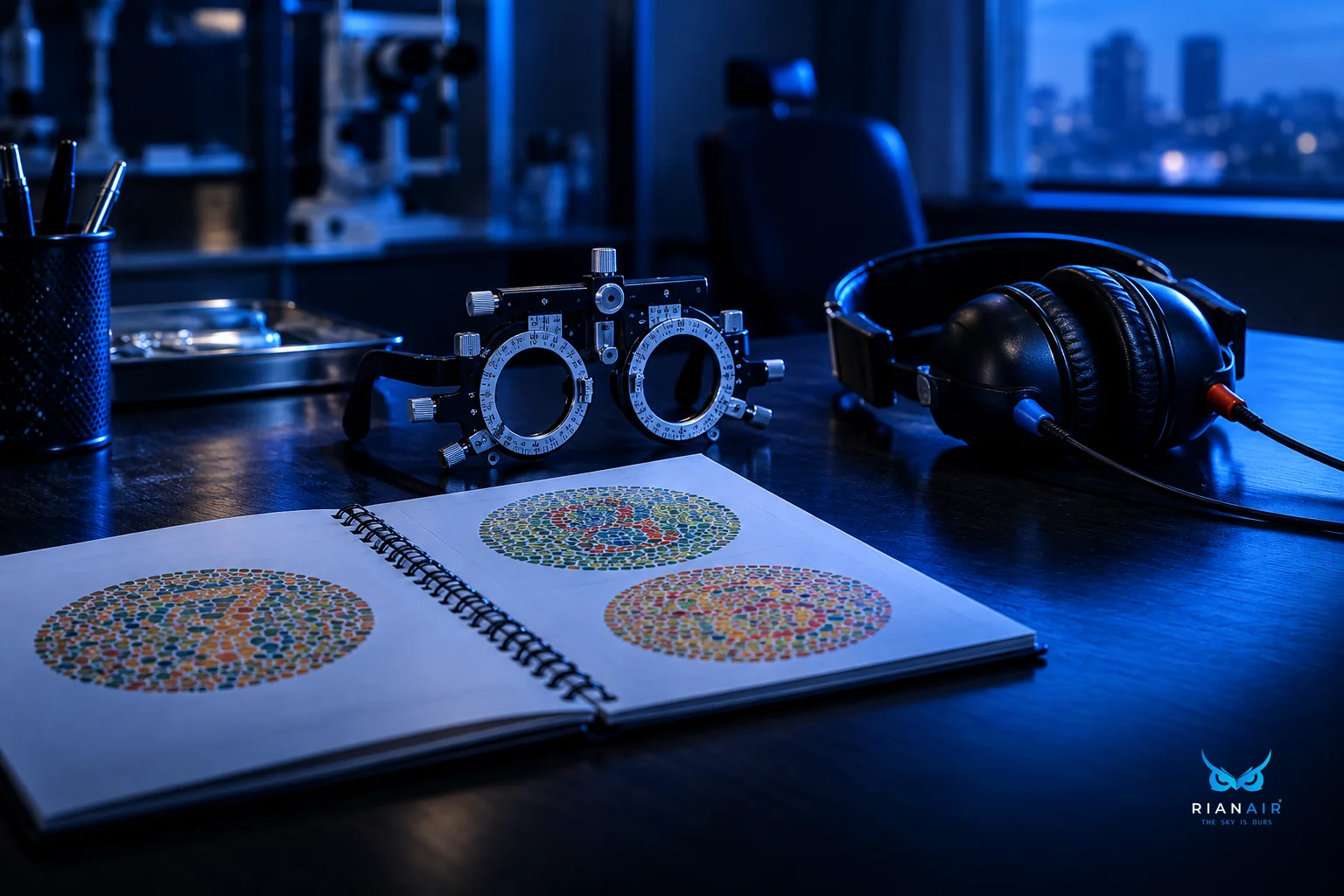
The examiner reviews your general health and medical history, then checks the systems that matter in the cockpit. Expect tests of eyesight and colour vision, hearing and ENT, heart and blood pressure, lungs, blood and urine, and a review of your mental and neurological health.
The exact list and the limits for each test are set in the DGCA medical requirements, so treat any summary, including this one, as a map and not as a rulebook. Carry any glasses you use and a record of past illnesses or surgeries.
Keep your reports. Airlines run their own medical test, including a drug test, at the end of recruitment, so a clean medical history helps well beyond the CPL.
If you are medically unfit, do not proceed
An unfit finding is the point where you stop and reassess, not the point where you look for another school. Do not pay a deposit, do not buy books and do not enrol in flight training until the medical question is settled.
Ask the examiner for the reason in writing, and ask whether it is a temporary finding that can be reviewed or a permanent one. If DGCA assesses a student as permanently unfit, flying as a career is closed.
Aviation still offers non-flying paths, such as air traffic control or flight dispatch, which carry their own licences and eligibility rules. Check those rules separately before you plan around them.
Step 4: DGCA ground classes
Ground classes prepare you for the DGCA theory papers. For a CPL these are Air Navigation, Aviation Meteorology, Air Regulations, Technical General and Technical Specific for single and multi engine. The first four are the core of every student's plan.
Rian Air teaches these subjects in classes and backs them with practice on RAPT, which has a question bank of 20,000+ questions. We teach in Delhi, Mumbai and Thrissur, and our guide to DGCA ground school in India explains the syllabus in detail. Kerala aspirants can also read about pilot training in Thrissur.
Students describe the app as helpful. One Google review reads, "The app is simple to use, informative, and great for aviation students" (Sachu, 5★, Google review). If you want to see where you stand before you commit to classes, you can take the free RAPT progress check.
For ground training timing, Rian Air plans 4-6 months for the entire ground training covering Nav, Met, Regs, RTR and simulator sessions. Tech Specific and Tech General are optional if you want to fly in India, and they can be done during flight training.
Students typically take 6 to 12 months, and some have cleared in as little as 4 months and started flight training. For tools that support this phase, see our guide to the best pilot career intelligence app in India.
Step 5: Computer number and how to get it
A computer number is the identity number DGCA allots to you once your application on the Pariksha portal is approved. Every DGCA pilot exam is booked against it, so you cannot apply for a paper without one. The application is made online at pariksha.dgca.gov.in.
The process runs in a clear order:
Read the user manual for candidates published on the portal before you type anything.
Register and fill in your details exactly as they appear on your Class 10 and Class 12 marksheets.
Upload clear scans of the documents the manual lists. These usually cover identity, date of birth and education, plus your photograph and signature.
Submit the application and wait for DGCA approval.
Note your computer number and keep it safe.
When the portal opens for a session, apply for a roll number for the papers you want and pay the fee online.
The DGCA eligibility requirement states that the portal publishes the schedule for computer number applications and roll number applications for each session, and that payment is available through Bharat Kosh, as described in CAR Section 7, Series B, Part I. We have no verified figure for the approval turnaround, so check the current schedule and notices on the portal.
Most applications stall on small mismatches. A name spelt one way on the marksheet and another on the ID, a wrong date of birth or an unreadable scan is enough to cause a rejection. Fix these before you submit and you save weeks.
Step 6: DGCA exams for CPL and what each attempt costs
The DGCA CPL theory exams are Air Navigation, Aviation Meteorology, Air Regulations, Technical General and Technical Specific, plus Technical Specific Multi Engine. You also need the radio telephony exam (RTR), which has a written Part 1 and a spoken Part 2. The RTR(A) exam is conducted by the DGCA.
Paper formats are worth knowing in advance. Air Regulations has 50 questions, carries 100 marks, runs for 2 hours and has no negative marking. Technical General has 100 questions, carries 100 marks and runs for 3 hours.
If you go abroad without clearing Air Navigation and Meteorology, they merge into one composite exam of 100 questions in 3 hours. Rian Air recommends clearing every exam before you leave India.
Exam fees per attempt
Fees depend on the month you sit, and the table below shows what Rian Air students pay. Check current fees and session dates on the DGCA Pariksha candidate FAQs.
Exam | Fee |
|---|---|
Regular attempt (March, June, September, December) | ₹2,500 per exam |
Other months (on-demand, OLODE) | ₹5,000 per exam |
RTR Part 1 | ₹2,000 |
RTR Part 2 | ₹500 |
ATPL exams | Same as CPL |
The practical advice follows from the table. Aim for the four regular months, because a paper taken on demand costs double.
Attempts, validity and the 42-day cool-off
Every passed DGCA exam is valid for 5 years. That gives you room to finish flight training without sitting papers again, as long as you do not let the validity run out.
Most students need one or two attempts per subject. In our own experience, roughly 80% pass at the first attempt. This is an internal estimate, not a published DGCA statistic. Nearly everyone passes at the second attempt, and only one or two students so far have needed a third.
After a failed paper, the current rule is a 42-day cool-off before you can reattempt it. That is the rule as of now, and DGCA may remove it in future. Use the six weeks to revise only the subject you missed.
Step 7: Flight training and the exact hour split
A CPL in India needs 200 actual flight hours, not 250. The Times of India reports the commercial pilot licence involves a minimum of 200 hours of flying along with theory exams. Our explainer on how many hours it takes to become a commercial pilot covers the calendar side.
How the hours break down
Inside the 200 actual hours, the structure parents hear about is as follows. 100 hours are flown as pilot in command, and the Times of India lists 100 hours as pilot-in-command and 50 hours of cross-country flying in its step-by-step guide. In the same programme, 15 hours are on a multi-engine aircraft.
You also fly a long solo cross-country of about 300 nautical miles with two full-stop landings at airports other than your home base. A further 20 hours on a simulator sit alongside the 200 actual hours.
The remaining hours are divided into dual instruction, solo, night and instrument time. The exact split for each category is set by the DGCA, so ask for the hour chart in writing before you enrol with any flight school. Most candidates complete this phase in 18 to 24 months, depending on weather, aircraft availability and pace.
Logging every hour in RAPT
Your logbook is your proof of experience, and DGCA relies on it at licence issue. RAPT has every field DGCA mandates, plus extras that other regulators require: take-off time and landing time (all in UTC), and the number of take-offs and landings.
The logbook runs on honour, and it is not meant to be cheated. Every entry has a time stamp, and an edited entry shows a later time stamp that is highlighted. A mismatch with aircraft logs can cause trouble. A student can correct an error, and the correction time stamp is highlighted.
A Rian Air representative checks every logbook entry before it is uploaded to the eGCA portal, so issues do not surface during licence issue or conversion. We tell students to fill the logbook right after the instructor's post-flight briefing. Ab initio Rian Air students have lifetime free access to RAPT, and non-Rian Air students pay ₹499 per month after 300 hours.
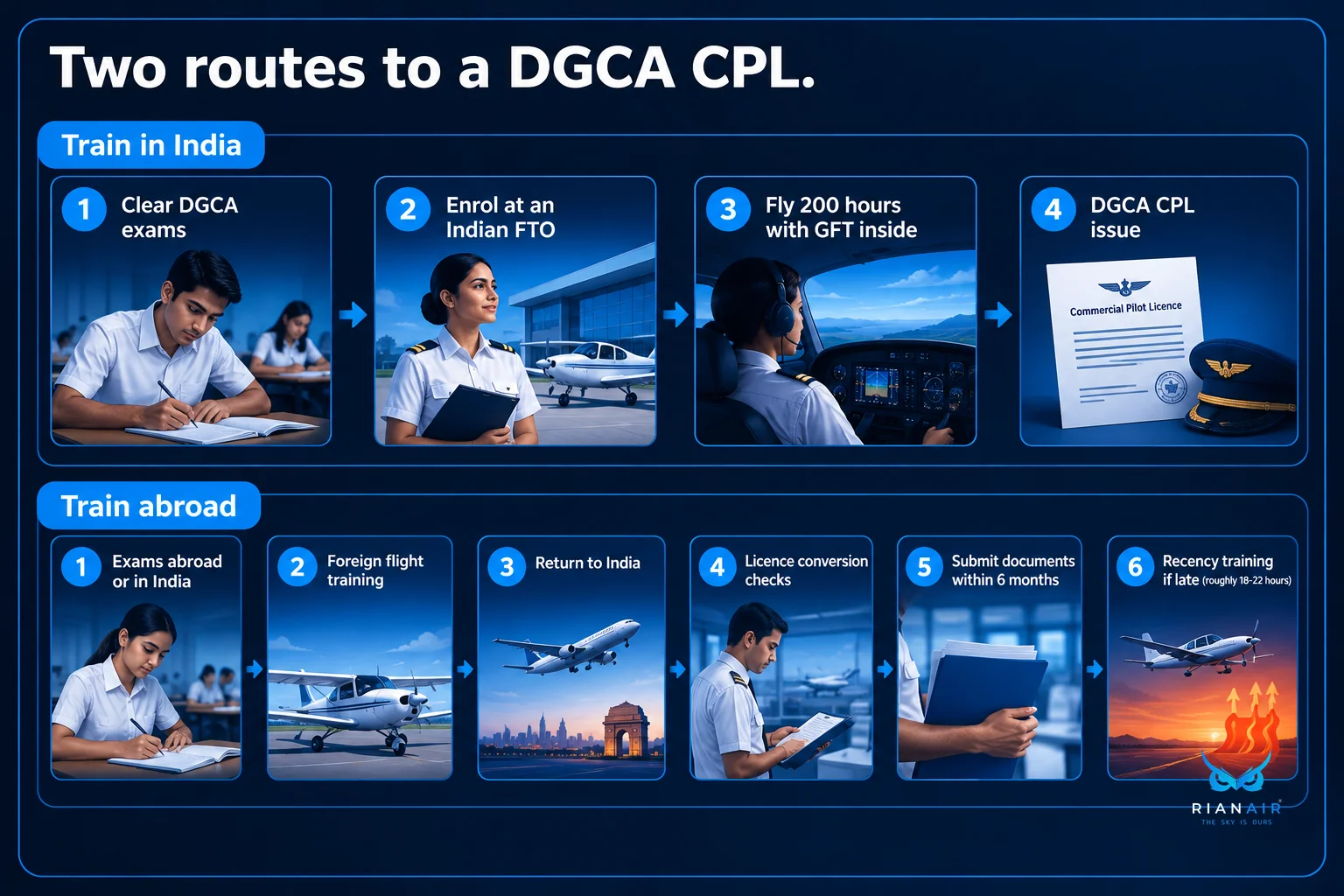
Why we encourage flight training in India
Rian Air encourages flight training in India, and the reasons are practical. A student who clears every DGCA exam before flying abroad usually completes conversion within 3 to 4 months. A student who leaves without clearing the exams faces timing that is hard to predict and gets only 1 or 2 attempts after arriving in India.
The paperwork risk is just as real. If documents are not submitted to DGCA within 6 months, the student must repeat recency training, roughly 18 to 22 extra flying hours. In India, some exams can be cleared alongside flight training, and you stay under DGCA rules from the first day.
Money is the other factor. Single-engine aircraft cost ₹22,000 to ₹30,000 per hour, and multi-engine aircraft cost ₹45,000 to ₹65,000 per hour. These are per-hour rates quoted by Rian Air, so confirm the current rate in the school's written agreement.
Accommodation in India with three meals a day is ₹20,000. The Times of India reports that a CPL in India now costs in the range of Rs 60 to 70 lakh, up from about Rs 50 to 60 lakh earlier.
Our CPL training in India page explains the course, and do you need to travel abroad for pilot training weighs the choice honestly. Rian Air does also offer pathways in Tunisia, Malta, New Zealand and USA for families who prefer them.
Paying for flight training without surprises
Read the agreement with the flying school before you pay. DGCA issued a public notice on 5 October 2026 introducing Flying Training Circular 02 of 2026, which contains guidelines for the agreement between flying training organisations and trainees.
Budget for the whole path, not only the headline fee. Our pilot training cost breakdown and the piece on where the hidden expenses come from list the items that families miss. Families with tight budgets can start with low-income pilot training options and instalment plan examples.
The lowest price can hide risks of its own, which we cover in what you risk cutting corners to save money.
Step 8: AELP and CPL issue
Aviation English Language Proficiency (AELP) is the assessment of your spoken English for radio work. It sits near the end of the CPL process, alongside your RTR exam, and it is easy to forget because it has no ground classes of its own. Ask your school who conducts it and book it early.
Once you have completed the hours, passed the flight test and held all exam passes within their 5-year validity, your documents go to DGCA. Your logbook pages are then uploaded to the eGCA portal, which is why every entry is checked before upload.
At the end of this step, DGCA issues the CPL. You must be at least 18 on that date, and your Class 1 medical must be current.
Step 9: Type rating or instructor rating, depending on your pathway
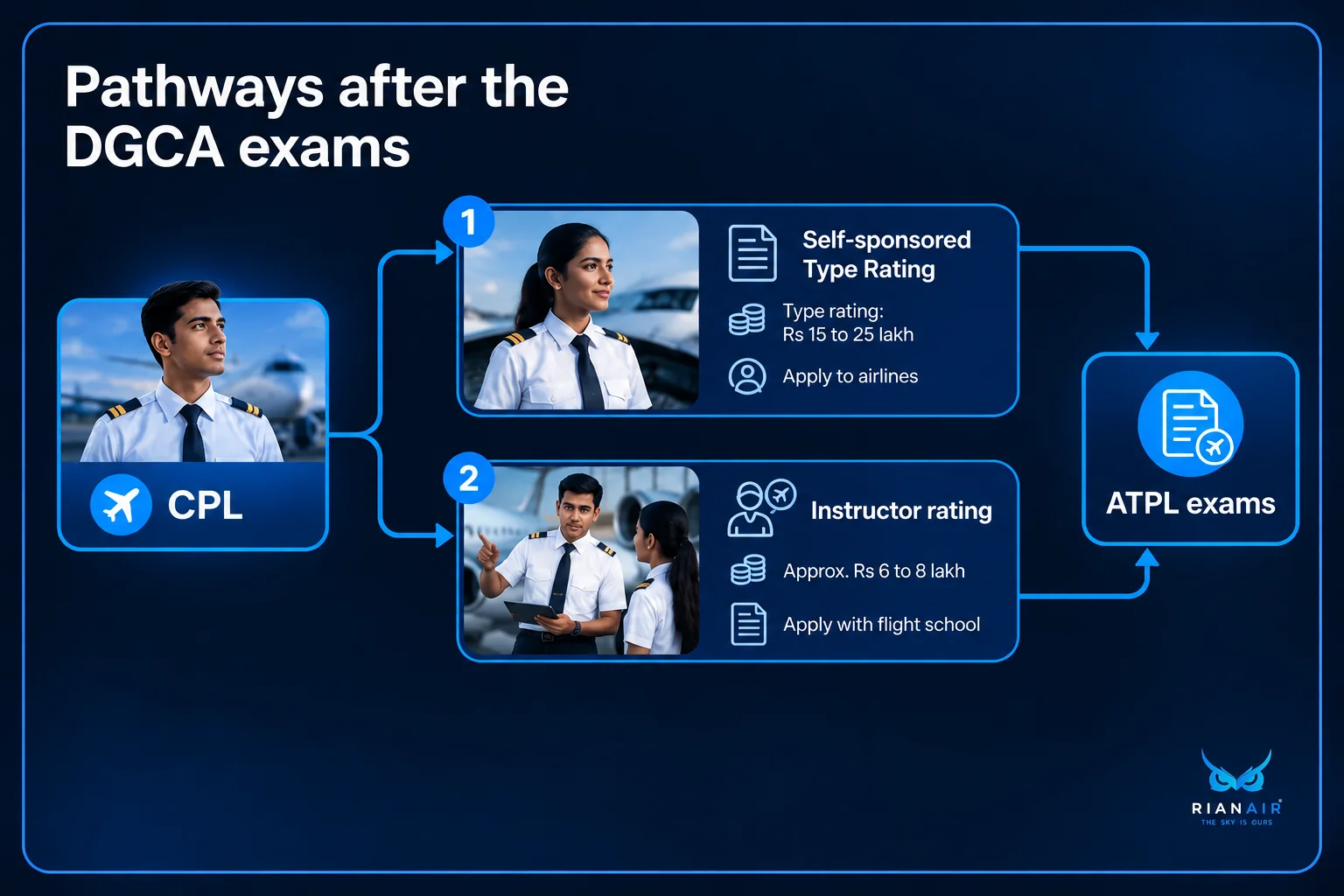
A CPL lets you fly for hire, but airlines usually want a type rating on the aircraft they operate. Alternatively, you can build hours as an instructor. The right choice depends on your finances and on how quickly airlines are hiring.
Airline cadet programme
Airline cadet programme fees start from ₹89 lakh and go up to ₹1.5 crore. The airline manages the pace of training, so a cadet moves quickly when the airline needs pilots and slowly when it does not. A student who is not up to the mark during training may be terminated.
Some airlines also ask cadets to complete ATPL exams before the type rating. Compare these terms carefully in our guide to cadet pilot programs in India.
Self-sponsored CPL, then type rating
Here you complete your CPL independently, then pay for a type rating, usually on an Airbus A320 or Boeing 737. A type rating costs ₹15 lakh to ₹25 lakh, depending on the aircraft type and the training location.
For a realistic planning figure, use about ₹17 lakh for an A320 or B737 type rating. That is the figure listed in a 2026 admission notice for optional A320/B737 type rating training through FSTC.
Providers sometimes run limited-period offers, with promotional prices of roughly ₹13 lakh to ₹15 lakh, but these are time-bound and may not cover every cost. Ask for a written quotation that states simulator sessions, base training, examiner and re-test charges, taxes and payment terms before you pay a deposit.
DGCA's type rating requirement, effective 7 September 2026, expects the trainee to have passed all requisite written exams before simulator training begins, and those passes must stay valid through the training. It also states that the earlier NOC from the Flight Standards Directorate is no longer needed.
Instructor rating
Newly qualified pilots can also train as flight instructors and build hours while earning at a flying school. It is slower to an airline seat, but it keeps you flying, and it suits students who want to stay close to the training environment.
Some flight schools sponsor your instructor rating with a 3-5 years bond but doing it yourself would cost you between 6-8 lakhs. It's preferable to complete your instructor rating after discussion with a flight school to ensure that they hire you after completion to be on a safer side.
How airlines select pilots
For pilots without a type rating, the usual rounds are a written exam, a psychometric test, an ADAPT or Compass test depending on the airline, a group discussion, a panel interview and a medical test with a drug test. For type-rated pilots, the steps are a written exam, psychometric evaluation, group discussion, an aircraft-specific simulator assessment, a panel interview and medical tests.
For a view of the working life that follows, see airline pilot lifestyle.
Step 10: ATPL exams
The ATPL is the licence for senior airline roles, and the minimum age is 21. It is not issued on single-engine aircraft, so your experience must come from multi-engine flying.
The Gazette notification dated 26 October 2026 (G.S.R. 957(E)) removes the ATPL viva. The knowledge requirement is now written papers in Air Regulations, Air Navigation, Avionics, Aviation Meteorology, and Aircraft and Engines, plus a Signals (practical) test. ATPL exam fees are the same as for CPL.
Your DGCA passes are valid for 5 years, so plan the ATPL attempts inside that window. So far 13 airline pilots have cleared their written exams with Rian Air. Active pilots can currently use the free ATPL question bank for active pilots.
Checks before you pay anyone
Parents should settle four points before a deposit changes hands. First, the medical result. Second, the written hour chart and the aircraft the school will use. Third, the exam plan: which papers will be cleared before flying and in which sessions. Fourth, the full cost, including exams, accommodation and per-hour rates.
Use our checklist for choosing a pilot training academy and the parent's question list when you visit a school.
Frequently asked questions
Can I become a pilot if I wear glasses?
Often yes, within limits. The Class 1 standard sets eyesight limits, and the examiner judges refractive error, correction and overall eye health. The examiner's finding decides, so take your Class 2 medical early and ask for the eyesight result in writing before paying any training deposit.
What happens if I have colour blindness?
Colour vision is tested in aviation medicals, and a deficiency can lead to an unfit finding or restrictions, depending on the test results and the examiner's assessment. Get tested before spending money. If the result is adverse, ask the examiner what review options exist in your case.
Can a commerce or arts student become a pilot?
A CPL path needs 10+2 with Physics and Mathematics from a recognised board or university. A student who did not study them must complete those subjects first, for example through an open schooling route that offers them. Confirm the details with the board and your academy.
How strong does my maths need to be?
You need comfort with Class 12 level arithmetic, ratios, basic trigonometry and unit conversion. Air Navigation, Meteorology and Performance use them daily. You do not need advanced mathematics, but you must be able to calculate quickly and carefully, with a manual flight computer in hand.
Do I need a passport before I start?
Usually not for training in India. You need one if you choose an overseas pathway such as Tunisia, Malta or New Zealand, along with the visa for that country. Applying early avoids delays, so check the validity of the passport before you commit to an overseas schedule.
Does a CPL guarantee an airline job?
No. A CPL lets you apply for pilot roles, but airlines run their own selection rounds and hire when they need pilots. Timing varies, so use the wait for a type rating, simulator practice and interview preparation, which keeps your skills sharp while you apply.
Is the cheapest academy the best choice?
Rarely. Judge price against the total cost and what is delivered: ground classes, exam fees, hours flown, aircraft availability and accommodation. A low headline fee can grow through weather delays, extra hours or missing support, so compare written breakdowns from each school.
Can parents track their child's progress?
Yes. RAPT includes a parent dashboard and a digital logbook, so parents can follow progress without waiting for updates. This matters most during flight training, when hours and exam results build up over many months and are easy to lose track of.
Can I fund training with an education loan?
Many families do, but eligibility depends on the lender. Banks usually ask for admission proof, a fee schedule and co-borrower income documents. Speak to the lender before you pay any fee, then read our practical guide to education loan eligibility to prepare.
How much does a pilot earn?
Pay depends on the airline, aircraft type, rank and hours flown, so a single number would mislead. Early-career pilots earn less than captains, and pay grows with experience. Our pilot salary in India guide explains the factors that move it.
Is pilot training a good option in India now?
It can be, if you are medically fit, can fund the full cost and accept that airline hiring moves in cycles. It is a poor fit if money is borrowed without a plan. Read our view on whether pilot training is a good option now before deciding.
Which city is best for ground classes?
Choose the city that you can reach daily and afford to stay in. Rian Air teaches in Delhi, Mumbai and Thrissur, and the guide to becoming a pilot in Kerala after 12th helps Kerala families decide. Classes matter less than regular practice.
What should I carry to my first medical appointment?
Carry your original Class 10 marksheet, a photo ID, passport-size photographs and any glasses you use. Bring records of past illnesses or surgeries. Ask the clinic in advance whether it needs anything else, because requirements can differ between examiners.
Your next step
If you have your Class 10 marksheet, book the Class 2 medical this month. If you already have 10+2, move to the Class 1 medical and the computer number, and keep your exam plan ready.
You can talk to Rian Air about ground training and flight training pathways, or try the free RAPT demo to see how DGCA-style practice works. For more on our programmes, visit the Rian Air website.
Follow short explainers on Instagram and watch longer walkthroughs on YouTube.
Recommended Resources
Start Your Pilot Journey Try Our Free RAPT Demo Now Home Rian Air