


The Commercial Pilot License Process in India: A Step-by-Step Starting Guide
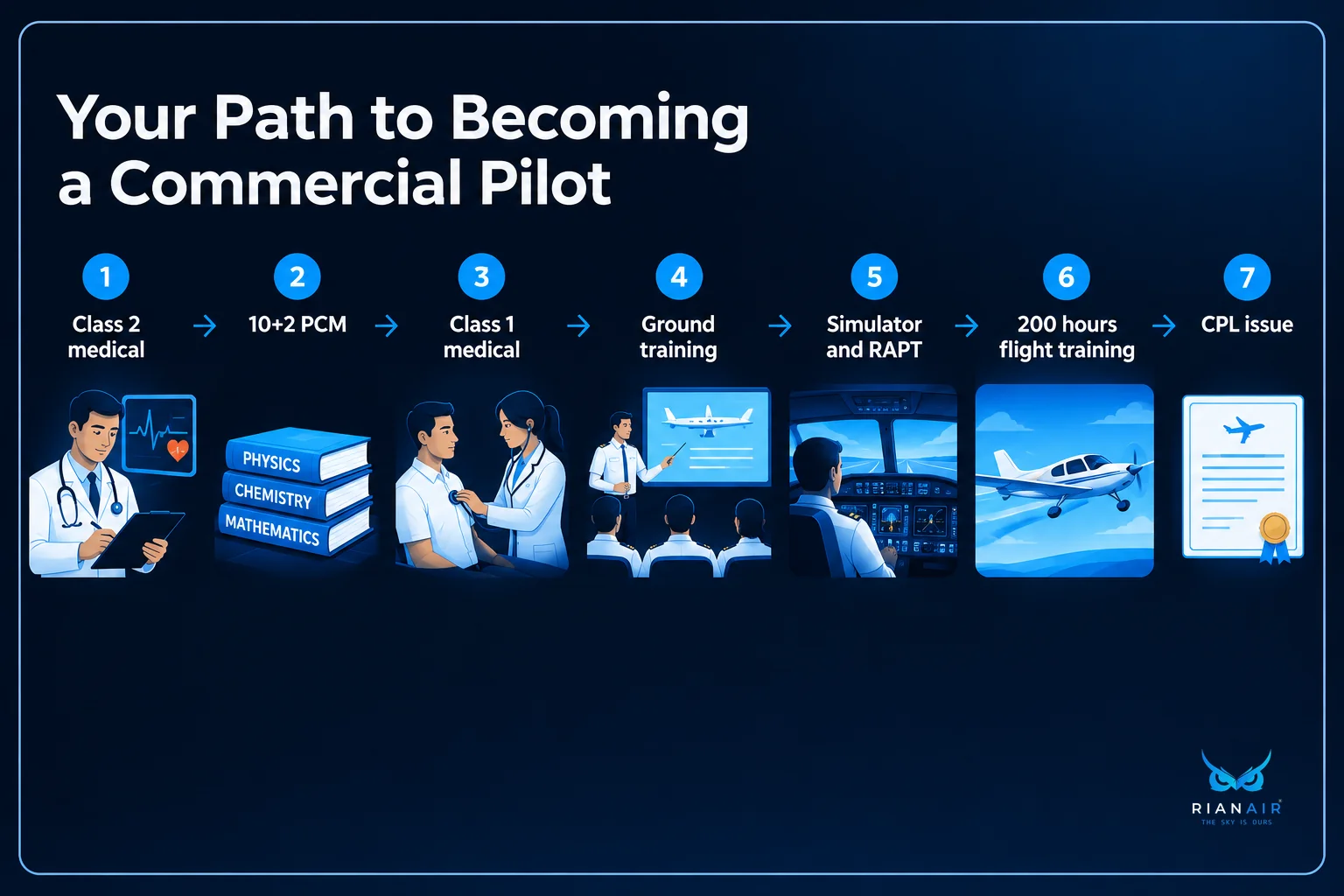
The commercial pilot license process in India has seven steps: a Class 2 medical after 10th, 10+2 with Physics and Mathematics, a Class 1 medical, DGCA ground exams, simulator practice, 200 hours of flight training (15 of them on a multi-engine aircraft), and finally CPL issue by the DGCA. At Rian Air, we teach the ground and simulator stages at our centres in Delhi, Thane and Kerala.

Most students and parents we meet in Delhi do not struggle with any single step. They struggle with the order. Doing the medical late, or choosing a subject stream without knowing the rule, can cost a year. This guide gives you the sequence once, in plain language, so you can plan backwards from the licence.
Commercial pilot license process in India at a glance
The table below shows each stage, what it needs and roughly what it involves. Details for every row follow in the numbered sections.
| Step | What you do | When |
|---|---|---|
| 1 | Class 2 medical with a DGCA-approved doctor | After the 10th-grade pass certificate |
| 2 | Complete 10+2 with Physics and Mathematics | Classes 11 and 12 |
| 3 | Class 1 medical | Before flight training |
| 4 | DGCA ground training and exams | After 12th |
| 5 | Simulator hours and RAPT practice | Alongside ground training |
| 6 | 200 hours of flight training, including 15 on multi-engine | After the required exams |
| 7 | CPL issue by the DGCA | After exams, hours, medical and skill test |
1. Class 2 medical after 10th pass
Once you hold your 10th-grade pass certificate from a recognised board in India, you can get a Class 2 medical from a DGCA-approved doctor. Do this before you commit to Physics and Mathematics in Class 11. It tells you early whether a medical problem could block a flying career.
The logic is simple. A student who spends two years on PCM and then discovers a disqualifying condition has lost time and effort. A student who checks first can decide with facts. If a result is not clean, ask the examiner what the outcome means and whether a retest is possible. Our guide on what happens if you fail a Class 2 medical covers the options.
2. Complete 10+2 with Physics and Mathematics
The DGCA requires a CPL applicant to have passed Class 10+2 with Physics and Mathematics from a recognised board or university, or an equivalent examination. The rule appears in DGCA Civil Aviation Requirements, Section 7, and the DGCA Pariksha pilot FAQs repeat it for every licence except the PPL.
That means Arts or Commerce students need a plan to complete Physics and Mathematics through an equivalent recognised route before the CPL can be issued. Check the exact route with the board and the DGCA before you rely on it. If you are still in school, our article on how to become a commercial pilot in India after 12th goes deeper on subject choices.
3. Class 1 medical
After the Class 2 check, you should also complete a Class 1 medical. This is the stricter standard that a commercial pilot needs, and it should be done before you spend money on flight training. Treat it as the gate between the classroom and the aircraft.
Both classes are issued only by DGCA-approved medical examiners, so book your Class 1 with one of them. A Class 2 medical is valid for 2 years. A Class 1 medical is valid for 1 year until you turn 40, and after 40 it must be renewed every 6 months.
You must be at least 18 to hold a CPL, so time your Class 1 so it is valid when you start flying and when you apply. Booking the Class 1 early also protects you from a late surprise. A student who clears all exams and then fails the Class 1 cannot fly commercially, however good the scores are.
4. Enrol in DGCA ground training
After 12th, you enrol for ground training and clear the DGCA theory papers. The core subjects are Air Navigation, Aviation Meteorology, Air Regulations and Radio Telephony (RTR), with RTR in two parts. Technical General and Technical Specific come next, and which ones you take depends on where and how you fly.
Which subjects and exams do you need?
You need Air Navigation, Meteorology, Air Regulations and RTR Part 1 and Part 2. If you train in a foreign country, these are the papers you clear in India before you leave. Technical General and Technical Specific are tied to the flight school and aircraft you fly in India.
Technical Specific depends on the aircraft type, so the single-engine and multi-engine Technical Specific papers are two different exams. A student who flies a single-engine trainer and then a twin must prepare for both. In our experience, Technical General and Technical Specific can be completed alongside flight training in India, so they are optional during ground classes.
For the subject-by-subject question banks, see our pages on Air Navigation and Meteorology. Air Regulations has a clear pass rule: 35 out of 50 questions, which is 70%, in a 2-hour exam.
How long does DGCA ground training take?
The full ground training at Rian Air takes 4 to 6 months, covering navigation, meteorology, regulations, RTR and simulator sessions. The time from enrolment to the last DGCA paper varies by student. The 4 to 6 months is our standard range for the whole programme. Some of our students have cleared everything in as little as 3.5 months, while others take more than a year.
The gap comes down to focus. A student who drifts finds that batchmates are already flying solo or finishing PPL, and then has to catch up. RTR Parts 1 and 2 combined take 2 to 4 weeks, because part of the RTR material is covered during Air Navigation for full-course students.
Worked example (anonymised): one of our students, call him Bharat, cleared all his DGCA exams in 4 months. That included his medicals, other formalities and his visa. He now holds his CPL from Tunisia and will convert it to an Indian licence soon.
How does RTR practice work?
RTR Part 1 is a written paper from a fixed question bank, which is why repeated mock tests work. Our students often start in the 50s or 60s on mock tests, reach the 70s within a week, and pass 90 by week three. By exam time, every student has 90 to 100 percent accuracy. Week two is when errors get removed.
Part 2 is spoken radio calls. For in-person students, we have them fly the simulator and make RTR calls under pressure, so the DGCA test feels familiar. The RTR package is INR 20,000 and includes 2 hours on a simulator. Extra simulator flying is charged separately.
What does ground training cost?
At Rian Air, Delhi ground training is INR 1,00,000 including RTR, Thane is INR 1,00,000 and Kerala is INR 1,25,000, with taxes extra. The Delhi and Thane prices are introductory. In Delhi, INR 80,000 covers Air Navigation, Meteorology, Air Regulations and 5 hours on a DA40/42 simulator, and RTR preparation is INR 20,000 extra.
Our latest batch gives a realistic picture of exam pressure. Most students attempted Navigation in the September attempt, and 13 of 21 cleared it. To compare centres, read our guide to pilot training fees in Delhi.
5. Simulator hours and RAPT
Every ground-training student gets 5 hours on the simulator, plus full access to RAPT, our pilot career intelligence platform. You can use the simulator at our Kerala, Delhi or Thane centres. Each simulator session has two students per instructor. Hours beyond the included 5 are INR 1,500 per hour with a dedicated instructor.
RAPT holds our DGCA question bank of 20,000+ questions, with a digital logbook and a parent dashboard. Full access is only for students who attend Rian Air ground training for a subject. A free demo gives you 500 questions, a small slice of the full bank, so you can judge the style before you commit.
If you are not sure where you stand, the free RAPT demo signup works as a quick progress check. Solve the 500 questions, see your weak subjects, and then decide how much ground training you need.
6. 200 hours of flight training
Flight training totals 200 hours as per DGCA standards, including 15 hours on a multi-engine aircraft. You must be at least 18 to hold a CPL. A student licence can be held from 16 and a PPL from 17. At Rian Air, this 200 hours is part of the full CPL pathway.
You can complete it in India, or at our partner schools in Tunisia, Malta or New Zealand. In India, our students most often train at Indian Flying Academy at Khajuraho.
How is the 200-hour split organised?
The 200 hours are not all the same kind of flying. They are divided into dual instruction, solo or pilot-in-command time, cross-country flying, instrument time and night flying, as the DGCA requires. Some instrument hours can be credited from an approved simulator.
The figures below are for the CPL with instrument rating and multi-engine (CPL IR ME), the route most students in India train for:
- 200 hours of actual flight time, plus 20 hours on a synthetic simulator.
- 100 hours as pilot-in-command (PIC), including 15 hours as PIC in the last 6 months.
- 50 hours as PIC cross-country (straight-line distance over 100 nautical miles as per the DGCA), including one 300 nm cross-country.
- 40 hours of simulated instrument time, of which 20 hours on the simulator can be used.
- 5 hours at night as PIC, with 10 take-offs and 10 landings.
- 15 hours on a multi-engine aircraft plus 10 hours on a multi-engine simulator, 25 in all. Airlines expect this, especially if you want an Airbus A320 type rating.
- If an IR is requested, 5 hours of IR are added.
Once the hours and exams are done, you fly a set of skill checks before issue. Typical durations are below (the CARs set a 45-minute minimum for the day check, but schools usually fly an hour):
- GFT day: 1 hour (45 minutes as per the CARs).
- GFT night: 1 hour.
- GFT IR: 1.5 hours, usually on a multi-engine aircraft.
- Day cross-country: 250 nm, usually 2 to 2.5 hours.
- Night cross-country: 120 nm, usually 1.5 hours.
For full-course students enrolled for the CPL in India, these checks are included in the course fee.
If a student flies abroad without clearing the DGCA exams, the timing is hard to predict; they get 1 or 2 attempts at the DGCA exams after arriving in India.
Cross-country flying is the most visible block. It is the part where you plan and fly routes between airports, which builds the navigation judgement airlines look for. Night and instrument flying come later in the programme. Do not assume the split is identical across schools; ask for the written syllabus.
What happens with landing fees and extra hours?
In India, landing fees are usually included in the course fee for full-course students. If a student lands at an airport outside the school's approved list, that airport charges its own tariff, and the school has no role in it. Rian Air charges nothing extra for landing, parking or fuel surcharge at the ground-training stage.
Type rating training is a separate stage. It has its own fees and tests. Our article on flight training in India after the DGCA exams explains how the flying stage runs.
How does a foreign CPL conversion work?
If you trained abroad, for example in Tunisia, you convert the foreign CPL to an Indian one. If the conversion is done within 6 months of the foreign licence, you repeat the GFT checks in India with a DGCA-approved examiner. They must be flown on the exact aircraft named on your foreign CPL. If the licence does not name an aircraft, use the aircraft on which you did your CPL check abroad.
If the 6-month mark is crossed, you must instead fly the DGCA 6-month rule requirements: 15 hrs PIC, 5 hrs night with 10 take-offs and 10 landings, 5 hrs IR, plus all GFTs, roughly 22 hours of flight time in India, which costs much more than the GFTs alone.
This is where the figure of about 4 lakh rupees applies: it is for students who trained in a foreign country and come to India for conversion. It covers roughly 7 to 8 flying hours at INR 35,000 per hour, plus the checks, registration fee and school SPL classes.
7. CPL issuance
Once you hold the required passes, flight hours and a valid medical, the DGCA issues the CPL. You need a computer number, and applications go through the eGCA portal. In order: first, register online for your unique eGCA ID, as the DGCA procedure requires.
Second, upload your documents and exam results. Third, submit the application with your medical and flight records. Your Class 1 medical must be valid on the day you apply: 1 year if you are under 40, 6 months if you are 40 or older.
Keep your documents ready: 10+2 marksheet, medical certificates, exam results, a flight training record and your logbook. A digital logbook makes the hours easier to prove. Your flying school's training records support the application, and a mismatch between logbook and school records is a common cause of delay.
What comes after the CPL?
After the CPL, most pilots move to a type rating, usually on the A320 or B737, and then apply to airlines. Others prepare for the ATPL while flying, or train as flight instructors. An Indian airline will not sponsor your type rating these days, so plan to fund it yourself.
At Rian Air, we do not have a full-motion A320 simulator in-house. Type rating simulator sessions run with partner type rating training organisations in cities such as Mumbai, Chennai, Gurugram, Sharjah and Tunis. For the ATPL, read ATPL preparation in India.
What does the whole process cost?
We estimate the typical all-in cost of the India CPL pathway at 72 to 75 lakh rupees including all overheads. Ground training is a small part of that, at INR 1,00,000 to INR 1,25,000 depending on the centre, plus taxes. Flight training and the type rating make up most of the rest.
Here is what we can break out from our own figures:
- Ground training: INR 1,00,000 to INR 1,25,000 plus taxes, depending on the centre. Simulator hours beyond the included 5 are INR 1,500 each.
- Flight training: the largest share. The CPL checks are included in the course fee for full-course students in India.
- Foreign licence conversion: about 4 lakh rupees for students who trained abroad (see the conversion section above).
- Type rating: a separate stage, paid by the student.
Costs differ by student. Retakes, extra flying hours and extra skill tests all add up, which is why a fast, focused ground stage matters. If you plan to enquire about fees, you can talk to Rian Air about ground training and get the current figures for your centre.
Frequently asked questions
Can I become a commercial pilot without Physics and Mathematics?
No. The DGCA requires 10+2 with Physics and Mathematics from a recognised board or university, or an equivalent examination, for a CPL. Students from other streams need to complete those two subjects through a recognised route before the licence can be issued.
When should I take the Class 2 medical?
Take the Class 2 medical right after you receive your 10th-grade pass certificate from a recognised Indian board. Use a DGCA-approved doctor. Doing it before Class 11 lets you check your medical fitness before committing two years to Physics and Mathematics.
Do I need both a Class 1 and a Class 2 medical?
Yes, in this sequence. Class 2 comes first, after 10th, as an early screen. Class 1 follows and should be done before flight training, because a commercial pilot needs the stricter standard. Both come from DGCA-approved examiners.
Which DGCA exams do I need for a CPL?
You clear Air Navigation, Aviation Meteorology, Air Regulations and RTR Part 1 and Part 2. Technical General and Technical Specific are linked to the aircraft you fly with your flight school in India. Check the current list with the DGCA before booking.
Are the single-engine and multi-engine Technical Specific exams the same?
No. They are two separate exams. The Technical Specific paper depends on the aircraft type, so a student who trains on a single-engine aircraft and a multi-engine aircraft prepares for each one separately.
How many flight hours are needed for a CPL?
Flight training totals 200 hours under DGCA standards, and 15 of those hours must be on a multi-engine aircraft, with 10 more on a multi-engine simulator for the CPL IR ME route. The hours include dual, solo, cross-country, instrument and night flying, as listed in section 6.
What is the pass mark for Air Regulations?
The Air Regulations paper has 50 questions and a 2-hour time limit. You need 35 correct answers to pass, which is 70 percent. Many students find it manageable with regular question practice and revision of the rules.
How long does ground training take?
Full ground training at Rian Air takes 4 to 6 months. The time from enrolment to the last DGCA paper depends on the student: some finish in 3.5 months, while students who lose focus can take over a year.
Is RAPT free?
The RAPT demo is free and gives you 500 questions to try. Full RAPT access is meant only for students who attend Rian Air ground training for a subject. For 2026, RAPT is also free for active pilots in India preparing for the December 2026 DGCA attempt.
Where can I use the simulator?
Ground-training students can use our simulator at the Kerala, Delhi or Thane centres. Five simulator hours are included in the ground-training package, and each session has two students per instructor. Additional hours cost INR 1,500 each with a dedicated instructor.
Do airlines in India pay for type rating?
No. Indian airlines do not offer a type rating these days, so new pilots must plan and fund it themselves.
Who pays landing fees during flight training?
For full-course students in India, landing fees are usually included in the course fee. If you land at an airport outside the school's approved list, that airport bills you under its own tariff.
Not sure where you stand before enrolling? Try the Rian Air RAPT demo for a quick check on your exam readiness, then plan your first ground-training step with the sequence above.
Recommended Resources
Start Your Pilot Journey Try Our Free RAPT Demo Now Home Rian Air