


Cheap Pilot Training in India: What You Risk Cutting Corners to Save Money
Cheap pilot training in India usually means a lower headline fee, not a lower total cost. A full Commercial Pilot Licence (CPL) has traditionally cost about ₹50 to ₹60 lakh, and shortcuts such as thin simulator time, unclear fees or unverified approval can add retakes, extra hours and delays. Families in Delhi, Thane and Thrissur should compare the written total, not the headline.
Key takeaways
- Headline fee is not total cost: a low quote that leaves out simulator hours, exam retakes or extra flying hours can end up above a higher, itemised quote.
- Simulator access must be in writing: ask for hours, session booking rules and the type of device, not just the word "simulator".
- Check approval at the source: verify the flying school against DGCA records, and read the fee agreement before paying anything.
- Refund promises need terms: a money-back promise is only worth what its conditions say, so ask for the conditions sheet first.
- Progress should be visible: parents paying for training should be able to see exam scores, hours and gaps without chasing anyone.
Cheap pilot training in India at a glance
| Red flag | Why it costs more later | What to ask for |
|---|---|---|
| Simulator access is vague | Students reach the aircraft underprepared and need extra paid hours | Simulator hours and device type, in writing |
| Ground school not verified | Exam failures mean repeated fees and lost months | Question bank size, update policy, mock exams |
| Fees not itemised | Add-ons appear after you have paid | A line-by-line fee sheet |
| Scholarship or "free" offer with no terms | Deposits and conditions surface late | Written terms and what is refundable |
| Refund promise without conditions | You cannot claim what you cannot read | The full terms and conditions sheet |
| No progress tracking | Parents learn about problems after the money is spent | A dashboard or regular written progress reports |
Why does the lowest price often cost more later?
The lowest price often costs more later because pilot training is paid in stages, and a cheap first stage can leave gaps in the next ones. Missing simulator practice, failed theory papers and unplanned extra flying hours each add fees and months. The final bill depends on how many of these you hit.
Start with the market itself. The Times of India reported in April 2026 that a CPL, which needs a minimum of 200 flying hours plus theory exams, used to cost about ₹50 to ₹60 lakh before jet fuel and the weaker rupee pushed it higher. So when a quote sits far below that range, the question is what was left out, not how the school did it.
Not every low number is a trick. The Hindu reported that the government flying school at Jakkur, Karnataka, charges ₹37 lakh for CPL training for Karnataka candidates and ₹42 lakh for candidates from other States. That is a government-run school with its own seat rules and waiting times. A private school quoting the same figure without such backing deserves a harder look.
For flying training at partner flying schools, our own figure is ₹50 lakh to ₹75 lakh per student, and it varies from student to student. The variation is real, and it depends on how many extra hours a student needs and how well prepared they are when they reach the aircraft. Preparation on the ground is the cheapest place to save money.
Where the extra money actually comes from
- Exam retakes: every failed DGCA paper means another attempt, more study months and more living costs.
- Extra flying hours: students who arrive without instrument or radio practice tend to need more aircraft time.
- Delays: a school with too few aircraft or instructors stretches a schedule, and rent and food do not pause.
- Unbundled items: medicals, simulator time, accommodation and exam fees may sit outside the package.
Our detailed list of these items is in the pilot training cost breakdown for parents. Read it next to any quote you receive.
What counts as genuinely cheap versus cheap on paper?
Genuinely cheap training is a lower total, itemised in writing, for the same outcome: the same licence, the same approved school and the same support. Cheap on paper is a lower first payment that excludes items you will need. The test is whether the full list of what you will pay is on one page before you commit.
Three things push honest prices up and down. Jet fuel and the rupee move flying costs, as the Times of India report above shows. Location matters, because some states and government schools price differently for residents. And the training route matters, since India, Malta, Tunisia and New Zealand each carry different living and travel costs.
If you are weighing countries, our comparison of CPL training in India, Malta and Tunisia lays out the differences. Whether prices will keep rising is not settled. Fuel and currency can move either way, so a quote should carry a date and say what happens if costs change.
Which red flags show a cheap institute may cost you later?
The main red flags are simulator access described without hours, ground training that nobody can verify, fees that are not itemised, offers with hidden conditions, refund promises without terms, and no way for parents to see progress. One flag alone is a reason to ask questions. Three together is a reason to walk away.
Limited or vague simulator access
A simulator is where a student learns instrument scans, radio calls and procedures before paying aircraft rates. Ask three things: how many hours are included, what device it is, and how sessions are booked. A good answer gives a number and a device. A weak answer says "available on request".
Pass mark: hours and device stated in your agreement. Walk-away signal: the simulator is mentioned in brochures but not in the fee sheet. For deeper background, see how fixed-base simulator training works.
Ground school that cannot be verified
DGCA theory papers are computer-based, and a ground school should show what it teaches from. Ask how many questions the bank holds per subject, whether past DGCA papers are included, and how often it is updated. Then ask for a trial. A school confident in its material lets you try it first.
For flying schools, check approval against official DGCA material. DGCA publishes a ranking of Flying Training Organisations, which is a useful starting list. If a school's name is missing and nobody can explain why, treat that as a stop sign until it is answered in writing.
Unclear fees and agreements
DGCA has issued Flying Training Circular 02 of 2026, guidelines for agreements between Flying Training Organisations and trainees. Read your agreement against it, or have someone who understands contracts read it with you. Look for what is included, what is extra, what happens if you leave, and what is refundable.
Pass mark: every cost has a line and an amount. Walk-away signal: "other charges as applicable" with no list. Families who learned this late describe it in how hidden fees in pilot training affect families.
Scholarships and free offers with no terms
Some offers sound free and are not. A genuine scholarship states who qualifies, how selection works, and what you must pay or deposit. Ours, the Women Empowerment Program, offers zero* fee DGCA ground training for aspiring women pilots on merit, and the asterisk means a refundable commitment deposit applies. We say that up front because hiding it would be the very problem this article warns about.
To learn how fake offers work, read why most scholarships in pilot training are scams.
Refund promises without conditions
A refund claim is only as good as its conditions. Our own promise is this: if Rian Air fails to get a student through the DGCA exams, the student gets their money back; terms and conditions apply. Ask for the T&C sheet before you pay, and read it. Any school offering a refund should hand over its conditions without hesitation.
No visibility for parents
Parents often pay for months without seeing exam scores or weak topics. By the time a problem is visible, a term is lost. Ask how progress is shared, how often, and in what form. A dashboard with scores and hours beats a monthly phone call.
What should transparent, structured pilot training include?
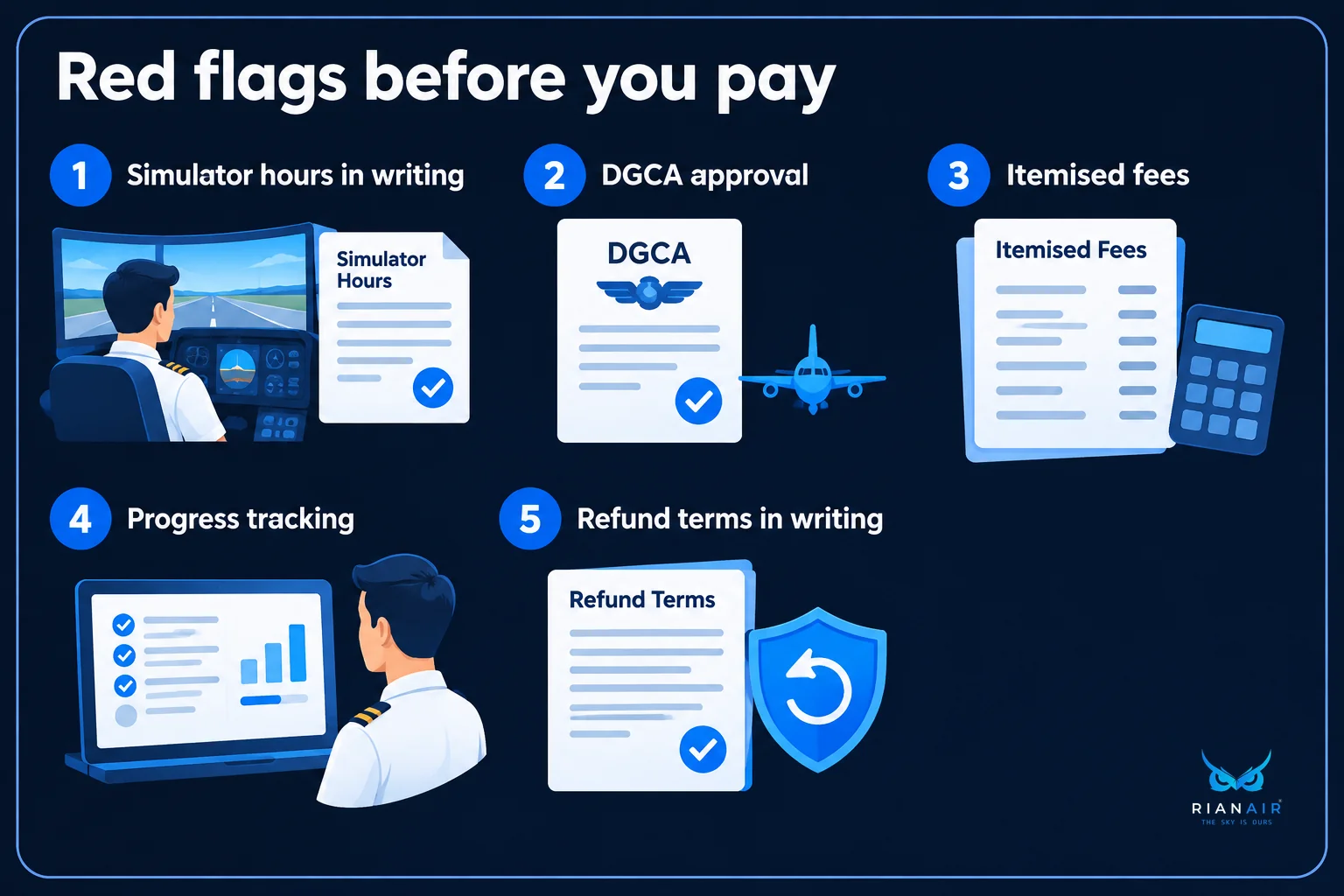
Transparent pilot training includes a written fee sheet, stated simulator hours, a ground syllabus with a question bank and mock exams, a defined pathway to flight training, visible progress tracking and written refund or scholarship terms. If any item is missing, ask for it. If the school cannot provide it, that is your answer.
Use this checklist when you visit or call. Each line has a pass mark and a walk-away signal.
- Itemised fees: pass if every item has an amount; walk away if a "miscellaneous" line is open-ended.
- Simulator hours: pass if hours and device are written in the agreement; walk away if the answer is "as needed".
- Question bank and mocks: pass if the bank covers every DGCA subject and is updated after exams; walk away if no one can say when it was last updated.
- Trial access: pass if you can try the material before paying; walk away if every preview is refused.
- Progress tracking: pass if parents get their own view; walk away if updates depend on asking.
- Written terms: pass if refund and scholarship conditions are on paper; walk away if they exist only in conversation.
- Funding plan: pass if the school explains loan paperwork and instalments in advance; walk away if it pushes a single lump sum.
For a longer list written for families, use the parent's checklist of questions to ask before enrolling.
How does Rian Air structure ground, simulator and progress tracking?
Rian Air combines DGCA-aligned ground training on its RAPT™ platform, simulator sessions at its centres, and a parent dashboard for progress tracking. Students study from a question bank of 20,000+ questions, practise on simulators in Thrissur and Delhi, and parents can follow results. Fees and terms are given in writing on request.
Ground training and the RAPT question bank
RAPT is our pilot career intelligence platform, available on web, Android and iOS. Our bank runs across the DGCA subjects: Meteorology 2000+ questions, Air Regulations 2500+, Air Navigation 5000+, Technical General 5000+, Technical Specific for various aircraft 2000+, and RTR Part 1 1000+. RTR Part 2 mocks use past questions from DGCA exam papers.
Some questions repeat across papers. We keep them on purpose, because a recently asked question is useful practice. The bank is updated after every DGCA exam so past papers and recent attempts are included. There is a free trial: register and speak to our support team.
Here is how a question reads in practice. Air Regulations: "The minimum age for a Commercial Pilot Licence in India is: 16, 17, 18." The answer is 18. A student pilot licence can be held from 16 and a PPL from 17. Meteorology: "Which cloud is associated with thunderstorms and hail: cirrostratus, altocumulus or cumulonimbus?" The answer is cumulonimbus, the thunderstorm cloud, linked to heavy showers, hail, lightning, severe turbulence and icing.
Which topics do students lose marks on most? Honestly, every topic matters. In Air Regulations and Meteorology, skipping or underestimating a topic leads to failure, so we do not tell students which chapters to skip.
Simulators in Thrissur, Delhi and Thane
In Thrissur, Kerala, we run a C172 fixed-base simulator, Kerala's first. In Delhi, our centre at G-94, Rian Air Building, Ramphal Chowk Road, Palam Extension, Sector 7 Dwarka, uses hybrid simulators. In Thane West, Maharashtra, our centre opposite Shree Bhagyalakshmi Bungalow, Anand Park, is being inaugurated this month, October, as a full facility with a library and a DA40/42 hybrid setup with an original G1000 glass cockpit and canopy.
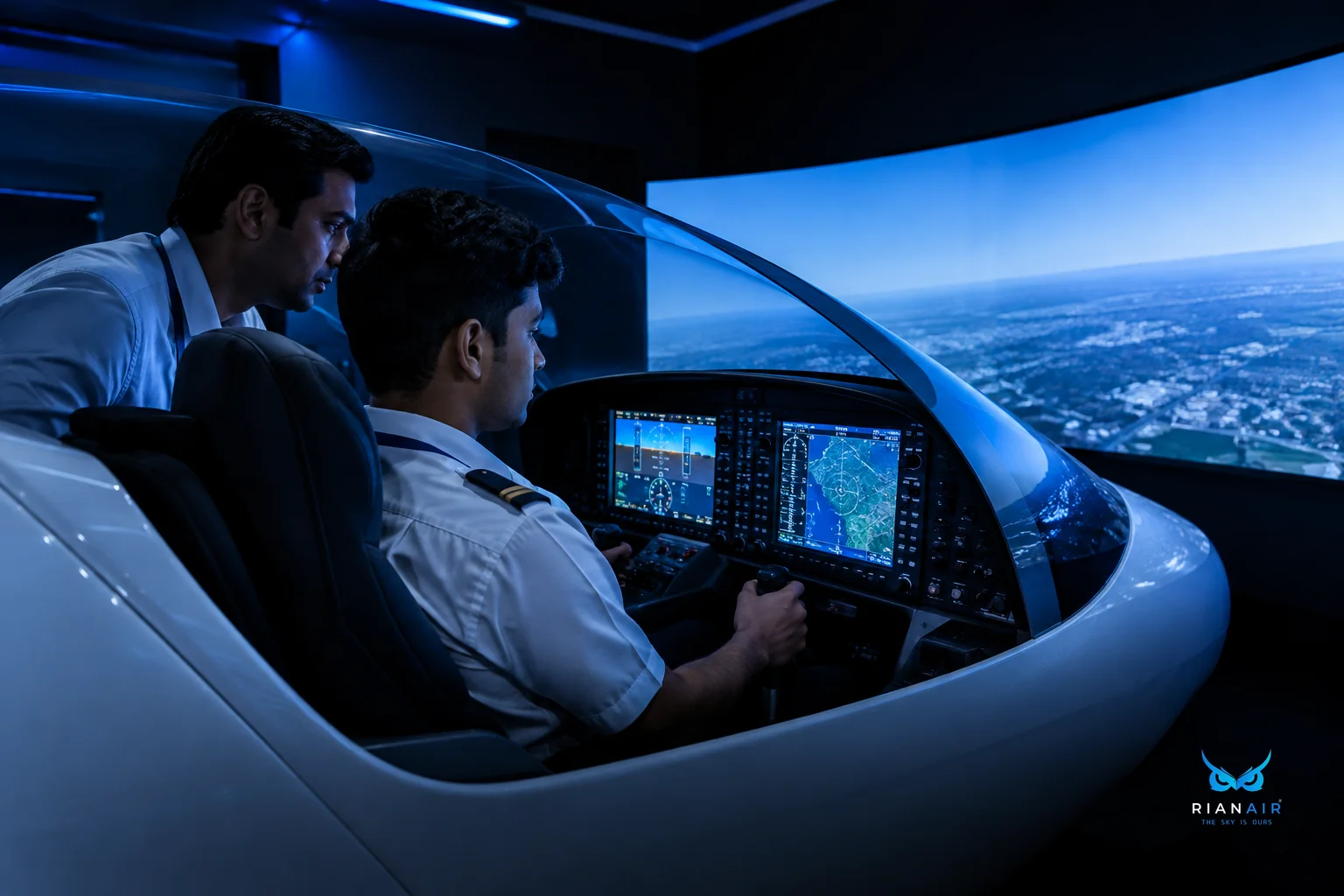
Until Thane opens fully, online ground training for aspiring pilots from Maharashtra is already running. Students can then move to the hybrid setup for in-person classes and simulator sessions. Our pathways page shows how ground training connects to flight training in India, Tunisia, Malta and New Zealand.
Type rating costs and hours, stated plainly
Our entry-level A320 type rating fee is ₹15 lakh through channel partners, and the programme takes 50 days. A type rating includes 36 to 44 hours on a simulator. We state this so a family can compare it against any quote that does not list simulator hours.
Parent dashboard and what students say
The parent dashboard shows progress through the digital logbook and RAPT results, so families see where a student stands without waiting. Google reviewers mention the app and the teaching. Abhishek V. wrote, "The trainers are highly experienced, supportive, and always willing to clear doubts with patience." Sachu wrote, "The app is simple to use, informative, and great for aviation students who want to improve their knowledge and preparation." Both left 5★ Google reviews.
How to compare two quotes: a worked example
To compare two quotes, convert both into one total that covers every item you will pay for over the full programme, then add a margin for retakes and extra hours. The lower total wins only if both quotes buy the same outcome. The example below is hypothetical and uses illustrative numbers, not any real institute.
| Line | Quote A (headline low) | Quote B (itemised) |
|---|---|---|
| Quoted programme fee | ₹45 lakh | ₹52 lakh |
| Simulator hours | Not stated; billed later, assume ₹2 lakh | Included and written |
| Extra flying hours after delays | Assume ₹4 lakh | Assume ₹0 to start |
| Six extra months of living costs | Assume ₹3 lakh | Assume ₹0 to start |
| Illustrative total | ₹54 lakh | ₹52 lakh |
Quote A looks ₹7 lakh cheaper and ends up ₹2 lakh dearer, and that is before any exam retake. Quote B may still need extra hours for a weak student, so it is not risk-free. But its cost is known in advance, and a known cost is something a family can plan a loan around.
How can families fund pilot training without choosing the cheapest option?
Families can spread the cost through an education loan, instalment plans or a merit scholarship, instead of picking the lowest quote. Partner banks usually take anywhere from one month to three months to sanction a student loan, depending on the paperwork, and they need every document before sanctioning. Start the paperwork early.
Our guides cover education loan eligibility for pilot training in detail. If funds are tight, a staged route may suit you better than a single cheap package; we set that out in pilot training options for low-income students. Both guides explain what to prepare before you apply.
Frequently asked questions
Is there a cheapest flying school in India?
No single school is cheapest for every student, because the total depends on extra hours, retakes and location. Government-run schools can quote lower fees for eligible candidates, such as Karnataka residents at Jakkur. Compare itemised totals for your own situation instead of searching for one cheapest name.
Which is the best pilot training academy in India?
The best academy is a DGCA-approved school that gives you a clear total cost, real simulator hours, visible progress tracking and a flight training pathway you can finish on schedule. Rankings help, but check these four items in writing before paying anyone.
How long does a type rating take?
Our A320 type rating programme takes 50 days, with 36 to 44 hours on a simulator. Type rating courses generally run eight to ten weeks, depending on the student's performance. Ask any provider for the number of simulator hours in the agreement.
Can I try Rian Air's study material before paying?
Yes. There is a free trial of the RAPT question bank. Register and speak to our support team, who can explain which subjects to start with and how the mock exams work.
Next step: ask for the full picture before you pay
Cheap pilot training is worth taking only when the low price survives a line-by-line check. Ask for itemised fees, simulator hours, the question bank policy, progress tracking and any refund terms in writing, from us or anyone else. If you want ours, start your pilot training enquiry and ask our academic counsellor for the T&C sheet.
You can also see Delhi centre life and student updates on our Instagram, or watch explainers on our YouTube channel. For a wider view of the market, read how to choose the best pilot training academy in India before you shortlist.