How to Choose the Best Pilot Training Academy in India (2026 Checklist)
The best pilot training academy in India is a DGCA-approved flying school that gives you a clear total cost, real simulator time, visible progress tracking and a flight training pathway you can finish on schedule. Check those four things in writing before you pay a rupee, whether you train in Delhi, Kerala or abroad.
Key takeaways
- Approval first: only a DGCA-approved flying training organisation can legally issue your flying hours, so verify approval before comparing anything else.
- Total cost: the full CPL pathway is about 60-65 lakhs in India and 50-80 lakhs abroad, depending on location.
- Time: at Rian Air, ground training takes 6-12 months and flight training 18-24 months.
- Simulator access: Rian Air includes 5 hours in its ground training package on a C172 fixed-base simulator, described as Kerala's first.
- Visibility: ask whether parents can see progress, logbook entries and exam results without chasing staff.
- Rankings help, not decide: a regulator rating is one input; aircraft availability, batch size and fee clarity matter just as much.
Quick facts at a glance
| Item | What to know |
|---|---|
| Full pathway cost, India | 60-65 lakhs for the complete program |
| Full pathway cost, abroad | 50-80 lakhs depending on location |
| Ground school with Rian Air | 80,000 INR up to 1.25 lakhs, taxes extra |
| Ground training time at Rian Air | 6-12 months |
| Flight training time at Rian Air | 18-24 months |
| Simulator hours in ground package | 5 hours |
| DGCA pass rate shown by Rian Air | 97% |
| Pilots trained by Rian Air | 200+ |
| Pathways offered | India, Tunisia, Malta, New Zealand |
| Money-back promise | On DGCA exams; terms and conditions apply |
Families in Delhi, Mumbai and Thrissur ask us the same thing: with so many academies advertising, how do you pick one? India now has 41 operational flying training organisations across 63 flying bases, with 11 more awarded Letters of Intent in August 2026. This checklist turns the decision into questions you can verify.
1. Is the academy DGCA approved and how is it rated?
Start with DGCA approval, because only an approved flying training organisation can log your training hours toward a Commercial Pilot Licence. Then look at the regulator's rating for the school. A rating gives you comparable data, but it is a starting point and not the final answer.
The choice of where to train has a large effect on how long your CPL takes, what it costs and how stressful it is. Ask for the approval document, the base location and the aircraft fleet assigned to your batch.
DGCA's rankings are also being debated. Some academies have questioned them, so treat the category as one signal. Ask each school what its own numbers are: exam pass rate, average completion time and aircraft per student.
How to verify DGCA approval
- Ask the academy for its DGCA approval document, naming the base and the course.
- Check that the name and base on the document match the school you are visiting.
- Look for the school on the regulator's own website, the Directorate General of Civil Aviation under the Ministry of Civil Aviation, and confirm it with DGCA directly if the listing is unclear.
- Do not rely on an advertisement or a third-party list alone.
What an academy should disclose in writing
- Fleet size: how many aircraft are assigned to your batch.
- Instructor ratio: how many students each instructor handles.
- Completion time: the average from joining to CPL, with last year's figure. Rian Air's is 6-12 months for ground training and 18-24 months for flight training.
Questions to put to every academy
- Is the flying base DGCA approved, and for which course?
- How many aircraft and instructors serve each batch?
- What was the average time from joining to CPL last year?
- Can I speak to current students, not only alumni chosen by the school?
2. What simulator infrastructure should you look for?
Look for a simulator that is used as a training step, with logged hours and instructor feedback, before you spend money on aircraft time. A fixed-base C172 simulator lets you practise procedures, radio calls and instrument flying cheaply, so flying hours are used better.
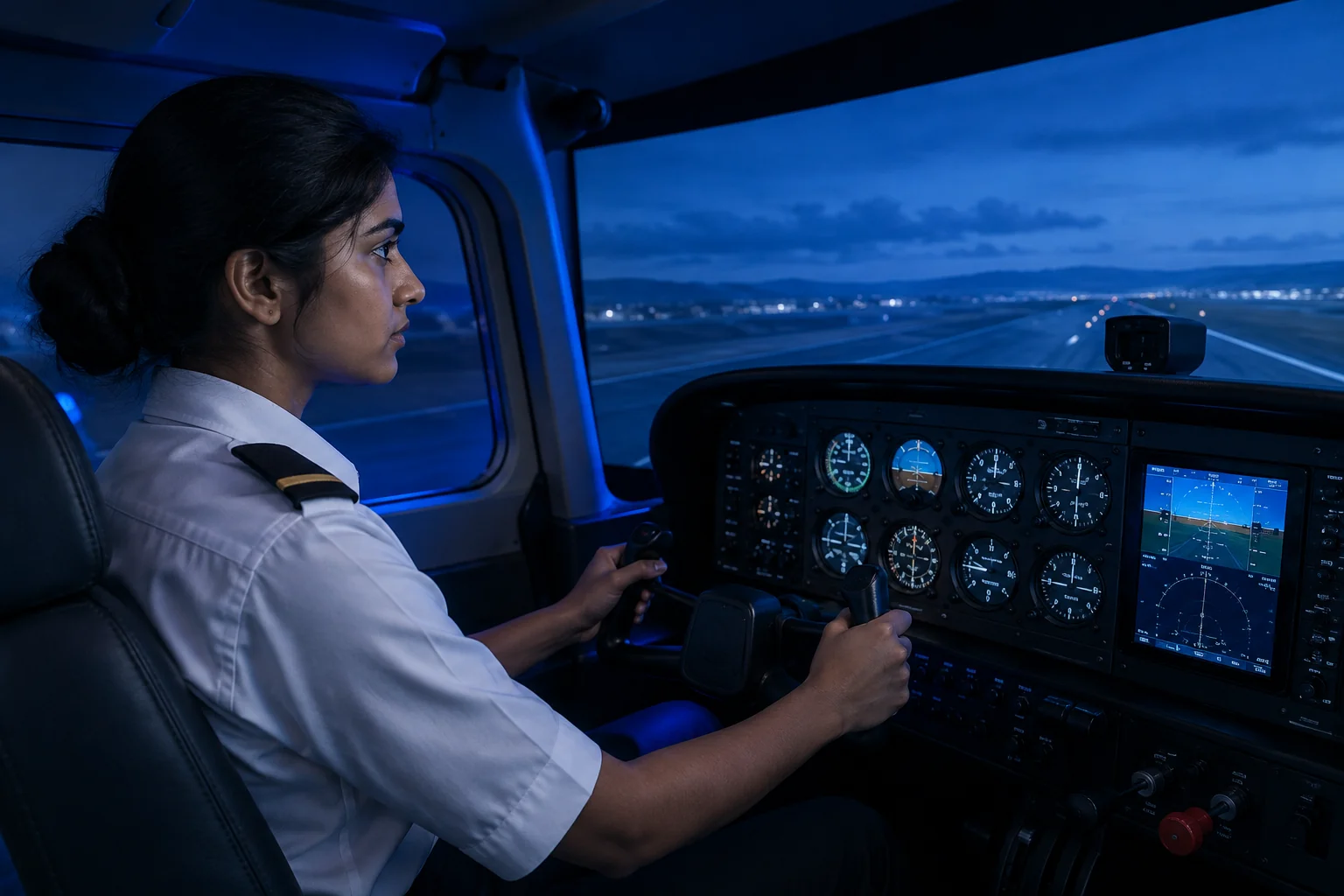
Rian Air offers a C172 fixed-base simulator, described as Kerala's first, and 5 hours are included in the ground training package. Hybrid simulators are available in Delhi. For a deeper look at what this training is and is not, read how fixed-base simulator training actually works.
Ask three things: how many hours are included, whether they are logged in your digital record, and who debriefs you afterwards. A simulator that sits idle behind glass adds nothing.
3. Which digital tracking tools actually matter?
The tools that matter are a digital logbook, exam and question-bank analytics, and a parent dashboard showing progress in near real time. Together they replace guesswork with records, which protects both the student and the family paying the bills.

Rian Air runs RAPT, which it describes as India's first technology-driven pilot training ecosystem. It joins DGCA academics, a 20,000+ question bank, simulator data, performance analytics and a digital pilot logbook, on web, Android and iOS.
For sponsors, the parent dashboard is the point. If a school cannot show you what a parent sees on day 30, assume you will hear about problems late.
4. How do India and international pathways compare?
India is usually the simpler choice for families who want to stay close and control cost, while Tunisia, Malta and New Zealand suit students who want faster flying in more predictable weather. Total cost abroad ranges from 50 to 80 lakhs, against 60-65 lakhs in India.
| Factor | India | Abroad (Tunisia, Malta, New Zealand) |
|---|---|---|
| Full pathway cost | 60-65 lakhs | 50-80 lakhs by location |
| Family access | Easy to visit | Travel and visas needed |
| Ground training | Delhi, Mumbai, Thrissur | Often done in India first |
| Main question | Aircraft availability | Living costs and travel |
Rian Air now supports flight training in India as well as internationally, including Tunisia and Malta. Our comparison of CPL training in India vs Malta vs Tunisia goes through the trade-offs. You can also explore the pathways side by side.
Whether foreign training ends up cheaper is not settled. Currency, living costs and delays change the final number, so always ask for a line-by-line total.
5. How should you read costs, scholarships and promises?
Read every cost as a total, not a headline. Ask for ground school, simulator, flight hours, exam fees, medicals, accommodation and taxes in one document. Ground training at Rian Air starts at 80,000 INR and goes up to 1.25 lakhs, with taxes extra.
Line-item cost template
Ask every academy to fill in this list, and add the lines up yourself.
| Line item | Rian Air figure | Ask the academy |
|---|---|---|
| Ground school | 80,000 INR to 1.25 lakhs, taxes extra | What is included, and are taxes extra? |
| Simulator hours | 5 hours in the ground training package | Are more hours charged separately? |
| Flight hours | Part of the 60-65 lakhs in India or 50-80 lakhs abroad | Rate per hour and total hours |
| Type rating | Covered as a training phase | Is it in the total or extra? |
| Exam fees, medicals, accommodation | Ask us | Written amounts |
| Taxes | Extra on ground school | Total with taxes |
Worked example: one student's timeline
Suppose a student joins Rian Air for the India pathway. Ground training takes 6-12 months, and flight training follows for 18-24 months. Added together, that is 24-36 months from joining to the end of flight training.
On cost, the ground school line is 80,000 INR to 1.25 lakhs plus taxes. The complete program in India is 60-65 lakhs. A student choosing abroad would instead plan for 50-80 lakhs, depending on location. Your own total depends on the written quote.
Rian Air also advertises a money-back promise: if it fails to get a student through the DGCA exams, the student gets their money back, and terms and conditions apply. Ask for the T&C sheet through the enquiry form before relying on it.
A Women Empowerment Program offers zero* fee DGCA ground training for aspiring women pilots on merit, where a refundable commitment deposit applies. A gender-neutral merit-based scholarship also exists. Eligibility and amounts are shared on request, so ask the team through the enquiry form.
A parent's list of questions to ask before enrolling covers the fine print.
6. How does a technology-driven academy differ from a traditional flying club?
A technology-driven academy tracks every step digitally and builds simulator and exam preparation into one system. Traditional flying clubs, often long-established and aircraft-focused, may rely more on paper records and in-person updates. Both can produce good pilots; the difference is visibility.
| Question | Technology-driven ecosystem | Traditional flying club (category) |
|---|---|---|
| Progress records | Digital logbook and dashboard | Ask how records are shared |
| Exam preparation | Question bank with analytics | Ask what is provided |
| Simulator use | Logged hours before flying | Ask if available |
| Parent visibility | Dedicated dashboard | Ask how updates arrive |
The right-hand column is a list of questions, not a verdict. Put them to any school you visit, including ours.
7. What is the 12-point checklist before you enrol?
Use these twelve checks as a scorecard and walk away from any academy that cannot answer the first four in writing. They cover approval, cost, training depth and family visibility.
- DGCA approval document for the base and course
- Regulator rating or category
- Written total cost with taxes
- Written refund and money-back terms
- Simulator hours included and how they are logged
- Aircraft and instructor count per batch
- Average CPL completion time
- Digital logbook and exam analytics
- Parent dashboard access
- International pathway options and partners
- Type rating and airline readiness support
- Location: Rian Air's campus is 1-2 minutes from Ramphal Chowk in Delhi
Rian Air covers ground training, simulator training, flight training, type rating and airline readiness, and shows a 97% DGCA pass rate with 200+ trained pilots. For wider reading, see how to become a commercial pilot after 12th, and follow our Instagram and YouTube channel for student walkthroughs.
Frequently asked questions
What qualification do I need to start pilot training in India?
You need to have passed 10+2 with Physics and Mathematics. Age and medical requirements, including the DGCA medical class needed at each stage, should be confirmed with DGCA directly before you enrol. Ask the academy to show the current rule in writing.
How much does pilot training cost in India?
The complete program in India costs between 60 and 65 lakhs at Rian Air, while abroad it can run from 50 to 80 lakhs depending on location. Ground school alone starts at 80,000 INR, taxes extra.
Is a DGCA-approved school enough on its own?
No. Approval is the minimum legal requirement. You should also compare aircraft availability, instructor numbers, batch size, total cost clarity and completion time, because these decide how fast and how smoothly you finish your CPL.
How long does it take to get a CPL?
At Rian Air, ground training takes 6-12 months and flight training takes 18-24 months. Total time depends on aircraft availability, weather and how quickly you clear exams. Ask each academy for last year's average.
Does Rian Air offer international CPL training?
Yes. Rian Air offers structured CPL pathways in India and internationally, including Tunisia and Malta, and also lists New Zealand. Pick the location by cost, travel and the support you want.
What is the money-back promise?
If Rian Air fails to get a student through the DGCA exams, the student gets their money back, and terms and conditions apply. Ask for the T&C sheet through the enquiry form before you enrol.
Can women get free ground training?
The Women Empowerment Program offers zero fee DGCA ground training for aspiring women pilots based on merit, with a refundable commitment deposit. Eligibility and amounts are shared on request, so contact the admissions team.
What is the RAPT platform?
RAPT is Rian Air's training ecosystem, described as India's first technology-driven pilot training ecosystem. It combines DGCA academics, simulator data, performance analytics and a digital logbook, available on web, Android and iOS.
How can parents track a student's progress?
Through the parent dashboard inside RAPT, which shows progress and records during training. Ask any academy for a live demonstration before you pay, so you know exactly what you will see.
Should I train in Delhi, Mumbai or Kerala?
Choose the ground school city closest to home to cut living costs. Rian Air serves Delhi, Mumbai and Thrissur, with its Delhi campus 1-2 minutes from Ramphal Chowk. Flight training location is a separate choice.
Take the next step
Start your pilot journey by sending an enquiry. Ask for the total cost sheet, the money-back T&C, scholarship eligibility and a RAPT demo, then compare the answers with every other school on your list.