



Pilot Career After 12th Science in India: Subjects, Timeline and First Steps Explained
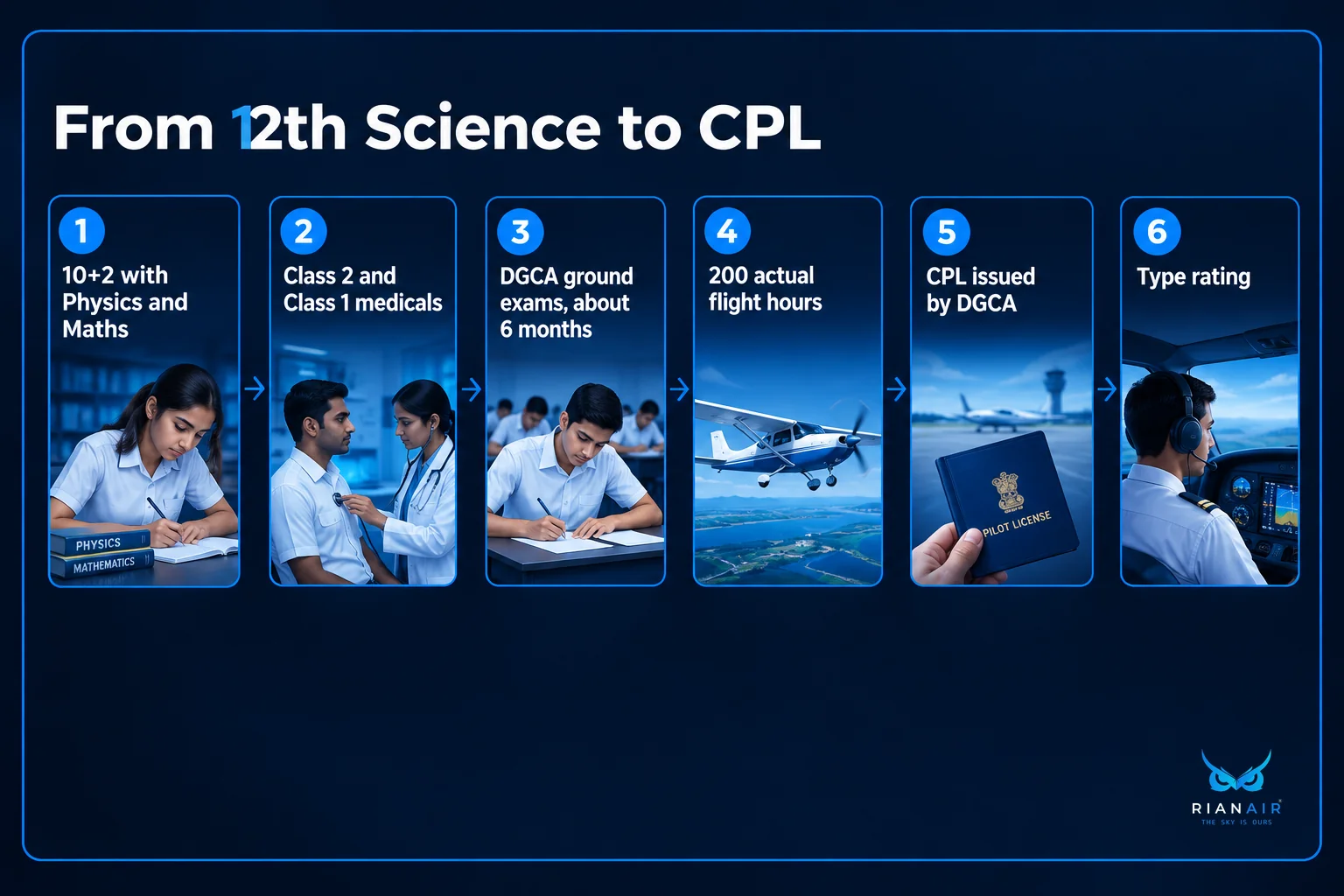
A pilot career after 12th science in India needs a pass in 10+2 with Physics and Mathematics, a DGCA medical, DGCA ground exams, 200 actual flight hours for the Commercial Pilot Licence (CPL) and, for airline work, a type rating. CPL training usually takes 18 to 24 months from admission, and PCM is the stream that keeps every door open.
Rian Air trains students from Delhi, Mumbai and Thrissur with DGCA-aligned ground classes, a 20,000+ question bank on our RAPT platform and a C172 fixed-base simulator in Kerala. The 18 to 24 month range is a commonly reported duration for CPL training, as NDTV explains, and it assumes no long weather delays or backlogs in flying hours.
Eligibility by stream: Science with Physics and Mathematics (PCM) can apply after 10+2 and a medical. Biology (PCB), Commerce or Arts students must first add Physics and Mathematics through an open school board. Chemistry is not required.
Is PCM mandatory for a pilot career after 12th science?
Yes. A Commercial Pilot Licence applicant in India needs a pass in 10+2 with Physics and Mathematics, which is why Science with PCM is the safest stream. Chemistry is not required in India to become a pilot: only Physics and Mathematics count. Students from Biology or other streams can still qualify if they add the missing subjects through an open school board before applying.
The Civil Aviation Department of Haryana prospectus lists the same entry rule: 10+2 Non-Medical with Physics and Maths for CPL applicants. Academies can add their own selection steps on top of that minimum, so the DGCA rule is the floor, not the whole admission test.
You may read that DGCA has proposed dropping the PCM condition so Arts and Commerce students can apply. Until the Ministry of Civil Aviation notifies a change, plan as if PCM is required. If you are already past Class 12 in another stream, our guide on becoming a pilot after 12th commerce covers the routes open to you.
Medical fitness: Class 2 first, Class 1 before flying
Pilot training needs two DGCA medicals. A Class 2 medical comes before ground training, and a Class 1 medical comes before flight training. Both confirm that you can hold a licence at all, so treat them as an entry requirement, not a formality for later.
A finding of permanent medical unfitness rules out a CPL. That is why we ask students to complete the medical early, before committing large fees. It costs little compared with a full course and answers the one question no marks can change.
Where and how to book the medicals
DGCA medicals are done only by DGCA-approved medical examiners and aeromedical centres, not by any general doctor. The Press Information Bureau reported in October 2025 that 10 new Aeromedical Evaluation Centres were added across the country to handle DGCA medical examinations.
Class 1 is the assessment for CPL and ATPL holders, while Class 2 covers student and private pilots. Applications and appointments are routed through the DGCA eGCA portal, so create your eGCA profile first and ask the examiner which documents to upload.
DGCA's FCL Circular 03 of 2025 says Class 1 medicals are held at DGCA-empanelled IAF Boarding Centres, IAF Renewal Centres, private hospitals and Class 1 medical examiners, and that an applicant must be 17 or older for the initial Class 1 medical. Expect the examination to take 1 to 3 days. Carry a photo ID (the one used on eGCA) and, if you wear spectacles, a fresh prescription.
The licensing fee is paid online through the Bharatkosh portal. The tests include blood counts, urine, blood sugar, liver and kidney function, a lipid profile and an ECG, and the examiner can ask for more based on your history. Confirm the current centre list and costs with your chosen centre before booking.
Merit requirements at Rian Air
Our gender-neutral, merit-based scholarship has three conditions: you must be medically fit, have passed 10+2 with Physics and Mathematics, and score among the top 12 out of 100 candidates at one of our three branches in Kerala, Delhi or Thane. Merit here means the test score, not the percentage on your marksheet.
Students outside the top group can still enrol in our regular DGCA ground training. The medical and PCM conditions are the same either way.
What is a realistic timeline from admission to CPL?
A realistic timeline from admission to CPL is 18 to 24 months overall, assuming flying hours and exams do not stall. At Rian Air, DGCA ground training takes about 6 months of that, and the rest goes to flying 200 actual hours, paperwork and the usual weather and aircraft delays.
Ground subjects overlap, so the total is shorter than adding every line below. Here is how our ground phase breaks down, with the abroad route for comparison.
| Stage | Typical time | What to know |
|---|---|---|
| Air Navigation | 2 to 2.5 months | The longest single subject; part of RTR is completed during it |
| Air Regulations and Meteorology | About 1.5 months | Taught at the same time |
| Radio Telephony (RTR) | About 15 days | Shorter because some portion is done during Navigation |
| Technical General | 2 to 2.5 months | Optional for students flying abroad; our partner flying school in India covers it |
| All ground subjects | About 6 months | Overall Rian Air ground timeline |
| Licence conversion after training abroad | Usually 3 to 4 months | When all DGCA exams were cleared before leaving |
Exam dates, not classroom time, are the usual cause of slippage. Our checklist for choosing a pilot training academy shows how to ask any school about attempt dates, aircraft availability and batch sizes before you pay.
DGCA ground exams: subjects, fees and attempts
DGCA's syllabus CAR for the CPL and Instrument Rating (aeroplanes) sets the written papers. For a student training on aeroplanes, the ground phase covers Air Navigation, Meteorology, Air Regulations, Technical General (Aircraft and Engines), Technical Specific and Radio Telephony (RTR). Each one maps to a cockpit skill, from plotting a route to reading weather and speaking correctly on the radio.

Students who use RAPT practise from topic-wise questions with explanations, then sit timed mocks. Reviewers on Google describe the classes and app practice as helpful for understanding subjects and preparing for DGCA exams, and one says they cleared Met and Regs. The free demo is a sample of the bank; full access follows your course.
Exam fees and attempt months
Fees depend on when you sit, as stated on DGCA's website. The regular attempt months are March, June, September and December; any other month is an on-demand sitting and costs more.
| Exam | Fee |
|---|---|
| Each exam, regular attempt (March, June, September, December) | Rs 2,500 |
| Each exam, other months (on-demand) | Rs 5,000 |
| RTR Part 1 | Rs 2,000 |
| RTR Part 2 | Rs 500 |
ATPL fees are the same as CPL fees. Planning every sitting for a regular month halves the per-exam fee, which matters when a retake is involved.
Cool-off and validity
If you fail a subject, the current rule makes you wait 42 days before the next attempt. DGCA might remove that cool-off in future, but plan on it today.
DGCA's Civil Aviation Requirement on eligibility criteria for crew licence examinations (Section 7, Series B, Part I) says theory exams for a CPL or ATPL must fall within five years before the licence application, so a student who clears exams early must still finish flying inside that window.
Flight hours, CPL and type rating
Under DGCA's Civil Aviation Requirements (CAR) and the Aircraft Rules, only 200 actual flight hours are required for a CPL in India. Rian Air students most often train at Indian Flying Academy at Khajuraho, while we handle ground training and RAPT practice. Students can also choose to fly abroad and convert the licence in India afterwards.
Clear the exams before you fly abroad
We recommend clearing all DGCA exams before leaving. In India, some exams can be cleared alongside flight training, but abroad that is harder. A student who leaves without clearing them gets attempts after returning, yet timing is hard to predict.
Air Navigation and Meteorology then merge into one composite exam of 100 questions in 3 hours. If documents are not submitted to DGCA within 6 months of returning, recency training is repeated, roughly 18 to 22 extra flying hours. Clearing exams first avoids both costs.
Type rating after the CPL
A type rating qualifies you on one aircraft, such as an A320 or a B737, and airlines expect it for first officer roles outside cadet programmes. The DGCA type rating CAR, effective 7 September 2026, sets a CPL with instrument rating as the prerequisite for the training. Our pilot training cost breakdown shows where simulator and examiner charges appear.
The CAR also requires the trainee to pass the DGCA Technical Specific exam, or an exam authorised by the regulator of the country concerned, before simulator training starts. The whole programme must finish within 45 working days of starting, unless DGCA approves otherwise. The older NOC from DGCA's Flight Standards Directorate is no longer needed.
What does the full path cost from 12th science to first type rating?
In India, a CPL costs around 60 lakh rupees and a type rating around 15 lakh rupees. Abroad, CPL training costs between 50 and 70 lakh rupees plus licence conversion in India, depending on the country. These are Rian Air's guidance ranges, and the final bill depends on school, location and retakes.
| Route | CPL cost (Rian Air guidance) |
|---|---|
| India | Around 60 lakh |
| Abroad, general range | 50 to 70 lakh, plus licence conversion in India |
| New Zealand | 70 to 75 lakh, including miscellaneous expenses |
| Type rating in India | Around 15 lakh |
Ask every school for a line-by-line fee sheet. On 5 October 2026, DGCA published a public notice on Flying Training Circular 02 of 2026, which carries guidelines for agreements between flying training organisations and trainees. Ask to see the agreement before you pay.
Before you pay any school, ask these questions and get the answers in writing:
- Fees: What does the quoted fee include, and which costs (exam fees, medicals, simulator hours, accommodation) are extra?
- Refunds: What part of the fee is refundable if you stop, fail to qualify medically or a visa is refused, and by when?
- Aircraft availability: How many trainee aircraft and instructors serve a batch, and what is the usual wait for flying slots?
- Extra hours: What is the charge per additional flying hour if you need more than 200?
Career options and salary after CPL
After the CPL, most new pilots build hours or move into airline roles. Pilot pay in India is not officially published, so these are indicative ranges from public salary surveys published in 2024 to 2026, and they often disagree.
- Flight instructor: a common way to build hours while waiting for an airline job. Entry-level instructors are reported at about Rs 30,000 to 60,000 a month, and experienced instructors at Rs 1 lakh to 2.5 lakh.
- Charter and business jets: far fewer openings and highly variable pay, reported at roughly Rs 1.5 lakh a month for a first officer, rising to around Rs 10 lakh for a captain at established operators.
- Airline first officer: airlines generally expect a type rating, and pay rises with aircraft type and seniority from first officer to captain.
Age and English proficiency
You must be at least 18 years old for a CPL to be issued, though training can start earlier. You must also show ICAO English language proficiency, with Level 4 as the commonly cited minimum. Check the current DGCA wording before you apply.
First steps to take while still in school
- Protect Physics and Maths. Those two subjects decide CPL eligibility, so keep your marks and your marksheet safe. If either is missing, plan to add it through an open school board.
- Book the medicals. Take the Class 2 medical first and the Class 1 before flying. Do not pay a large course fee before you know your result.
- See where you stand. Try our free RAPT demo to sample DGCA-style questions and check your starting level before you choose a course.
- Compare academies in writing. Ask for total cost, exam support, partner flying school and what happens to fees if plans change.
- Learn the exam calendar. Aim your attempts at March, June, September or December, and keep the 42-day cool-off in mind.
When you have your shortlist, our team can walk you through batches and branches in Delhi, Mumbai and Thrissur through the admission enquiry page. You can also browse rianair.in, follow us on Instagram and watch explainers on YouTube.
Questions students and parents ask next
Is 250 flight hours required for a CPL in India?
No. Only 200 actual flight hours are required for a CPL in India, not 250. If an academy quotes a higher number, ask it to explain in writing where the extra hours come from and what they cost, because every added hour adds to the bill.
Where do Rian Air students train in India?
Rian Air students most often train at Indian Flying Academy at Khajuraho. Rian Air handles DGCA ground training, and the flying school handles flight hours. Airmanship Aviation Academy is a second partner school that is coming soon, so ask our team which option is open for your batch.
Who covers Technical General and Technical Specific?
Rian Air does not cover Technical General. The partner flying school in India, such as Indian Flying Academy, covers Technical General and Technical Specific for single-engine and multi-engine aircraft for all Rian Air students. The subject takes about 2 to 2.5 months and is optional for students who will fly abroad.
Is an airline letter of intent a job guarantee?
No. A letter of intent is not a legal guarantee of a job. One student we know received an LOI from a major airline in India, yet had to stop after most of his training was complete when the school and the airline terminated him. Read every programme term before paying.
How are airline selection rounds different for type-rated pilots?
Non type-rated candidates face a written exam, psychometric test, ADAPT or Compass test (depending on the airline), group discussion, panel interview and a medical with a drug test. Type-rated pilots take a written exam, psychometric evaluation, group discussion, a simulator assessment on the specific aircraft, a panel interview and medical tests.
What if a cadet programme abroad rejects my visa?
Visa refusal is a real risk. About 12 students we know did not get visa approval the first time they applied for a cadet programme abroad, and a second application meant spending more money. Ask any academy what happens to fees if a visa is refused, and get the answer in writing.
What are the career options after CPL in India?
After a CPL, most pilots join an airline as a first officer (usually after a type rating), work as a flight instructor to build hours, or look for charter and business jet roles. The career section above gives indicative pay for each route.
What is the minimum age to start the DGCA exam process?
DGCA's eligibility CAR sets a minimum age of 16 for generating a computer number, which is the first step for the ground exams. The CPL itself is issued only from age 18, so a student who finishes Class 12 at 17 or 18 can start ground training straight away.
Do I need a type rating before applying to airlines?
Usually yes for direct first officer hiring, and airlines often state it in the vacancy. Cadet programmes are the main exception, because they include the type rating in their own pathway. Check each airline's current requirements before you spend on a rating.
Is chemistry required to become a pilot in India?
No. Only Physics and Mathematics in 10+2 are required for a CPL in India. Chemistry is not needed.
Recommended Resources
Start Your Pilot Journey Try Our Free RAPT Demo Now Home Rian Air