


CPL Flight Training in India: Requirements, Cost, Steps 2027
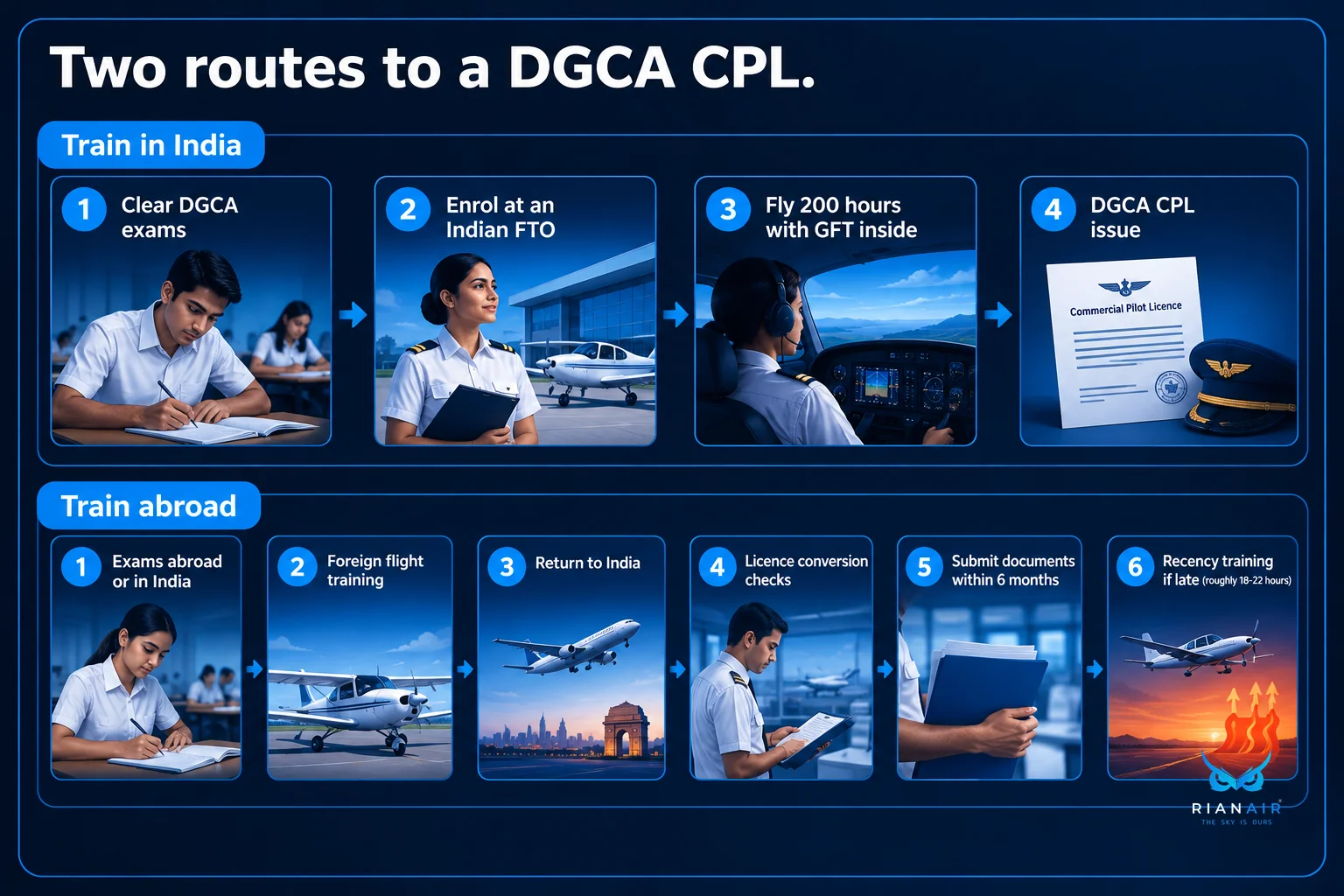
How to start, in short: get your DGCA Class 2 and Class 1 medicals, complete ground training and clear the DGCA exams, then fly the 200 hours at an approved Indian flying school. The comparison with training abroad in this guide covers only some countries, mainly Tunisia, Malta, New Zealand and the USA, and is not a survey of every foreign route.
Flight training in India is the better choice for most Indian students in 2027. The DGCA CPL that airlines hire on needs only 200 hours of logged flight time. Training at home avoids the yearly foreign medicals, visas, air tickets, licence conversion and six-month recency clock that come with training abroad. For students and parents in Delhi, Mumbai and Thrissur, that gap has widened every year.
At Rian Air, we run DGCA-aligned ground training, simulator practice and flight training pathways in India, supported by our RAPT™ platform with a 20,000+ question bank and a digital logbook. Our students most often fly with partner schools such as Indian Flying Academy at Khajuraho.
Our founder, Capt. Vikas Nair, set out to become a pilot in 2007, when going abroad was the default choice. He flew in the USA in 2010, when the money went much further. This guide sets out what a DGCA CPL needs, then compares training in India with training abroad and explains why we now advise India.
What Does a DGCA CPL Require?
The Commercial Pilot Licence (CPL) lets you fly for hire and is the entry point for airline first officers. Whether you train in India or abroad, Indian airlines ask for the DGCA CPL, so that is the target we compare routes against. Requirements are from the DGCA Civil Aviation Requirements, Section 7, Series B Part I.
| Point | DGCA CPL requirement |
|---|---|
| When you take it | First professional licence, after ground exams and flight training |
| Prerequisite | In this order: DGCA Class 2 medical, DGCA Class 1 medical, ground training, computer number, DGCA exams, then flight training. We advise clearing both medicals as early as possible |
| Minimum age | At least 18 (student licence from 16, PPL from 17) |
| Flying required | 200 hours in total, made up of 185 hours on a single-engine aircraft and 15 hours on a multi-engine aircraft in our India pathway |
| PIC time on the way | The General Flight Test (GFT) with a DGCA-approved examiner counts as PIC time |
| Skill tests | 1 hr GFT by day, 1 hr GFT by night, 1 hr IR check, 250 nm cross-country by day, 120 nm by night |
| Theory subjects | Air Navigation, Meteorology, Air Regulations, Technical General, Technical Specific, RTR, plus Performance where applicable. Technical General and Technical Specific are mandatory to fly in India; they are optional only if you plan to fly abroad |
| Exam fees | Rs 2,500 per regular attempt (March, June, September, December), Rs 5,000 on-demand. RTR Part 1 Rs 2,000, RTR Part 2 Rs 500 |
| Ground training time | 6 to 8 months including clearing all the DGCA exams |
| Flight training time | 18 to 24 months in India; in our experience a CPL abroad takes at least 2 years |
| Typical cost to plan | 72-75 lakhs all-in for our India CPL pathway; flight training alone is 59.5 lakhs with Indian Flying Academy |
| Typical role | Paid pilot, usually airline first officer after a type rating |
CPL cost split: ground, flying and medicals
The 72-75 lakh all-in figure for our India pathway breaks into phases. Flight training is the largest part. The 59.5 lakh fee with Indian Flying Academy covers 185 hours on a single-engine aircraft, 15 hours on a multi-engine aircraft and all the checks. That is 185 + 15 = 200 hours, the same 200-hour minimum stated above. No other costs are included in that fee.
Ground training, DGCA exam fees, the Class 2 and Class 1 medicals and living costs are paid separately. Exam fees are listed in the table above. Medicals cost anywhere between Rs 6,000 and Rs 25,000, depending on the medical type and the centre.
Accommodation with three meals a day is about Rs 20,000 in India. Ground training is charged only for the subjects a student attends with Rian Air, so ask us for the fee of the specific subject you need (Navigation, Meteorology, Regulations or RTR).
We do not publish a per-subject fee here. To get it, enquire at Rian Air, or start with the free RAPT demo as a progress check. For ATPL, after the 500 free questions, the subscription is 500 per month per subject.
Typical spend: India versus abroad
These are the totals we quote, and they include miscellaneous expenses where stated. Abroad, license conversion in India comes on top.
- India CPL: the flight training fee is 59.5 lakhs (about 60 lakhs rounded), and the all-in total is 72-75 lakhs once ground training, exams, medicals, living costs and other overheads are added.
- Abroad, general range: 50-80 lakhs depending on location, plus conversion in India.
- Tunisia: 48,000 euros at present, bound to increase in 2027. Accommodation is not included, and first-time exams are included.
- New Zealand: 70-75 lakhs including miscellaneous expenses.
- Type rating: 15-25 lakhs depending on aircraft type and training location.
Our flying schools also quote per-hour rates of Rs 22,000-30,000 for a single-engine aircraft and Rs 45,000-65,000 for a multi-engine aircraft. Diamond DA40 and DA42 aircraft cost more to operate than Tecnam, Cessna or Piper types.
Eligibility and funding
Eligibility: you need a pass in 10+2 with Physics and Mathematics, you must be at least 18 to hold a CPL (a student licence is possible from 16 and a PPL from 17), and you must clear the DGCA Class 2 and Class 1 medicals. Do the medicals first, as the steps below explain.
Funding: most families fund the 72-75 lakh total through savings, a bank loan or a mix. Banks look closely at the training fee and your documents, so read what banks actually ask before approving a pilot training loan and the education loan eligibility guide before you apply.
How to start your CPL in India, step by step
- Check eligibility. Confirm you have 10+2 with Physics and Mathematics before you pay any fee.
- Get your DGCA Class 2 medical as soon as possible. A problem found here is far cheaper to learn about now than after you have paid for ground training or flying.
- Get your DGCA Class 1 medical straight after. Failing Class 1 after the exams are done, or leaving it until just before flight training, is a huge risk and a sheer waste of time.
- Start DGCA ground training. With both medicals cleared, begin ground school (about 6 to 8 months including all the exams).
- Create your eGCA profile and get your computer number. Register on the DGCA eGCA portal with your personal details and documents. You need the computer number before you can book a DGCA exam on the Pariksha portal.
- Book and clear your DGCA exams. Book a slot on the Pariksha portal. Use RAPT to find weak subjects, and plan for the cool-off period (42 days in published exam guides, confirm the current rule on Pariksha) if you need a retake.
- Enrol for flight training in India. Choose a school using the checklist below; ours include Indian Flying Academy at Khajuraho.
- Use simulators in the monsoon. Fill June to September with simulator hours or pending exams.
- Keep your logbook clean. Enter each flight right after the post-flight briefing.
Timeline and DGCA exam schedule
Plan on 6 to 8 months of ground training, including clearing all the exams, followed by 18 to 24 months of flight training. DGCA regular exam sessions run in March, June, September and December at Rs 2,500 per exam, and on-demand sittings in other months cost Rs 5,000. Every passed exam is valid for 5 years from the date of passing.
How to choose an Indian flying school (FTO)
Do not pick a school on price or a brochure alone. Ask for each answer in writing, and treat the points below as walk-away signals.
- DGCA approval: Walk away if the school cannot show a current DGCA Flying Training Organisation approval that covers the aircraft you will fly.
- Fleet: Ask how many aircraft are serviceable, which types they are and whether they have glass cockpits. If the school cannot say how many are flying today, expect waits for slots.
- Weather: Ask how many flying days students usually lose in the monsoon and what the school does with those months, such as simulator hours.
- Instructor ratio: Ask how many students share each instructor and how many hours a student flies per month. If neither is answered, your hours may stall.
- Track record: Ask for DGCA exam results and the outcomes of past students, and speak to current students. Do not sign if the school will not share either.
- Fee clarity: Ask what the fee covers. Our partner fee of 59.5 lakhs covers 185 single-engine hours, 15 multi-engine hours and all checks, and nothing else. Compare any quote on that basis.
How to verify a DGCA-approved FTO
- Open the DGCA website (the Directorate General of Civil Aviation, the regulator) and look for its published list of approved Flying Training Organisations. Always use the current version.
- Find the school's exact name and base on that list.
- Check that the aircraft types you will fly are covered by its approval.
- Ask the school for its approval document in writing and compare it with the list.
- If the school is not on the list, do not pay any fee.
Airline Cadet Programmes vs Self-Funded Flying Schools
Airline cadet programmes are run by an airline to select, train and hire its own pilots, so the route and the employer are fixed from the start. A self-funded route through a flying school (FTO) means you pay for your own CPL, then apply to airlines as a licensed pilot.
On cost and entry, the two routes differ. A self-funded CPL costs 72-75 lakhs all-in on our India pathway, and you are admitted once you meet the eligibility and medical rules. A cadet programme is chosen and fixed by the airline, so its fees and selection terms come from that airline; ask it for them in writing.
Entry to cadet programmes is competitive and decided by the airline, so many students plan a self-funded CPL in parallel. Our guide to cadet pilot programmes in India compared with self-sponsored CPL sets the two side by side.
Why Is Flight Training in India the Best Option in 2027?
Flight training in India is the best option in 2027 because it gives you the one licence Indian airlines accept, a DGCA CPL, in 200 flight hours, with costs you can see and parents who can visit. Training abroad adds recurring expenses, conversion checks and a recency deadline.
The reasons are concrete. India has more flight schools, newer aircraft and glass cockpits, as the next section shows. The rupee now trades at about ₹93 to the dollar, so every foreign spend weighs more. And you train under the system that finally issues your licence, which keeps DGCA conversion out of the picture.
How Has Flight Training in India Changed Since 2007?
Flight training in India has changed from 10 to 15 schools with very little infrastructure in 2007 to 41 flight schools today, with 11 more holding a DGCA no-objection certificate. Newer aircraft, glass cockpits and simulators now make training at home a practical first choice, not a fallback.
When Capt. Vikas Nair wanted to train in 2007, most Indian students looked overseas because the options at home were thin. That is no longer true. The fleets are changing too, from older aircraft to modern Diamond, Tecnam and Piper Archer DX trainers, with Cirrus aircraft ordered by DYPAA and on their way to India.
Glass cockpits, where digital displays replace the old round dials, are being introduced by flight schools. Students learn on the same type of screens they will meet in airline cockpits.
New capacity is arriving across the country this year. An airline-backed academy in Maharashtra has received its DGCA approval as a Flying Training Organisation, and a proposed institute at Darbhanga airport has received a defence ministry no-objection certificate.
Demand is clear in the numbers: by 30 June 2026, India had issued 1,331 Commercial Pilot Licences, and 540 of them, 41 percent, went to cadets trained outside India. That share shows how much training capacity still has to be built at home, and why we want students to use it.
Our own students train with Indian Flying Academy at Khajuraho, and Airmanship Aviation Academy is coming soon as another partner school. Both fit a simple plan: finish your ground exams, then fly close to home.
What Does Training Abroad Cost That Training in India Does Not?
Training abroad adds recurring costs that Indian training does not: a foreign medical every year on top of the DGCA Class 1 medical, visas, return air tickets, daily living expenses, foreign study software and extra training. Everything is paid in a currency that has grown much more expensive against the rupee.
The exchange rate alone changes the maths. In 2010, when Capt. Vikas Nair was flying in the USA, one dollar cost about ₹45 to ₹50. In November 2026 it is about ₹93, close to double. A fee that looked affordable on a 2010 spreadsheet looks very different today.
Recurring costs side by side
| Cost item | Training in India | Training abroad |
|---|---|---|
| Medical | DGCA Class 1 medical only | Foreign medical renewed every year, plus the DGCA Class 1 medical |
| Travel | Domestic tickets; parents can visit when they like | International tickets, with peak-season fares such as December |
| Visa and living | Not applicable; living near home | Visa, accommodation, food and daily expenses in a stronger currency |
| Study material | RAPT and Indian ground classes | Foreign study software and extra training |
| Failed checks | Re-test close to home | A failed checkride adds more flying, weeks and living costs |
| Coming home | No conversion step | Licence conversion, GFTs and possible recency flying |
Time multiplies these costs. A programme in Tunisia, for example, takes about 2.5 years, which means three medical renewals, each paid in euros. A US commercial licence under FAA rules typically needs 250 hours (check the current FAA requirement for your route), while an Indian CPL needs 200 flight hours, the DGCA minimum. Why pay to fly the extra 50?
For a rupee-by-rupee view of what you pay locally, read our pilot training cost in India breakdown of hidden fees parents miss.
A worked cost example (hypothetical)
This example is hypothetical. It uses the 48,000 euro Tunisia fee quoted above, converted at about Rs 102.49 per euro (18 November 2026), and the conversion range of Rs 3.5 to 11 lakhs from this guide.
- Tunisia fee: 48,000 euros x 102.49 = about Rs 49.2 lakhs. Accommodation is not included.
- Licence conversion in India: Rs 3.5 to 11 lakhs, so the running total is about Rs 52.7 to 60.2 lakhs.
- Still to add: three foreign medical renewals over about 2.5 years, a visa, return air tickets, accommodation and daily living costs, and foreign study software. Ask the academy for each of these in writing.
- India: Rs 72-75 lakhs all-in, which already includes ground training, exams, medicals and living costs.
On the headline fee, Tunisia looks cheaper. The fair comparison is the all-in total, so add the recurring lines above to the Rs 52.7 to 60.2 lakh figure before you compare it with the India total. Exchange rates move, so recalculate with the day's rate.
Why Clear Your DGCA Exams Before Flight Training?
Clear your DGCA exams before flight training because it removes the biggest source of delay and extra cost. A student who passes everything first can enrol straight for flying, and if conversion is needed, it is usually done within 3 to 4 months. A student who skips exams cannot predict the timeline.
Technical General and Technical Specific are mandatory if you want to fly in India. Students who skip them in India often end up sitting 14 to 18 exams in a foreign country.
If exams are not cleared before leaving, the student gets only 1 or 2 attempts at the DGCA exams after arriving in India. Air Navigation and Meteorology then merge into one composite exam of 100 questions in 3 hours.
Ground training timeline we plan around
The whole ground phase, including clearing all the exams, takes about 6 to 8 months with us:
- Air Navigation: 2 to 2.5 months.
- Air Regulations and Meteorology: about 1.5 months, studied at the same time.
- RTR: 15 days, because part of it is completed during navigation.
- Technical General and Technical Specific: 2 to 2.5 months. We do not teach these papers ourselves. Partner schools in India such as Indian Flying Academy cover them, for single and multi-engine aircraft, for all our students.
Every passed DGCA exam is valid for 5 years, so a student who finishes ground exams has a comfortable window to complete flying. If you still have one or two papers pending, you can clear them alongside flight training by booking a slot in a city near your flight school on the DGCA Pariksha portal. Students abroad do not have that option.
If you are planning the exams-first route, our guide to flight training in India after completion of DGCA exams explains what the next steps look like. You can also try our free RAPT demo to see how you score on exam-style questions before you commit to a plan.
Training in India vs Abroad: Side-by-Side Comparison
This table sets out how the two routes differ on the points that decide cost, time and licence risk. It reflects our view as an Indian pilot-training provider, built on DGCA rules and what our students tell us. It covers only some countries, not every foreign route.
| Factor | Flight training in India | Flight training abroad |
|---|---|---|
| Hours for a CPL | 200 flight hours (185 single-engine + 15 multi-engine) | Can be 250 hours, for example for a US CPL |
| DGCA exams | Clear before or alongside flying | Often 14 to 18 exams abroad, then 1 or 2 DGCA attempts after returning |
| Medicals | DGCA Class 1 | Foreign medical every year plus DGCA Class 1 |
| Checks on return | GFTs are covered within the 200 hours | Separate checks in India |
| Recency | No six-month conversion clock | Roughly 18 to 22 extra flying hours if documents miss the 6-month window |
| Parents | Can visit and check progress when they want | Many parents cannot see what happens day to day |
| Weather | Monsoon pause from June to September | Harsh winters in some countries |
| Airline hiring | DGCA licence is the one airlines ask for | Conversion needed first |
Does a Foreign Licence Get You an Airline Job in India?
A foreign licence alone does not get you an airline job in India. Indian airlines want the DGCA licence, so students trained abroad must first convert. In our view, the surest way to an Indian airline seat is to train for a DGCA CPL from the start.
DGCA looks closely at licence conversion for pilots returning from foreign flying schools. It knows Indian FTOs well, so in our experience issuance is easier when you train at one. The conversion checks for a foreign CPL are a Composite paper and Air Regulations, plus skill tests in India, and the cost depends on the case.
We see conversion cost from ₹3.5 lakh to ₹11 lakh. The low end is just the check. The high end covers recent flight experience, which can run to about 21 to 22 hours depending on the FTO in India.
The six-month recency problem
The 6-month window is one of the most common problems we see in students returning from abroad. If documents are not submitted to DGCA within 6 months, the student repeats recency training, roughly 18 to 22 extra flying hours. Students flying in Indian FTOs do not face this issue at all.
The same point applies to the General Flying Tests that returning students must complete in India. Inside an Indian CPL, they are covered within the 200 hours. Our foreign licence conversion to DGCA CPL guide for 2027 walks through the full conversion process for anyone already abroad.
Weather, Safety and Parents' Visibility
Training close to home helps on weather, safety and visibility because you can plan around the monsoon, avoid peak-season ticket costs and let parents see the training with their own eyes. Abroad, parents often cannot check progress, and a problem can grow before they hear about it.
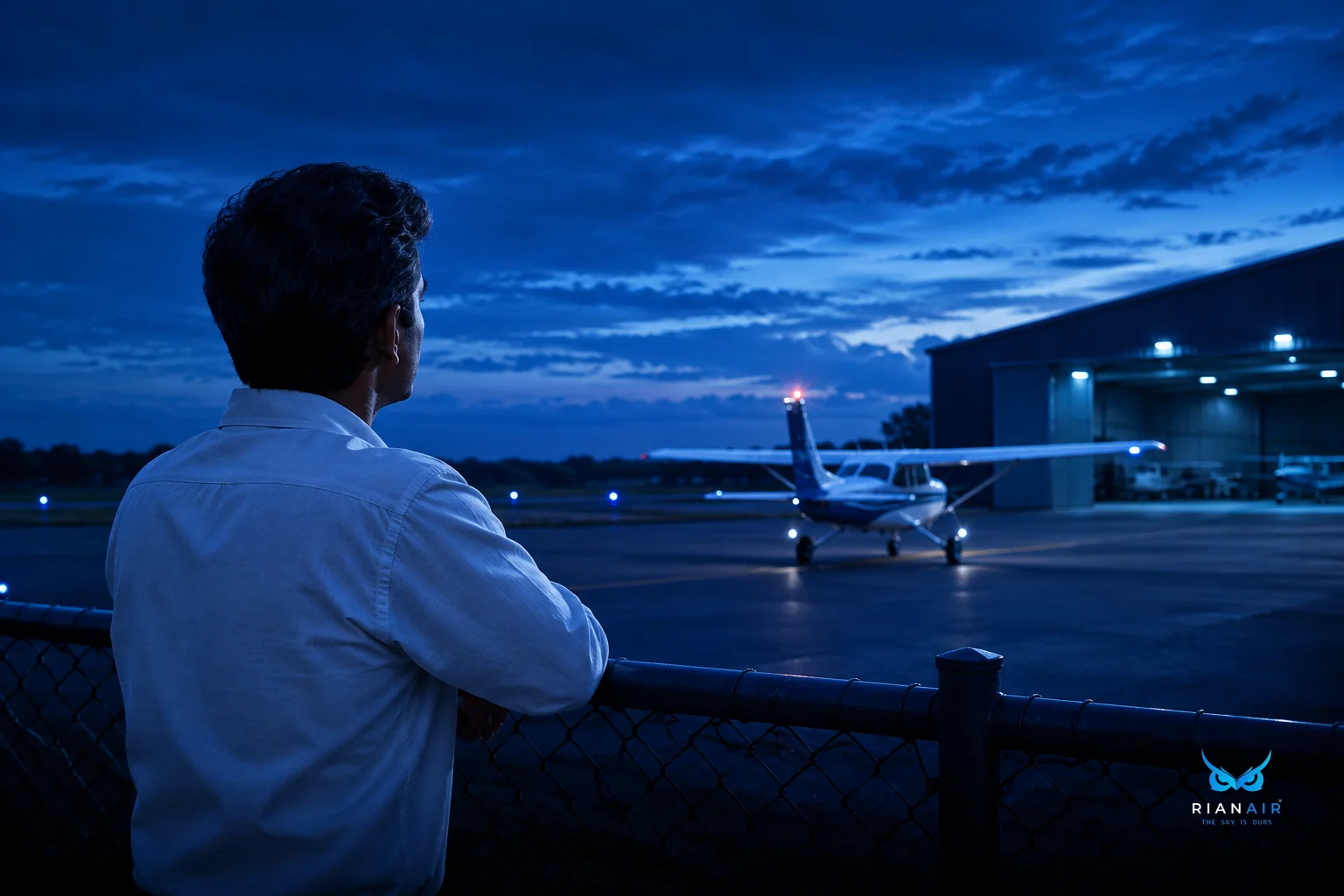
In India, bad weather from June to September is manageable. Use those months for simulator training or to clear any DGCA exams still pending. Abroad, winters can be harsh too, and the air fares home during peak periods such as December can burn a hole in a family's budget.
Parents can visit an Indian school whenever they want, meet instructors and see the aircraft. Our parent dashboard adds progress tracking, and the RAPT logbook records each entry with a time stamp. A Rian Air representative checks every logbook entry before it is uploaded to the eGCA portal, so problems do not surface at licence issue or conversion. Falsified or later-edited entries are flagged by their time stamp.
Questions to Ask Any Agent Before You Pay
Ask every agent which recurring costs the quote leaves out, and check the quote line by line.
- Which costs are not in the quote? Medicals, visas, tickets, living costs, foreign study software and extra training should all be listed in writing.
- What happens if I fail a checkride, and who pays for conversion and recency flying? Get the 6-month rule in writing.
- Which DGCA conversion papers will I sit, and where do I book them? For a foreign CPL, the checks are a Composite paper and Air Regulations, plus skill tests in India. Book the exam slots on the DGCA Pariksha portal, and confirm the current paper names there before you pay.
Ask for DGCA exam results and the outcomes of past students, whichever country you consider.
Ready to Plan Your CPL?
To see where you stand today, try our free RAPT demo as a quick progress check. When you are ready to plan your training, enquire about flight training at Rian Air. If you are comparing options first, our guide on CPL training in India vs Malta vs Tunisia sets out the other side in detail.
Frequently Asked Questions
What is the minimum age to start CPL training in India?
A student pilot licence can be held from age 16 and a PPL from 17, but a CPL applicant must be at least 18. Most students start ground training after Class 12 and apply for the CPL once they turn 18 and finish the required flying.
How long is a passed DGCA exam valid?
Every passed DGCA exam stays valid for 5 years. That gives you time to finish flight training in India without re-sitting papers. File your CPL application before the earliest passed paper reaches the end of that period.
How much does each DGCA exam attempt cost?
A regular attempt costs Rs 2,500 per exam in March, June, September and December, and Rs 5,000 in other months (on-demand, OLODE). RTR Part 1 is Rs 2,000 and RTR Part 2 is Rs 500.
Is there a waiting period between two attempts at a DGCA exam?
Yes. As we understand the current rule, there is a 42-day cool-off before you can apply again for a subject you did not pass. DGCA can change this, so confirm the latest notice on the DGCA Pariksha portal before you fix your retake dates.
How long does DGCA ground training take at Rian Air?
About 6 to 8 months in total, including clearing all the exams: 2 to 2.5 months for Air Navigation, 1.5 months for Air Regulations and Meteorology together, and 15 days for RTR. Technical General and Technical Specific add 2 to 2.5 months. They are mandatory to fly in India (optional only if you plan to fly abroad) and are taught by the partner flying school, not by Rian Air.
Which medicals do I need before flight training in India?
You need both the DGCA Class 2 and Class 1 medicals. Do them first and as soon as possible, in the order set out in the steps above. Medical costs run from Rs 6,000 to Rs 25,000 depending on the type and centre.
Which Class 12 subjects do I need to become a pilot?
You need a pass in 10+2 with Physics and Mathematics. Check this before you pay any fee, in India or abroad, because the subject requirement applies to the DGCA pathway. Students from other streams should look at their eligibility options first.
What is an FTO, and how do I know a school is approved?
An FTO is a Flying Training Organisation approved by DGCA to train commercial pilots. Ask any school to show its current DGCA approval before you pay, and check that the aircraft you will fly are listed with it.
Does an Indian CPL guarantee an airline job?
No. A CPL makes you eligible, but airlines still run their own selection and usually expect a type rating. Treat the licence as the entry ticket and plan for interviews and type rating costs separately.
I have already started training abroad. Is it too late to switch?
Not necessarily. Hours flown abroad may count towards conversion, but how many depends on your licence and records. Gather your logbook and licence papers and have the DGCA requirements checked before you spend more.
Can I check my exam readiness before joining any course?
Yes. The free RAPT demo works as a progress check: you answer exam-style questions and see which subjects need work. It does not commit you to any programme.
Recommended Resources
Start Your Pilot Journey Try Our Free RAPT Demo Now Home Rian Air