


How Many Hours to Become a Commercial Pilot in India: The Real Number Behind the DGCA Minimum
How many hours to become a commercial pilot in India? The DGCA minimum is 200 hours of actual flying plus 20 hours on a simulator, and the calendar time it takes to reach that number is usually longer than brochures suggest. This guide is for aspiring pilots and parents in Delhi, Mumbai, Thrissur and beyond who want a realistic plan, not a headline figure.
At Rian Air, our students most often train at Indian Flying Academy in Khajuraho, and we track every hour through the RAPT digital logbook. Below, we break the 200 hours into the pieces the DGCA actually checks, then explain why the real timeline stretches and how to protect it.
What Is the DGCA Minimum Number of Hours for a CPL in India?
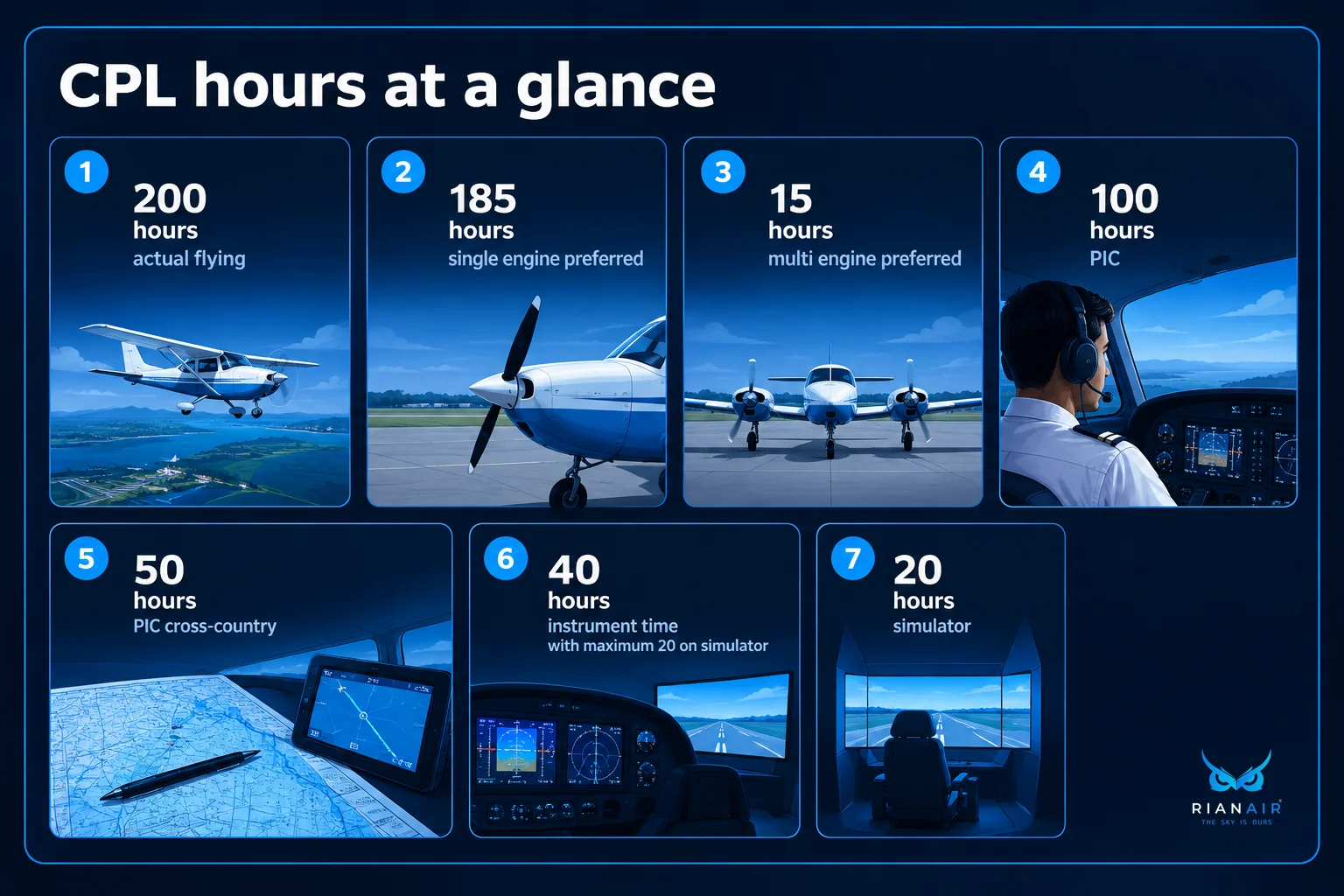
The DGCA minimum for a Commercial Pilot Licence in India is 200 hours of actual flying plus 20 hours on a simulator. The 200 hours must include 100 hours of pilot in command time, 50 of them cross-country, and all mandatory checks.
A Karnataka government flying training school page also lists a compulsory minimum of 200 flying hours for the CPL course. A Times of India guide for aspirants likewise states that the CPL requires a minimum of 200 hours of logged flight time.
The 250-hour figure you may see on forums comes from other countries' systems. For an Indian CPL, 200 actual hours is the number to plan around. The table below gathers every hour-based requirement in one place.
Requirement | What the DGCA expects |
|---|---|
Actual flight time | 200 hours (preferred split: 185 single-engine, 15 multi-engine) |
Simulator time | 20 hours, in addition to the 200 (multi-engine preferred) |
PIC time | 100 hours inside the 200 |
PIC cross-country time | 50 hours inside the 100 PIC hours |
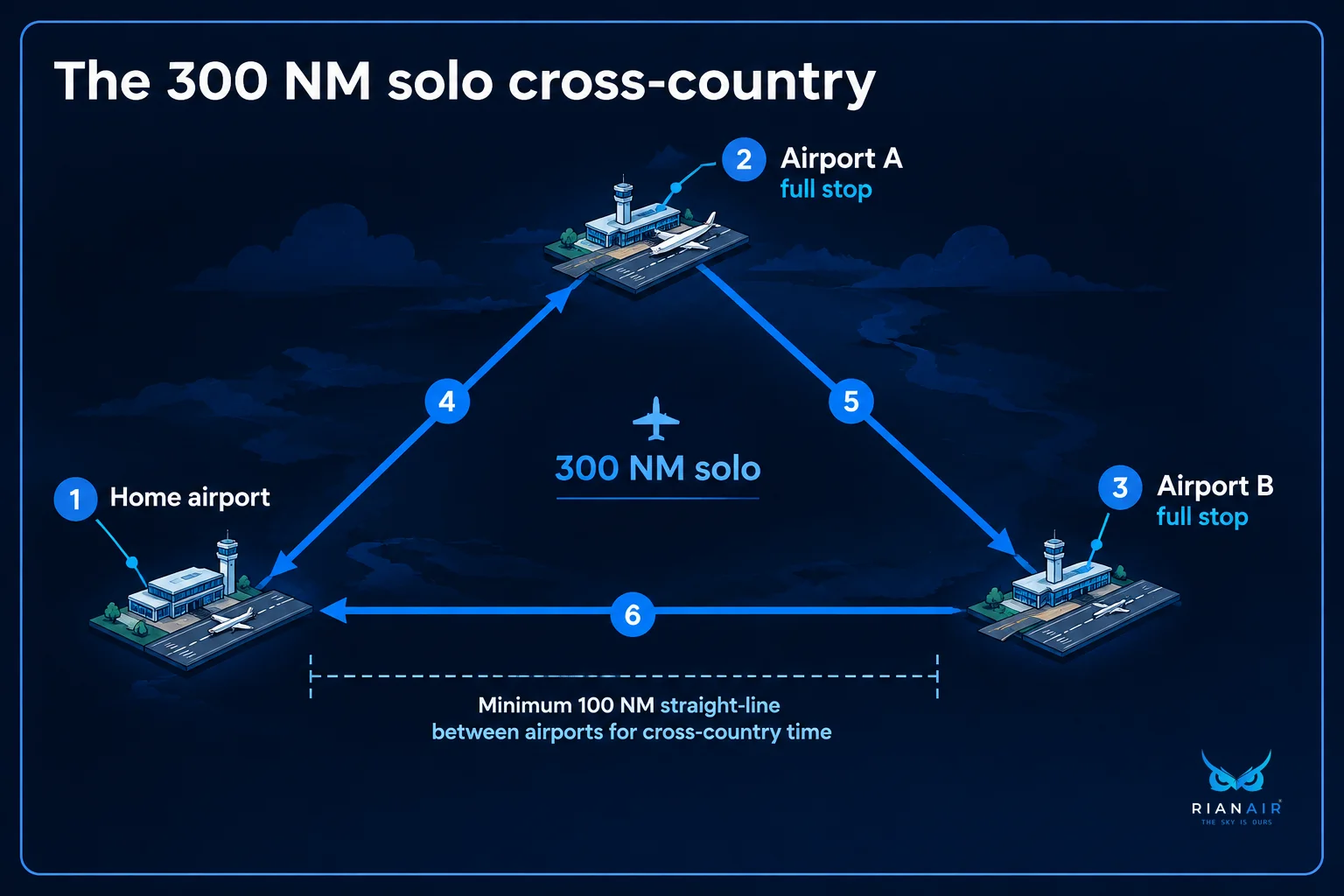
Long solo cross-country | 300 nautical miles with 2 full-stop landings at 2 airports other than the home airport |
Instrument time | 40 hours, of which no more than 20 on a simulator |
Last 6 months before document submission | 15 hours PIC, 5 of them at night, with at least 10 night take-offs and 10 night landings |
General flight tests (checks) | Completed with a DGCA-approved examiner, inside the 200 hours |
Age matters too. A CPL applicant must be at least 18, while a student pilot licence can be held from 16 and a PPL from 17.
How Are the 200 Hours Split Between Aircraft Types?
The preferred split of the 200 hours is 185 on a single-engine aircraft and 15 on a multi-engine aircraft. The 20 simulator hours are preferably multi-engine. Separately, 40 hours of instrument time are needed, and no more than 20 of them can be flown on a simulator.
Think of the 200 as one container with several compartments inside it. PIC time, cross-country time, instrument time and the checks are not extra hours stacked on top. They are filled from the same 200, which is why careful planning of each flight matters.
The 20 simulator hours sit outside the container: they are on top of the 200 flight hours. They can also be counted towards the 40 hours of instrument time, up to 20 hours, so at least 20 instrument hours have to be flown in the aircraft.
What Counts as PIC Time?
PIC time is the time when a student pilot flies solo or flies under supervision on a check flight, such as the IR check, day check or night check. The DGCA requires 100 hours of PIC time within the 200 flight hours, and 50 of those must be cross-country.
That second half of the definition surprises many families. Check flights with an examiner count as PIC time, even though another pilot is on board. This means your checks help fill the 100-hour requirement as well as proving your skill.
The practical lesson: solo flying is where the PIC hours come from. A student who spends many hours flying dual with an instructor will reach 200 total hours but still be short on PIC time.
What Counts as a Cross-Country Flight?
Under DGCA rules, a cross-country flight is one where the straight-line distance between two airports is at least 100 nautical miles. A student needs 50 hours of PIC cross-country time. One solo flight of 300 nautical miles, with two full-stop landings at two airports other than the home airport, is also required.
The straight-line distance is the number that counts, not the distance you actually fly. A short hop between nearby airports adds hours to your logbook but does not add to your cross-country total.
The 300 nautical mile flight is flown solo, so it counts as PIC time as well. Each of the two landings must be a full stop, not a touch-and-go, and neither airport can be your home airport.
Which Mandatory Checks Fall Inside the 200 Hours?
The general flight tests, called checks, all fall inside the 200 hours and are conducted by a DGCA-approved examiner. Single-engine checks are a day check, a night check and two cross-country checks. Multi-engine checks are an IR check, a day check and a night check.
Aircraft | Check | Duration or distance |
|---|---|---|
Single-engine | Day check | 1 hour |
Single-engine | Night check | 1 hour |
Single-engine | Cross-country by day | 250 nautical miles |
Single-engine | Cross-country by night | 120 nautical miles |
Multi-engine | IR check | 1.5 hours |
Multi-engine | Day check | 1 hour |
Multi-engine | Night check | 1 hour |
Because the checks sit inside the 200 hours, they are not a surcharge on the minimum. They are also part of why the minimum is rarely a clean stopping point. A check that is postponed by weather or an unserviceable aircraft pushes your finishing date, even if your hour count is ready.
What Is the Last-Six-Months Rule Before Document Submission?
In the six months before you submit documents to the DGCA, you must log 15 hours of PIC time. Five of those 15 hours must be flown at night, with at least 10 night take-offs and 10 night landings. Plan your final flying so this window is already complete.
This is a recency rule, and it catches students who finish early requirements and then pause. If your 200 hours were mostly flown a year ago, you will need fresh PIC hours before the paperwork goes in.
It also explains why some students keep their last stretch of flying tight. Night flying depends on daylight hours, weather and aircraft slots, so the 10 night take-offs and landings are worth scheduling early rather than leaving to the final week.
Why Does the Real Timeline Run Longer Than the Hour Count?
The hour count is a flying minimum, not a calendar. Weather, aircraft availability and other delays leave gaps between flights, so the same 200 hours can take far longer than brochures suggest. Slow exam preparation adds more time, because students who delay ground exams see batchmates start flying first.
Flying is not possible every day, however motivated you are. Rain, fog, airport traffic slots and aircraft under maintenance all interrupt the schedule. None of these change the 200-hour requirement, but all of them stretch the weeks between your first and last flight.
How Long Does the Ground Side Take?
From enrolment to the last DGCA paper, the time depends entirely on the student. Some of our students have cleared everything, including all the DGCA exams, in as little as 3.5 months. Others who are not focused take more than a year, and by the time they notice, their batchmates are already flying.
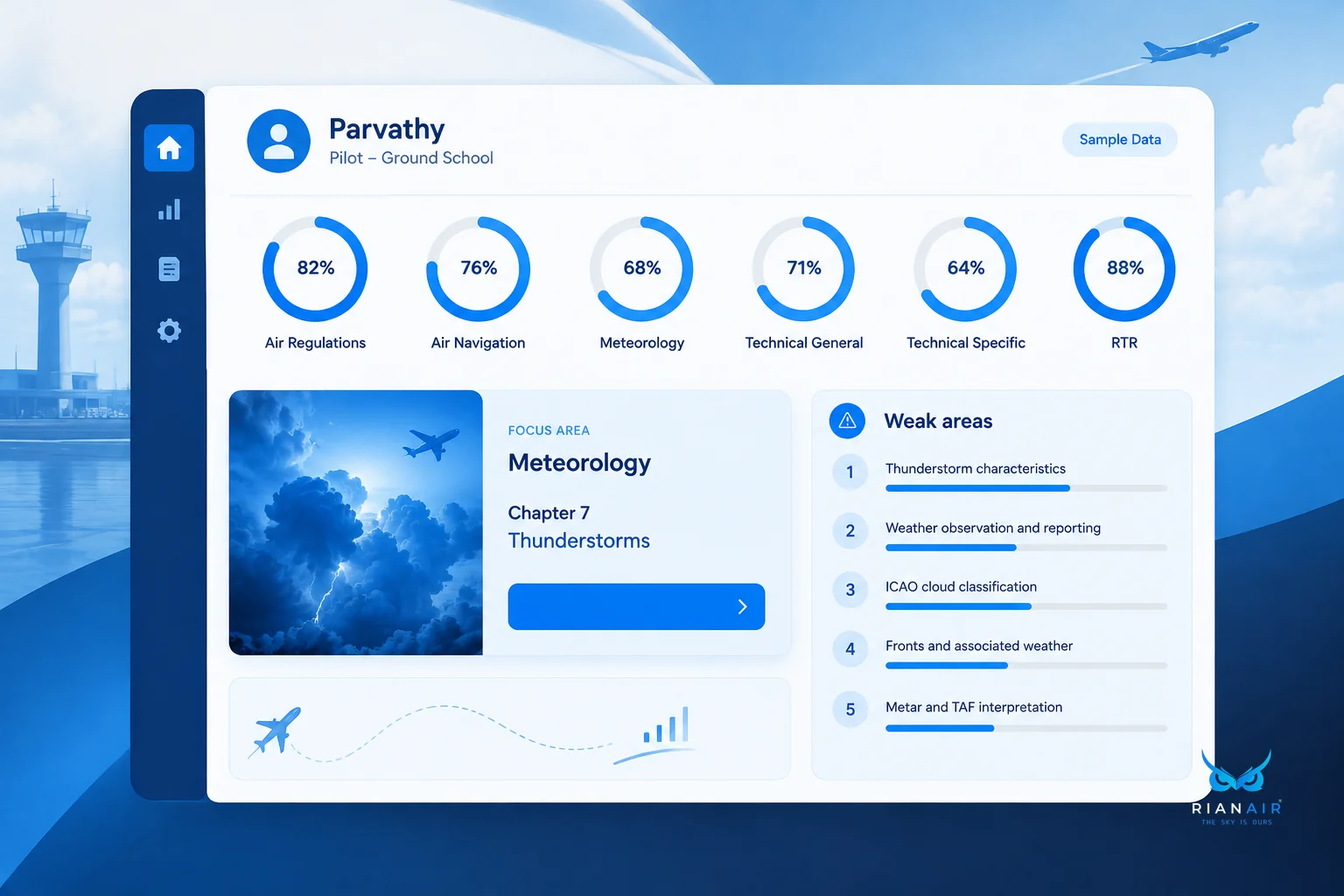
Those batchmates are collecting milestones such as solo and PPL while the late student scrambles to catch up. You can check where you stand before committing to a schedule by trying the free RAPT demo.
What we recommend: finish your DGCA theory subjects and all the exams in 6 to 8 months, which is realistic for most students, and then move on to flight training. If a couple of exams are still not cleared, you can clear them during flight training, before your CPL hours are complete.
How Long Does Flight Training Take?
Flight training takes 18 to 24 months. It starts slowly while you get used to the aircraft. In a couple of months you fly solo, then come area familiarisation, cross-country flights, instrument time (flown dual with an instructor), multi-engine training and finally document submission.
Cross-country flying builds hours fastest, because it does not depend on an instructor. Dual flights need an instructor, and they also depend on the instructor's flight duty time limits (FDTL), which are followed monthly and yearly.
Example only: one student's path to 200 hours. Every student's pace is different.
Stage | Example timing |
|---|---|
DGCA theory subjects and exams | Months 1 to 8 |
First flights and first solo | Flight training months 1 to 3 |
Area familiarisation | Months 3 to 5 |
Cross-country flights (PIC hours build fastest) | Months 5 to 12 |
Instrument time, dual with an instructor | Months 12 to 18 |
Multi-engine training and checks | Months 18 to 22 |
Last-six-months requirements and document submission | Months 22 to 24 |
What Does a Realistic Plan Look Like?
Use this checklist from enrolment to document submission:
Get your DGCA Class 2 and Class 1 medicals.
Enrol and get your DGCA computer number on the Pariksha portal.
Clear your DGCA theory subjects and exams, ideally in 6 to 8 months.
Start flight training and fly your first solo.
Build PIC time with area familiarisation and cross-country flights, including the 300 nautical mile solo flight.
Complete 40 hours of instrument time, up to 20 of them on the simulator.
Finish multi-engine training and all checks with a DGCA-approved examiner.
In the last six months, log 15 PIC hours, 5 at night, with 10 night take-offs and 10 night landings.
Get your logbook reviewed and submit your documents to DGCA.
Then add a buffer. Parents budgeting time and money for a child should treat the DGCA minimum as the floor and expect pauses for weather and aircraft availability. Our own exam numbers show the same pattern: about 80% of our students pass each paper on the first attempt, and almost all clear it by the second.
How Can You Use Simulator Hours During Delays?
The 20 simulator hours can be completed during flight training, on bad-weather days, aircraft delays and other waiting periods, so the clock keeps moving. Some students prefer to keep the simulator hours for the end. Either way, the 20 hours count on top of the 200 actual flight hours.
The first approach turns lost days into useful ones. When rain grounds the aircraft at Indian Flying Academy in Khajuraho, a student who has simulator hours still pending can use that slot and keep progress on track.
The second approach, keeping simulator time for the end, suits students who want to concentrate on actual flying while the weather is good. It carries a small risk: if all 20 hours are left to the final stretch, a simulator availability problem can hold up the document submission.
Because multi-engine is preferred for these hours, the simulator is also a low-cost way to build comfort on the type of aircraft you will fly for the multi-engine IR check. Students in Delhi and Thrissur can also begin with simulator practice at our centres before flying starts.
How Should You Keep Your Logbook So Hours Are Accepted?
Fill each entry right after the flight, once the instructor's post-flight briefing is done, and record every field accurately. The logbook runs on the honour system, and any edit carries a visible time stamp. Honest, timely entries prevent problems when DGCA reviews your hours for licence issue.
Every entry should carry the date, aircraft type, registration, from and to airports, chocks off to chocks on (block time), total time, capacity (PIC, solo, dual and so on), day or night, instrument or VFR time, multi-engine or single-engine time, number of take-offs and landings, simulator time and remarks.
RAPT includes all the fields the DGCA mandates for logbooks, plus extras other regulators need: take-off and landing times in UTC, and the number of landings and take-offs.
Faking logs is possible, but every log has a time stamp, and a mismatch with aircraft logs can cause trouble. A Rian Air representative reviews each entry before it is uploaded to the eGCA portal, so problems are caught before licence issue or any later conversion, not after.
What Does Each Extra Hour Do to Your Budget?
Flight time is priced per hour: ₹22,000 to ₹30,000 on a single-engine aircraft and ₹45,000 to ₹65,000 on a multi-engine aircraft, per Rian Air's current figures. So any flying beyond the minimum raises the bill quickly. Indian Flying Academy currently charges ₹59.5 lakh for the full DGCA-required flying for a CPL with multi-engine instrument rating (CPL ME IR). Check the current fee before you enrol.
That per-hour range is why delays hurt twice, once in months and once in money. A student who returns after a long break may need extra practice hours to regain currency, and each of those hours is billed at the same rate.
Other items sit outside the flying rate. Each regular DGCA exam attempt costs ₹2,500, a medical costs between ₹6,000 and ₹25,000 depending on the type and centre, and accommodation with three meals a day in India is around ₹20,000. A type rating, which follows the CPL, is around ₹15 lakh in India.
How to Protect Both Time and Money
Three habits keep a CPL close to the minimum. Clear your DGCA exams before flying heavily. Fly consistently once you start, because long gaps cost recency. Use simulator hours on the days weather stops flying.
Ask any academy for a written breakdown of what the quoted fee covers and what happens to the price if you need extra hours. If you want a personal timeline for your own situation, talk to Rian Air about planning your CPL hours before you commit.
Frequently Asked Questions
How long does it take to fly 200 hours in India?
Flight training usually takes 18 to 24 months. It is slow at first and speeds up once you fly solo. Cross-country flights build hours fastest, while dual flights depend on instructor availability and their flight duty time limits.
Do simulator hours count towards the 200 hours?
No. The 20 simulator hours are on top of the 200 actual flight hours. Up to 20 of them can count towards the 40 hours of instrument time.
Why do I need an instrument rating with my CPL?
Because every hiring company asks for it. Airlines, charter operators, air ambulance services and flying schools hiring instructors all require a CPL with multi-engine instrument rating (CPL ME IR). A CPL alone will not get you a pilot job.
What is the minimum age to start a CPL in India?
A CPL applicant must be at least 18 years old. A student pilot licence can be held from 16, and a PPL from 17. Check the age limit before you book flying, because a CPL cannot be issued to an applicant under 18.
Do DGCA exam passes expire before I finish flying?
Every passed DGCA exam is valid for 5 years. Flying 200 hours usually fits inside that window, but long gaps from delays or poor planning can eat into it. Track the pass date of each paper so you are not caught out at the document stage.
How long must I wait before retaking a failed DGCA exam?
The current rule is a 42-day cool-off before you can apply for the next attempt. This is the rule as of now, and DGCA might remove it in future. Confirm the latest position with DGCA before you plan. Use those six weeks to revise only the subject you failed.
How many attempts do students usually need to clear the DGCA exams?
Among Rian Air students, about 80% pass on the first attempt, and almost all pass by the second. Only one or two students have so far gone to a third attempt. Each regular DGCA exam attempt costs ₹2,500 in exam fees, as per our current figures.
Can I correct a mistake in my logbook?
Yes. A student can correct an error, and the time stamp of the correction is highlighted. Corrections are therefore visible and acceptable when they are honest, but a pattern of edits made long after the flight looks suspicious. Fix mistakes promptly and keep your aircraft records consistent.
Do I need to fly a multi-engine aircraft for the CPL?
Yes, the multi-engine checks (IR check, day check and night check) are part of the requirements, so some multi-engine flying is needed. The preferred share is 15 of the 200 hours. The 20 simulator hours are also preferably multi-engine, so plan for it from the start.
Where do Rian Air students do their flight training?
Our students most often train at Indian Flying Academy in Khajuraho. Rian Air recommends clearing all exams before flight training, though in India some exams can be cleared alongside flying. We serve students in Delhi, Maharashtra, Thrissur and other parts of India on the ground training and exam side.
Recommended Resources
Start Your Pilot Journey Try Our Free RAPT Demo Now Home Rian Air