Pilot Training Cost in India Breakdown: Hidden Fees Parents Miss
A ₹40,000 skill test retest, a $500 currency swing on a type rating instalment, an accommodation bill nobody quoted upfront: this is what actually inflates the pilot training cost in India breakdown beyond what most brochures show. The real number lands lakhs above the headline figure, and middle-class families on education loans feel every rupee of that gap.
Key Takeaways
- Headline packages exclude a lot: Ground school and flight-hour fees are usually quoted, but fuel surcharges, skill test fees, and gear costs rarely appear in the same document.
- Retests are the silent budget killer: A failed DGCA paper or a failed skill test can add anywhere from ₹5,000 to over ₹1 lakh depending on the stage.
- Currency risk is real: Type ratings and overseas CPL modules are billed in USD or EUR; an 18-24 month course can see a 5-8% currency swing add several lakhs.
- Gear and accommodation are rarely itemised: Uniforms, headsets, kneeboards, iPads, and lodging near training bases are almost never listed in the main fee sheet.
- Transparent tracking reduces surprises: Platforms that log every hour and cost against a plan, such as RAPT's parent dashboard, let families see spend against milestones instead of discovering gaps later.
Pilot Training Cost in India: Quick-Look Breakdown
Cost Head | Usually Quoted Upfront? | Typical Hidden Range Added |
|---|---|---|
Ground School + DGCA Exam Fees | Partly | ₹15,000-₹60,000 (re-attempts, transport to exam centres) |
Simulator Hours | Mostly | ₹20,000-₹1,00,000 (extra hours if behind pace) |
Flight Training + Fuel Surcharge | Rarely for surcharge | ₹1-4 lakh (fuel surcharge alone) |
Type Rating (A320/B737) | Partly, in foreign currency | ₹2-6 lakh (currency swing + license conversion) |
Skill Tests & Retests | Rarely | ₹30,000-₹1.2 lakh per attempt |
Accommodation & Travel | Almost never | ₹1-3 lakh over the full course |
Gear (uniform, headset, kneeboard, iPad, logbook) | Almost never | ₹80,000-₹2.5 lakh |
Recurring Medicals | Rarely | ₹10,000-₹40,000 across the programme |
Why the Advertised Pilot Training Cost in India Is Rarely the Final Bill
Most academies in Delhi, Mumbai, and Kerala quote a package covering ground school and a fixed number of flying hours. That figure looks clean on a brochure. It is not the number a family actually pays.
The smallest slip, a missed exam question, a rushed skill test, an overlooked medical requirement, can cost lakhs in aviation training. That is not an exaggeration. A single re-attempt at a DGCA paper, plus the travel to sit it again, plus lost training days, compounds quickly.
For families who have taken an education loan to fund their child's pilot training, this compounding is not an abstract risk. It is EMI pressure, and it is why a transparent, itemised pilot training cost in India breakdown matters more than a low headline number.
1. Ground School and DGCA Exam Fees Parents Underestimate
Ground school fees usually cover tuition and study material for the DGCA syllabus. What they often exclude is the cost of appearing for the exam itself, and appearing again if a subject is not cleared the first time.
- DGCA exam fees per subject: charged per attempt, so a student who clears five of seven subjects on the first try still pays twice for the remaining two.
- Transportation to exam centres: DGCA papers are held at designated centres, and travel plus stay near Delhi or Mumbai for exam week is rarely built into the ground school fee.
- Question bank access: some academies bundle this, others charge separately for extended access beyond the first attempt window.
Understanding how to become a commercial pilot in India after 12th means budgeting for at least one retest per subject, not zero. That single assumption changes a family's total ground school outlay by tens of thousands of rupees.
2. Simulator Hours: What's Included and What's Billed Separately
Simulator training, whether on a C172 fixed-base rig or a hybrid platform, is usually sold as a bundled block of hours. The trouble starts when a student needs more sessions than the block covers.
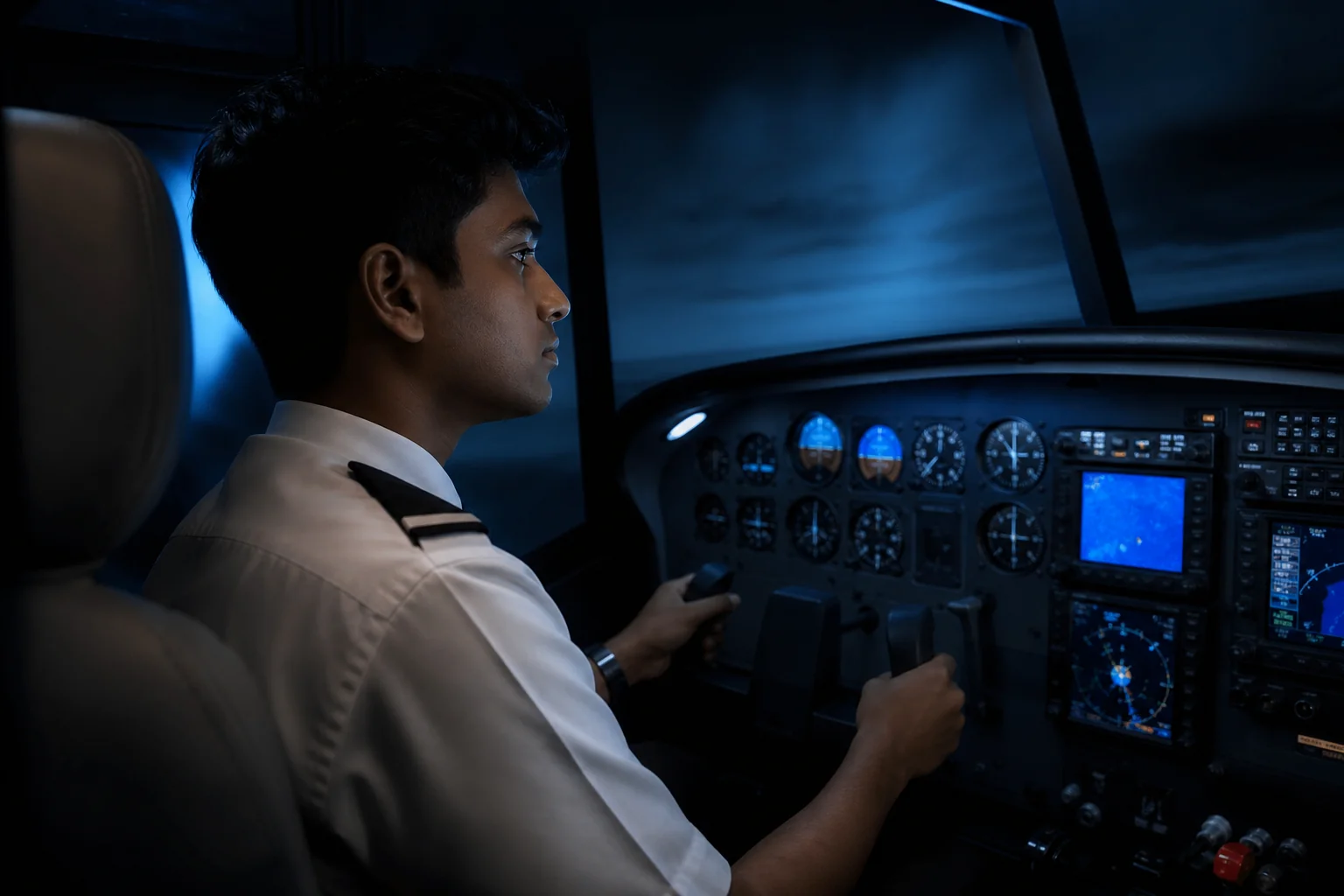
Extra simulator hours are billed per session, and pace varies by student. Someone who needs six additional hours before moving to real flight training will pay for those hours outside the original package. This is exactly why simulator-first training matters: it catches gaps on the ground, in a controlled cockpit replica, before they turn into an expensive extra flying hour in the air.
Academies with simulator infrastructure across Delhi and Kerala's Thrissur base can absorb some of this variability into scheduling, but families should still ask how many buffer hours are included before extra charges begin.
3. Flight Training Fees and the Real Cost of Aircraft Availability
Why is the fuel surcharge never mentioned upfront?
Fuel surcharge is charged separately from the base per-hour flying rate because it tracks crude oil prices, which change monthly. Academies rarely lock this into the headline package because they cannot predict it themselves, but it is always added to the final invoice.
Over a full CPL programme requiring 200 hours of flying, even a modest surcharge adds up to a significant sum. Families should ask for the surcharge policy in writing, not verbally, before signing any contract.
Aircraft availability is the other quiet cost driver. When trainer aircraft are grounded for maintenance or shared across too many students, training stretches over more months. Longer timelines mean more accommodation, more travel, and sometimes more recurring medical renewals. Delays caused by aircraft availability are one of the least visible ways a course budget grows past its original quote.
Skill test fees sit on top of all this. A CPL skill test with a DGCA-approved examiner is charged separately from training hours, and a failed attempt means paying for a retest along with the additional flying hours needed to prepare for it again.
4. Type Rating Costs: The Six or Seven-Figure Line Item
An A320 or B737 type rating is usually the single largest expense in a pilot's training path, and it is frequently billed in USD or EUR rather than INR, since many type rating training organisations operate internationally.
Beyond the core course fee, families should plan for:
- License conversion charges: converting a foreign-issued licence component to a DGCA-recognised one carries its own paperwork and processing fee.
- Visa charges: for the country where type rating training is delivered, plus any visa extension if the course runs longer than planned.
- Recurring medicals: a DGCA Class 1 medical is not a one-time cost; it must be renewed at intervals, and each renewal carries its own consultation and test fees.
- Additional medical tests: if an examiner flags anything during a routine check, follow-up tests (cardiac, vision, ENT) are billed separately and are almost never mentioned in the original quote.
5. Living, Travel, and Gear: The Hidden List Most Parents Never See
What expenses do pilot academies typically leave out of their quote?
Academies typically leave out accommodation, gear, and incidental travel from their headline quote because these vary by student choice and location, but they are unavoidable and add up to real money across an 18-24 month course.

Here is the list families most often discover too late:
- Accommodation fees: near training bases in Delhi, Mumbai, or Kerala, and near any overseas CPL location such as Malta, New Zealand, or Tunisia.
- Flight tickets: for the overseas CPL leg of training, plus return trips home during breaks.
- Uniform, epaulettes, and logbook: physical gear required from day one of ground school, rarely bundled into tuition.
- Headset, kneeboard, and iPad: essential flight training equipment that students are expected to purchase themselves.
- Skill test fees: charged per attempt, separate from the training package.
- Additional medical tests: beyond the initial DGCA medical, especially if a condition needs a specialist's clearance.
None of these individually looks large. Added together across a full training pathway, they routinely cross a lakh or two, and they are the exact items a first-time quote conversation skips.
How Currency Fluctuation Quietly Inflates Your Pilot Training Budget
Does the rupee-dollar exchange rate really affect my pilot training cost?
Yes, it does, because type rating fees and several overseas training modules are invoiced in USD or EUR, and the rupee's exchange rate against these currencies moves throughout an 18-24 month training window, changing the final INR amount owed.
A 5-8% swing in the rupee against the dollar or euro over that period is not unusual. On a type rating fee in the range of several lakh rupees, that swing alone can mean paying an extra ₹1-2 lakh compared to what the exchange rate suggested on enrolment day.
Families budgeting for CPL training abroad, whether in the Reserve Bank of India's published reference rates or through their bank, should build in a currency buffer rather than assuming the day-one rate holds for the whole course.
How RAPT's Transparent Structure Helps Families Budget Accurately
Rian Air built its RAPT™ platform specifically because pilot training costs are hard to track across ground school, simulator hours, flight training, and type rating stages spread over many months.
The digital logbook records every flying and simulator hour against the training plan, so parents are not relying on verbal updates. The parent dashboard shows progress and spend side by side, which means a family can see, in real time, whether the course is tracking to the original estimate or drifting because of a retest or an extra simulator block.
Rian Air's money-back promise also changes the retest math: if Rian Air fails to get a student through the DGCA exams, the student gets their money back, terms and conditions apply. Families should always ask for the T&C sheet before assuming what this covers.
For women aspiring to aviation careers, the Women Empowerment Program offers zero-fee DGCA ground training based on merit, with a refundable commitment deposit applying. A gender-neutral merit-based scholarship is also available, reducing the entry barrier for financially constrained families regardless of gender.
A budget built on a headline quote is not a budget. It is a starting point that still needs the fuel surcharge, the retest fee, and the gear list added before it means anything.
A Practical Checklist Before You Sign Any Pilot Training Contract
Before signing with any academy, ask for these in writing:
- An itemised fee sheet that separates ground school, simulator, flight training, and type rating, with the fuel surcharge policy stated explicitly.
- Skill test and retest fees listed as a standalone line, not buried inside "training charges."
- Accommodation and travel estimates for every stage, including any overseas CPL leg.
- A gear list covering uniform, headset, kneeboard, iPad, and logbook, with approximate costs.
- Currency policy for any fee billed in USD or EUR, including whether the academy offers any hedge or fixed-rate option.
- The T&C sheet for any money-back promise, read in full before assuming what it covers.
Families who compare pathways across India, Malta, New Zealand, and Tunisia should also explore pathways before committing to one country's fee structure, since accommodation and visa costs differ meaningfully between them.
FAQs on Pilot Training Cost in India
What is the total pilot training cost in India, all costs included?
The total pilot training cost in India, once ground school, simulator hours, flight training, fuel surcharge, type rating, gear, and living expenses are added, typically runs several lakh rupees higher than the headline package most academies quote first.
Are simulator hours included in the flight training package?
Simulator hours are usually bundled as a fixed block within the flight training package, but any hours beyond that block, needed if a student requires extra practice, are billed separately per session.
Do I need a separate budget for type rating after CPL?
Yes, type rating is almost always budgeted separately from CPL training because it is a distinct programme, often billed in foreign currency, with its own licence conversion and medical requirements.
Why do fees vary so much between pilot training academies?
Fees vary because academies differ in what they bundle: some include simulator buffer hours, accommodation support, or fixed fuel surcharge caps, while others leave every one of these as a separate, unquoted charge.
A clear pilot training cost in India breakdown is the difference between a family that budgets confidently and one that discovers a lakh-rupee gap midway through the course. Rian Air's RAPT™ platform, parent dashboard, and money-back promise exist to close that gap before it opens. Check your eligibility for a transparent, itemised training plan, or talk to a pilot career advisor to walk through every cost head before you commit a rupee. You can also schedule an appointment to review the T&C sheet on the money-back promise in person, follow updates on Instagram, or watch training breakdowns on YouTube.