


How to Become a Pilot in India After 12th: A Year-by-Year Roadmap
Self-sponsored route in short: ground training and exams, then Class 1 medical, flight training and CPL. In India, flight training is ₹59.5 lakh for 200 hours, plus ground training at ₹1 to 1.25 lakh.
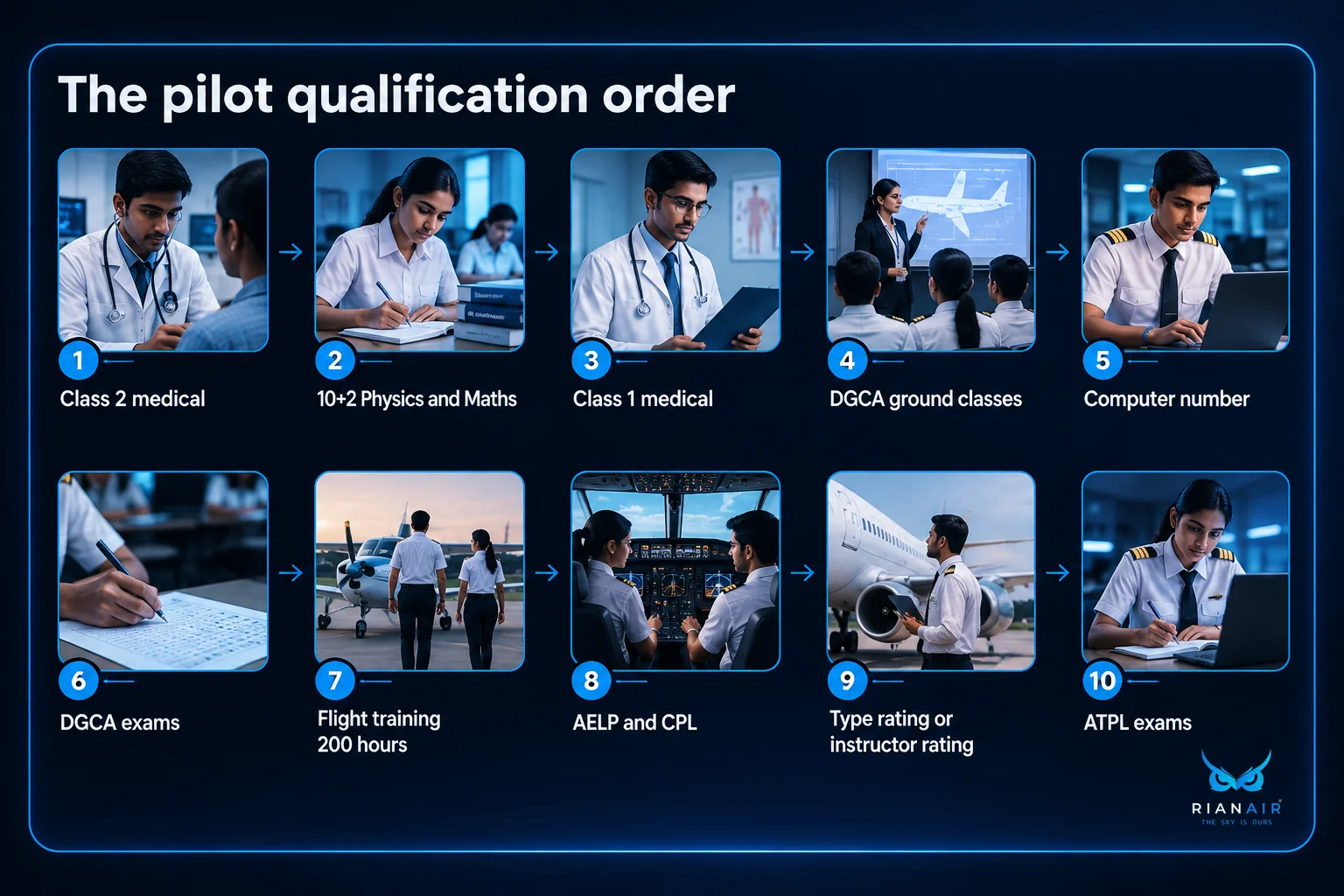
To become a pilot in India after 12th, you clear 10+2 with Physics and Mathematics, hold a DGCA Class 2 and then a Class 1 medical, finish ground training and the DGCA exams, fly the required 200 hours at an approved school, and receive your Commercial Pilot Licence (CPL). Most students need about two years from ground school to CPL.
That timeline matches reporting by The Financial Express, which puts commercial pilot training in India at 18 months to two years. The order of the steps matters more than the speed.
Eligibility After 12th: The Quick Check
Already finished 12th? Check these four points before you spend anything.
Subjects: You need 10+2 with Physics and Mathematics, as the DGCA guidelines state. The DGCA Pariksha FAQ says the same for every applicant except a PPL applicant.
Marks: The DGCA rule names the subjects, not a percentage. At Rian Air we need students to be medically fit and 10+2 with Physics and Mathematics, and the top 12 scores in the 12th grade get the seat. Other schools and airline programmes set their own cut-offs, so check each one.
Medical: You need a DGCA Class 2 and then a Class 1 medical.
Age: A student pilot licence can be held from 16, a PPL from 17, and a CPL applicant must be at least 18.
A student who flies before clearing the right exams, or who skips a medical, pays for it later in repeat hours and lost months.
At Rian Air we run DGCA ground training from our Delhi centre. A full Thane centre opens in December, and online ground training is already running for aspiring pilots from Maharashtra. They can move to a hybrid set-up for in-person classes and simulator sessions.
We also teach in Thrissur, Kerala. Our CPL flight training pathways run in India and abroad through Tunisia, Malta and New Zealand.
This guide walks through every stage in the order it happens, with the exam lists, the hours, the ranks that follow and a month-by-month plan you can bookmark.
Stage 1: 10+2 With Physics and Mathematics, and the Class 2 Medical
If you have already passed 12th with Physics and Mathematics, go straight to the Class 2 medical. If you are still in school, this stage also tells you whether to choose those subjects at all. Students who are planning after Class 10 can do the same check earlier.
Get the DGCA Class 2 medical from an examiner on the DGCA list of Class 2 medical examiners. You can start the moment you pass Class 10 and hold the pass certificate.
Per section 5.1 of the DGCA medical CAR, a Class 2 medical is valid for two years up to age 50, and one year after that.
The order protects you. Many families pick science subjects for two years, then discover a medical problem at the Class 1 stage. The lighter Class 2 check early tells you whether the pilot route is open before you commit.
The subject rule is not optional. The DGCA Pariksha FAQ requires 10+2 with Physics and Mathematics from a recognised board or university, or its equivalent. Commerce and arts students need a route through an equivalent qualification before they can sit CPL exams.
Stage 2: The Class 1 Medical
Once you hold the Class 2 assessment, you can apply for the Class 1 medical at a DGCA-approved centre. Class 1 is the full assessment that an airline will later expect.

Taking it before you pay for flight hours confirms that your body meets the standard an airline will later demand. The DGCA medical CAR requires a Class 1 Medical Assessment for a Commercial Pilot's Licence and an Airline Transport Pilot's Licence.
It says the physical and mental, visual and hearing requirements follow paragraphs 6.3.2, 6.3.3 and 6.3.4 of ICAO Annex 1, together with the DGCA's medical AICs. The CAR also requires that you be free from any abnormality, disability, injury or medication effect likely to interfere with the safe operation of an aircraft.
Section 5.1 of the CAR sets the Class 1 validity: one year up to age 60 and six months after that, and for single-crew operations six months above age 40.
We have not reproduced the numeric vision and hearing limits here. Read paragraphs 6.3.3 and 6.3.4 of ICAO Annex 1 as referenced in the CAR, and the DGCA's medical AICs, for the exact figures. Take the CAR to the examiner and ask which tests will be run.
Age rules sit alongside the medicals. A student pilot licence can be held from 16, a private pilot licence from 17, and a CPL applicant must be at least 18.
For a fuller comparison of the two grades, our guide to pilot qualification in India lists every checkpoint in sequence.
Stage 3: DGCA Ground Training and Exams
After 10+2 with Physics and Mathematics, you attend ground training that follows DGCA standards. This is where you learn the theory papers that the DGCA tests before you may fly or convert hours into a licence.
Which papers you sit depends on where you will do your flight training.
Exams if you fly in India
If you complete flight training in India, you clear eight papers: Air Navigation, Aviation Meteorology, Air Regulations, Technical General, RTR Part 1, RTR Part 2, Technical Specific for a single-engine aircraft and Technical Specific for a multi-engine aircraft.
The DGCA eligibility CAR lists the CPL theory subjects as Air Navigation, Aviation Meteorology, Air Regulation, and aircraft and engine or instruments (general, specific and performance where applicable).
Exams if you fly abroad
If you train in a foreign country, you clear five papers before leaving: Air Navigation, Aviation Meteorology, Air Regulations, RTR Part 1 and RTR Part 2. Technical General is optional for students flying abroad.
Your foreign flying school covers the technical content as part of its own programme.
Paper | Flying in India | Flying abroad |
|---|---|---|
Air Navigation | Required | Required |
Aviation Meteorology | Required | Required |
Air Regulations | Required | Required |
RTR Part 1 and Part 2 | Required | Required |
Technical General | Required | Optional |
Technical Specific (single engine and multi engine) | Required | Not on this list |
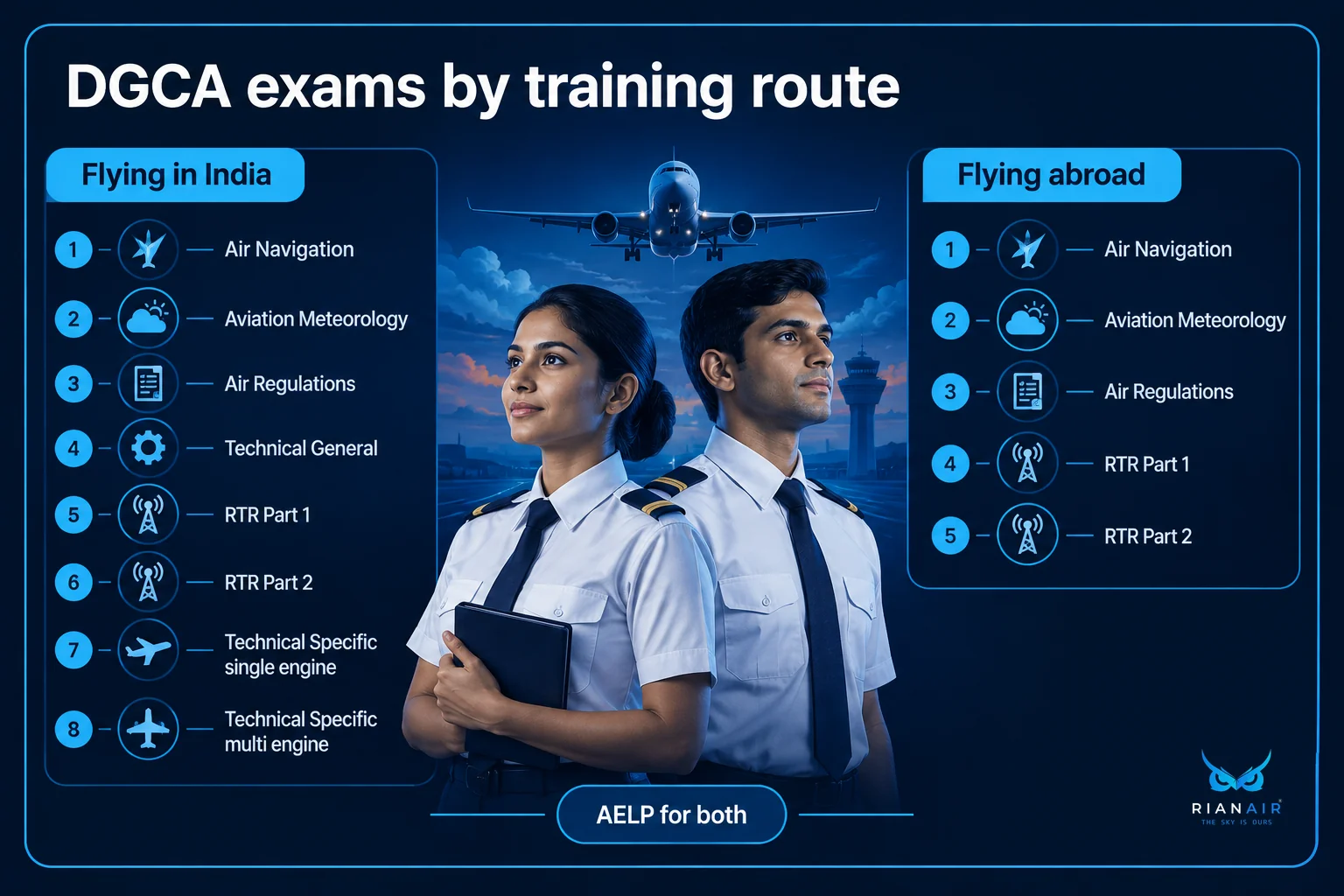
AELP, the English proficiency requirement
Every student also undergoes AELP training and testing, the aviation English language proficiency assessment. If you train abroad, the requirement still applies, but it can depend on the foreign licence.
Sometimes the training is skipped and only the test is needed. Confirm this with your school before you depart.
Why we advise clearing every exam before you leave
We recommend finishing all DGCA exams before departing for flight training. Students who have not cleared Air Navigation and Aviation Meteorology can sit them as one paper called the composite exam after obtaining a foreign CPL.
We do not recommend that route.
Students who return from abroad get multiple attempts, but the clock is real. If documents are not submitted to the DGCA within six months, you repeat recency training, roughly 18 to 22 extra flying hours.
Every passed DGCA exam stays valid for five years, so clearing papers early costs you nothing in validity.
How long ground training takes
What ground training costs at Rian Air: the fee is ₹1.25 lakh including GST at our Kerala centre, and ₹1 lakh as an introductory price at our Thane and Delhi centres. It covers Air Navigation, Meteorology, Air Regulations and RTR preparation, plus 5 hours of simulator sessions.
The full programme runs about six months. Air Navigation takes 2 to 2.5 months. Air Regulations and Meteorology run together over about 1.5 months.
RTR takes around 15 days because part of it is completed during navigation. Technical General takes 2 to 2.5 months, and partner flying schools in India cover it along with technical specific for single and multi-engine aircraft.
Some students take six to twelve months in total, and we have had students clear everything in as little as four months and start flying. Before you book, register for a DGCA computer number on the Pariksha portal, since every paper is booked against it.
The fee per exam is ₹2,500 for a regular attempt in March, June, September and December, and ₹5,000 in other months on demand. RTR Part 1 costs ₹2,000 and RTR Part 2 costs ₹500.
To check where you stand before paying for classes, try the free RAPT demo as a progress check on real exam-style questions.
Stage 4: Flight Training and the 200-Hour Requirement
Flight training means 200 hours of actual flying, plus 20 hours on a simulator, at an approved flying school. The DGCA's CAR on flying training requires that the experience for private and commercial licences be gained at a Flying Training Organisation approved or recognised by the Director General.
NDTV's explainer also gives 200 hours as the minimum.
How the 200 hours break down
Per The Times of India, the 200 hours include at least 100 hours as Pilot-in-Command, 50 hours of cross-country flying, and 40 hours of instrument flight training. Our hours guide adds the 15 multi-engine hours. The school's training plan sets the rest of the allocation, so ask for it in writing before you enrol.
The procedure, step by step
First, choose an approved school in India or one of the countries we work with: Tunisia, Malta or New Zealand. Second, make sure your Class 1 medical is valid and your exams are cleared.
Third, fly in stages: dual instruction with an instructor, then solo flying, cross-country navigation, instrument flying and multi-engine time.
Fourth, finish with the CPL skill test. Our guide on how many hours it takes to become a commercial pilot explains the split of those 200 hours, including the solo cross-country requirement.
The logbook and the eGCA upload
Your logbook runs on an honour system. It is not meant to be cheated, and edited entries show a highlighted time stamp.
We encourage students to fill it straight after the post-flight briefing. A Rian Air representative checks every entry before it goes to the eGCA portal, so the DGCA licence issue or a foreign licence conversion does not stall on a fault.
Stage 5: CPL Issue and What You Can Do With It
When the exams, the hours, the medical and AELP are in place, the DGCA issues your CPL. It opens several careers: airline pilot, cargo pilot, charter pilot, air ambulance pilot and flight instructor.
Every flying role except instruction needs a type rating on the aircraft you will operate. Flight instruction needs an instructor rating.
Type rating
A type rating is a rating for each aircraft type, such as the A320 or B737. The DGCA's type rating CAR, effective 7 September 2026, dispenses with the NOC from its Flight Standards Directorate and allows training at an approved training organisation in India or in an ICAO contracting state.
You must pass the technical specific exam before simulator training begins.
An airline in India does not sponsor type rating for new pilots nowadays, so plan to fund it. Type rating is a shorter route, and airlines do prefer type-rated pilots first, so your queue may be shorter.
It is still not a job assurance.
Instructor rating
The instructor path starts with about 20 hours of patter flying, which costs roughly ₹6 lakh. Some schools sponsor it in return for a three to five year bond after you earn the rating.
Our guide to becoming a flight instructor in India covers eligibility and timeline.
Cadet programmes
An airline cadet programme costs between ₹89 lakh and ₹1.5 crore. The student works five years after receiving the final letter of intent.
If a student is not up to the mark, training can end early. The airline also sets the pace according to its hiring needs, so training can speed up or stall.
Read the cadet and self-sponsored CPL comparison before you sign anything.
Stage 6: ATPL Exams, 1,500 Hours and the Left Seat
The Airline Transport Pilot Licence (ATPL) is the next licence. You clear the ATPL exams, and once you log 1,500 flight hours you become a commander and an ATPL holder.
ATPL exam fees match the CPL fees. Whether you move to the left seat straight away depends on each airline's policy.
The ATPL hour requirement also includes pilot-in-command, cross-country, night and instrument time. Check the exact split against Schedule II of the Aircraft Rules, 1937 and the latest DGCA notification before you plan, because the rules are being reworked.
The 26 October 2026 Gazette notification G.S.R. 957(E) sets out the new framework, and ATPL is a written-exam stage with no oral requirement under it. We could not link the Gazette text, so read the notification in the Gazette of India before relying on this.
Airline pilots are typically rostered for about 70 to 80 flying hours a month. That sits well inside the ceiling in the DGCA flight duty time limitations CAR (Section 7, Series J, Part III), which caps flight time at 100 hours in any 28 consecutive days, 300 hours in 90 days and 1,000 hours in 365 days.
If your 200 training hours count towards the total, the remaining 1,300 hours take roughly 16 to 19 months at the rostered rate (1,300 divided by 80 and by 70).
Your airline's roster and aircraft type change the real figure. Active pilots can prepare using the free ATPL question bank for active pilots.
Airline Ranks, Instructor Ranks and Ground Roles
Careers split into three tracks once you are flying. Each has its own steps, and many pilots move between them over a long career.
Track | Rank order |
|---|---|
Airline | Junior First Officer, Senior First Officer, Commander, Senior Commander, Line Training Captain, Check Pilot |
Flight instruction | Assistant Flight Instructor, Flight Instructor, Deputy Chief Flight Instructor, Chief Flight Instructor |
Ground and specialist | Simulator Instructor, Simulator Examiner, Test Pilot (with an aircraft manufacturer) |
A pilot tired of flying, or one who wants to be home with family every day, can move to a ground role after several years. Simulator instructor and examiner posts for type rating suit that change.
Under the Aircraft Rules, 1937, a pilot who has reached 65 cannot act as Pilot-in-Command or Co-pilot in commercial air transport. For pay at each rank, see our pilot salary in India guide.
What does the year-by-year timeline look like?
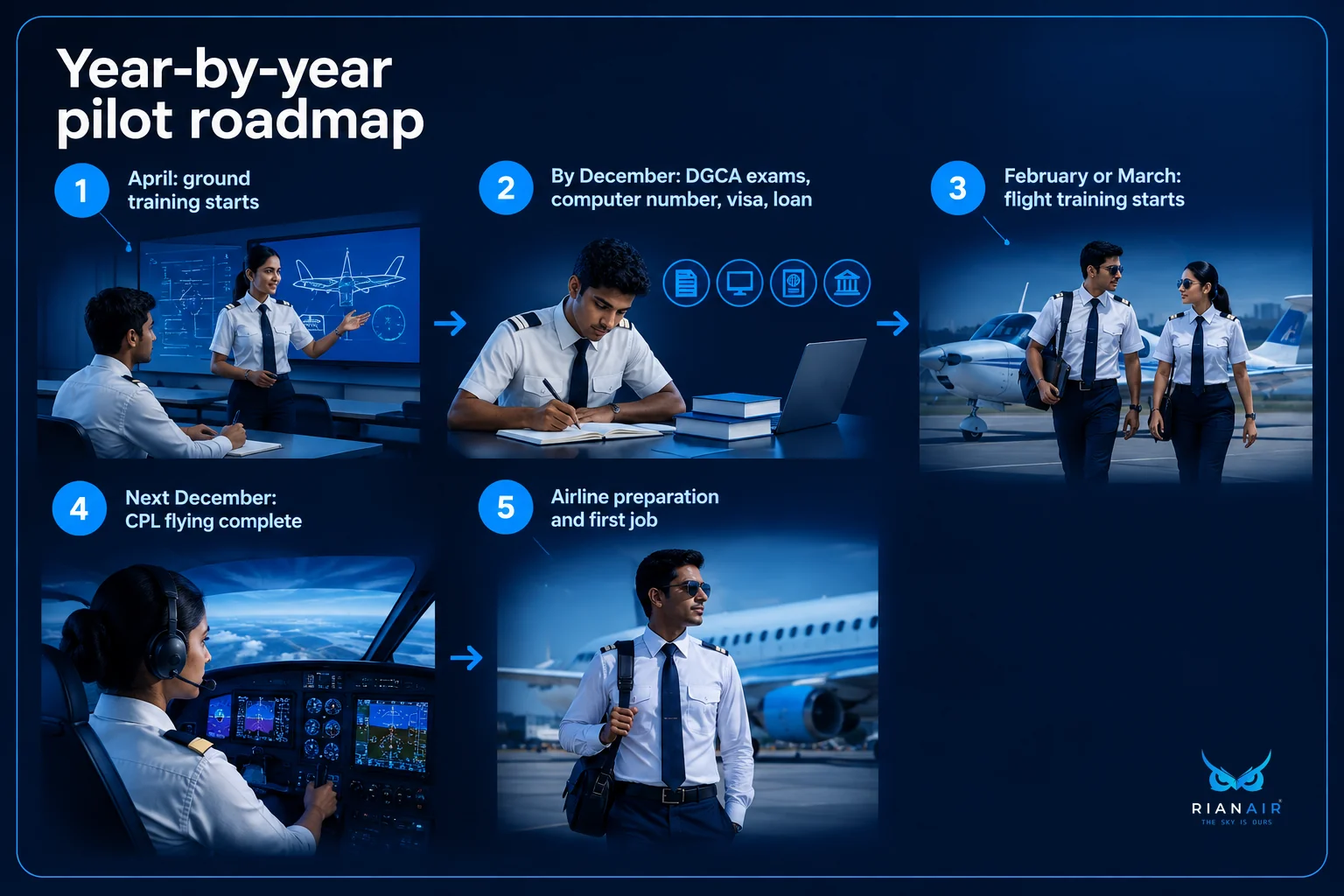
Start ground training in April after 10+2, clear every DGCA exam and finish paperwork such as the computer number, visa and bank loan by December. Begin flight training in February or March, and finish flight training by December of the following year.
The whole stretch from ground school to CPL is roughly two years.
When | What happens |
|---|---|
April (after 10+2 with Physics and Mathematics) | Enrol in ground training |
By December | Clear all DGCA exams, get the computer number, finish the visa process if training abroad, and complete any bank loan process |
February or March, next year | Start flight training, because summer is the best time to begin for steady progress |
December, the year after | Complete flight training, about two years from the start |
Afterwards | Keep studying for airline preparation and join an airline or another pilot role |
Hypothetical example: a student finishes 10+2 and starts ground school in April. If Air Navigation and Meteorology are cleared in the September attempt, the student can fly in February.
If they miss it and take the composite exam (100 marks, 100 questions, 3 hours) in December, flying may slip by a few months.
Delhi, Thane, Mumbai and Thrissur students follow the same sequence. Only the location of classes changes.
What the Roadmap Costs and What Families Overlook
Flight training fees: in India, the school's own current price at IFA is ₹59.5 lakh for 200 hours of training. The Tunisia package is 48,000 euros and Malta is 60,000 euros for training.
We recommend flight training in India to avoid the licence conversion hassles that come with training abroad.
Beyond tuition, plan for exam fees (listed in Stage 3), type rating, and instructor rating if you choose that track. Patter flying for the instructor rating is about ₹6 lakh. A cadet programme is ₹89 lakh to ₹1.5 crore.
The costs families miss are repeat exam months at ₹5,000 per paper, recency training of 18 to 22 hours after a lapse. Visa, Flight tickets, medical in foreign country, living expenses add to the burden and usually not shown in the list.
About 12 students did not get a visa approved on the first try for a cadet programme abroad, which meant extra spending nobody had budgeted. Our breakdown of hidden pilot training expenses lists these in detail.
If you want a counsellor to map your own dates, start your pilot enquiry here. You can also follow our updates on Instagram and YouTube, or visit the Rian Air home page.
Frequently Asked Questions
Can I become a pilot after 12th with commerce or arts?
The DGCA requires 10+2 with Physics and Mathematics for every licence except the private pilot licence. A commerce or arts student therefore needs Physics and Mathematics at 10+2 level, or an accepted equivalent, before sitting CPL exams.
The usual route is to add Physics and Mathematics through the National Institute of Open Schooling (NIOS) and clear the Class 12 exams in those subjects.
The DGCA Pariksha FAQ speaks of a recognised board or university "or its equivalent" and, in the text we could read, does not name NIOS. Before you pay for classes, confirm with the DGCA that your NIOS certificate is accepted for your computer number application.
What is the minimum age to start?
A student pilot licence can be held from 16, a private pilot licence from 17, and a CPL applicant must be at least 18. You can begin medicals and ground study at the end of Class 10, well before the age when you can hold a CPL.
Is there a maximum age for CPL training?
The DGCA framework sets minimum ages for each licence, not a maximum for starting CPL training. What decides your path is medical fitness, since you need a valid Class 1 medical, and airline hiring preferences, which differ from airline to airline.
Do I need a computer number before the exam?
Yes. The DGCA issues a computer number once it approves your application on the Pariksha portal, and every pilot exam is booked against it.
Apply early in the ground training period, with names and dates of birth that match across all documents, so booking is not delayed.
Is simulator time part of the 200 hours?
No. The requirement is 200 hours of actual flying plus 20 hours on a simulator, so simulator sessions do not replace aircraft time.
Ask your school how its training plan allocates the 20 simulator hours across instrument and procedure work.
Which month should I book my DGCA exam?
Regular attempts in March, June, September and December cost ₹2,500 per exam. Other months are on demand and cost ₹5,000.
If your preparation is on schedule, booking a regular month halves the fee for each paper.
What if I miss the six-month document window after returning from abroad?
You repeat recency training, which is roughly 18 to 22 extra flying hours. That adds cost and delays your licence.
Clearing all exams before you leave, and submitting documents to the DGCA promptly on return, avoids it.
Can I fly the airline type rating without a job offer?
Yes, students can pay for a type rating themselves, and airlines tend to prefer pilots who already hold one. Indian airlines do not sponsor type rating for new pilots nowadays.
A type rating can shorten your wait in the queue but does not assure a job.
Is a cadet programme cheaper than self-sponsored training?
Not necessarily. Cadet programme fees range from ₹89 lakh to ₹1.5 crore, and the student works five years after the final letter of intent.
Pace depends on the airline's hiring needs, and a student who falls short can be terminated. Compare the full terms first.
Who checks my logbook before the licence application?
A Rian Air representative reviews each logbook entry before it is uploaded to the eGCA portal. Falsified entries are flagged, and corrected entries show a highlighted time stamp.
This review aims to prevent problems at licence issue by the DGCA or during licence conversion.
Do I have to leave my city to study?
Not for ground training. Rian Air teaches in Delhi and Thrissur, the Thane centre opens in December, and online ground training is running for Maharashtra students.
They can later join in-person classes and simulator sessions. Flight training happens at an approved school in India or abroad.
How long can I keep flying as a pilot?
A pilot can keep flying as long as they stay medically fit. Airlines treat 65 years as the retirement age from flying.
After that, ground roles such as simulator instruction or examining are common choices for pilots who want to remain in aviation.
Recommended Resources
Start Your Pilot Journey Try Our Free RAPT Demo Now Home Rian Air