DGCA Ground School Syllabus Explained for Beginners: Subjects, Duration, and What to Expect
The DGCA ground school syllabus for a Commercial Pilot Licence runs across eight exams: Air Navigation, Technical General, Aviation Meteorology, Air Regulations, Technical Specific (Single Engine), Technical Specific (Multi Engine), RTR Part 1, and RTR Part 2. Each written paper needs a 70% pass mark, with no negative marking and no shortcut around any subject.
Key Takeaways
- Eight papers, one bar: every DGCA theory subject requires a minimum 70% score, and each subject is graded independently.
- Navigation and Technical General are the heaviest: both carry 100 marks across 100 questions in a 3-hour window.
- Meteorology, Air Regulations, and the two Technical Specific papers share a lighter format: 100 marks, 50 questions, 2 hours each.
- RTR has two halves: Part 1 is a 100-mark MCQ paper, Part 2 is a practical oral radio telephony test.
- Ground school typically takes six to eight months for a 12th-pass student studying full-time, longer if papers need retakes.
DGCA Ground School Exams at a Glance
| Exam | Marks | Questions | Duration | Format |
|---|---|---|---|---|
| Air Navigation | 100 | 100 | 3 hours | MCQ |
| Technical General | 100 | 100 | 3 hours | MCQ |
| Aviation Meteorology | 100 | 50 | 2 hours | MCQ |
| Air Regulations | 100 | 50 | 2 hours | MCQ |
| Technical Specific (Single Engine) | 100 | 50 | 2 hours | MCQ |
| Technical Specific (Multi Engine) | 100 | 50 | 2 hours | MCQ |
| RTR Part 1 | 100 | MCQ-based | As scheduled | MCQ |
| RTR Part 2 | Pass/Fail | N/A | Oral/Practical | Spoken R/T test |
What Is the DGCA Ground School Syllabus?
The DGCA ground school syllabus is the theory curriculum every CPL aspirant in India must clear before touching an aircraft for commercial training. It is set by the Directorate General of Civil Aviation and delivered as computer-based tests through the official Pariksha portal.
A 12th-pass student with Physics and Mathematics is eligible to begin. The syllabus covers eight subjects in total, and every one of them demands a 70% pass mark, a bar that applies uniformly across navigation, meteorology, regulations, and technical papers alike. There is no weighted average across subjects: each paper stands or falls on its own score.
This structure matters because DGCA will not issue a CPL, without every one of these eight exams cleared. Ground school is not a formality before flying. It is the gate.
1. Air Navigation
Air Navigation is a 100-mark paper with 100 questions, completed in 3 hours. It is widely considered the heaviest subject in the DGCA ground school syllabus.
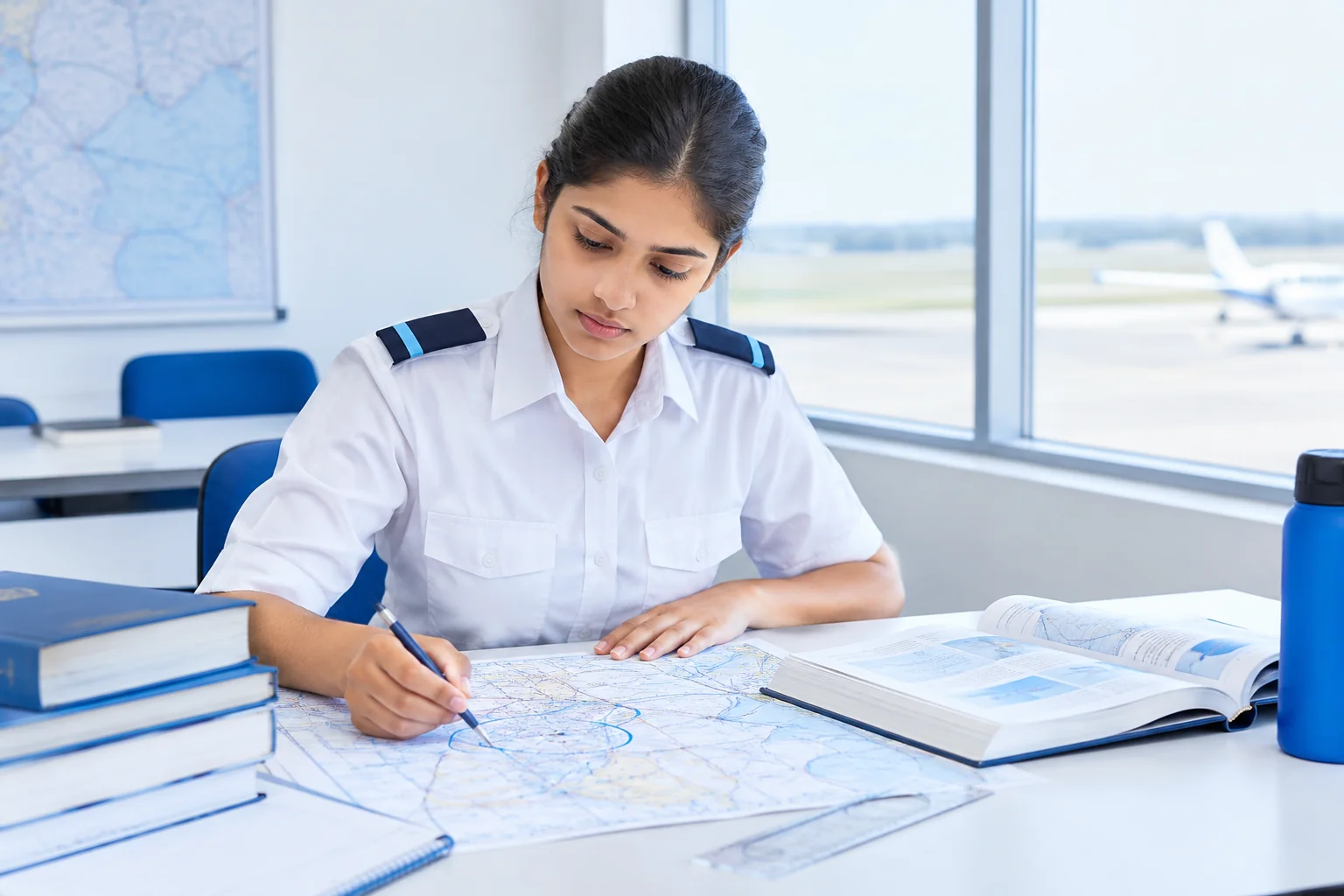
The paper covers dead reckoning navigation, radio navigation aids, chart reading, time and speed calculations, and flight planning across varying wind and altitude conditions. Students who struggle here usually underestimate the calculation speed the 3-hour window demands. Practising timed mock papers, not just reading theory, is what closes that gap.
2. Technical General
Technical General carries the same weight as Navigation: 100 marks, 100 questions, 3 hours. It covers the shared engineering backbone behind every aircraft type: airframes, powerplants, electrical systems, instruments, and basic aerodynamics.
Because this subject underpins the two Technical Specific papers later, students who build a genuinely solid base here tend to move faster through type-specific systems study afterward.
3. Aviation Meteorology
Aviation Meteorology is scored out of 100 marks across 50 questions, with a 2-hour duration. It is lighter in question count than Navigation but no lighter in content density.
Topics include cloud formation, weather systems, icing, turbulence, and how to read METAR and TAF reports. Weather directly affects flight safety decisions, which is why this subject stays a core part of every DGCA online ground training curriculum, not an optional add-on.
4. Air Regulations
Air Regulations follows the same pattern as Meteorology: 100 marks, 50 questions, 2 hours. The paper tests knowledge of DGCA's Civil Aviation Requirements and relevant ICAO annexes governing licensing, airworthiness, and airspace rules.
Students often treat this as a memory-only subject. It is, but the volume of rule numbers and cross-references means spaced repetition across weeks works far better than last-minute cramming.
5. Technical Specific (Single Engine)
Technical Specific Single Engine is a 100-mark, 50-question paper completed in 2 hours. It narrows Technical General's broad engineering concepts down to the systems of a specific single-engine training aircraft.
Fuel systems, electrical architecture, instrument panel layout, and emergency procedures specific to that airframe all appear here. This is also where ground school starts to feel connected to the aircraft a student will eventually fly.
6. Technical Specific (Multi Engine)
Technical Specific Multi Engine mirrors the single-engine paper in format: 100 marks, 50 questions, 2 hours. The content shifts to twin-engine systems, covering engine-out procedures, fuel balancing between two engines, and the added electrical and hydraulic redundancy multi-engine aircraft carry.
Students who clear this subject thoroughly tend to find multi-engine simulator sessions less intimidating, since the systems logic is already familiar on paper.
7. RTR Part 1 (Technical)
RTR Part 1 is a 100-mark MCQ paper testing the technical knowledge behind radio telephony: frequencies, call sign conventions, distress and urgency procedures, and the regulatory framework around aeronautical communication.
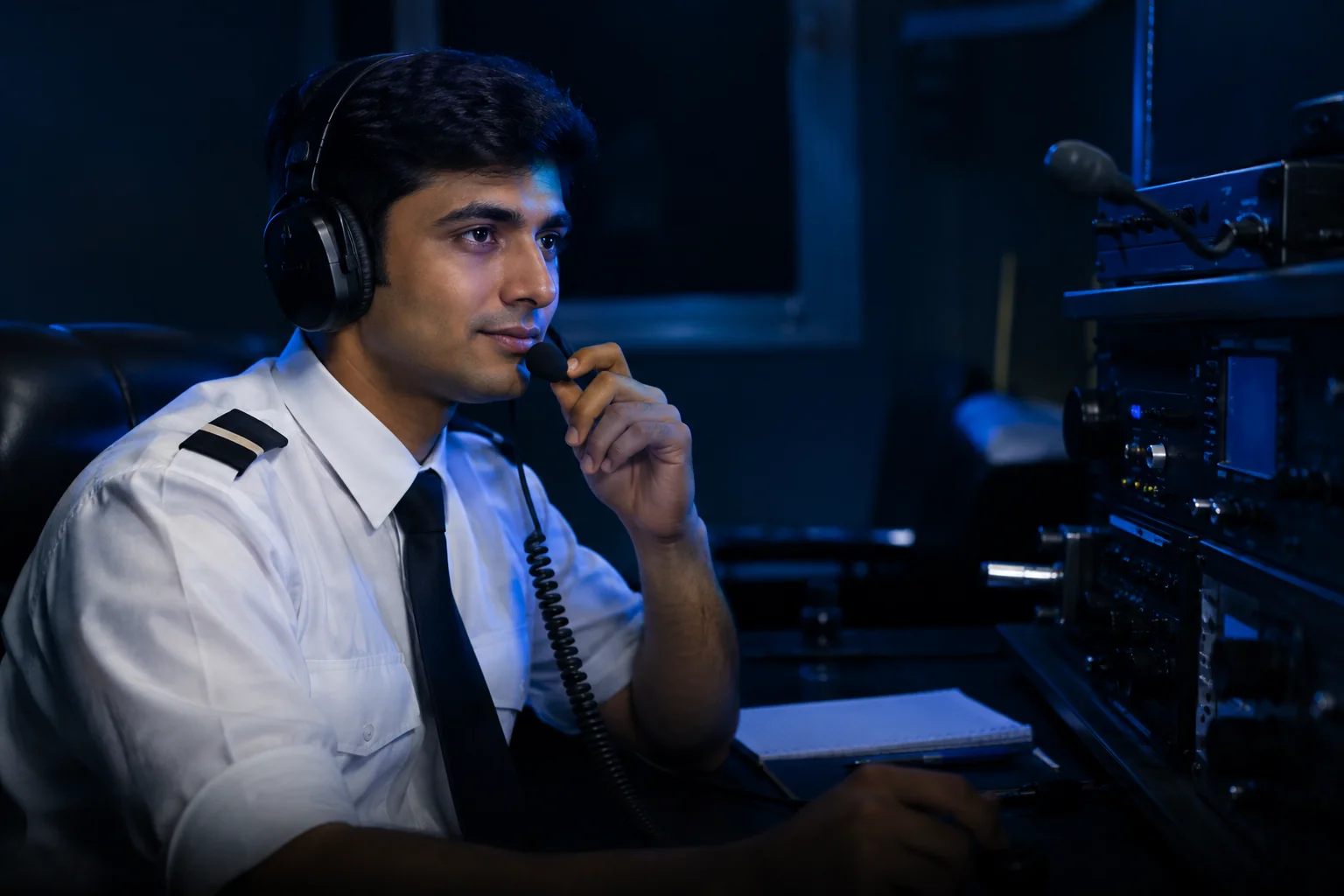
It is conducted under the Directorate General Of Civil Aviation (DGCA) and is a prerequisite for the practical half that follows.
8. RTR Part 2 (Practical/Oral)
Is RTR Part 2 an oral exam?
Yes, RTR Part 2 is a practical, oral radio telephony test. Unlike every other paper in the DGCA ground school syllabus, it has no written MCQ component and is graded on spoken procedure and phraseology accuracy, not a numeric score.
Candidates simulate real air traffic control exchanges, reading back clearances, declaring emergencies, and following standard phraseology under time pressure. Confidence under pressure matters as much as technical accuracy, which is why instructor-led mock sessions before the actual test are worth prioritising.
How Long Does DGCA Ground School Take?
How long does it take to clear the DGCA ground school syllabus?
Most 12th-pass students studying full-time clear the DGCA ground school syllabus in six to eight months. The timeline stretches when a student needs a retake on any of the eight papers, since each failed subject must be rescheduled and cleared on its own.
Students in Delhi, Mumbai, or Thrissur generally follow a similar pace, since the syllabus itself is fixed by DGCA regardless of city. What differs is batch scheduling, access to instructors for doubt-clearing, and how far a student lives from their classroom. A beginner's roadmap for ground training in Delhi can help map out a realistic month-by-month plan for the Delhi service area specifically.
How a Large Question Bank Changes DGCA Exam Prep
Does a bigger question bank actually help pass DGCA exams?
Yes, a large, subject-tagged question bank helps because it lets a student drill weak topics repeatedly instead of re-reading the same textbook chapter. Volume alone does not help; organisation by subject and difficulty is what turns practice into retention.

Rian Air's RAPT platform ties a 20,000+ question bank directly to each of the eight subjects above, so a student revising Air Navigation sees only navigation questions, tagged by topic and tracked for accuracy over time. That kind of structured repetition is far harder to replicate with loose PDFs or scattered WhatsApp question sets. You can see how the bank is organised subject-wise in the RAPT platform DGCA question bank for CPL and ATPL.
Parents tracking a child's readiness benefit too, since subject-wise accuracy trends make it obvious which of the eight papers needs more attention before an exam date is booked. A printable reference covering every subject and paper is also available as a free printable checklist for DGCA CPL exam subjects and syllabus.
What Does DGCA Ground School Cost?
Ground school fees for the DGCA syllabus typically start around ₹80,000 and go up to ₹1.25 lakh, with taxes extra, depending on the institute and batch type. This is the theory portion only, separate from simulator and flight training costs.
Ground school is one component of a longer financial plan. A full CPL pathway completed entirely in India runs between ₹60 to 65 lakh, while training routed partly abroad, depending on the location chosen, can run ₹50 to 80 lakh. Families comparing both routes should read through the detailed cost and duration breakdown in DGCA CPL training in Kerala: costs, duration, and what to expect before committing to a city or country.
Rian Air also runs a money-back promise tied to DGCA exam outcomes, and a merit-based Women Empowerment Program with zero-fee ground training for eligible candidates. Both carry specific terms, so ask for the full terms and conditions sheet through the enquiry form before assuming eligibility.
Frequently Asked Questions
How many exams are in the DGCA ground school syllabus?
There are eight exams in total: Air Navigation, Technical General, Aviation Meteorology, Air Regulations, Technical Specific Single Engine, Technical Specific Multi Engine, RTR Part 1, and RTR Part 2.
What is the passing mark for DGCA ground school exams?
Every written subject needs a minimum of 70% to pass. There is no averaging across subjects and no negative marking on wrong answers.
Which DGCA subject has the most questions?
Air Navigation and Technical General are the heaviest, each with 100 questions over a 3-hour paper. The remaining written subjects carry 50 questions over 2 hours.
Is RTR Part 2 written or spoken?
RTR Part 2 is a spoken, practical radio telephony test, not a written MCQ paper. It evaluates phraseology and procedure under simulated air traffic control conditions.
Can I retake a single DGCA subject if I fail it?
Yes, each subject is scheduled and graded independently, so a student retakes only the failed paper rather than repeating subjects already cleared.
What is the eligibility to start DGCA ground school?
A 12th-pass qualification with Physics and Mathematics is the baseline eligibility DGCA requires before a student can register for ground school.
How long does DGCA ground school usually take to complete?
Most full-time students finish all eight papers in six to eight months. Part-time study or multiple retakes can extend this further.
Does ground school include simulator hours?
At Rian Air, the ground training package includes 5 simulator hours as part of the structured course, ahead of full flight training.
Is ground school training different in Delhi, Mumbai, and Kerala?
The DGCA syllabus itself is identical nationwide. What differs between the Delhi, Mumbai, and Kerala service areas is batch scheduling and classroom access, covered in Mumbai vs Delhi vs Kerala for ground classes for pilots.
Do I need to clear all eight exams before flight training starts?
Yes, DGCA ground school exams must be cleared before progressing into structured flight training, since the CPL issuance depends on it.
What happens after I clear the DGCA ground school syllabus?
Once all eight exams are cleared, training moves into simulator sessions and flight hours, either in India or at an international location, before type rating and airline readiness stages begin.
Clearing eight exams at a 70% bar each is a real commitment, not a formality to rush through. If you are a 12th-pass student or a parent mapping out this syllabus for the first time, a structured plan built around subject-wise question banks, scheduled mock exams, and simulator exposure makes the difference between a six-month timeline and a year of retakes. Start your pilot journey with Rian Air to get a clear subject-by-subject study plan, or explore pathways to see how ground school connects to simulator training, flight hours, and type rating. For daily glimpses of ground school life and student progress, follow Rian Air on Instagram or subscribe on YouTube.