


How to Become a Flight Instructor in India: DGCA Eligibility, Training and Timeline
To become a flight instructor in India, you first earn a DGCA Commercial Pilot Licence (CPL) with a valid Class 1 medical.
Then you complete an instructor rating at an approved flying training organisation, complete 20 hours of patter flying from the right-hand seat to become an Assistant Flight Instructor (AFI), then log 500 hours of pilot-in-command (PIC) time, including 200 hours of AFI time, to become a Flight Instructor (FI). The route is the same whether you start ground training in Delhi, Thane or Thrissur.
Key takeaways
CPL comes first: No one instructs without a valid CPL and a Class 1 medical, so the instructor rating is a second step after your DGCA ground exams and CPL flying, not a shortcut around them.
Two rating levels: DGCA's Pariksha portal lists exam sessions for both the Assistant Flight Instructor Rating (AFIR) and the Flight Instructor Rating (FIR), so plan for a staged climb.
Cost is mostly the CPL: A conventional CPL is quoted at roughly ₹55 to ₹65 lakh for 200 hours of flying in 2026. We could not source a reliable published fee for the instructor rating itself, so get it in writing.
Instructor-first vs cadet intake: Instructing earns income and logbook hours while you wait. Airline cadet programmes are structured but cost far more upfront, and selection is out of your hands.
Our part: Rian Air covers DGCA ground training and simulator sessions. We do not run the instructor rating, and we do not refer students to airlines.
At a glance: instructor route vs cadet intake
Item | Instructor-first route | Direct airline cadet intake |
|---|---|---|
Starting requirement | Valid CPL, valid Class 1 medical, English proficiency | Airline selection, then ground and flying training under its terms |
Typical cost context (2026) | CPL about ₹55 to ₹65 lakh for 200 flying hours; instructor rating fee varies by organisation | Generally about ₹95 lakh to ₹1.5 crore |
Instructor exam process | 8 to 10 months in India for the instructor process after CPL | Not applicable |
Income while waiting | Possible once you are rated and hired as an instructor | None until the programme ends and you are placed |
Control over timing | High, you choose the school and pace | Low, the airline sets intake and schedule |
Rian Air ground training fee | ₹1.25 lakh plus taxes, ₹1,47,500 in total, for Navigation, Meteorology, Regulations, RTR and 5 hours of simulator sessions | |
What does it take to become a flight instructor in India?
You need a valid CPL, a valid Class 1 medical, English language proficiency and enrolment at an approved flying training organisation (FTO) offering the instructor rating. You then complete 20 hours of patter flying (flying from the right-hand seat with an instructor on the left) and clear the oral exam to become an AFI. Minimum age and other entry conditions differ between organisations, so confirm them before paying.
Look at how training organisations publish their entry rules and a pattern appears. Most ask for a valid CPL, a Class 1 medical and aviation English fluency. Minimum age is stated differently by different schools, from 18 upward. That spread is why you should read the current DGCA requirement and the organisation's written terms side by side.
The age ladder before you can instruct
The ages worth knowing come from our own DGCA air regulations question bank. A student pilot licence can be held from 16, a Private Pilot Licence (PPL) from 17, and a CPL applicant must be at least 18. In practice, an instructor rating is something you pursue after your CPL, so the real earliest timeline starts at 18 and extends from there.
Why the Class 1 medical matters early
The instructor rating asks for a valid Class 1 medical, the same grade you need for CPL flying. A medical problem found late can end the plan, so many students get it done before spending on flight training. Our guide on why DGCA Class 1 medicals matter before flight training explains the timing.
Step-by-step: the instructor rating route
Here is the order most Indian candidates follow, from 12th pass to a rated instructor. Each step has a document or check attached, and each can stall the next one if skipped.
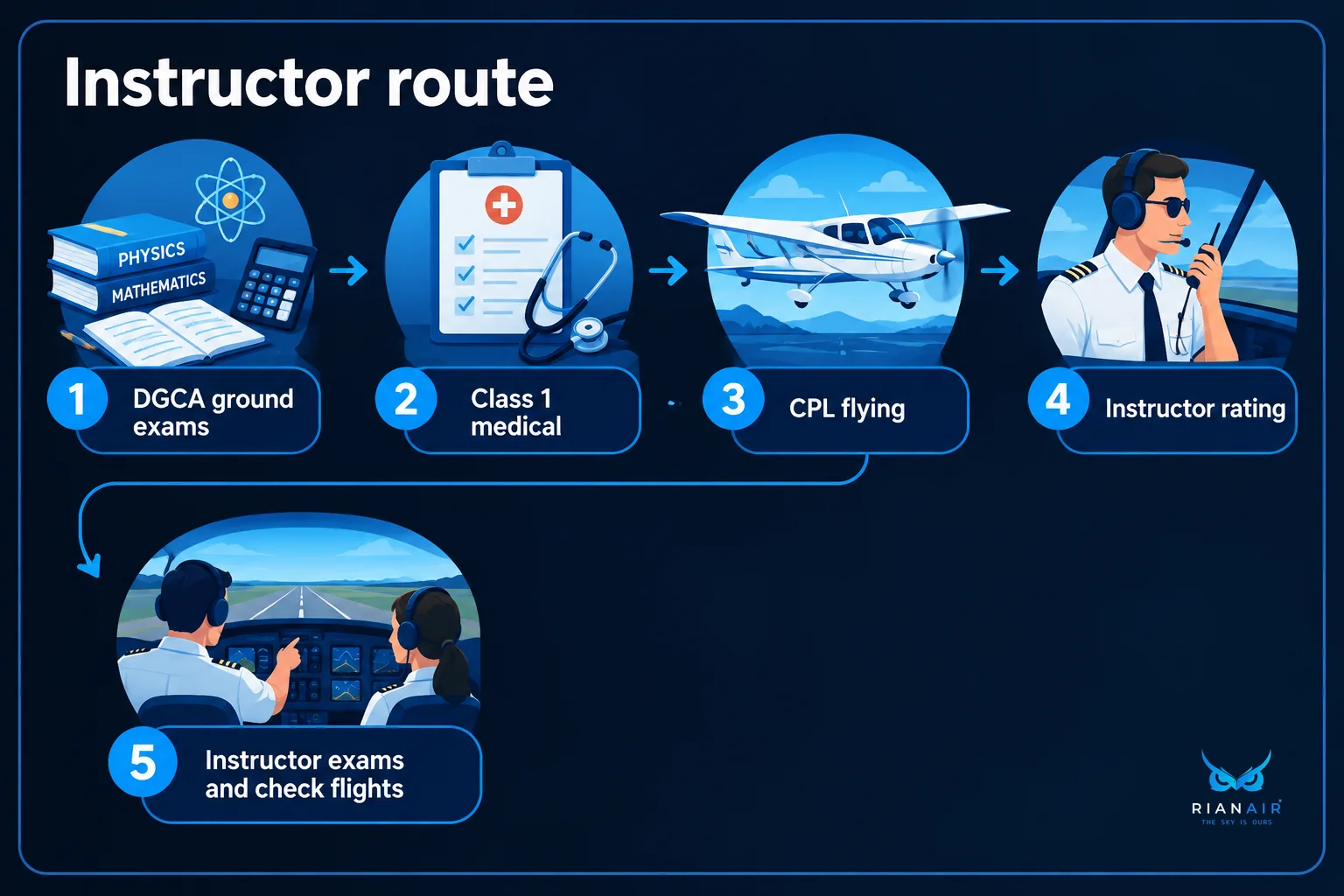
Finish 10+2 with Physics and Mathematics. This is the usual qualification to register as a flight crew candidate. The DGCA Pariksha FAQ sets out the minimum qualification for registration, so check it against your own mark sheet.
Get a Class 2 medical, then a DGCA computer number. The computer number is free and links you to the Pariksha portal, where exam registration happens. Read about Class 2 medicals before ground training before you book classes.
Get a Class 1 medical. This is the medical grade you need for CPL flying and for instructing, so complete it before you spend on flight training.
Clear the eight DGCA exams. They cover Air Navigation, Meteorology, Regulations, Technical General, Technical Specific and the RTR papers. The Pariksha portal is where DGCA posts exam sessions for flight crew.
Complete CPL flying and get your CPL. The minimum is 200 hours of flying. Many students do this in India; others train abroad.
Complete 20 hours of patter flying. Patter flying means 20 hours flown from the right-hand seat, with an instructor in the left-hand seat. It comes after your CPL flying and before the oral exam, and it is what qualifies you as an Assistant Flight Instructor (AFI).
Pass the oral exam. Once your hours are complete, you sit the instructor oral exam. The Financial Express reported in January 2026 that this process spans 8 to 10 months in India.
Start instructing and log hours. You teach students under the FTO's supervision, and the hours go into your logbook as you fly. Once you are an AFI, you need 500 hours of PIC time, including 200 hours of AFI time, to become a Flight Instructor (FI).
The Financial Express reports that the instructor process takes 8 to 10 months in India after you already hold a CPL. That is on top of your ground school and CPL flying, not instead of it. Treat it as a planning estimate and ask your FTO for its own written schedule.
If a step fails
If an instructor exam attempt fails, ask the FTO exactly which sections caused it and whether the retest fee is separate. If your medical lapses, you cannot fly until it is renewed. If the FTO has no available aircraft, the check flights wait. Ask how many aircraft and examiners it has before you enrol.
What to ask an FTO before you enrol
Is it DGCA-approved to run the instructor rating, and can it show the approval?
What is the total fee in writing, including retests and aircraft hire?
How many aircraft and examiners does it have, and what is the usual wait for a check flight?
What is its pass rate and average delay for the instructor oral exam?
Does the training agreement match DGCA's guidelines, and what are the refund terms?
Instructor-first path vs direct airline cadet intake
The two routes solve different problems. Instructing keeps you flying, earning and building hours while you wait for an airline seat. A cadet programme hands you a fixed structure, but you pay a lot more upfront and the airline decides who gets in and when.
Factor | Instructor-first | Cadet intake |
|---|---|---|
Who chooses you | You choose the FTO and the pace | The airline selects you |
Upfront cost (2026) | CPL about ₹55 to ₹65 lakh for flying; instructor rating added | Generally about ₹95 lakh to ₹1.5 crore |
What it adds | Teaching experience, logbook hours, possible income | A defined airline-linked structure |
Main risk | Extra months and exams; instructor jobs depend on FTO demand | Selection is competitive; read the contract for any job commitment |
Best suited to | CPL holders who can wait and want to keep flying | Families who can fund the full amount and are selected |
Our fuller comparison of cadet pilot programmes and conventional pilot training covers cost, timeline and job security in depth.
We do not refer students to airlines. If a student needs ground or simulator preparation to enter a cadet programme, we arrange that training at our own facility. The programme itself, its fee and its selection belong to the airline.
What instructing adds before airline placement
An instructor flies often, and every flight lands in the logbook. You also learn to brief, debrief and spot mistakes in another pilot's flying, skills that carry into later work. The same Financial Express explainer describes the wider shortage of pilots and instructors, which is why FTOs look for rated instructors.
What we cannot tell you is how much an instructor job pays or how fast any airline counts those hours. Pay differs by organisation, and we have no sourced figure. Ask the FTO for a written offer before you plan around it.
What does the flight instructor route cost?
A conventional CPL in India costs roughly ₹55 to ₹65 lakh in 2026 for the 200 hours of flying alone. Ground school, exams, living costs and a type rating sit on top. The instructor rating adds a further fee that varies by organisation, and we could not find a reliable published figure.
Cost context matters here. Business Standard reported in 2019 that pilot training in India had reached very high levels and was becoming the preserve of the rich. Prices have kept rising since; recent 2026 reports link the increase to costlier jet fuel and a weaker rupee.
Cost item | Range or amount | Basis |
|---|---|---|
200 hours of CPL flying (conventional) | About ₹55 to ₹65 lakh | 2026 published estimates |
Full journey with ground school, exams, living costs and type rating | About ₹75 to ₹95 lakh | 2026 published estimates |
Airline cadet programme | Generally about ₹95 lakh to ₹1.5 crore | 2026 published estimates, not a Rian Air figure |
Instructor rating fee | Not sourced; varies by FTO | Ask for a written quote |
Rian Air ground training | ₹1.25 lakh plus taxes, ₹1,47,500 in total | Navigation, Meteorology, Regulations, RTR and 5 hours of simulator sessions |
Our ground training fee has no miscellaneous charges, and we handle the paperwork for every student.
Read the training agreement before you pay
DGCA has issued a public notice with guidelines for agreements between flying training organisations and trainees, dated 5 October 2026. Whether you pick an instructor course or a CPL school, ask for the agreement in writing and compare it to those guidelines.
Our post on how to choose a pilot training academy in India turns that into a checklist. It also answers a question our site hears often, which is how to find the top flying schools in India without trusting marketing.
How long does it take from enrolment to instructor?
From enrolment to a rated instructor, expect well over a year. Ground school with us takes about 6 months, CPL flying follows for 18-24 months, and the instructor process after your CPL adds roughly 8 to 10 months, as reported by the Financial Express. Individual timelines swing with exam attempts, aircraft availability and how fast medicals and paperwork are cleared.

Our ground training timeline
Here is how our six months usually breaks down, subject by subject, as run at Rian Air.
Air Navigation: 2 to 2.5 months, including simulator work on the instrument portion.
Regulations and Meteorology: about 1.5 months, taken together.
RTR: around 15 days, since part of it is covered during Navigation.
Technical General: 2 to 2.5 months, optional for students who fly abroad.
Technical Specific: about a month, right before flight training.
Rian Air does not teach Technical General or Technical Specific. Our partner flying schools in India cover them for single and multi engine aircraft for Rian Air students.
Most students take 6 to 12 months to clear everything. Our fastest have cleared in as little as 4 months and moved straight to flight training. One student, Bharat, cleared all his exams in 4 months, including medicals, formalities and his visa, and now holds a CPL from Tunisia. He is about to convert his licence.
How many attempts do students need?
In our batches, about 80% of students clear a subject on the first attempt, and nearly everyone clears it on the second. Barely one or two students so far have needed a third. Some students have left the programme for reasons outside exams, such as a family bereavement, loan problems, job losses or the war in the Middle East.
How we teach it
Simulator training happens during the instrumentation portion of Air Navigation and again just before students leave for flight training, so procedures are fresh. Our library is open to students. Revision sessions are allowed, but we push students toward solving questions once they understand a concept.
The RAPT platform holds our 20,000+ question bank, and it is always available online. Past DGCA papers are added after every exam, so the bank stays current. Parents can follow progress live, day to day, in RAPT. Our post on the flight training that follows DGCA exams covers what comes next.
Who should choose the instructor route, and who should wait?
Choose the instructor route if you already hold a CPL, can fund the added months, and want to keep flying and logging hours. Wait for cadet intake only if your family can fund the full programme fee and you are comfortable with the airline deciding selection and timing.
Here is the rule we would apply. If you are 18 to 20 and still in ground school, do not decide yet. Clear your DGCA papers and your medical first, because both routes need them. Decide once you hold a CPL and can compare actual quotes.
If money is the main limit, neither route is easy. Our guide to pilot training options for low income students lists realistic funding choices. Treat any promise of cheap flying with suspicion; we have written on why the cheapest flight training does not exist.
One thing remains open. Instructor demand and pay vary by FTO and by year, and we have no sourced figures. If an organisation promises you a specific instructor salary, ask for it in writing.
Rian Air's offer: where it stops
We cover DGCA ground training, simulator sessions and the RAPT platform, plus the first steps toward flight training. We do not run instructor ratings, we do not run flight training for the instructor course, and we do not refer students to airlines. Be clear on that boundary before you enrol.
What we do cover is the base every instructor needs. That is the DGCA ground papers, handled one subject at a time, with simulator work and live progress for parents.
RAPT is currently exclusive to our students, and pricing for others has not been decided.
FAQ: becoming a flight instructor in India
What is the minimum age to become a flight instructor in India?
A CPL applicant must be at least 18, and an instructor rating follows the CPL. Individual training organisations state their own minimum ages for the instructor course, some set higher than 18. Check the current DGCA rule and your chosen organisation's written terms before you apply.
Can I become a flight instructor straight after 12th?
No. After 12th you must clear DGCA ground exams, hold a Class 1 medical, complete CPL flying and get the licence. Only then can you start an instructor rating. Our guide on how to become a commercial pilot in India after 12th covers the first half.
What are the top flying schools in India?
There is an official ranking by the DGCA, so be wary of lists. Compare approved flying schools on total written cost, aircraft availability, results data, simulator access and refund terms. Ask each for its pass rate and average delay in writing, and prefer real results over celebrities or funny reels.
Is the instructor route cheaper than a cadet programme?
The CPL cost comes first either way, about ₹55 to ₹65 lakh for flying in 2026, against roughly ₹95 lakh to ₹1.5 crore for cadet programmes. The instructor rating adds a fee, but it can bring income afterwards. Get both quotes in writing and compare.
Next steps
If you are still at the ground exam stage, start there. Start your pilot training enquiry with us to book your DGCA ground training in Delhi, Thane or Thrissur. You can also explore the training pathways to see how flying fits in after your papers.
For ongoing tips, follow Rian Air on Instagram and subscribe on YouTube for walkthroughs of DGCA subjects and RAPT. A free trial of RAPT is available when you register and speak to our support team.