DGCA Class 1 Medicals: Importance Before Flight Training
A DGCA Class 1 medical failure after a student returns from flight training abroad can end a pilot career that took years and lakhs of rupees to build. The importance of DGCA Class 1 medicals before flight training is simple: it is the one test that decides whether a foreign Commercial Pilot Licence can ever be converted into an Indian one. Clear it first, and every rupee spent later actually counts.
Key Takeaways
- Sequence matters: Get the DGCA Class 2 medical done before ground school, and the DGCA Class 1 medical done before committing to flight training abroad, not after.
- Foreign medicals are not equivalent: Many foreign civil aviation authorities apply less stringent cardiac, vision, and psychiatric standards than the DGCA, so clearing a medical overseas guarantees nothing back home.
- License conversion is blocked without it: A student who trains abroad on a student visa still needs a valid DGCA Class 1 to convert that foreign CPL into an Indian license.
- Two outcomes exist: A "temporary unfit" result can be reviewed, often after six months. A "permanent unfit" result is final and closes the door on a commercial pilot career in India.
- Refund protection matters: Rian Air refunds any fee paid by a student who is later assessed permanently unfit by the DGCA, with no questions asked, once the CA35 and DGCA permanent unfit assessment are produced. Taxes paid are non-refundable.
At a Glance: Class 1 vs Class 2 Medical
| Factor | Class 2 Medical | Class 1 Medical |
|---|---|---|
| Required for | Student Pilot Licence, Private Pilot Licence, entry to ground school | Commercial Pilot Licence, Airline Transport Pilot Licence |
| Examined by | DGCA-approved doctor (single practitioner) | Air Force or DGCA-empanelled Class 1 medical centre |
| Duration of exam | A few hours, single visit | A full day, sometimes spread over two days |
| Depth of testing | Basic vision, hearing, general fitness | ECG, chest X-ray, detailed blood work, psychiatric evaluation, ENT, audiometry |
| Typical cost | Roughly ₹3,000 to ₹8,000 | Higher, varies by centre; budget separately from flight training fees |
| When to take it | Before enrolling in any ground school or PPL training | Before committing to CPL flight training, in India or abroad |
| Consequence of failure | Delays PPL/ground school start | Can permanently end a commercial pilot career, even with a completed foreign CPL |
What Is a DGCA Class 1 Medical and Why Does It Matter Before Flight Training Abroad?
A DGCA Class 1 medical is a full-day physical and psychological assessment that confirms a candidate is fit to hold a Commercial Pilot Licence or Airline Transport Pilot Licence in India. It matters before flight training abroad because passing a foreign country's medical does not guarantee passing this one, and without it, an Indian CPL conversion simply cannot happen.
Students often assume that once a foreign flying school accepts them, medical fitness is settled. It is not. As Rian Air Explains, the DGCA runs periodic and pre-training medical checks specifically to confirm a pilot is physically and mentally fit to operate an aircraft safely, and that standard does not bend for training completed overseas.
1. Understand the Difference Between Class 2 and Class 1 Medicals
Class 2 is the entry ticket. It clears a student for ground school and a Private Pilot Licence, and any DGCA-approved doctor can conduct it. Class 1 is the career-defining test, reserved for those pursuing a CPL or ATPL, and it must be done at an Air Force or DGCA-empanelled Class 1 centre.
As Rian Air puts it, the Class 1 assessment is aviation's "gold standard" and effectively an all-day or two-day process, far more intensive than the Class 2 check. Skipping straight to expensive CPL training abroad without first confirming Class 1 eligibility is the single costliest sequencing mistake a family can make.
Families who want the full academic roadmap alongside the medical timeline can review the DGCA CPL exam subjects and syllabus checklist before finalising any enrollment decision.
2. Why Foreign Medicals Are Not a Safe Substitute for DGCA Class 1
Foreign medicals are not a safe substitute because several countries' civil aviation authorities apply looser thresholds on vision correction, BMI, and cardiac markers than the DGCA does. A student can clear a foreign medical exam with ease and still fail the Indian Class 1 check months later.
This gap catches families off guard. A student trains for two years in a country with a lighter medical regime, logs the required hours, and earns a foreign CPL. They then fly home expecting a straightforward license conversion. Instead, the DGCA Class 1 medical, taken only after arrival, becomes the very first hurdle, and for some, the last one.
The DGCA Class 1 medical is often the most comprehensive pilot medical test India offers, and it is deliberately stricter than many equivalent overseas checks precisely because it protects commercial aviation safety at scale.
Anyone comparing training destinations before committing money should first read CPL Training in India vs Malta vs Tunisia for Indian Students to understand how medical timing interacts with each pathway.
3. What Happens When a Student Fails the Class 1 Medical After Returning to India?
When a student fails the Class 1 medical after returning from abroad, the license conversion process stops immediately and cannot proceed regardless of flight hours logged overseas. If the result is a permanent unfit assessment, that student cannot legally fly commercially in India at all.
The financial damage compounds from there. Most students train abroad on a student visa, not a work visa, which means flying commercially in that country was never a legal option in the first place. The plan was always to return to India and convert the license. If Class 1 blocks that conversion, the entire investment, often several years of tuition, accommodation, and living costs, produces no career at all.
Even for students who do pass, a bare 200-hour foreign CPL rarely opens doors on its own. Foreign airlines generally do not hire Indian pilots on minimum-hour licenses, and Indian airlines expect DGCA-aligned training, type rating readiness, and interview preparation most academies address only in the CPL's later stages. Reviewing what airlines look for in first officer interview rounds shows how far training has to go beyond a basic license before it converts into a job.

4. Common Reasons Students Fail DGCA Class 1 Medicals
Students fail Class 1 medicals for a defined set of recurring reasons, most of which show up in the detailed testing that a lighter Class 2 or foreign check never catches. The common causes include:
- Uncorrected or borderline vision: Colour vision deficiency or refractive errors beyond permitted limits.
- Cardiac irregularities: Abnormal ECG readings or undiagnosed heart conditions picked up only under detailed cardiac screening.
- High or low BMI: Body mass outside the accepted range, which can often be corrected with time.
- Hearing loss: Failing audiometry thresholds required for radio communication and cockpit alerts.
- Psychiatric history: Past diagnoses or ongoing treatment for anxiety, depression, or related conditions.
- History of accidents or injuries: Old fractures, head injuries, or surgeries that affect physical function.
- Substance-related history: Any past dependency flagged during examination or blood work.
5. Temporary Unfit vs Permanent Unfit: What's the Difference?
A temporary unfit result means the condition can improve or be corrected, and the DGCA typically allows a review, often after six months. A permanent unfit result means the condition is irreversible under DGCA standards, and the assessment closes that career path for good.
Conditions like a high BMI, a minor fracture still healing, or a recent minor accident usually fall under temporary unfit. Students can address these, wait out the review period, and reapply. Conditions like significant structural heart defects, advanced colour blindness, or certain chronic psychiatric diagnoses are typically permanent, because no amount of time or correction changes the underlying finding.
This is exactly why the Class 2 medical exists as an early filter. As Rian Air Notes, getting a Class 2 screening done before spending on ground school or flight training is the cheapest insurance a family can buy, since the screening itself takes a single day and costs a fraction of what training abroad costs.
6. Tests Included in a DGCA Class 1 Medical Examination
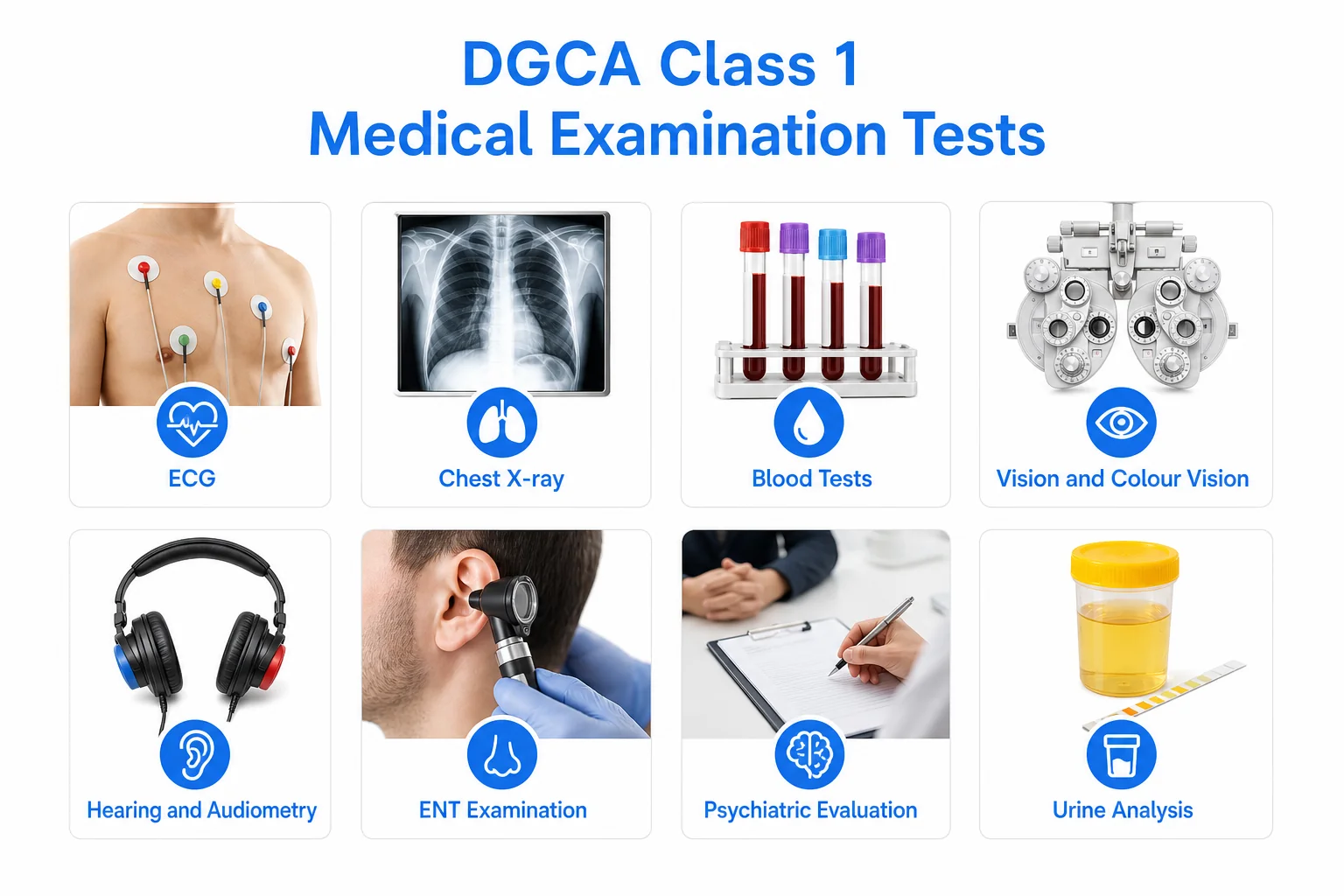
The DGCA Class 1 medical examination covers far more ground than a routine health check. Typical components include:
- Electrocardiogram (ECG) to screen for cardiac abnormalities
- Chest X-ray
- Detailed blood tests, including lipid profile and blood sugar
- Vision testing, including colour vision and depth perception
- Hearing tests and audiometry
- ENT (ear, nose, throat) examination
- Psychiatric and psychological evaluation
- Urine analysis
Because the exam runs across a full day, or sometimes two, candidates typically need to plan travel and stay around the assessment centre in advance.
7. Where Can You Get a DGCA Class 1 Medical Done in India?
Class 1 medicals in India are conducted at Air Force medical establishments and at DGCA-empanelled private centres. The Institute of Aerospace Medicine in Bengaluru, run by the Indian Air Force, is one of the most widely used facilities for aspiring commercial pilots. Several private centres in Delhi, Mumbai, and Kolkata are also DGCA-empanelled and conduct the same standard of assessment.
Slots at these centres fill up quickly, particularly during peak enrollment seasons after Class 12 results. Booking early, ideally before finalising any flight training abroad, gives a student time to address a temporary unfit finding well before departure dates and non-refundable tuition deposits come into play.
8. The Smartest First Investment: Get Medically Cleared Before You Spend
The single smartest financial decision a family can make is spending a few thousand rupees on Class 2 and Class 1 medicals before committing lakhs to flight training, whether in Delhi, Mumbai, Thrissur, or overseas. It is a small, early cost that protects a much larger one.
Every academy that asks for money before this medical clearance should be asked one direct question: is that money refundable if the student is later found medically unfit? Many agents and so-called mentors tell families the fee is non-refundable under any circumstances. That leaves a family that has saved for years, and a student who has dreamed of this career since childhood, with nothing to show for the investment.
Rian Air's policy is different. If a student is assessed permanently unfit, based on the CA35 form and the DGCA's own permanent unfit assessment, Rian Air refunds any fee the student has paid, with no questions asked. Taxes already paid are the only exception and remain non-refundable. This is described in more detail on the Money-Back Promise page covering hidden costs of pilot training abroad.
For families comparing full training pathways and budgeting realistically before enrollment, the Pilot Training Cost in India breakdown is a useful next read, and the parent's checklist for enrolling in a pilot training academy lays out every question worth asking before a single rupee changes hands.

Frequently Asked Questions
Is a Class 1 medical required before starting ground school?
No, only a Class 2 medical is required before ground school or Private Pilot Licence training. The Class 1 medical becomes mandatory before committing to CPL flight training, since it determines eligibility for a commercial career.
Can a temporarily unfit student retrain and clear the test later?
Yes. Temporary unfit findings, such as BMI outside range or a recent minor injury, usually allow a review after roughly six months, once the condition is addressed and re-examined by the medical board.
Does every flight school in India check medicals before enrolling students?
Not every academy insists on this sequence. Families searching for the best pilot training academy in India should specifically ask whether Class 2 and Class 1 medical clearance come before, or after, any fee is collected.
Getting medically cleared first is not a delay, it is the one step that protects everything that follows. If your child has dreamed of flying since primary school, the responsible move is to confirm medical fitness before a single rupee goes toward flight training abroad. Start Your Pilot Journey with a clear-eyed medical roadmap, or Explore Pathways across India, Malta, Tunisia, and New Zealand to see which route fits your family's situation. For real stories and day-to-day updates from students on this exact path, follow Rian Air on Instagram or subscribe on YouTube.