What Airlines Look for in First Officer Interview India
Airlines score first officer candidates on four things. They check verified technical knowledge. They check documented flying and simulator hours. They check Crew Resource Management (CRM) behaviour. They check clear English under pressure. What airlines look for in first officer interview India rounds goes well beyond a clean CPL marksheet.
A recruiter wants proof that you can think out loud. They want proof that you follow SOPs without hesitation. They want proof that you work as half of a two-person crew from the very first sim check. This guide walks through each round, what is scored in it, and how to prepare for it.
Key Takeaways
- Technical re-testing is standard: licensed CPL holders still get re-questioned on Air Regulations, Meteorology and Navigation. Airlines assume knowledge fades without daily use.
- Panels run in stages: most Indian carriers use an HR or psychometric round, a technical viva, and a simulator check before a final offer.
- Hours matter, but so does the type: multi-engine time, PIC hours and type rating status often outweigh which flying school issued the license.
- CRM failures are the top rejection reason: candidates who cannot describe a decision made jointly with a captain lose marks fast. So do candidates who freeze on a scenario question.
- Documentation shortens the process: a digital logbook with verifiable simulator and flight data shows a recruiter that your numbers are real.
At a Glance: First Officer Interview Rounds in India
| Round | Primary Focus | Typical Duration | What Gets Assessed |
|---|---|---|---|
| HR / Psychometric | Attitude, stability, motivation | 30-45 minutes | Behavioural fit, stress response, communication style |
| Technical Viva | DGCA subject recall | 20-40 minutes | Air Regulations, Meteorology, Navigation, aircraft systems |
| CRM Scenario Round | Teamwork and decision-making | 15-30 minutes | Joint decision scenarios, emergency handling, captain-FO dynamic |
| Simulator / Sim-Readiness Check | Practical flying competence | 30-60 minutes | Instrument scan, SOP adherence, handling under load |
| Documentation Review | License, hours, medicals | 10-20 minutes | Logbook accuracy, type rating status, medical validity |
| Final Panel / Offer | Overall readiness | 15-20 minutes | Consolidated scoring, salary and base discussion |
1. Build the Technical Foundation Airlines Actually Test
Every Indian carrier re-checks the same DGCA subjects in the technical round. A license proves you passed once. The viva checks whether you still know it today.
These are the subject areas panels draw from:
- Air Regulations
- Aviation Meteorology
- Air Navigation
- Technical General
- Technical Specific, single-engine
- Technical Specific, multi-engine
- RTR(A)
Recruiters flag the same three gaps again and again:
- Rules mixed up with company practice. Candidates quote a company SOP when the panel asked for the regulatory limit, or the other way round.
- No fluency with weather products. They cannot read out a METAR or a TAF without a reference sheet in front of them.
- No spoken failure drill. They cannot talk through a systems failure step by step, the way a first officer briefs it in a real cockpit.
Fix each gap by rehearsing out loud, not by re-reading notes. Say the limit, then say where it comes from. Read a live METAR aloud each morning. Walk a friend through one failure sequence a day.
Freshers who came through a structured ground school answer these questions with more confidence than question-bank crammers do. Our DGCA CPL exam subjects and syllabus checklist is a useful way to revisit these areas before an interview, not just before the license exam.
2. What Airlines Look For in First Officer Interview India: The Core Assessment Areas
Beyond subject recall, panels score five practical areas. Each area is scored on its own. A weak result in one area can outweigh strong marks in the rest.
- Technical acumen. Systems knowledge and regulatory awareness, tested by direct questions.
- CRM and soft skills. Whether you defer to a captain and still speak up about a safety concern.
- English under pressure. How clearly you narrate a scenario, not just your grammar.
- Simulator handling. Instrument scan and workload management while the panel watches.
- Attitude toward SOPs. Tested with questions like "what would you do if the checklist and the captain's instruction disagreed".
Prepare for all five, not only the first. Candidates who drill technical answers alone tend to lose the interview in the CRM round.
Why Does CRM (Crew Resource Management) Matter So Much in the Interview?
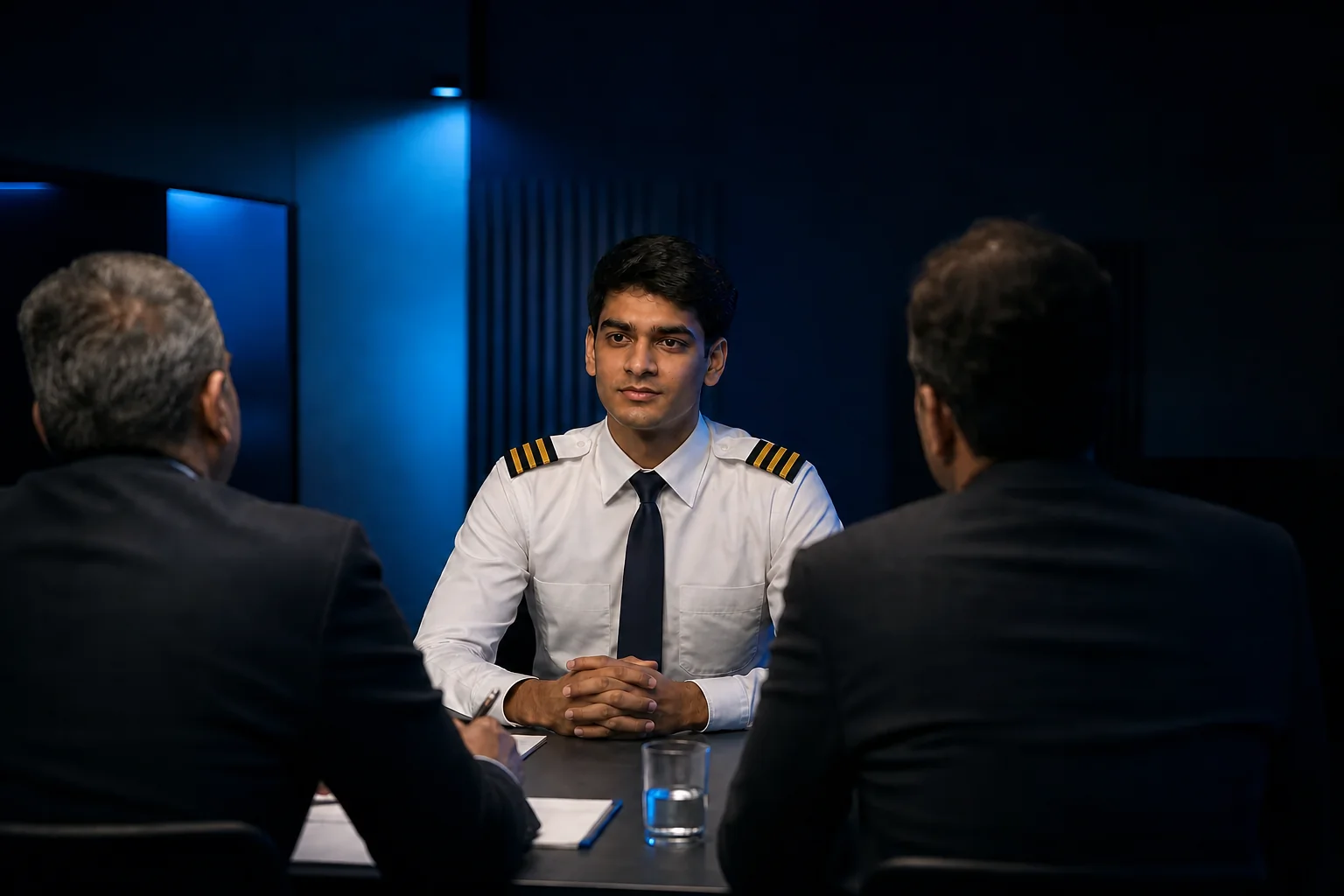
CRM matters because a first officer's real job is joint decision-making under pressure. It is not solo flying. Panels test this with scenario questions. They ask how you would raise a concern, handle a disagreement with the captain, or run a checklist during an abnormal situation.
A typical CRM question sounds simple. "Your captain wants to continue an approach you think should be discontinued. What do you say?" There is no single correct script. Panels listen for a calm, assertive and respectful answer.
A strong answer follows a clear shape:
- State the observation. Say what you can see on the instruments or outside.
- Name the specific concern. Tie it to a limit or an SOP, not to a feeling.
- Propose a concrete alternative. Offer the go-around, the hold, or the diversion out loud.
- Confirm the decision. Read back what the captain decides, and fly it.
Silence fails this question. So does arguing. Candidates who practise structured briefings in simulator sessions answer it naturally. Those with solo flight hours and no crew scenarios often struggle here, even with strong logbooks.
3. Simulator and Flying Hours: The Numbers Airlines Actually Check
Airlines verify your hours before any technical discussion starts. They look at total flying hours, PIC hours, multi-engine time, and current type rating status. Your headline hour count matters less than how those hours are spread.
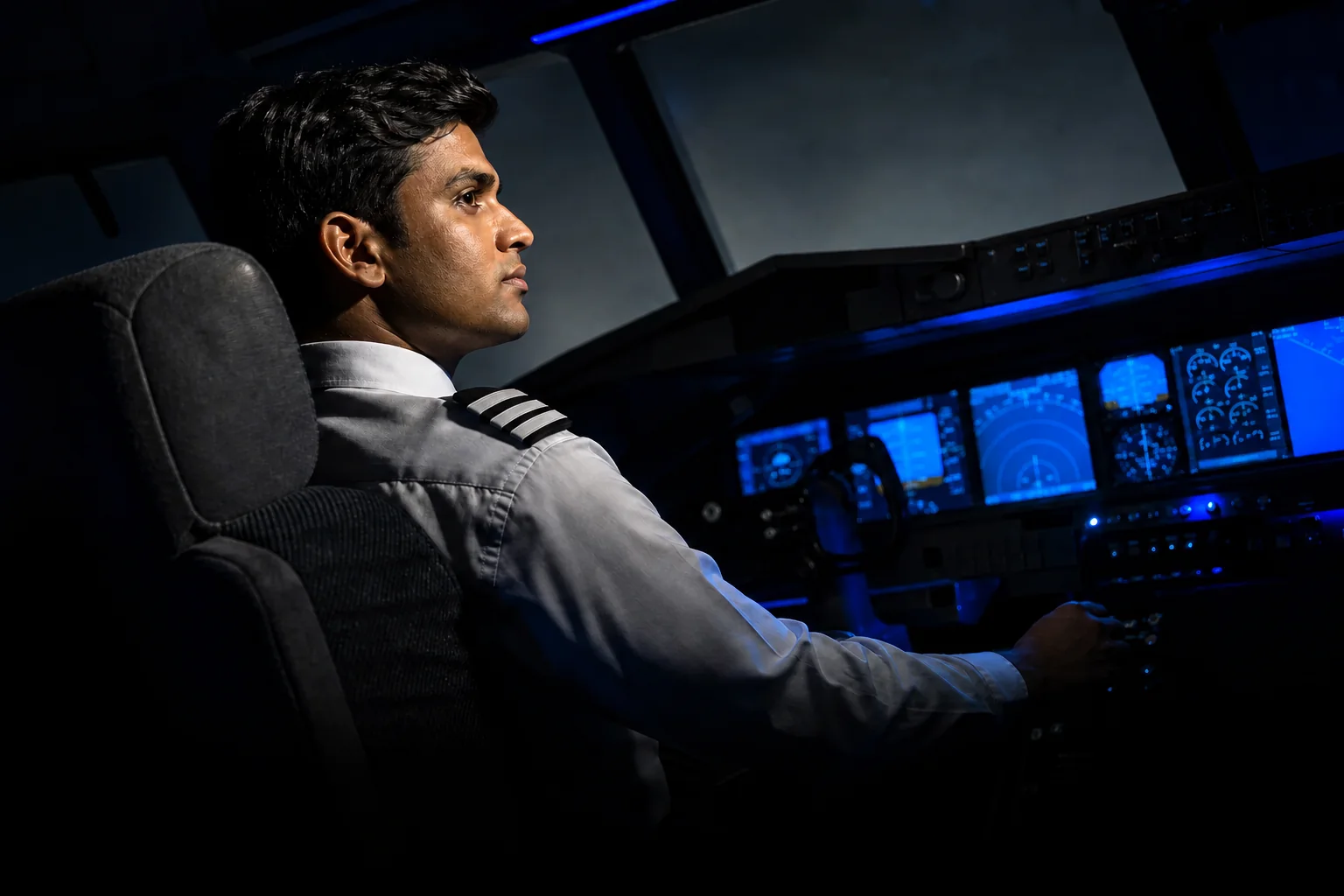
Regional and low-cost carriers in India usually look for a CPL with an active type rating. Full-service carriers often prefer extra multi-crew coordination exposure. The table below shows the pattern recruiters commonly reference. Exact minimums vary by airline and by year, so check the advertisement you are applying against.
Carrier Type | Typical Minimum Total Hours | Type Rating Requirement | MCC Exposure Preferred |
|---|---|---|---|
Regional / Turboprop operators | 200 plus CPL | Not always mandatory at entry | Preferred, not always required |
Low-cost carriers (A320/B737 family) | 200-plus with active CPL | Type rating strongly preferred | Required or fast-tracked post-hire |
Full-service carriers | 300-plus, cadet routes vary | Type rating often required | Required before line training |
A completed type rating is one of the strongest signals you can bring to a panel. It shows the aircraft-specific systems study is already done. If you are still choosing between aircraft families, our comparison on A320 type rating preparation and simulator training walks through what that study involves.
What the Documentation Review Round Actually Checks
The documentation round is short, and it is the easiest round to lose. Carry a folder with each of these ready to hand over:
- Licence. Current CPL, with the ratings printed on it matching what your application claims.
- Logbook. Total hours, PIC hours, multi-engine time and cross-country time, each totalled and signed.
- Simulator record. Session dates and content, so sim time is documented rather than described.
- Type rating status. Completed, in progress, or not started, stated plainly.
- Medical. A valid medical with the expiry date visible, since an expired medical stops the process.
Check that every total in the folder matches the total on your application form. Panels cross-check the two, and a mismatch you cannot explain reads as dishonesty.
4. How to Prepare: A Step-by-Step Path From Ground School to Airline Cockpit
Getting hired as a first officer in India follows a fixed sequence. Skipping a step, or rushing one, is what later shows up as a gap in the interview.
- Complete 12th with Physics and Mathematics and clear the DGCA Class 1 medical early. A medical failure late in training wastes both time and money.
- Enroll in a structured DGCA ground school covering all the CPL subjects. Pick one with a digital question bank that tracks weak topics rather than generic mock tests. Our guide on how to become a commercial pilot in India after 12th covers this stage in detail.
- Log simulator hours before real flight training to build instrument scan and checklist discipline. The simulator is the lower-cost, lower-risk place to make those mistakes. Our fixed-base simulator training guide explains why this sequencing matters.
- Complete CPL flight training, in India or abroad. Accumulate the PIC and cross-country hours airlines expect to see documented, not estimated.
- Pursue a type rating on an A320 or B737 platform once your flight hours are in place. Match the aircraft family your target airline actually operates.
- Apply to airlines and prepare for the rounds specifically. Practise CRM scenarios and spoken technical recall. Re-reading DGCA notes is not interview preparation.
- Complete line training under supervision once selected, before you fly unsupervised as a first officer.
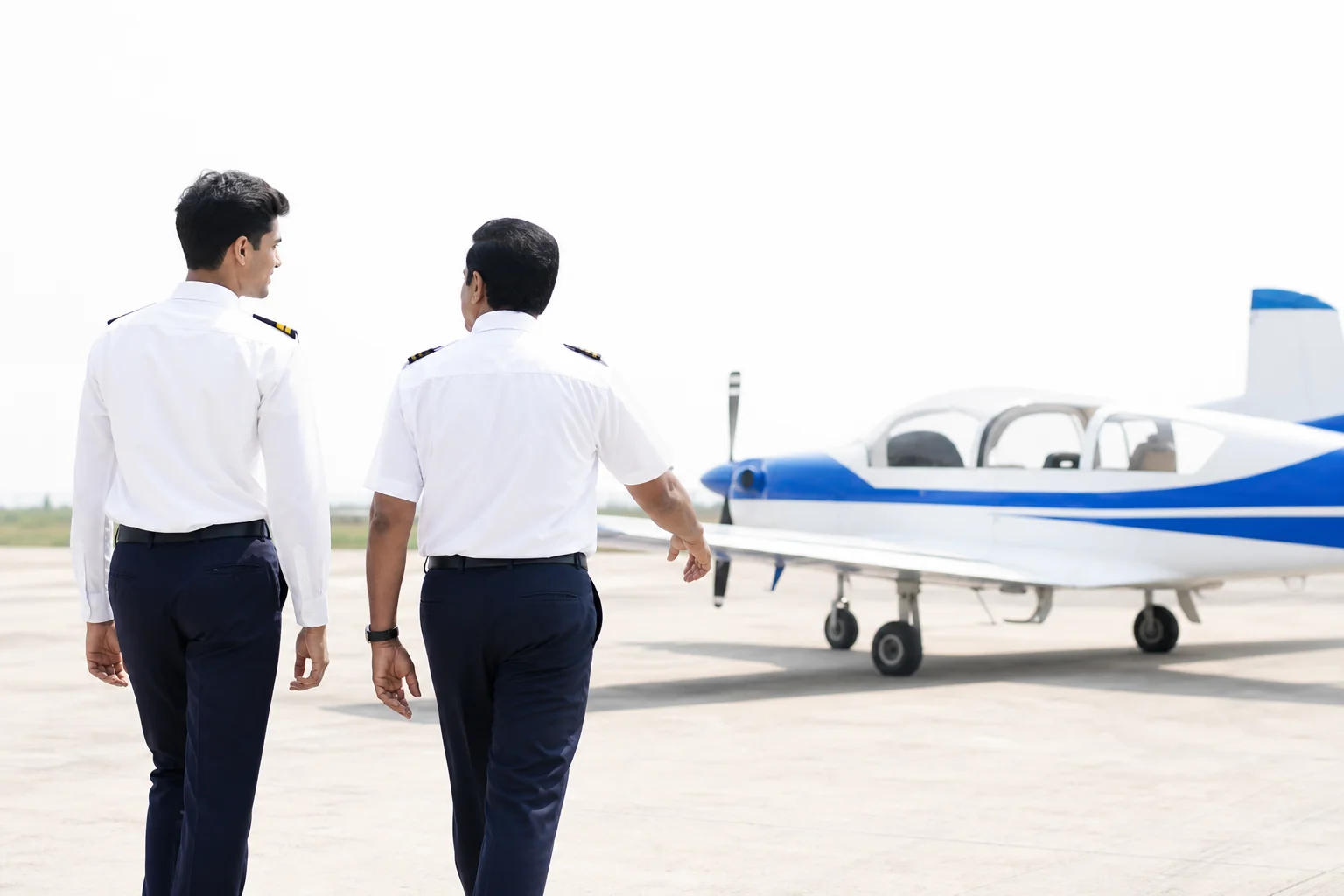
How to Pass DGCA Exam in First Attempt Before You Even Reach the Interview Stage?
Passing the DGCA exam in the first attempt comes down to two habits. Track your subject-wise scores daily. Isolate repeated wrong answers early, instead of mass-revising near the exam date.
Candidates who do this reach the interview with sharper recall, because the knowledge was built rather than crammed. Our detailed parents' guide on passing the DGCA exam in the first attempt breaks down what daily tracking looks like. It also lists the mistakes that push students into multiple attempts.
5. Common Mistakes That Get First Officer Candidates Rejected
Weak technical knowledge is the most frequent rejection reason. Poor spoken English under scenario pressure is close behind. Each mistake below has a fix you can start this week:
- Correct answers delivered badly. Hesitating, rambling or switching languages mid-sentence costs marks even when the content is right. Rehearse answers aloud, in English, against a timer.
- Inconsistent logbook entries. Panels cross-check hour totals against training records. Reconcile your totals before you apply, and carry the record that proves them.
- Silence in the CRM round. A candidate who never challenges the captain scores as unsafe. Practise the four-step answer shape above until it is automatic.
- Regulatory limits quoted from memory of a company SOP. Separate the two in your notes so you can name which one you are quoting.
- No simulator evidence. Sim hours that only exist as a claim carry no weight in the documentation round.
Several of these habits start in ground school. Our instructor-focused piece on common mistakes DGCA aspirants make during ground school covers the study patterns that later show up as weak interview answers.
What Airlines in India Specifically Look For
Airlines hiring out of the Delhi and Mumbai hubs look for the same core skills as the rest of the country. The one difference is emphasis. They weigh rapid, confident English more heavily, because of the higher volume of international routes and multinational crew mixes.
Candidates trained in Kerala's academies and flown into these metro hubs face the same CRM and technical bar. Preparing for the hub is not a different syllabus. It is the same syllabus, rehearsed out loud.
If you are travelling to Delhi to prepare, the training infrastructure at Rian Air's Ramphal Chowk facility combines simulator access with ground school revision. That combination suits last-mile interview readiness rather than starting from scratch.
6. How RAPT and Structured Training Help You Walk Into the Interview Ready
A documented, verifiable training record removes one whole layer of interview anxiety. RAPT™, Rian Air's pilot career intelligence platform, tracks ground school scores, simulator sessions and flight hours in one digital logbook.
That means you can produce accurate numbers during the documentation round instead of reconstructing them from memory. It also means your sim time is evidence, not a claim.
Parents see the same data through a parent dashboard. That matters when a family is financing months of training and wants proof of progress before the airline application stage. Our piece on questions parents should ask about the parent dashboard is a good place to start.
India's Directorate General of Civil Aviation sets licensing and medical standards as minimums, not as a finish line. Airlines set their own interview bar well above those minimums. International bodies such as ICAO continue to treat CRM and human factors as core competencies rather than optional extras, for exactly this reason.
FAQs on First Officer Interviews in India
How many rounds does a first officer interview in India have?
Most carriers run an HR or psychometric round, a technical viva, a CRM scenario round, a simulator or sim-readiness check, a documentation review, and a final panel. Durations run from about 10 minutes for documentation to about an hour for the simulator check, as the table above shows.
Do I need a type rating before I apply?
Not always. Regional and turboprop operators do not always demand one at entry. Low-cost carriers strongly prefer it, and full-service carriers often require it. A completed type rating is the single strongest document you can bring, because the aircraft systems study is already finished.
What is the best pilot training academy in India for airline-ready candidates?
The best academy for airline readiness is the one that documents simulator hours, flight training and ground school scores in a single verifiable record. The lowest headline fee is not the measure. Look for DGCA-aligned academics, real simulator infrastructure, and transparent progress tracking before you enroll.
Is cheap pilot training in South Africa a good idea before an airline interview?
Cheap pilot training in South Africa often cuts simulator hours or CRM exposure to hold the price down. That gap shows up directly in the scenario rounds. A lower fee is only worth it if the training still covers documented simulator time, structured ground school, and honest hour logging.
What should I check before choosing among the top flying schools in India?
Confirm DGCA approval status, simulator availability and aircraft fleet condition. Ask whether ground school uses a tracked question bank rather than static notes. Then ask directly how the school prepares students for airline CRM and technical rounds, not only for the DGCA exam.
How do I prepare for the simulator check specifically?
Fly the scan, not the aircraft. The check looks at instrument scan, SOP adherence and handling under load. Practise structured briefings and standard calls in a simulator before the assessment, so the panel hears a crew member rather than a solo pilot.
The rounds reward evidence over claims: totalled hours, dated simulator sessions, subject-wise scores and a medical that is still in date.
Interview readiness is built months before the panel calls your name. Start the record now, keep it accurate, and carry it into the documentation round.
If you want a clear view of where you stand on hours, simulator sessions and DGCA scores, start your pilot journey enquiry with Rian Air today and get a structured readiness plan instead of guesswork.
You can also explore pathways across ground school, simulator and type rating stages to see where the interview-ready milestones sit. For training footage and interview preparation tips, follow Rian Air on Instagram or subscribe on YouTube.