


Education Loan for Pilot Training: What Banks Actually Ask Before Approving
Banks reviewing an education loan for pilot training mainly check three things: that the course is DGCA-approved, that the co-borrower's income and collateral cover the amount, and that the institute gives a clear written fee structure. Rian Air's ground training costs ₹1.25 lakh plus taxes (₹1,47,500), and our money-back promise and scholarships can reduce what a family needs to borrow.
Key takeaways
Banks lend against the course and the co-borrower: approved pilot training, a repayment source (usually a parent's income) and, for larger amounts, security.
The loan is sized by what you finance, not by the total dream: splitting ground training from flight training lets you borrow in stages and only the gap.
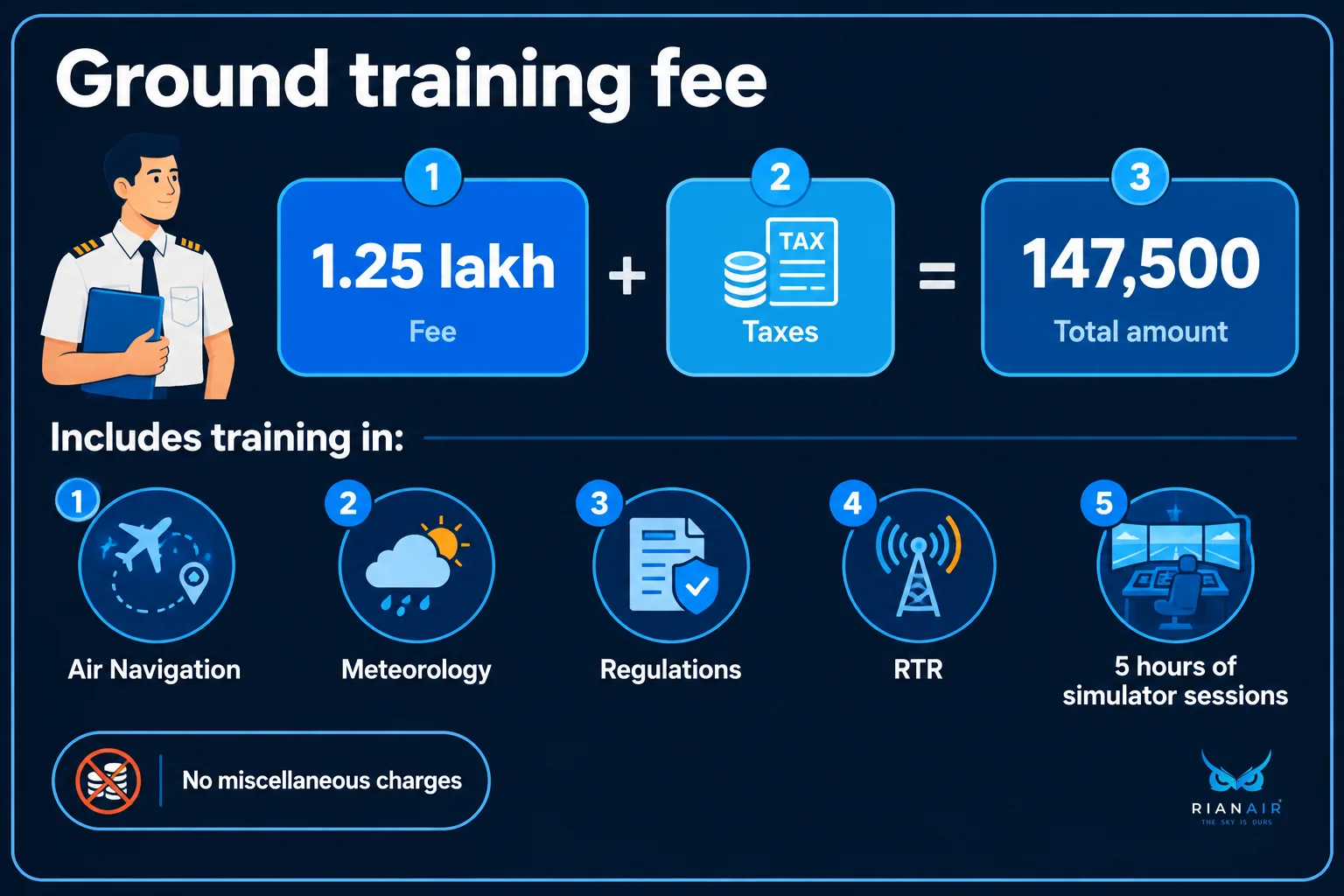
Our ground training fee is ₹1.25 lakh plus taxes, ₹1,47,500 in total: it covers Air Navigation, Meteorology, Regulations, RTR and 5 hours of simulator sessions, with no miscellaneous charges.
Flight training at partner flying schools is 50 lakhs to 75 lakhs, and it varies from student to student. Plan the loan around a written quote.
Money-back promise and scholarships reduce exposure: if Rian Air fails to get a student through the DGCA exams, the student gets their money back; terms and conditions apply.
No one can promise loan approval: the bank decides. Bring a clean fee quote, the T&C sheet and a realistic timeline.
At a glance: education loan for pilot training
Item | What to know |
|---|---|
What banks check first | DGCA-approved course, co-borrower income, collateral, fee structure from the institute |
Collateral on small loans | No collateral or third-party guarantee up to ₹4 lakh under the model scheme banks are advised to follow |
Rian Air ground training fee | ₹1.25 lakh plus taxes, ₹1,47,500 in total, no miscellaneous charges |
Included in that fee | Air Navigation, Meteorology, Regulations, RTR and 5 hours of simulator sessions |
Flight training at partner flying schools | 50 lakhs to 75 lakhs, varies from student to student |
A320 type rating through channel partners | Entry level 15 lakhs; our A320 programme takes 50 days |
Ground training duration | About 6 months; our students typically take 6 to 12 months overall, and some clear in 4 |
Bank sanction time | Anywhere between a month and 3 months, depending on the paperwork |
Money-back promise | If Rian Air fails to get a student through the DGCA exams, the student gets their money back; T&C apply |
Women Empowerment Program | Zero* fee DGCA ground training, based on merit (*refundable commitment deposit applies) |
Gender-neutral scholarship | Merit-based; open to all applicants |
What do banks actually ask before approving a pilot training loan?
Banks ask whether the course is approved, who will repay, what security backs the loan and whether the institute's fee quote is clear and itemised. Documents follow from those four questions. The bank is judging repayment risk, so the co-borrower's finances usually matter more than the student's marks.
The Indian Banks' Association's model scheme lists regular degree and diploma courses such as pilot training approved by the Director General of Civil Aviation, if pursued in India. That is why banks want proof that your flying school and ground training are on a DGCA-recognised path.
The Reserve Bank of India has advised all scheduled commercial banks to adopt the Model Education Loan Scheme. In practice each bank still sets its own terms, so two branches can answer the same file differently.
The four checks, and what a pass looks like
Course check: a DGCA-approved flying school and a written fee schedule. If the quote is a single lump sum with no breakdown, expect questions.
Co-borrower check: a parent or guardian with steady, documented income. Irregular or undocumented income is the most common reason for a request for more security.
Security check: for loans above ₹4 lakh, banks commonly ask for collateral such as property or fixed deposits. Under the model scheme, no collateral or third-party guarantee is required up to ₹4 lakh.
Credit check: the co-borrower's repayment history. A poor score can slow or stop the file, so check it before you apply, not after.
If a check fails, do not argue with the branch. Fix the gap: ask the institute for an itemised quote, add a second earning co-applicant, offer a fixed deposit, or reduce the amount you ask for. Some students leave training for reasons like a recent poor credit score blocking a loan. Check early so you do not start training before the funding is certain.
Timing matters too. Partner banks usually take anywhere between a month and 3 months to sanction a student loan, depending on the paperwork. They need each and every document before sanctioning, so an incomplete file adds weeks.
The eligibility guide covers documents; this guide covers loan size
Our education loan for pilot training in India eligibility guide walks through the documentation bank officers request in more depth. The list below is enough to start a file without opening it.
This article asks a different question: how much does your family really need to borrow, and which parts of the cost can you shrink before you ever walk into a bank? A smaller, better-justified loan is easier to get sanctioned and easier to repay.
Documents to carry to the branch
Banks differ, so confirm the final list with your branch. These are the papers the four checks above point to:
Written, itemised fee quote from the flying school and from Rian Air for ground training (₹1,47,500 including taxes).
Proof that the course is DGCA-approved.
Co-borrower's income proof and credit history details.
Details of any collateral, such as property papers or fixed deposit receipts, if the amount is above ₹4 lakh.
Any scholarship offer in writing.
The T&C sheet for the money-back promise, from our academic counsellor.
How does the money-back promise change the loan a family needs?
It lowers the risk that borrowed money is spent without a result. Our promise is: if Rian Air fails to get a student through the DGCA exams, the student gets their money back; terms and conditions apply. A family can then borrow for one stage at a time instead of funding every stage up front.
We do not describe the promise beyond those words. What it covers, the conditions and how a claim works are all in the T&C sheet, which is available from our academic counsellor. Ask our academic counsellor for it before you pay anything, and read it with your co-borrower. You can reach us through the Rian Air enquiry page.
What it does and does not do for your loan
It does not remove the loan, and it does not replace the bank's decision. It does help you plan. If ground training is the first stage and protected by the promise, you do not need a large safety buffer built into the borrowing for that stage.
What banks and schemes publish on limits and interest
Public pages show a few patterns. The model scheme asks for no collateral up to ₹4 lakh, as the Press Information Bureau notes for the Model Education Loan Scheme. PM-Vidyalaxmi has no cut-off on the highest amount.
The NSFDC lists a loan limit of up to 90% of project cost, with interest rate, repayment period and moratorium shown per scheme in its education loan table. Gujarat's state scheme is a fixed 4% a year.
Published bank-product listings show the same variety. One comparison lists an interest range starting at 9.50% onwards, with a term loan up to INR 1 crore for domestic and INR 2 crore for international studies, in the Forbes Advisor India education loan guide.
The Economic Times rate comparison lists loan amount, interest rate, scheme name and eligible institution for each lender. Treat these as starting points and confirm current figures on the bank's own page.
Source | Limit shown | Rate or cost shown |
|---|---|---|
IBA model scheme (via PIB) | No collateral or third-party guarantee up to ₹4 lakh | Set by each bank |
PM-Vidyalaxmi guidelines | No cut-off on highest amount; depends on course fee and other charges | See the guidelines and your bank |
NSFDC education loan scheme | Up to 90% of project cost | Per scheme in its table |
Gujarat scheme for commercial pilot training | ₹25,00,000 | 4% a year |
Forbes Advisor India listing | Up to INR 1 crore domestic, INR 2 crore international | 9.50% onwards |
Processing fees and prepayment rules
The public pages we reviewed do not give one standard processing fee or prepayment rule, because each bank sets its own. We will not quote a figure we cannot source. Ask the branch for these in writing: the processing fee and whether it is refundable if the loan is rejected, whether you can prepay part or all of the loan, and whether any penalty applies.
How interest, moratorium and repayment work
Interest: it is either fixed, which stays the same, or variable, which can move with the bank's rate. Ask which one applies. Moratorium: this is a period when you do not pay full instalments, usually while training continues.
Interest may still build up, so ask whether it is added to the loan. Repayment: instalments begin after the moratorium and run over a period the bank sets. A longer period lowers each instalment but raises total interest. Ask for all three in writing before you sign.
Ground training fee: what 1.25 lakh plus taxes covers
Our ground training package costs ₹1.25 lakh plus taxes, which comes to ₹1,47,500. It covers Air Navigation, Meteorology, Regulations, RTR and 5 hours of simulator sessions. There are no miscellaneous charges, and we handle the paperwork for every student.
Technical General and Technical Specific are not part of our package. Our partner flying schools in India, such as Indian Flying Academy, cover those, and Technical General is optional for students who fly abroad. Ask your flying school for that fee in writing so the bank sees the full picture.
Flight training and type rating fees
Flight training at our partner flying schools ranges from 50 lakhs to 75 lakhs, and it varies from student to student. For the type rating, the A320 course is entry level 15 lakhs through channel partners. The A320 programme takes 50 days, and a type-rating course usually runs 8-10 weeks depending on the student's performance. It includes 36 to 44 hours on a simulator.
Why an itemised fee helps a loan file
Banks prefer a quote that names what is included. A fee with no hidden extras is simpler to justify, and it stops the amount creeping up after sanction. The DGCA has issued Flying Training Circular 02 of 2026 with guidelines for agreements between flying training organisations and trainees, aimed at transparency and fair practice. Read any agreement you are asked to sign with that purpose in mind.
Time is part of the cost
Our ground schooling runs about 6 months. That breaks down as 2 to 2.5 months for Navigation, 1.5 months for Regulations and Meteorology together, about 15 days for RTR (some is covered during Navigation) and 2 to 2.5 months for Technical General. Most of our students take 6 to 12 months overall, though some have cleared in as little as 4.
Pass attempts matter as well. In our experience about 80% of students clear a subject on the first attempt, nearly everyone clears on the second, and only 1 or 2 students so far have needed a third. Fewer retakes mean less waiting while interest or family costs run on.
Can scholarships reduce how much you borrow?
Yes, for eligible students. The Women Empowerment Program gives zero* fee DGCA ground training to aspiring women pilots, based on merit, where the asterisk marks a refundable commitment deposit. We also run a gender-neutral, merit-based scholarship open to everyone. Neither is guaranteed; selection depends on merit.
For a family, the effect is direct. If ground training is covered, the first stage needs little or no borrowing, and the loan application can focus on flight training. The refundable commitment deposit still has to be paid up front, so plan for it in your savings. Ask our counsellor for the deposit amount in writing.
Be careful about what else is offered out there. We have written about how many pilot training scholarships turn out to be scams. A real scholarship tells you the conditions in writing, and never asks you to pay a vague fee to release it.
Which one to apply for
Women candidates: apply for the Women Empowerment Program, and ask about the gender-neutral merit option as well.
Other candidates: the gender-neutral merit scholarship is the route.
Not selected: go back to the loan plan; the scholarship result should not be assumed when you meet the bank.
How to size the loan: a step-by-step decision rule
Split the total cost by stage, remove what scholarships or savings cover, and borrow only the gap, one stage at a time where the bank allows. Then compare banks on terms, not only on the headline loan limit. This keeps repayments lower and approval more likely.
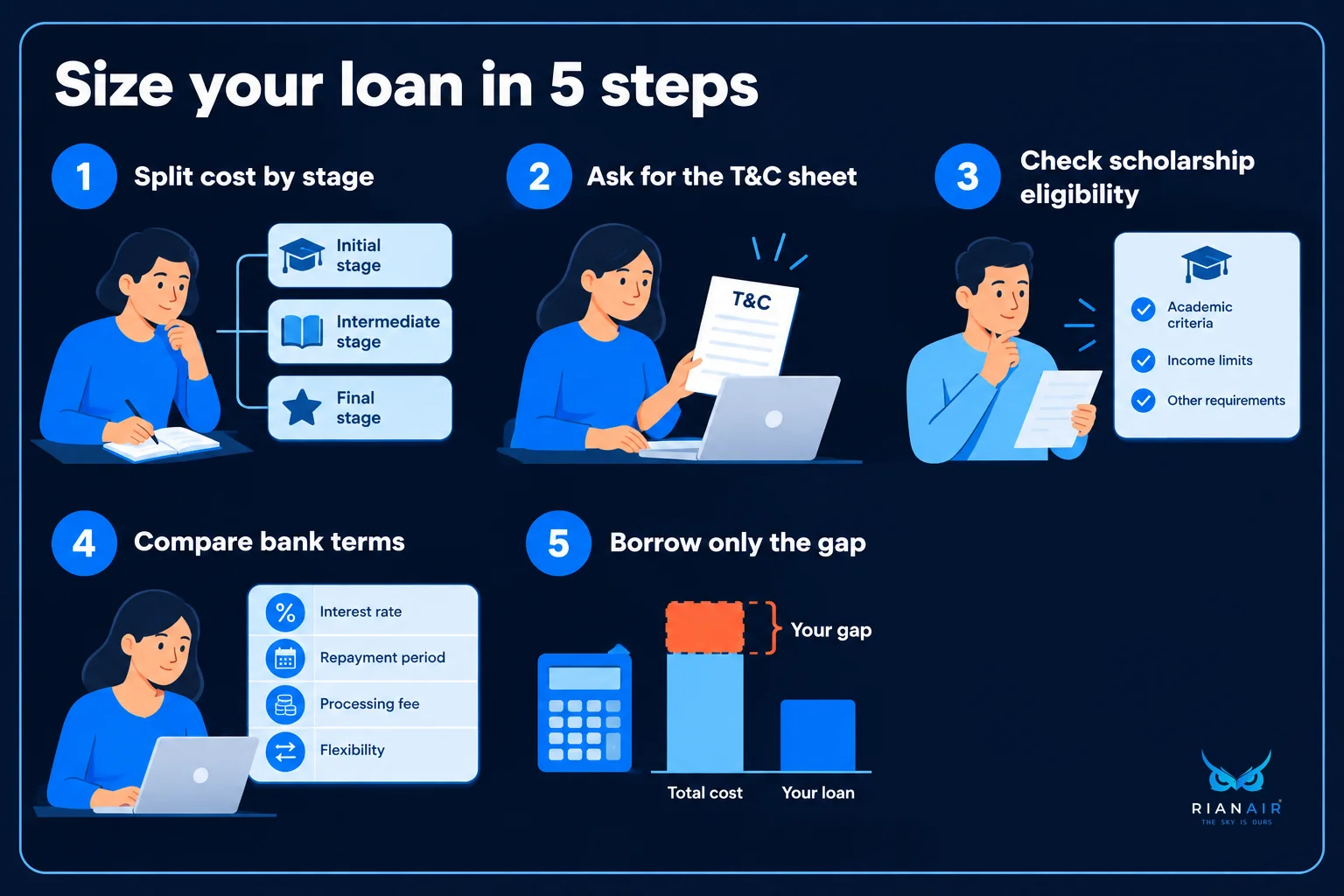
List the stages. Ground training, medicals, flight training, licence conversion and any type rating. Get each as a written quote.
Take out what is covered. Subtract savings, any scholarship you hold in writing and family contributions.
Read the T&C sheet. Ask our counsellor for the money-back terms so you know which stage is protected.
Compare bank terms. Check interest type, moratorium, processing charges, prepayment rules and collateral needed.
Borrow the gap. Apply for the amount you can justify, with the quotes attached.
A sample cost range to size against
Using the figures above, a family planning ground training, flight training and an A320 type rating faces these stages. Ground training is ₹1,47,500 including taxes. Flight training at partner schools is 50 lakhs to 75 lakhs. The A320 type rating is entry level 15 lakhs. These are separate stages, so ask for each quote and loan against each one in writing rather than adding them into one number.
A worked example with hypothetical numbers
Suppose a family gets a flight training quote of ₹40 lakh from a flying school. This number is only for illustration. Ground training at our fee is ₹1,47,500. If the student earns the Women Empowerment Program, ground training is zero* fee, leaving only the refundable deposit to fund.
The family would then apply to the bank for the flight training portion, not the full sum plus ground. Without the scholarship, the same family would add ₹1,47,500 to savings or to the loan. Our ground fee alone is under the ₹4 lakh point where the model scheme asks for no collateral, though how a bank treats a small ground-only loan is its own call.
Government schemes worth checking
Under PM-Vidyalaxmi, the guidelines say there is no cut-off on the highest education loan amount and it depends on the course fee and other charges. Whether your course and institution qualify under the scheme is something to confirm with the bank.
Some states run their own schemes. Gujarat's welfare department lists a loan of ₹25,00,000 at 4% a year for commercial pilot training for eligible communities. Check the page for eligibility; most families will not qualify, and we are not suggesting every family should expect this. Ask your state's welfare department what similar help exists locally.
For deeper reading on spreading payments, see our pilot training installment payment plans case study.
Mistakes parents make when choosing an institute for a loan
The mistake we see most is choosing the school with the best marketing instead of the best results. A bank will ask about the school's fee structure; a family should ask about its results. Check real results, not celebrities or funny reels.
Three practical checks help:
Ask for pass data. Our own figure is about 80% of students passing a subject on the first attempt, with nearly everyone through on the second.
Ask how you will see progress. With Rian Air, parents can track every step of their child's progress live, day to day, via RAPT.
Ask what happens if it fails. That is where the money-back promise and its T&C sheet matter.
Terms change by branch and by applicant. What we can do is give you a clear fee quote, a written promise to read and a realistic timeline to put in front of the bank.
Frequently asked questions
Can I get an education loan only for ground training?
It depends on the bank. Many lenders prefer to finance the full course and flying, but some will consider smaller amounts. Our ground training fee is ₹1,47,500 including taxes. Ask the branch directly, and bring our itemised fee quote with you so the officer sees exactly what is included.
Do banks guarantee approval if the fee is clear?
No. A clear fee quote helps the file, but the bank decides based on the co-borrower's income, credit history and security. Neither we nor any institute can promise approval, so do not pay non-refundable amounts on the assumption that the loan will come through.
Is there a free trial of RAPT before I commit?
Yes. You can register and speak to our support team about the free trial. RAPT is the Rian Air Assessment and Practice Tool, and it is available online at all times. It lets you and your parents see what ground training looks like before any money is spent.
Where are Rian Air centres?
Our Delhi centre is at G-94, Rian Air Building, Ramphal Chowk Road, Dwarka, New Delhi 110077. In Kerala we are on the 2nd floor, Pottekkat Building, Thrissur Round East, 680001. Our Thane centre, opposite Shree Bhagyalakshmi Bungalow, Anand Park, Thane West, is being inaugurated this month, and Maharashtra students can start with online ground training.
Do I need collateral for a pilot training loan?
It depends on the amount and the bank. Under the model scheme banks are advised to follow, loans up to ₹7.5 lakh need no collateral or third-party guarantee. Larger amounts, such as flight training, usually need security. Ask the branch what it will accept before you apply.
Who has to be the co-borrower?
Banks look for a repayment source, and for a student that is usually a parent's income. The co-borrower's income and credit history are checked along with the course. Confirm the exact requirement with your bank, as it can change by branch and applicant.
How long does a bank take to sanction an education loan?
Sanction can take anywhere between a month and 3 months, depending on the paperwork. Complete documents help: a written fee quote, the course details and the co-borrower's income proof. Plan your start date with this wait in mind.
Which documents will the bank ask for?
Expect the bank to ask for proof that the course is DGCA-approved, an itemised fee structure from the institute, and the co-borrower's income and identity records. Ask your branch for its full checklist. We can give you an itemised fee quote and the T&C sheet for the money-back promise to attach.
Can I take the loan in stages instead of one lump sum?
Where the bank allows it, yes. Ground training, flight training and the type rating are separate stages with separate costs. Borrowing the gap for one stage at a time can keep repayments lower, but not every bank offers staged disbursement, so ask before you sign.
Does the money-back promise protect my loan?
The promise is that if Rian Air fails to get a student through the DGCA exams, the student gets their money back; terms and conditions apply. Ask our counsellor for the T&C sheet to see which stage it covers. It does not guarantee loan approval, and it does not replace what the bank requires.
Are there government schemes that can help with a pilot training loan?
Possibly. The PM-Vidyalaxmi guidelines state there is no cut-off on the highest education loan amount, and it depends on the course fee and other charges. Some states also run schemes for eligible communities. Whether your course qualifies is for the bank or the state department to confirm.
Start with the numbers, then talk to the bank
A strong education loan for pilot training file has three parts: an itemised fee, a realistic plan by stage, and a co-borrower who understands what is being signed. Our ground training is ₹1,47,500 including taxes, and the T&C sheet for the money-back promise is yours to read before you commit.
Ready to build your plan? Start your pilot journey with an enquiry and ask our counsellor for the fee quote and T&C sheet. You can also explore training pathways to compare flight training options before you decide how much to borrow. For updates and parent-friendly explainers, follow us on Instagram and subscribe on YouTube.