
Ground Training Institute in Kerala For Pilots. What to compare ?
The best ground training institute in Kerala for pilots is the one that gives you a physical simulator, a clear subject-by-subject timeline, written refund terms and a way to track your progress. Compare those four things before you pay. This guide shows how to check each one, with a focus on Thrissur-area students and families.
Key takeaways
- Simulator first: A fixed-base C172 simulator with real controls teaches procedures better than a desktop trainer. Rian Air runs Kerala's first C172 fixed-base simulator.
- Timeline: Our typical ground schooling is 6 months. Students usually take 6 to 12 months overall, and one of our students cleared in 4 months.
- Results: About 80% of our students clear their papers on the first attempt, and second attempts usually clear the rest.
- Paperwork: Read the exit and refund policy, the policy for weak performance, and any placement conditions before paying anything.
- Tracking: Pick an institute that shows your scores, weak topics and logbook in one place. That is what the RAPT platform does.
Ground training institutes for pilots in Kerala at a glance
| What to compare | What we publish at Rian Air |
|---|---|
| Typical ground schooling | 6 months (students overall: 6 to 12 months) |
| Air Navigation | 2 to 2.5 months |
| Air Regulations and Meteorology | About 1.5 months, taught at the same time |
| RTR (Radio Telephony) | About 15 days, as part of it is covered during navigation |
| Technical General | 2 to 2.5 months, optional for students flying abroad, covered through partner flight schools in India |
| First-attempt pass rate | 80% of our students |
| Simulators | C172 fixed-base in Kerala; hybrid simulators in Delhi |
| Refund | Money-back promise on DGCA exams; terms and conditions apply |
What should you compare in a ground training institute in Kerala?
Compare eight things: simulator hardware, subject-wise timeline, how exam progress is tracked, first-attempt results, refund and exit terms, library access, the flight training pathway after exams, and whether the institute operates in more than one city. Brochures rarely cover all eight, so ask for each in writing.
Most families in Thrissur start with fees. Fees matter, but a low fee attached to a vague timeline or a weak exit policy usually costs more later. Our cheapest flight training does not exist article explains why.
The sections below take each point in turn. Where we give a number, it is our own figure for our own students, and we say which batch or service it covers.
Why this comparison matters more in Kerala
Kerala has a state-owned flying academy in Thiruvananthapuram, listed among India's pilot training institutes, plus several private coaching centres and flight-school-linked classes. Choice is real, so the decision comes down to fit.
A student who plans to fly in India has different needs from one heading to Tunisia, Malta or New Zealand. The first needs tight links with a flying school at home. The second needs paperwork, medicals and visa support alongside theory.
Simulator infrastructure: fixed-base C172 vs desktop trainers
A fixed-base simulator has no motion, but it reproduces the cockpit: yoke, throttle, rudder pedals and a full instrument panel. A basic desktop trainer uses a keyboard or joystick and on-screen gauges. The first builds procedural habits; the second builds familiarity with the basics.
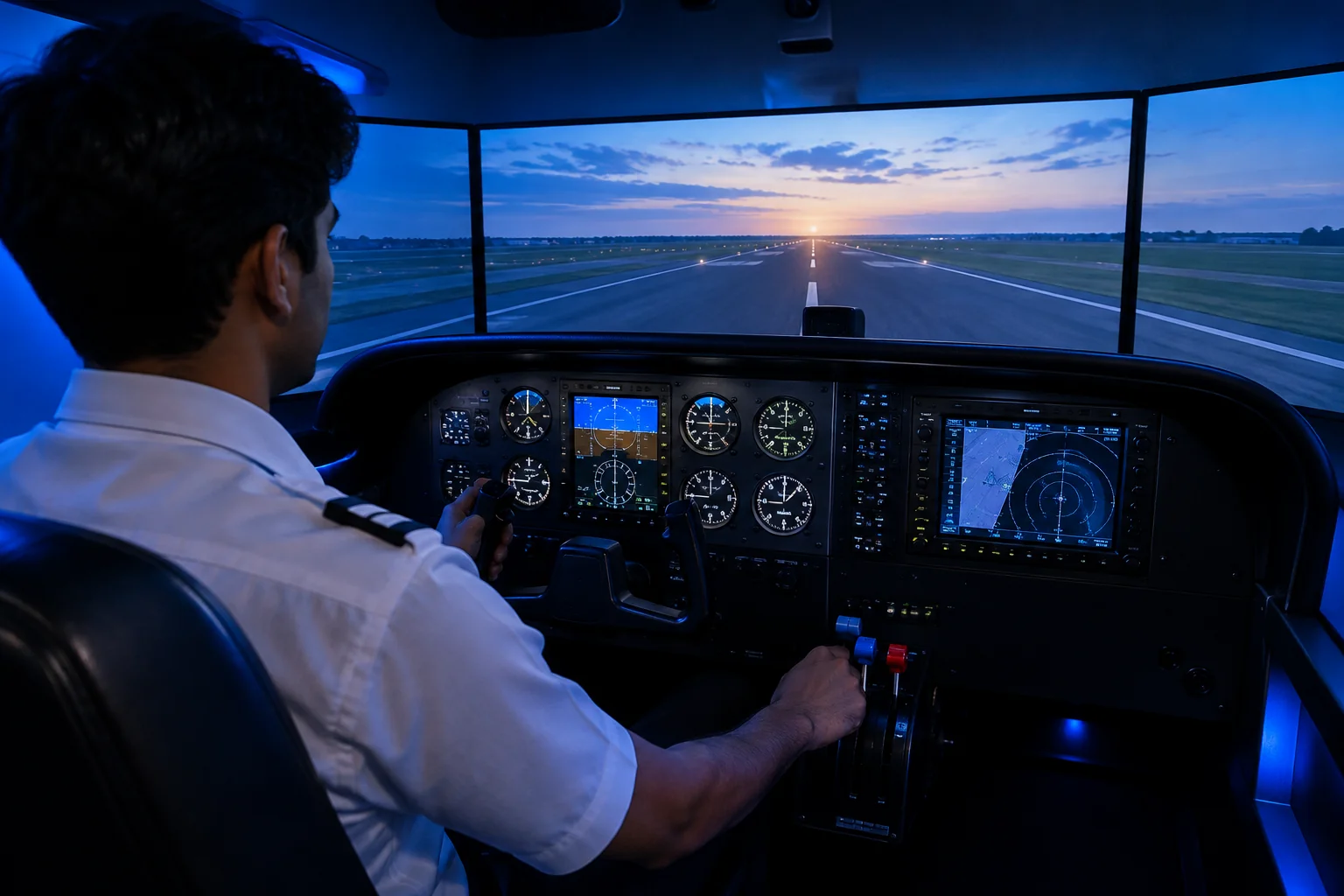
We run Kerala's first C172 fixed-base flight simulator, and hybrid simulators in Delhi. For a student in Thrissur, that means you can feel the layout of a Cessna cockpit before you spend a rupee on aircraft hours. Our post on how fixed-base simulator training actually works covers a session in detail.
| Feature | Fixed-base C172 simulator | Basic desktop trainer |
|---|---|---|
| Controls | Physical yoke, throttle and pedals | Keyboard, joystick or small yoke |
| Instrument panel | Full panel laid out like the aircraft | On-screen gauges |
| Best use | Checklists, radio calls, instrument scan, circuit practice | Learning what each instrument does |
| Instructor review | Session-by-session debrief | Often self-paced |
| Limit | No motion cues; not a replacement for aircraft hours | Weak transfer of muscle memory |
Questions to ask about any simulator
- Is it a fixed-base cockpit with real controls, or software on a PC?
- Which aircraft type does it match, and is that the type you will fly?
- Who sits beside you, and do you get a written debrief?
- Are your simulator sessions recorded somewhere you and your parents can see?
- Is there a charge per session, or is it part of the course fee?
Ask these in person. A simulator that looks impressive on a website but sits unused tells you more than any photo.
Types of ground training providers in Kerala compared
Providers fall into a few types, and none is right for everyone. The table below compares categories, not individual businesses, so use it to build your own list of questions.
| Provider type | Best fit for | Ask before enrolling |
|---|---|---|
| State-owned flying academy | Students who qualify for its intake and want ground and flying under one body | Current intake rules, waiting time and total cost |
| Independent coaching centre | Students who want only theory classes close to home | Mock exam practice, results, what happens if you fail |
| Ground school attached to a flying school | Students sure about one flight school | Whether you can leave for another school, and at what cost |
| Multi-city ground training ecosystem (Rian Air) | Students who want simulator, question bank, tracking and a choice of flying pathways | Refund terms sheet, partner schools, abroad costs |
We are an example of the last type, so read our column with a critical eye. Our alumni views are collected in Rian Air vs Others: Which is Better for Pilot Training.
Multi-city presence: does it matter?
It does if your plans can change. We operate across Thrissur in Kerala, Delhi and Mumbai, so a student who moves for family or work can keep the same records, question bank and teaching approach. Compare the cities in Mumbai vs Delhi vs Kerala for ground classes.
Our Delhi centre uses hybrid simulators, and our study spaces are wired into RAPT, so your progress follows you.
Syllabus, duration and weeks per subject
Ground schooling at Rian Air is typically 6 months. Students overall take 6 to 12 months, and we have had students clear in as little as 4 months and start flight training. The pace depends on how quickly you grasp concepts and how much problem-solving you do.
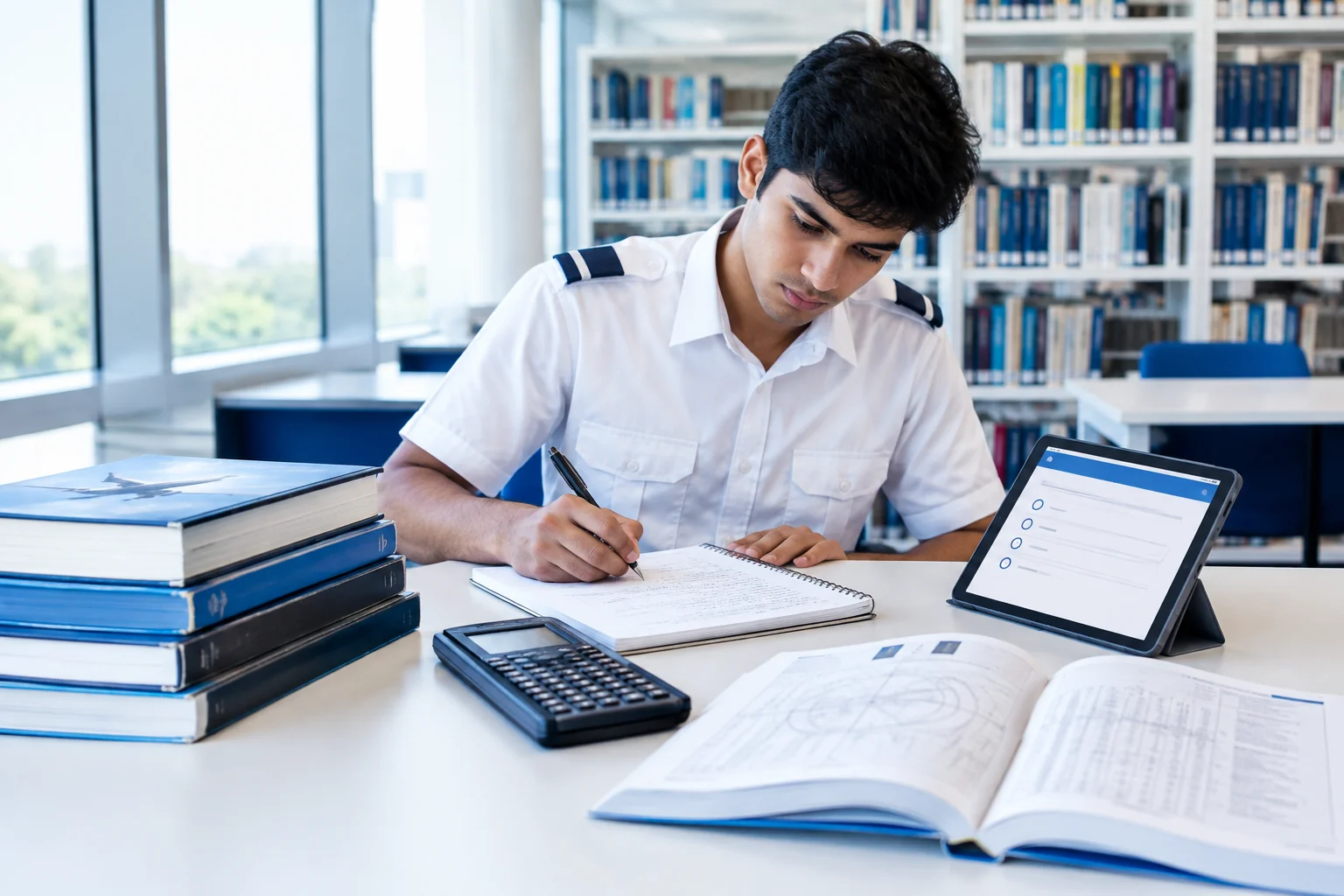
Here is how those 6 months break down, according to our own batches:
- Air Navigation: 2 to 2.5 months.
- Air Regulations and Meteorology: about 1.5 months, taught together.
- RTR: about 15 days, because part of it is covered during navigation.
- Technical General: 2 to 2.5 months. It is optional for students flying abroad. We do not teach it ourselves; our partner flight schools in India cover Technical General and Technical Specific for single and multi-engine aircraft for all Rian Air students.
Be wary of any institute that promises a fixed finish date without asking about your background. Revision sessions are allowed in our programme, and the library is open to you, but we put more weight on solving questions once you understand the concept. Rereading a chapter rarely beats ten solved problems on it.
A real timeline from enrolment to licence
One of our students cleared all his DGCA exams in 4 months. That figure includes medicals and other formalities. He then got his visa, completed his CPL in Tunisia and is about to convert his licence in India.
He is our fastest case, not the typical one. Plan for 6 to 12 months and treat anything faster as a bonus. Get your Class 2 medical done early; why medicals come before ground training explains the reasoning.
Why RAPT should be part of your comparison
RAPT is Rian Air's pilot career intelligence platform, available on web, Android and iOS. It combines a 20,000+ question bank, performance analytics, simulator data and a digital logbook. It matters because it shows you which topics are costing you marks, not just a final score.
Most institutes track progress with monthly mock results on paper. A platform that records every question you answer lets you and your instructor target weak chapters early. It also supports the parent dashboard, so sponsors can see attendance and scores without calling the office.
How RAPT access works
- Demo: about 25% of the questions are free to try.
- CPL question bank: included during ground training with us.
- Students outside our ground training: pricing is not decided yet. Contact us to know more.
- ATPL: free for the first 100 first officers, and we already have 12.
When you visit any institute, ask to see its question bank and analytics on a screen. If the answer is a printed booklet, that is a fair data point for your comparison.
Pass rates, refunds and the agreement terms to read first
About 80% of our students clear on the first attempt. Second attempts usually clear the rest. So far only one or two students have gone to a third attempt. A few left the programme for reasons outside exams, such as a father's death, loan problems after a recent low CIBIL score, the war in the Middle East and parents losing jobs.
We have trained 200+ pilots to date, and 48 students so far this year. Those are our numbers, and you should ask every institute for the same details: how many, and how many on first attempt.
The money-back promise, in plain words
If Rian Air fails to get a student through the DGCA exams, the student gets their money back; terms and conditions apply, so ask for the T&C sheet. Among those terms, 90% attendance is mandatory, and failing the exams more than 3 times entitles the student to the refund.
Ask any institute that advertises a refund for its terms sheet in writing before you enrol. A refund promise is only as good as its conditions.
The Women Empowerment Program
Our Women Empowerment Program offers zero* fee DGCA ground training for aspiring women pilots based on merit (*a refundable commitment deposit applies). The full amount is refunded if the student completes ground training and all DGCA exams within 240 days and goes to one of our recommended flight schools. The entire amount is refunded once she has trained at the flight school for more than 6 months. Details are in our scholarship eligibility guide.
Which agreement terms should parents read first?
Read the training fee with miscellaneous charges first, then the exit and refund policy, the policy if student performance is below the mark, and any job placement or hidden conditions. These four clauses decide who bears the loss if plans change.
Training can be discontinued midway depending on student performance. That applies to flying programmes more than ground school, but ask every institute where it sits in the agreement.
Multi-city presence and what happens after ground school
Ground school is only the first stage. After the exams, you choose where to fly: India, Tunisia, Malta or New Zealand. Your ground training institute should help you compare these options honestly, including the costs nobody likes to mention.
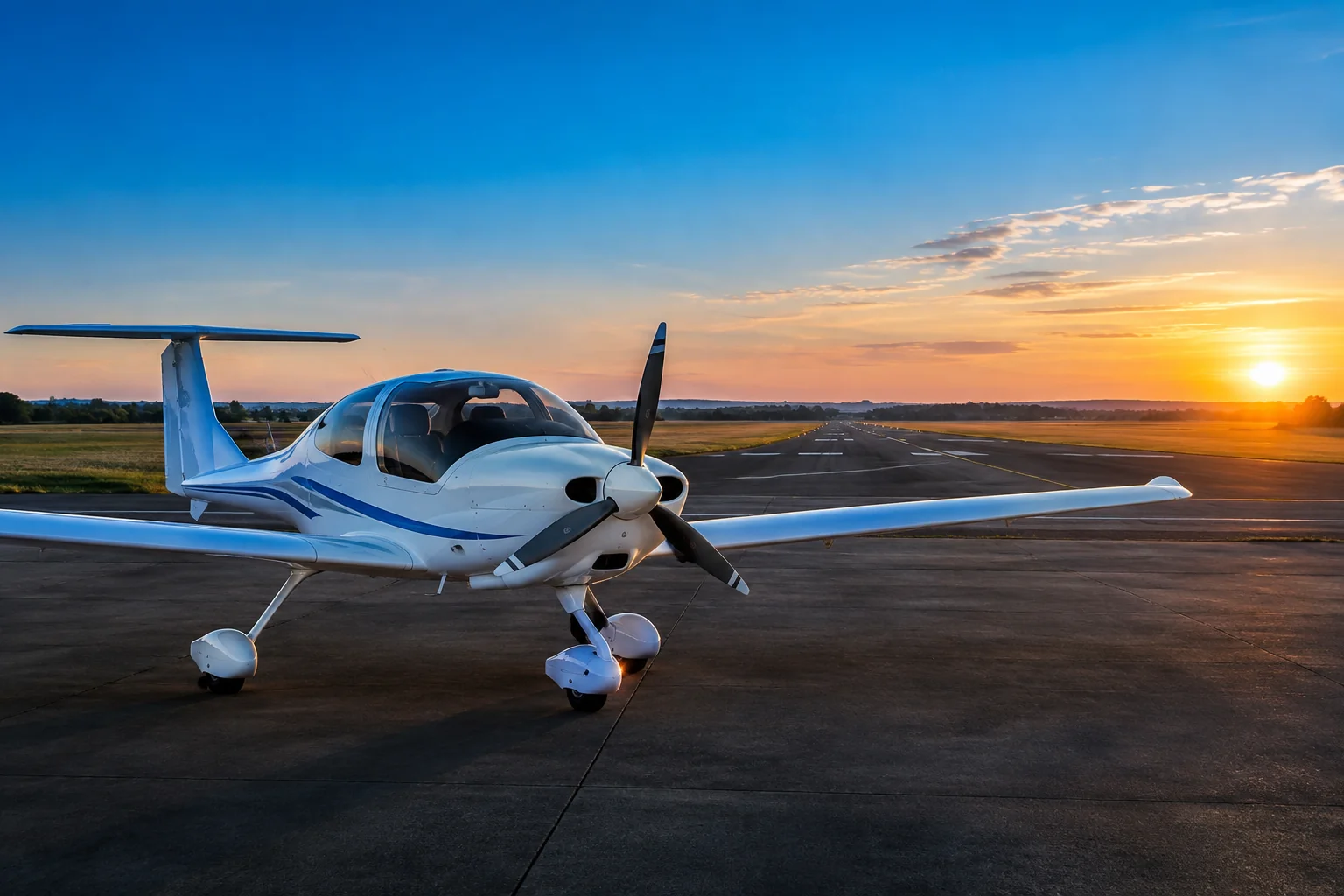
Many partner flight schools use modern fleets such as the Diamond DA40 and DA42. Ask for the aircraft type and age, plus how many aircraft are serviceable at any time, because flight delays cost money.
Costs after ground school, as we see them
| Route | Figure we share | Basis |
|---|---|---|
| CPL in India | Around ₹60 lakh | Our estimate for CPL alone |
| Type rating in India | Around ₹15 lakh | Our estimate |
| CPL abroad | ₹50 to ₹70 lakh, plus conversion in India | Depends on location |
| New Zealand | ₹70 to ₹75 lakh | Including miscellaneous expenses |
| Licence conversion | ₹3.5 lakh to ₹11 lakh | Check only, or recent-experience flying of about 21 to 22 hours, depending on the flying school in India |
| Khajuraho flying | ₹25,000 per hour single-engine; ₹60,000 per hour multi-engine | Block-hour rates; conversion students pay extra for small hour counts |
One recent student's total, including conversion, was ₹50 to ₹75 lakh for training abroad. Our deeper look at CPL in India vs Malta vs Tunisia explains the trade-offs.
Airline cadet programmes: what to know before you apply
We do not refer students to airlines, but we arrange training at our facility for students who need it to enter a cadet programme. Airline cadet programme fees start from ₹89 lakh and go up to ₹1.5 crore, and duration is always 24 to 36 months. After a final LOI, the student works for the airline for 5 years.
The pace is controlled by the airline and its affiliates, so training can be fast when hiring is strong and slow when it is not. Sometimes the airline asks for ATPL exams before type rating. We cannot share airline bond terms; always ask the airline directly, never a middleman.
One student we know received his LOI and was training in the USA under an airline-run cadet programme. Some cadets there were asked to do extra simulator sessions to clear solo. He was terminated after about three quarters of training and is now finishing with another flight school.
Student performance is what most often stalls or changes an LOI application. Separately, about 12 students did not get a visa the first time they applied for an overseas cadet programme, which means extra spend.
A comparison checklist for Thrissur families
Print this and take it to every institute you visit. Score each one from 1 to 5, and do not enrol until every line has a written answer.
- Simulator: fixed-base, real controls, session debriefs.
- Timeline: weeks per subject, in writing.
- Pass data: first-attempt rate and how many reach attempt three.
- Tracking: a platform or dashboard for scores and attendance.
- Refund terms: the full T&C sheet, including attendance rules.
- Exit policy: what you pay if you leave in month three.
- Next step: named flight schools and a cost for each route.
- Cities: can you continue if you move?
If I had to pick one decision rule, it would be this: choose the institute whose weakest answer you can live with. If a family needs the lowest cash outlay today and does not care about tracking, a coaching-only centre may suit them better than us. If you want the simulator, data and a multi-city route in one place, take the full comparison to us.
What stays unsettled is how each academy's results compare, because no public register publishes ground school pass rates. Until one does, ask for numbers and the batch they refer to. For a full local picture, read ground training for pilots in Kerala.
Ready to see the simulator, the RAPT dashboard and the T&C sheet yourself? Start Your Pilot Journey with an enquiry, or explore pathways in India, Tunisia, Malta and New Zealand. You can also follow us on Instagram and subscribe on YouTube for simulator walkthroughs.
Frequently asked questions
What is a ground training institute for pilots?
A ground training institute teaches the theory papers required for a DGCA Commercial Pilot Licence: Air Navigation, Meteorology, Air Regulations, Technical General, Technical Specific and RTR. Good ones add simulators, mock exams and progress tracking, so students enter flight training with the theory and procedures already in place.
How long does ground training for pilots take in Kerala?
At Rian Air, ground schooling typically takes 6 months. Students overall take 6 to 12 months, depending on how quickly they absorb concepts and clear papers. We have had a student clear in 4 months, including medicals and formalities, and start flight training soon after.
Which is better, a fixed-base C172 simulator or a desktop trainer?
A fixed-base C172 simulator is better for building procedural habits, because it has a physical yoke, throttle, pedals and a full instrument panel. A desktop trainer is fine for learning what instruments show, but it transfers less muscle memory. Neither replaces actual aircraft hours.
What is the first-attempt pass rate at Rian Air?
About 80% of Rian Air students clear their DGCA papers on the first attempt. Second attempts usually clear the rest, and so far only one or two students have needed a third attempt. These are our own figures, and you can ask us for the batch details.
Do I have to pay for the RAPT question bank?
About 25% of RAPT demo questions are free. The CPL question bank is included during ground training with Rian Air. Students outside our ground training can contact us, since pricing is not decided yet. The ATPL bank is free for the first 100 first officers; 12 have already joined.
What does the Rian Air money-back promise cover?
If Rian Air fails to get a student through the DGCA exams, the student gets their money back, with terms and conditions applying. Attendance of 90% is mandatory, and failing more than 3 times entitles the student to a refund. Ask for the T&C sheet before enrolling.
Can a student in Thrissur start ground training without moving?
Yes, Rian Air has a Kerala presence with Kerala's first C172 fixed-base simulator, and students can also continue in Delhi or Mumbai if they relocate. Ask our team about class formats and current batch dates so you can plan around your own schedule.
How much does pilot training cost after ground school?
Our estimate for a CPL in India is around ₹60 lakh, with a type rating around ₹15 lakh. Training abroad ranges from ₹50 to ₹70 lakh for the CPL, plus licence conversion of ₹3.5 lakh to ₹11 lakh in India. Costs vary by location.
Is an airline cadet programme better than self-sponsored training?
Not automatically. Airline cadet programmes cost ₹89 lakh to ₹1.5 crore, run 24 to 36 months and require 5 years of service after the final LOI. Termination is possible if performance falls short. Self-sponsored training gives more control over pace and school choice.
What should parents check before paying a ground school?
Parents should check the training fee with miscellaneous charges, the exit and refund policy, what happens if performance is not up to the mark, and any job placement or hidden conditions. Ask for everything in writing and keep a copy of the signed terms.