
What is scholarship in pilot training ?
A scholarship in pilot training is supposed to reduce the fee a student pays for ground school, simulator hours, or CPL flying. In reality, most of the scholarships are scams: they are entrance-exam fee traps dressed up as merit awards, and a California-based flight school running exactly this model in India recently showed how profitable the trick can be.
Key Takeaways
- The exam fee is the product: a school charging ₹5,000 to 10,000 exam-takers collects ₹5 crore before a single scholarship is awarded.
- The "scholarship" is a marketing cost: sponsoring one CPL student at ₹50-60 lakh and discounting a few more still leaves the school ₹3-4 crore in profit.
- Impossible conditions are deliberate: requirements like 95% marks in every subject or clearing DGCA papers in one attempt are set so almost nobody qualifies.
- Genuine offers exist in writing before you pay: Rian Air's money-back promise on DGCA exams is documented on a stamp paper, and its Women Empowerment Program states its zero-fee ground training terms upfront.
- Legitimate full scholarships are rare: a real 100% award for flight training happens only occasionally, not every intake cycle.
At a Glance: Real vs Fake Scholarship Signals
| Signal | Fake scholarship pattern | Genuine scholarship pattern |
|---|---|---|
| Entrance fee | ₹3,000-10,000 charged to every applicant, no exceptions | Free or nominal, or waived for scholarship applicants |
| Terms and conditions | Revealed only after payment, verbal promises | Given in writing before enrolment, sometimes notarised |
| Eligibility bar | 95%+ in all subjects, clear DGCA in one attempt | Merit-based with realistic, stated thresholds |
| Number of applicants who actually win | School won't disclose past figures | School can quote how many students benefited last cycle |
| What the school actually sponsors | 1 full award funded by thousands of exam fees | Structured discount tied to an actual training seat |
| Refund policy if you fail | None, or buried in fine print | Documented money-back terms, e.g. on stamp paper |
What is a Scholarship in Pilot Training, Really?
A pilot training scholarship should mean one thing: a training provider reduces or waives part of your ground school, simulator, or CPL flying fee because you met a stated, verifiable standard. That is the textbook definition, and it is also the phrase that gets abused most in Indian aviation marketing today.
The word "scholarship" carries weight because parents financing a ₹40-80 lakh training programme are actively looking for ways to cut cost. Flight schools and ground academies know this. Some genuinely sponsor seats. Others use the word purely to get a family to open their wallet for a preliminary "entrance exam," and that is where the real business model sits, not in the training fee at all.
If you are researching how to become a commercial pilot in India after 12th, you will run into dozens of these offers before you ever sign a training contract. Knowing which ones are structurally sound matters more than knowing which ones sound generous.
The Entrance Exam Scam: A California Flight School's India Case Study
How does an entrance-exam scholarship scam actually make money? It works by charging every applicant a fee for a mandatory qualifying test, then sponsoring only a token number of winners while pocketing the rest of the collected fees as profit.
A California-based flight school running recruitment in India offers a clean, verifiable example of the math. It charged applicants an entrance exam fee, positioned as the gateway to a "full scholarship" for CPL training. Roughly 10,000 students appeared for the exam.
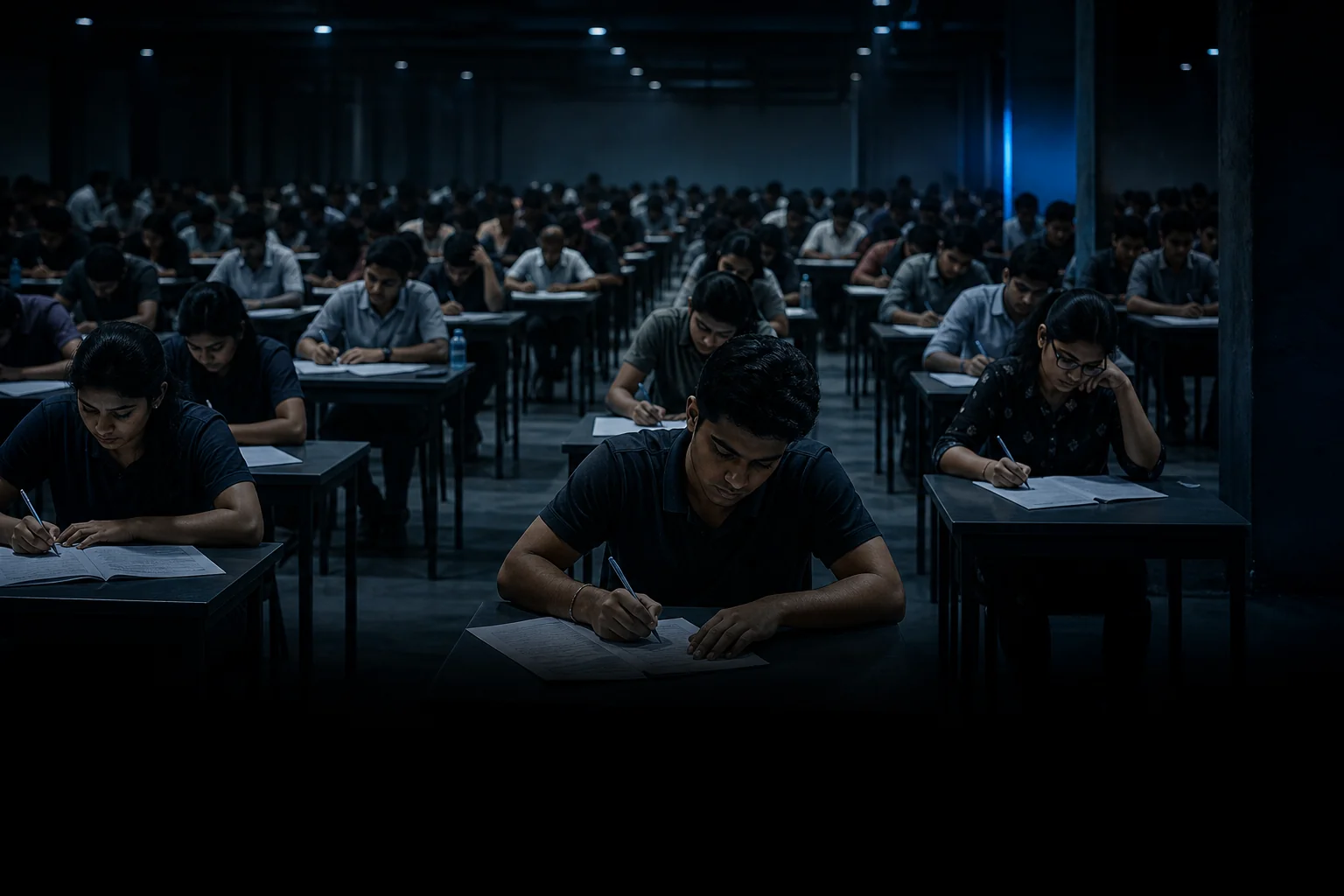
At ₹5,000 per candidate, that single exam round collected close to ₹5 crore before a single rupee went toward training anyone. The school then sponsored full CPL training for one topper, at an approximate cost of ₹50-60 lakh. A second-ranked student received around 70% off. Everyone else in a shrinking tier received discounts somewhere between 20% and 50%, most of whom would never actually enrol.
Net result: the school spends roughly ₹50-60 lakh on the top scholarship, gives away a modest amount in partial discounts to a handful of students who convert, and still walks away with an estimated ₹3-4 crore in profit from the exam fee alone. The larger the applicant pool, the larger the margin. Ten thousand candidates is not incidental; it is the entire point of the campaign.
This is not a training business subsidising talent. It is an exam-fee business that uses the language of merit to justify mass collection.
How the Entrance Exam Becomes a Lead-Capturing Funnel
Beyond direct revenue, what does the exam fee actually buy the school? It buys a database of thousands of motivated families, each one already primed by a discount narrative to enrol in paid ground school or CPL packages afterward.
Every applicant hands over a phone number, an email address, parental contact details, and a payment record. That data becomes the counselling call list for the following three months. The scholarship framing does the persuasion work for free: a student who scored well but missed the top discount tier feels invested enough to pay full fee rather than walk away.
The discount tiers themselves are usually reverse-engineered. The school first calculates how many students are statistically likely to convert at 20-50% off, then labels that number a "scholarship band" so it reads as generosity rather than a sales funnel. It rarely has anything to do with academic merit measured against a fixed, published standard.
Genuine ground schools that publish their DGCA CPL exam subjects and syllabus openly, without charging for access to that information, are a useful contrast. Free information is a service. A paid exam gate is a filter for leads.
Why Most of the Scholarships Are Scams: The Impossible Terms and Conditions Trick
Why do so many advertised scholarships end with almost nobody actually winning one? Because the eligibility bar is deliberately set above what any realistic student can achieve, so the marketing headline circulates while the payout obligation almost never triggers.
Common versions of this trick include requiring 95% or higher marks across every single DGCA subject, demanding that a student clear all seven papers in one sitting with zero retakes, or insisting the applicant pass every exam on the first attempt with no exceptions for illness, travel, or scheduling clashes. Real DGCA aspirants rarely clear all subjects in one attempt; even strong students often need two rounds for at least one paper.
A condition that fewer than 1% of applicants can ever meet is not a merit filter. It is a marketing claim with an escape clause built in.
Ground schools running these campaigns rarely publish how many students actually received the award in the previous cycle. If a school cannot answer "how many scholarships did you actually give last year, and to whom," treat the number zero as the working assumption until proven otherwise.
Parents who understand the real DGCA pass patterns are far less likely to fall for this. That is one reason we cover how to pass the DGCA exam in first attempt as an honest process, not a marketing promise dependent on it.
How to Spot a Genuine Scholarship Program
You can spot a genuine scholarship by checking three things before you pay anything: whether the terms are in writing, whether there is a paid entrance gate, and whether the school will disclose past numbers.
Ask for the written terms and conditions before the exam date, not after. Ask whether the entrance test fee is separate from, or bundled into, the scholarship marketing. Ask how many students in the last intake actually received a discount, and at what percentage. A school with nothing to hide will answer all three without hesitation.
What Rian Air Actually Offers (In Writing)
What does Rian Air actually offer instead of a headline scholarship claim? Two documented programmes: a money-back promise on DGCA exam outcomes, and a Women Empowerment Program with zero-fee ground training, both stated in writing with terms and conditions attached, not verbal promises.

The money-back promise states that if Rian Air fails to get a student through the DGCA exams, the student gets their money back, subject to terms and conditions that are provided on a stamp paper, not buried in a footnote. That structure means the commitment is enforceable, not aspirational.
The Women Empowerment Program offers zero-fee DGCA ground training for aspiring women pilots, based on merit, with a refundable commitment deposit applying as stated. There is also a gender-neutral, merit-based scholarship route open to all qualifying candidates. Neither of these is tied to a paid mass entrance examination designed to fund itself.
We should also be honest about what Rian Air does not currently offer: there is no 100% scholarship for flight training at this time. Genuine full-cost awards in aviation are scarce, and they should be. When one becomes available, it will be announced, not marketed through an exam fee funnel disguised as merit selection.
You can start reviewing programme eligibility directly through the Check Your Eligibility form, or explore the different Explore Pathways options for ground school, simulator training, and CPL routes before committing to any programme.
Where This Matters for Parents in Delhi, Mumbai and Kerala
Families across Delhi, Mumbai, and Thrissur are among the most heavily targeted markets for these entrance-fee campaigns, since large urban and semi-urban student populations make bigger applicant pools and bigger exam-fee collections possible.
Local ground schools in these cities routinely run seasonal "scholarship test" campaigns timed around Class 12 results, when students are most anxious about next steps. A Delhi family evaluating options should ask the same three verification questions before paying any exam fee, regardless of how well-produced the school's marketing looks. A Thrissur student weighing Kerala's simulator training options against a scholarship claim from an out-of-state school should apply identical scrutiny; a training academy's simulator infrastructure or DGCA pass record tells you far more than a discount percentage ever will.
If you want a structured comparison of what genuine, DGCA-aligned training actually costs before any discount claims enter the picture, our breakdown of pilot training cost in India and hidden fees parents miss is a better starting reference than any single scholarship advertisement.
A Checklist Before You Pay Any Pilot Scholarship Exam Fee
- Ask for the scholarship terms and conditions in writing, before the exam date.
- Confirm whether the entrance exam fee is refundable if you don't win any discount.
- Ask how many students received a scholarship in the last intake, and at what percentage each.
- Check if the eligibility bar (marks, attempts, subjects) is realistically achievable by a typical strong student.
- Verify the school's DGCA approval and training infrastructure independently, separate from the scholarship claim.
- Compare the entrance fee against the size of the applicant pool the school is targeting; a mismatch signals a lead-generation exercise, not a genuine award.
- Never treat a verbal promise as a substitute for a signed, dated document.
The Directorate General of Civil Aviation publishes official CPL licensing requirements on its own portal, which is a useful independent reference point when a school's marketing claims don't line up with what the regulator actually requires; see the DGCA's official website for licensing rules. Consumer complaints about fee-based education scams in India can also be filed through the government's National Consumer Helpline.
Frequently Asked Questions
Are all pilot training scholarships fake?
No, but most of the scholarships are scams when they are attached to a mandatory paid entrance exam and impossible eligibility terms. Genuine ones are documented in writing, don't depend on a paid test to fund themselves, and are disclosed with real past numbers.
How does Rian Air's money-back promise work?
If Rian Air is unable to get a student through the DGCA exams, the student receives their money back, subject to terms and conditions provided in writing on a stamp paper. It is not tied to any entrance exam fee or discount tier.
Who is eligible for the Women Empowerment Program?
Aspiring women pilots can access zero-fee DGCA ground training on a merit basis, with a refundable commitment deposit applying as per the programme's stated terms. It is separate from Rian Air's gender-neutral, merit-based scholarship track.
Before you pay any exam fee for a pilot "scholarship," ask for the written terms first. If you want a straight, documented answer about what Rian Air's programmes actually cover, Talk to a Pilot Career Advisor or Schedule Appointment for a walkthrough of eligibility and current training pathways. You can also follow real training updates on Instagram and YouTube before committing to any programme.