



DGCA Past Question Papers for Pilots: Sample CPL MCQs With Answers
DGCA does not release official past question papers. The DGCA publishes the syllabus for each examination, and that syllabus is the official reference. You can read it on the DGCA Pariksha syllabus page. Practice papers built on the pattern of earlier CPL theory exams fill the gap.
They cover Air Navigation, Meteorology, Air Regulations, Technical General, Technical Specific and RTR. At Rian Air in Delhi, they sit inside the RAPT platform with answers and explanations, and a free demo gives you 500 questions to try first.
Key Takeaways
- Past papers teach the pattern: You learn how DGCA words questions, which topics repeat and where you lose marks, long before exam day.
- Six CPL areas, one platform: RAPT covers Air Navigation, Meteorology, Air Regulations, Technical General, Technical Specific (single and multi engine) and RTR Part 1.
- Free start: The RAPT demo has 500 questions, and you sign up with your name, phone number, email and date of birth.
- Practice works fast: On RTR Part 1 mocks, students who start in the 50s or 60s typically reach the 70s in a week and above 90 by week 3.
- Parents can follow along: The RAPT parent dashboard shows a student's progress, so families are not guessing.
DGCA Past Question Papers at a Glance (Quick Facts)
| Paper / Item | What to know |
|---|---|
| Air Regulations | 50 questions, 35 correct needed to pass (70%), 2 hours |
| Air Navigation and Meteorology | Separate CPL papers; the two become one composite paper (100 marks, 100 questions, 3 hours) in the foreign licence conversion route if they are not cleared before departure |
| Air Navigation, Meteorology, Air Regulations (RAPT banks) | Per-subject counts vary and are being updated, so ask your counsellor for the current figure for each. We have not fixed one here. |
| Radio Navigation (RAPT bank) | 2757 questions |
| Technical General | RAPT bank holds more than 1500 questions |
| Technical Specific | Aircraft-type based; multi engine is a separate paper |
| RTR Part 1 | DGCA pattern is 50 questions; RAPT bank has about 800 questions |
| Free RAPT demo | 500 questions with answers and explanations |
| Question updates | New questions are added after every DGCA exam, every month |
What Are DGCA Past Question Papers and Why Do They Matter for CPL?
DGCA past question papers are questions that reflect earlier Commercial Pilot Licence theory exams, grouped by subject. They matter because the exam rewards pattern recognition. You see how examiners phrase a question, which topics return often, and where your own gaps are before you pay for an attempt.
The DGCA's Civil Aviation Requirement for flight crew licensing lists the CPL theoretical knowledge subjects as Air Navigation, Aviation Meteorology, Air Regulation and aircraft and engine papers (general and specific). Radio Telephony, RTR(A), is the sixth piece most students sit alongside them.
Every attempt costs money. The Pariksha user manual states that exam fees are paid online at Rs.2500 per examination paper. A failed paper is therefore a real cost, and practising on past-pattern questions is the cheapest insurance.
Where to find official DGCA material
The official source for exam notices, results and admit cards is the DGCA Pariksha portal. The syllabus for each examination is published on the DGCA syllabus page. Be careful with PDFs of "past papers" shared on messaging apps or random sites, because they may be outdated or carry wrong answers. Check the syllabus first, then practise on a bank that is updated after each exam.
Which topics recur most? A worked look at wrong-answer data
We do not publish a ranked topic list, and we will not invent one. The wrong-answer log inside RAPT is where recurrence shows up, and you can run the analysis yourself in four steps:
- After each mock, count wrong answers per topic.
- Divide each topic's wrong answers by your total wrong answers to get its share.
- Rank the topics by share.
- Retake a mock built on the top two.
Suppose you got 10 questions wrong in a mock: 4 on variation, 3 on lapse rate and 3 on rules of the air. Variation has the largest share of your errors, so it goes first. This example is hypothetical and is not RAPT data.
The sample questions below cover the topics we see return: latitude and heading calculations in Air Navigation, ISA, clouds and fog in Meteorology, rules of the air in Air Regulations, and the four forces and instruments in Technical General.
A note on the sample questions below
The MCQs in this guide are not actual DGCA past papers. They are representative practice questions written to show how each paper works, and they are not copied from any DGCA exam. Each sample set is a short slice, not a full 50-question paper. DGCA's pattern is 50 questions, and on RAPT you can build full 50-question papers in different permutations.
Which syllabus topic does each sample question test?
| Sample question | Syllabus topic tested |
|---|---|
| Air Nav Q1, Q5 | Earth geometry and the 1-in-60 rule |
| Air Nav Q2 | Direction: true, magnetic and variation |
| Air Nav Q3, Q4 | Time and distance; turn rates |
| Met Q1, Q2 | The International Standard Atmosphere |
| Met Q3, Q4 | Clouds, thunderstorms and fog |
| Met Q5 | Altimetry and pressure settings |
| Air Regulations Q1-Q5 | ICAO and Annexes, rules of the air, registration marks |
| Technical General Q1-Q5 | Principles of flight, controls and instruments |
| Technical Specific Q1-Q10 | Piston engines, propellers and multi engine handling |
| RTR Q1-Q5 | Radio telephony phraseology and emergency procedures |
Who this guide is for
Aspiring CPL pilots in Delhi, Mumbai and Thrissur, and the parents funding them, will find each paper explained in plain language. If you are still planning, our beginner's roadmap to ground training in Delhi covers the bigger picture.
How Do You Use DGCA Past Question Papers in Plain Steps?
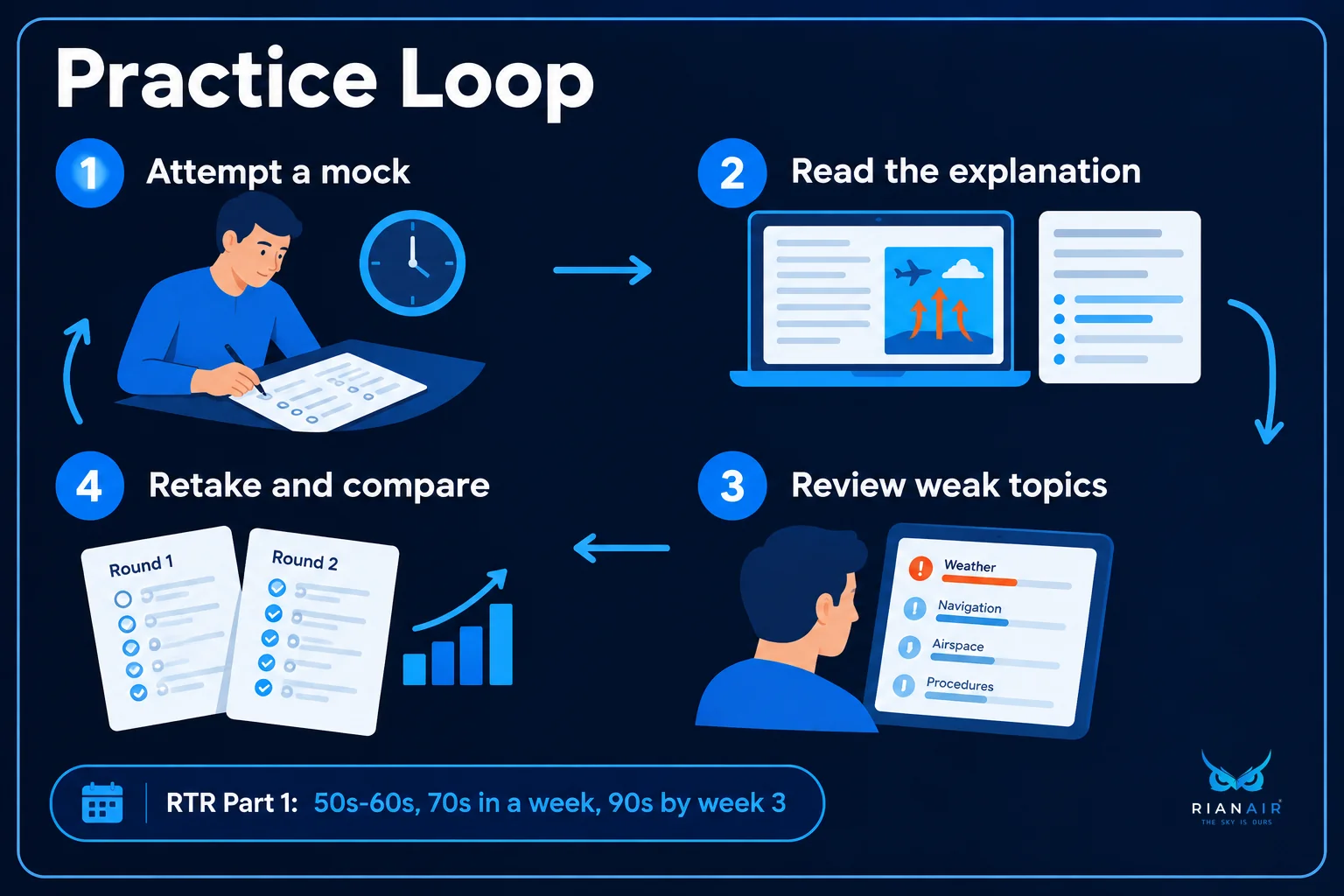
Attempt a timed mock, read the explanation for every answer, list the topics you missed, then retake a mock filtered to those topics. Repeat this loop daily. Consistent repetition is what moves scores, because the same topic keeps returning in different wording across papers.
- Start with the demo. Solve the first 500 questions to see your starting level without any pressure.
- Take one subject at a time. Finish a subject's chapters before mixing papers.
- Read every explanation. Read it even when you answered correctly, to confirm you got it for the right reason.
- Filter by weak areas. RAPT lets you build a mock around your weakest chapters.
- Finish with exact-format mocks. In the last weeks, use the exact DGCA format under timed conditions.
A worked wrong-answer review
Suppose you answer Air Nav Q2 below with (a) 085°. Do not just note the right answer. Write down three lines:
- What I chose and why: I subtracted the 5° variation because I forgot the direction rule.
- The rule: Magnetic = true + West variation, and magnetic = true − East variation.
- Retest: Redo three variation questions with both East and West before the next mock.
RAPT lets you attempt wrong questions again, so the mistake is eliminated by exam day. That is why we aim for 100% in mocks.
What scores should you expect?
On RTR Part 1 mock tests, students often begin in the 50s or 60s. With daily practice they reach the 70s within a week and score above 90 by week 3. Week 2 matters most, because that is when careless errors are removed. By exam time, students report 90-100% accuracy.
The same pattern holds across subjects. Consistent practice beats long, irregular study sessions. As Capt. Vikas Vikramdas Nair says, everything is difficult if you do not practise, and everything is easy if you practise consistently.
Air Navigation Sample MCQs With Answers
Air Navigation tests chart work, headings, wind, time and distance. These five questions show the calculation style. Our air navigation question bank guide goes deeper into each topic.
Q1. How many nautical miles equal one degree of latitude? (a) 30 (b) 60 (c) 90 (d) 120
Answer: (b) 60. One degree of latitude is 60 NM everywhere on Earth.
Q2. True heading is 090° and variation is 5° West. What is the magnetic heading? (a) 085° (b) 090° (c) 095° (d) 100°
Answer: (c) 095°. The rule is magnetic = true + West variation. So 090° + 5° = 095°. For East variation you subtract instead.
Q3. Ground speed is 120 knots. How long does 90 NM take? (a) 30 min (b) 40 min (c) 45 min (d) 50 min
Answer: (c) 45 min. 90 divided by 120 is 0.75 hours.
Q4. A standard rate turn is how many degrees per second? (a) 1 (b) 2 (c) 3 (d) 6
Answer: (c) 3. That gives a full 360° turn in two minutes.
Q5. After 60 NM you are 6 NM off track. By the 1-in-60 rule, what is the track error? (a) 3° (b) 6° (c) 10° (d) 12°
Answer: (b) 6°. One NM off per 60 NM flown equals one degree.
In our September batch, most students attempted navigation, and 13 of 21 cleared their exams in that attempt. Separately, 35 of 38 students using our question bank cleared the DGCA Air Navigation paper on the first attempt, and RAPT records show more than 90% till date.
Meteorology Sample MCQs With Answers
Meteorology covers the atmosphere, clouds, fronts, fog, thunderstorms and weather reports. Questions are mostly factual, so repetition pays. Read more in our meteorology question bank guide.
Q1. What are ISA mean sea level temperature and pressure? (a) 10°C, 1000 hPa (b) 15°C, 1013.25 hPa (c) 20°C, 1013.25 hPa (d) 15°C, 1000 hPa
Answer: (b). ISA starts at 15°C and 1013.25 hPa at sea level.
Q2. What is the approximate ISA lapse rate in the troposphere? (a) 0.5°C per 1000 ft (b) 1°C per 1000 ft (c) 2°C per 1000 ft (d) 6°C per 1000 ft
Answer: (c). The rule is that ISA temperature falls about 2°C per 1000 ft, which is the same as 6.5°C per kilometre. Option (b), 1°C, is too small, and (d), 6°C, confuses the per-kilometre figure with the per-1000 ft figure.
Q3. Which cloud type is associated with thunderstorms? (a) Stratus (b) Cirrus (c) Altostratus (d) Cumulonimbus
Answer: (d) Cumulonimbus. It is the towering cloud with strong up- and downdrafts.
Q4. Which fog forms on a clear, calm night over land? (a) Advection fog (b) Radiation fog (c) Steam fog (d) Frontal fog
Answer: (b) Radiation fog. The ground cools by radiation and chills the air above it to dew point.
Q5. With QNH set, what does the altimeter read on the ground? (a) Zero (b) Pressure altitude (c) Aerodrome elevation (d) Density altitude
Answer: (c) Aerodrome elevation. QNH is the pressure setting that makes the altimeter read altitude above mean sea level. On the ground, that reading equals the aerodrome elevation. Setting 1013.25 hPa (standard) would give pressure altitude instead.
Air Regulations Sample MCQs With Answers
The Air Regulations paper has 50 questions and a 2-hour limit, and you need 35 correct (70%) to pass. Students find it manageable once rules of the air and licensing sections are revised. See our air regulations question bank guide for more.
Q1. Which convention created ICAO? (a) Tokyo 1963 (b) Chicago 1944 (c) Montreal 1999 (d) Paris 1919
Answer: (b) Chicago 1944.
Q2. Which ICAO Annex covers the Rules of the Air? (a) Annex 1 (b) Annex 2 (c) Annex 6 (d) Annex 13
Answer: (b) Annex 2. Annex 1 is personnel licensing, Annex 6 is operation of aircraft.
Q3. Two aircraft approach head-on. What should each do? (a) Climb (b) Descend (c) Alter heading to the right (d) Alter heading to the left
Answer: (c) Alter heading to the right.
Q4. Which aircraft has right of way when one overtakes another? (a) The overtaking aircraft (b) The overtaken aircraft (c) The faster aircraft (d) The larger aircraft
Answer: (b) The overtaken aircraft. The overtaking aircraft keeps clear by altering course to the right.
Q5. Indian civil aircraft registration marks begin with which letters? (a) AI (b) IN (c) VT (d) IA
Answer: (c) VT.
Technical General Sample MCQs With Answers
Technical General covers principles of flight, airframes, systems and instruments. RAPT holds more than 1500 questions for it, and every topic deserves equal time. Students rarely fail one topic; they fail because they practised too little overall. Our Technical General question bank guide explains more.
Q1. Which four forces act on an aircraft in flight? (a) Lift, weight, thrust, drag (b) Lift, mass, power, drag (c) Lift, weight, torque, drag (d) Lift, thrust, speed, weight
Answer: (a).
Q2. When airflow velocity increases, static pressure will: (a) Increase (b) Decrease (c) Stay the same (d) Double
Answer: (b) Decrease. This is Bernoulli's principle.
Q3. At what condition does a wing stall? (a) Below a set airspeed (b) At the critical angle of attack (c) Above a set altitude (d) At maximum power
Answer: (b). A wing can stall at any airspeed if the critical angle of attack is exceeded.
Q4. Which control surface controls roll about the longitudinal axis? (a) Elevator (b) Rudder (c) Ailerons (d) Flaps
Answer: (c) Ailerons.
Q5. Which instrument uses both pitot and static pressure? (a) Altimeter (b) Vertical speed indicator (c) Airspeed indicator (d) Turn coordinator
Answer: (c) Airspeed indicator. The altimeter and VSI use static pressure only.
Technical Specific Sample MCQs (Single Engine and Multi Engine)
Technical Specific questions depend on the aircraft type you train on, and the multi engine paper is separate. Students flying in India can complete these during flight training. The RAPT sets cover aircraft such as the C152, C172, PA34, Tecnam P2006, DA40, DA42 and Piper Archer, and aircraft and questions are added every day. Below are five single engine piston questions and five multi engine questions.
Single engine piston
Q1. Why do piston aircraft have two magnetos? (a) More power only (b) Redundancy and better combustion (c) Cooling (d) Charging the battery
Answer: (b). The ignition also works independently of the electrical system.
Q2. Applying carburettor heat has what effect on the mixture? (a) Leans it (b) Enriches it (c) No effect (d) Cuts fuel
Answer: (b) Enriches it. Hot air is less dense, so the mixture gets richer.
Q3. What colour is AVGAS 100LL? (a) Red (b) Green (c) Blue (d) Clear
Answer: (c) Blue.
Q4. Why lean the mixture in a climb? (a) Air gets less dense (b) Fuel gets heavier (c) Oil pressure drops (d) Cylinder heads cool
Answer: (a). Less air means less fuel is needed to keep the right ratio.
Q5. What does a constant-speed propeller governor adjust? (a) Throttle (b) Mixture (c) Blade pitch (d) Fuel flow
Answer: (c) Blade pitch. It holds the selected RPM.
Multi engine
Q6. What does Vmc mean? (a) Maximum cruise speed (b) Minimum control speed with one engine inoperative (c) Maximum climb speed (d) Minimum glide speed
Answer: (b). It is the lowest speed at which direction can be held after an engine failure.
Q7. In a twin with both propellers turning clockwise (seen from behind), which engine is critical? (a) Right (b) Left (c) Both equal (d) Neither
Answer: (b) Left. Which engine is critical depends on propeller rotation. With clockwise propellers, P-factor makes the descending blade on the right side produce more thrust, so the right engine's thrust line sits farther from the centreline. If the left engine fails, the right engine's thrust acts through that longer arm, and handling suffers most. With counter-rotating propellers, there is no critical engine.
Q8. What does feathering a propeller do? (a) Increases thrust (b) Reduces drag on a failed engine (c) Cools the engine (d) Raises RPM
Answer: (b). The blades turn edge-on to the airflow.
Q9. What is Vyse, the blue line speed? (a) Best glide (b) Best angle with both engines (c) Best rate of climb, one engine inoperative (d) Maximum flap speed
Answer: (c).
Q10. In "dead foot, dead engine," which pedal do you press? (a) The one on the failed side (b) The one on the operating side (c) Neither (d) Both
Answer: (b). Pressure goes on the live engine's side to keep the aircraft straight.
RTR Part 1 Sample MCQs With Answers
RTR Part 1 is the written radio telephony test. The DGCA pattern is 50 questions, and on RAPT you can build different permutations of them. The RAPT bank has about 800 questions, which is manageable if you revise well.
Q1. Which prefix signals an urgency message? (a) MAYDAY (b) PAN-PAN (c) SECURITE (d) BREAK
Answer: (b) PAN-PAN, spoken three times. MAYDAY is for distress.
Q2. Which frequency is the international emergency frequency? (a) 118.0 MHz (b) 121.5 MHz (c) 123.45 MHz (d) 126.7 MHz
Answer: (b) 121.5 MHz.
Q3. Which transponder code indicates radio failure? (a) 7500 (b) 7600 (c) 7700 (d) 7000
Answer: (b) 7600. 7500 is unlawful interference and 7700 is emergency.
Q4. What does "Roger" mean? (a) Yes (b) Repeat (c) I have received all of your last transmission (d) Stand by
Answer: (c). It does not mean yes or no.
Q5. What does "Wilco" mean? (a) Say again (b) Will comply (c) Wait (d) Correct
Answer: (b) Will comply. It means the message is understood and will be carried out.
Part 2: practising live calls
Part 2 is the oral test of live radio calls, and a question bank cannot replace speaking. In Delhi, in-person students fly our simulator and make RTR calls under pressure, so the DGCA exam feels familiar. Part 2 typically takes 3-4 weeks, and Parts 1 and 2 together take 2-4 weeks.
Our RTR prep is Rs 20,000 and includes 2 hours on a simulator; extra simulator hours are Rs 1,000 per hour. We recommend 3-5 hours in total. Our RTR exam guide explains both parts in detail.
Exam-Day Checklist
- Register on Pariksha. Create your flight crew candidate profile on the Pariksha portal. The Pariksha FAQ lists the minimum qualification to register.
- Choose papers and pay. After login, press "click here to proceed for paper selection" and pick your papers. Pay online at Rs.2500 per examination paper, as the user manual states.
- Check notices. Session dates, venue lists and admit card downloads appear on the portal's notice board.
- Download your admit card. Print it and carry it. We do not list ID requirements here, because they are set by DGCA. Open "Instructions for FC, AME and RTR examination" on the Pariksha notice board for your session and follow it exactly.
- Check attempt rules before you book. The user manual says that in a particular session a candidate is initially allowed to appear in only one specific aircraft paper. It also says the Rs.500 oral paper fee applies to the 2nd and 3rd attempt oral only. For current attempt-validity limits, read the same manual and the session instructions.
- Do a timed mock the day before. Use the exact DGCA format.
RAPT at a Glance, Including the Parent Dashboard
RAPT is Rian Air's pilot career intelligence platform, available on web, Android and iOS. It brings DGCA academics, simulator data, performance analytics and digital logbooks into one place.

- DGCA-aligned question bank: 2840 questions in total, with answers and explanations. The Technical General figure of more than 1500 and the Radio Nav figure of 2757 are per-subject counts from the owner's RAPT records and are not additive to this total.
- Mock exams: Use the exact DGCA format or customise by chapter, weak area and easy, moderate or hard mode.
- Performance analytics and logbook: See where you stand subject by subject, and keep flight and simulator records digitally.
- Parent dashboard: Parents and sponsors can follow a student's progress without chasing updates.
Why the parent dashboard matters
Parents often fund training without seeing what happens day to day. The dashboard gives them visibility into practice and results, so conversations at home are about facts. Students gain too, because steady progress is easy to see and hard to fake.
How RAPT access works after the demo
Beyond the 500-question demo, full CPL access is for students who attend ground training with Rian Air, who pay the ground training fee for the subject they attend. Air Navigation is Rs 40,000, Meteorology Rs 20,000, Air Regulations Rs 20,000 and RTR Rs 20,000, with taxes extra. RAPT is included during training.
Free 500-Question Demo and Progress Check
The free demo gives you 500 questions with no cost. It is the easiest way to see where you stand before you commit to anything. A per-subject split of the 500 is not fixed in our records, so treat it as one mixed set. Sign up on the RAPT free demo page and treat it as a progress check.
- Enter your name, phone number, email and date of birth.
- Open the email sent to your registered address.
- Follow the link to set your password.
- Log in and start solving.
If you are satisfied after 500 questions, you can sign up for classes, online or offline, or request a demo online class. Students needing offline classes can visit their nearest training centre. For more on the demo, read our free question bank demo guide.
Ground training for Navigation, Meteorology, Regulations and RTR typically takes 4-6 months. This is our own experience and not a DGCA-set duration. DGCA sets the syllabus and the exams, not the length of your preparation. Technical General and Technical Specific are optional if you want to fly in India, since they can be done during flight training there.
Frequently Asked Questions
Are DGCA past question papers enough to pass?
They are the most useful tool, but not the only one. Past-pattern questions show you what to expect, while syllabus study and classes fix the concepts behind wrong answers. Practise daily until your mock scores stay consistently high.
Which CPL papers does RAPT cover?
RAPT covers Air Navigation, Meteorology, Air Regulations, Technical General, Technical Specific (including a separate multi engine set) and RTR Part 1. Each subject has questions with answers and explanations.
Is the demo really free?
Yes, the 500-question demo costs nothing. Full CPL access beyond the demo is tied to attending ground training with Rian Air for a subject, and the fee for that subject covers it.
Are the questions updated?
Yes. We add new questions after every DGCA exam, every month, and we also update past question papers. The bank keeps growing, so you practise against current patterns and not a frozen set.
Can I take mock exams in the real DGCA format?
Yes. RAPT offers multiple mock exams in the exact DGCA format. You can also customise a mock by chapter or weak area, and apply easy, moderate or hard filters.
Is multi engine Technical Specific a separate paper?
Yes. Technical Specific for multi engine is a separate set, and RAPT keeps it separate. Practise it after your single engine set so aircraft details do not get mixed up in your memory.
Do I need Technical General and Technical Specific to fly in India?
They are optional in our ground-training plan if you want to fly in India, since they can be completed during flight training there. Navigation, Meteorology, Regulations and RTR make up the core ground course.
How long does CPL ground training take?
In our experience the full ground course, covering Navigation, Meteorology, Regulations, RTR and simulator sessions, takes 4-6 months. Pace varies by student. Some have cleared everything, including all DGCA exams, in as little as 3.5 months. Others take more than a year.
What does the parent dashboard show?
It lets parents and sponsors follow a student's progress on RAPT. Instead of asking for updates, they can see practice activity and results.
Can I use RAPT on my phone?
Yes. RAPT works on the web, Android and iOS, so you can practise questions on a phone during travel or between classes, and pick up again on a laptop.
Take the Next Step
You do not need to guess where you stand. Take the free demo, solve your first 500 questions, and see which subject needs work. When you are ready to plan your CPL, start your pilot training enquiry with Rian Air in Delhi, Mumbai or Thrissur, or explore training pathways in India and abroad.
For daily tips, follow us on Instagram and subscribe on YouTube.