



RTR Exam Guide for Indian Pilots: Part 1 Question Bank and Part 2 Mock Calls
The RTR exam is the DGCA test that clears a pilot to use an aircraft radio in India. It has a computer-based written paper (Part 1) and an oral test of live radio calls (Part 2). A question bank covers Part 1, while Part 2 needs spoken practice with a trainer. Rian Air students in Delhi and beyond prepare for both.
Key Takeaways
- Two parts, two skills: Part 1 tests what you know about radio rules, abbreviations and procedures; Part 2 tests how you speak when a call goes live.
- Practice beats rereading: RAPT gives you past papers, a study session, a test session and unlimited mock tests with easy, moderate and hard modes.
- Test by chapter: You can take one chapter, a range such as 1-10 or 12-22, or a hand-picked mix such as chapters 8, 11, 12, 17, 19 and 22.
- Part 2 is separate: RAPT does not include Part 2 mock drills. Rian Air runs online or in-person classes for mock calls in the DGCA pattern, and a self-practice tool is in development.
- Check first, enrol later: The free RAPT demo is a progress check that shows where you stand before you commit to anything.
RTR Exam at a Glance
| Item | Part 1 (written) | Part 2 (oral) |
|---|---|---|
| What it tests | Radio regulations, Q codes, abbreviations, procedures | Spoken radio calls through the phases of a flight |
| Format | Computer-based test on the DGCA Pariksha portal; 50 multiple-choice questions in 75 minutes; pass mark 70% (35 of 50); no negative marking | Oral exam conducted by the DGCA; you act as pilot and read from on-screen information. Check the current notice for duration and scoring criteria |
| Main way to prepare | Question bank, past papers, timed mock tests | Repeated spoken mock calls with a trainer |
| Where Rian Air helps | RAPT question bank, answers and solutions | Online or in-person classes in the DGCA pattern |
| Mock test options | Unlimited; easy, moderate, hard; chapter-wise or combined | Not part of RAPT; done in class |
| Free first step | RAPT demo as a progress check | Ask about classes when you enrol |
What Is the RTR Exam and Why Do Pilots Need It?
The RTR exam tests whether a pilot can operate an aeronautical radio and speak to air traffic control in standard phraseology. Passing it leads to the Radio Telephone Operator's Restricted (Aeronautical) licence, called RTR(A). Every commercial pilot candidate in India needs it alongside the other DGCA theory papers.
The RTR(A) licence has long been issued by the Wireless Planning and Coordination Wing of the Department of Telecommunications, as the DoT eServices RTR page describes. The DGCA now runs the RTR (Restricted) online exam through its Pariksha portal, in numbered sessions alongside the FC and AME exams. Check that portal for current session notices before you plan a date.
A pilot who cannot be understood is a safety risk, whatever their flying skill. The RTR exam fee is paid online on Pariksha at Rs.2500 per examination paper. The oral paper costs Rs.500, and that applies to the 2nd and 3rd oral attempts only.
Part 1 is a computer-based test of 50 multiple-choice questions to be finished in 75 minutes (1 hour 15 minutes). You need at least 70%, which is 35 correct answers out of 50, and there is no negative marking, so an educated guess never costs you marks. A Part 1 pass stays valid for 3 years, and you must clear Part 2 (the practical) within that window.
Before you can register, you need a DGCA Computer Number issued through eGCA. To book: check the current session notice on Pariksha, confirm your eligibility there, apply and pay the fee online, then download your admit card, which shows your centre. Re-check the duration, pass mark and fee in the current DGCA notice before you pick a date, because DGCA can revise them.
How Is the RTR Exam Structured: Part 1 and Part 2?
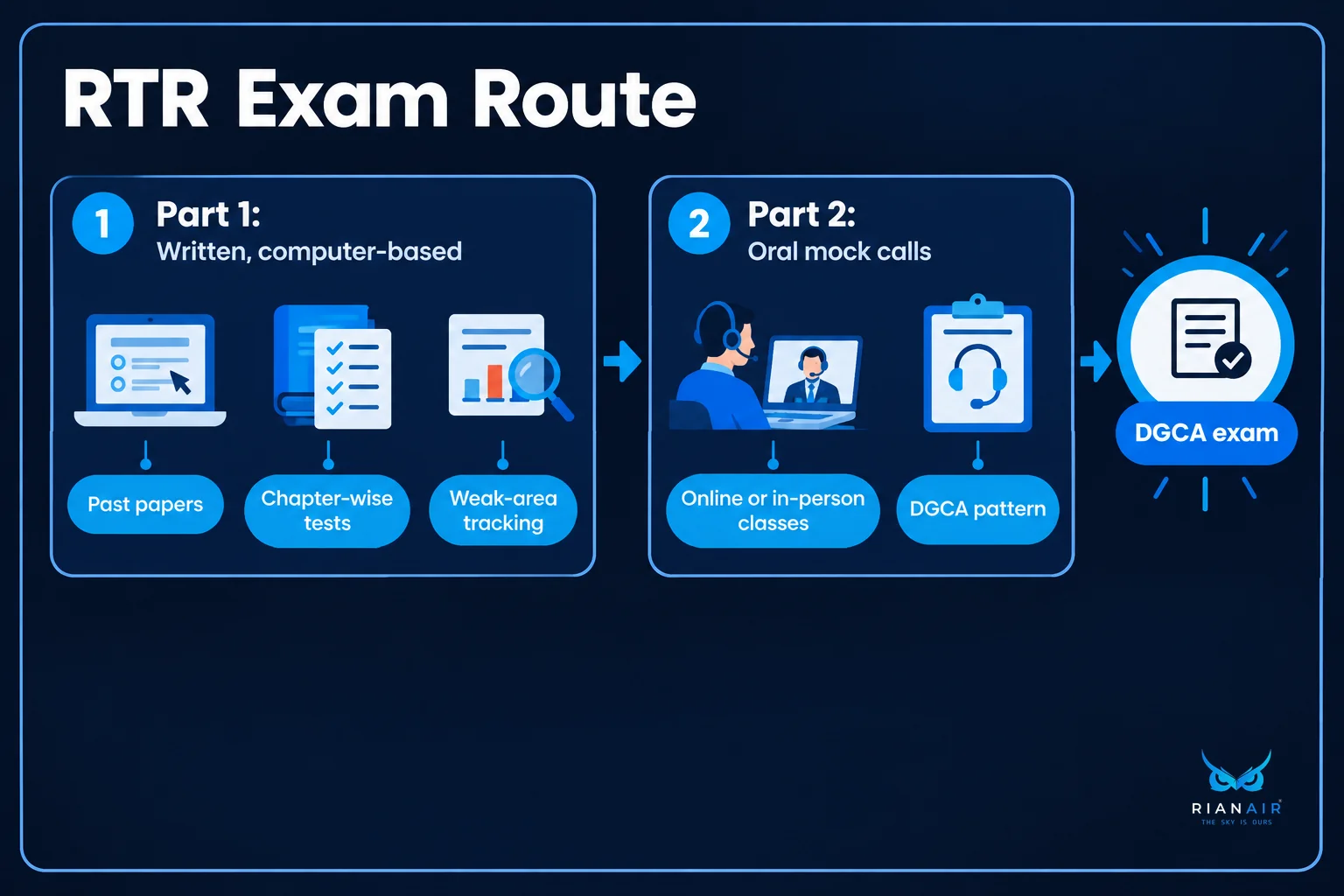
The RTR exam has two parts. Part 1 is a computer-based written test of radio theory, rules and procedures, following the DGCA pattern of 50 questions. Part 2 is an oral exam conducted by the DGCA, where you handle radio calls through the phases of a flight. You prepare for them differently, because one tests recall and the other tests speech.
What the Part 1 syllabus covers
The DGCA's own RTR syllabus annexure lists regulations and procedure topics. These include the International Telecommunication Convention and Radio Regulations, and the general and aeronautical Q code signals and abbreviations in ICAO Annex 10. It also covers general radio telephony procedures that a pilot uses on every flight.
In plain terms, expect three clusters of content. The table maps each cluster to the annexure items that name it, so you know which part of the syllabus a RAPT chapter is likely to draw on.
| Content cluster | What it covers | Annexure item it traces to |
|---|---|---|
| Rules | Radio regulations, licensing conditions and the legal side of operating a radio | International Telecommunication Convention and Radio Regulations |
| Codes and abbreviations | Q codes, standard aviation abbreviations and phonetic usage | General and aeronautical Q code signals and abbreviations in ICAO Annex 10 (vol. I and II) |
| Procedures | How calls are made, acknowledged and corrected, including distress and urgency messages | General radio telephony procedures |
The RAPT question bank is organised into chapters 1-22, and you can test any chapter or range. We have not verified which chapter number holds which annexure topic, so we do not print a chapter-by-chapter list.
The table above is the verified part: it ties each content cluster to the annexure wording. The RAPT demo shows the chapter list inside the platform, and you can place each chapter under one of the three clusters as you go.
What Part 2 asks of you
Part 2 is spoken. You act as the pilot while the examiner plays air traffic control, and the calls follow a flight from start-up through taxi, departure, en route, arrival and emergencies. You read from on-screen information, so you also need to turn weather and notices into short, correct radio messages without freezing.
We have not confirmed a Part 2 duration or scoring scheme from a current DGCA notice, so we are not quoting one. Read the DGCA instructions to candidates and the latest session notice on Pariksha for those details.
Where Do Candidates Lose Marks in RTR Part 1?
Candidates lose marks in RTR Part 1 mainly by underestimating the paper, memorising answers without understanding them, and skipping weak topics. Q codes and abbreviations are common trouble spots, because they look simple but reward exact recall. Poor time practice adds avoidable errors on exam day.
Here are the failure points we see most often among aspirants preparing for the RTR exam:
- Treating it as a last-minute subject. Students leave RTR until the end because it seems light. The syllabus is short, but the questions are precise.
- Memorising option letters. If you learn "answer B" instead of the reason, a reworded question breaks you.
- Mixing up similar codes and terms. Q codes and abbreviations that look alike cause quick, careless errors.
- Studying every chapter equally. You spend hours on topics you already know and few on the ones you keep missing.
- Never practising on a clock. Knowing the content is not the same as answering calmly on a screen.
- Ignoring Part 2 until Part 1 is done. Spoken phraseology improves with weeks of repetition, not days.
The fixes are practical. Practise by chapter, review every wrong answer's explanation, and track which topics keep returning. Our guide on how to pass the DGCA exam in the first attempt covers the same habits across all the theory papers.
Sample Part 1 questions: Q code, abbreviation, regulation
The syllabus names Q codes, abbreviations and radio procedures. The samples below are our own study drills in that style, not questions from the DGCA paper. Check each answer against the DGCA syllabus and ICAO Annex 10 before relying on it.
| Type | Sample question | Answer |
|---|---|---|
| Q code | What does QNH give you? | The altimeter sub-scale setting that makes the altimeter read elevation above mean sea level. |
| Abbreviation | What does ATIS stand for? | Automatic Terminal Information Service. |
| Q code | What does QFE give you? | The altimeter setting that makes the altimeter read zero on the aerodrome reference point (height above the aerodrome). |
| Q code | What does QNE refer to? | The altimeter reading with the standard setting of 1013.25 hPa set on the sub-scale. |
| Abbreviation | What does NOTAM stand for? | Notice to Airmen. |
| Abbreviation | What does SELCAL stand for? | Selective Calling system. |
| Procedure | Which prefix signals a distress message, and which an urgency message? | MAYDAY for distress and PAN PAN for urgency. |
Notice what each one rewards. The Q code question needs the meaning, not the letters. The abbreviation question needs the full expansion. The procedure question needs the exact word.
Multiple-choice practice, as on the real paper
The paper is computer-based with 50 questions. Try these in the same pick-one style, then check the answers below.
- Which Q code gives the altimeter setting for height above the aerodrome? A) QNH B) QFE C) QNE D) QFF
- What does NOTAM stand for? A) Notice to Airmen B) Notification of Air Movements C) Navigation Order to Aircraft D) Notice of Airspace Margins
- Which word signals an urgency message? A) MAYDAY B) SECURITE C) PAN PAN D) CLEARED
- The standard altimeter setting used with QNE is: A) 1000 hPa B) 1013.25 hPa C) 1030 hPa D) 29.00 hPa
Answers: 1-B, 2-A, 3-C, 4-B.
How Does an RTR Part 1 Question Bank Help?
A question bank helps because it turns reading into repeated, exam-style practice with answers and explanations. You see how questions are worded, find your weak chapters and fix them before the real paper. A structured bank also lets you test by chapter and under time pressure, which plain notes cannot do.
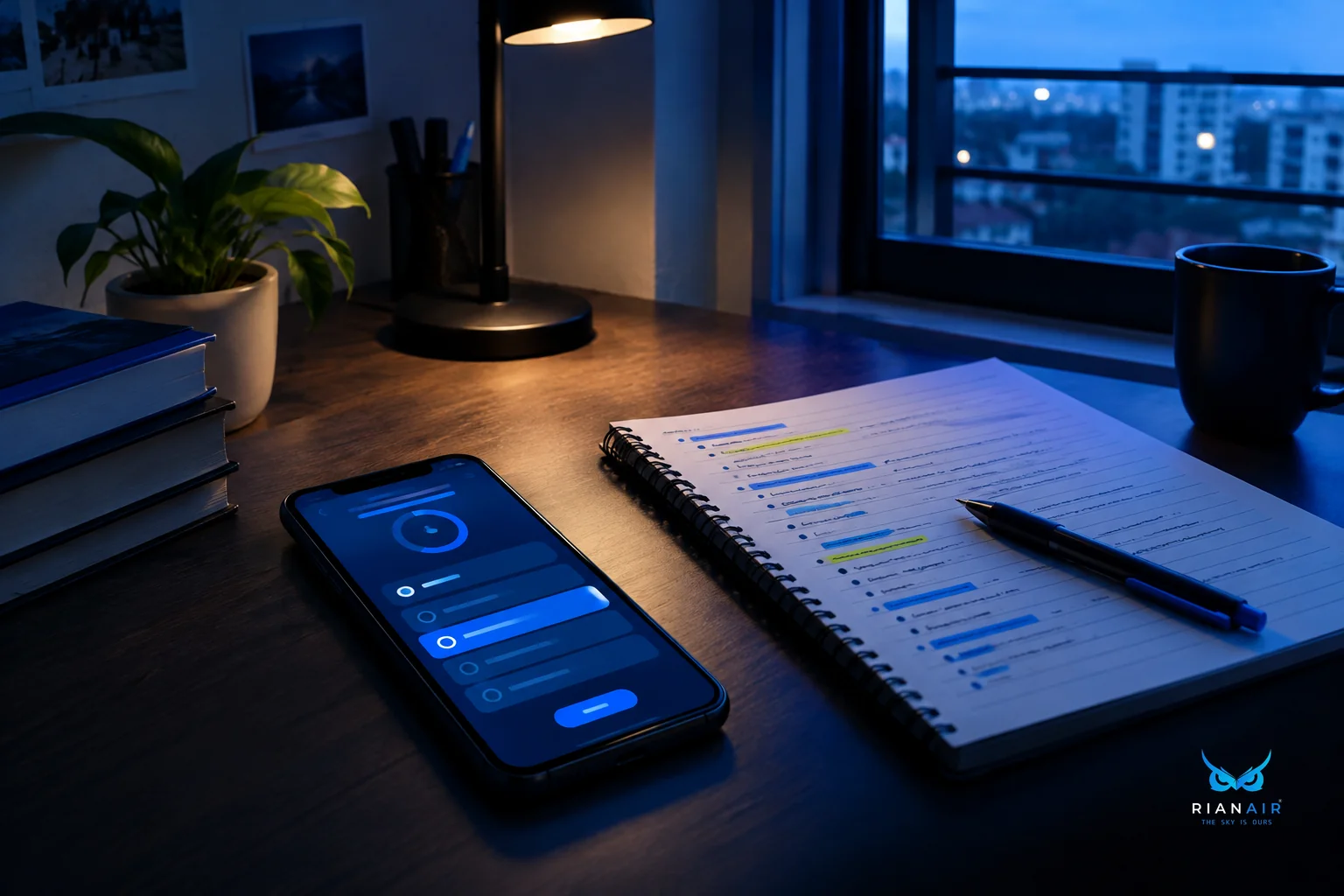
RAPT, our pilot career intelligence platform, carries the RTR Part 1 question bank. It runs on web, Android and iOS, so a student in Delhi, Mumbai or Thrissur can practise on a phone between classes. The platform is built around questions, answers and solutions, not video lectures.
Two numbers can look like a conflict, so here is how they fit. The DGCA paper has 50 questions. Rian Air describes the RTR question bank as barely 800 questions in total. On RAPT, mock tests can draw 50 questions in various permutations and combinations from that bank, so no two practice papers need to look alike.
What you get inside RAPT for RTR Part 1
- Past papers: all the past papers sit in the bank, so you see the real pattern of questions.
- Study session: read the question, the answer and the solution before you test yourself.
- Test session: attempt questions without seeing the answers, then review.
- Unlimited mock tests: take as many as you want before the DGCA exam.
- Difficulty modes: choose easy, moderate or hard to match where you are.
- Weak-area tracking and revision: the platform records what you miss so you can revise those topics.
Chapter-wise, combined and mixed tests
You do not have to sit a full paper every time. Pick a single chapter when you have just finished it. Combine ranges such as 1-5, 6-10, 1-10, 7-12, 12-22 or the whole 1-22 when you want a bigger check.
You can also build a custom mix. For example, you might select chapters 8, 11, 12, 17, 19 and 22 together, just to see how you do on a scattered set of topics. This is useful in the final week, when you want to test recall without a predictable order.
How RTR practice fits with the other DGCA papers
RAPT also covers the other theory subjects. If you are building a full plan, read about the RAPT platform DGCA question bank for CPL and ATPL to see how the papers fit together. Students who start in Delhi can also read our ground training roadmap for Delhi.
A Four-Week RTR Part 1 Study Plan
A simple four-week plan works for most students who study a few hours a day. Adjust it if you have more time. Your own mock scores are the measure that matters. The table shows the score progression students tell us they see on RAPT.
| Week | Focus | Typical mock score students report |
|---|---|---|
| Start | Study session, no testing yet | Some begin in the 50s or 60s |
| Week 1 | Read and learn, first chapter tests | Practice gets them over 70 |
| Week 2 | Test by chapter; the crucial week to eliminate errors | Errors fall as weak chapters are retested |
| Week 3 | Combine ranges, hard mode | More than 90 with constant practice |
| Exam time | Mixed and timed mocks | Rian Air reports 90-100% accuracy by exam time for students who keep practising |
These figures are Rian Air's own student reports, not independent data. This year so far, weekly mock scores were tracked for 13 students in Delhi, 38 in Kerala and 8 online. That is 59 students in total (13 + 38 + 8). We have not broken the score ranges down by student group.
- Week 1, read and learn. Use the study session to go through each chapter's questions, answers and solutions. Do not test yet. Write down terms you keep forgetting.
- Week 2, test by chapter. Take one chapter at a time in easy or moderate mode. Move on only when you answer almost all of them correctly and can explain why.
- Week 3, combine and push. Take ranges such as 1-10 and 12-22, then switch to hard mode. Spend extra time on the weak-area list.
- Week 4, mixed and timed. Take full mock tests and custom mixes under time limits. Your goal is steady scores across several tests, not one lucky high.
If a check fails, do not just take another test. Open the weak-area view, revise those topics, retest only those chapters, and then return to the mixed test. A score that swings widely between tests tells you the knowledge is not yet stable.
Start Part 2 speaking practice in week 2 or 3, not after Part 1. Even ten minutes a day of reading calls aloud makes the oral exam less strange later.
What Happens in RTR Part 2 Oral Mock Calls?
RTR Part 2 is an oral exam in which you speak radio calls aloud, as a pilot would, through the phases of a flight. Mock calls copy that format so you practise phraseology, order and calm delivery before the real DGCA exam. They are done with a trainer, not on a question bank.
RAPT does not include Part 2 mock drills, because Part 2 is an oral exam conducted by the DGCA. Part 1 is questions and answers, which a question bank handles well. Speaking needs a listener who can correct you in the moment.
For now, Rian Air offers online or in-person classes where students practise RTR Part 2 mock calls in the DGCA pattern. Each Part 2 mock call batch takes up to 12 students. The course runs 3-4 weeks.
We are also developing software for Part 2 self-practice. It is still in progress, and Rian Air will announce it to everyone once it is ready, so there is no launch date yet. Plan around the classes. We have no fixed batch start dates or class timings to publish here, so ask when you enquire.
Simulator-based Part 2 training for in-person students
In-person students can also fly the simulator and perform RTR calls under pressure, so the DGCA exam feels easier by comparison. This is not available online. It is not mandatory, but we recommend at least 3-5 hours of simulator training if you enrol for RTR.
Sample mock call script: taxi request and read-back
Practise this with a friend or a recording. One person plays the pilot, the other plays the tower. The callsign and runway are made up for practice. Your real call must follow the information on your exam screen.
| Who | Call |
|---|---|
| Pilot | "Delhi Ground, VT-ABC, at the apron, request taxi." |
| Tower | "VT-ABC, Delhi Ground, taxi to holding point runway 28 via taxiway Alpha, QNH 1008." |
| Pilot (read-back) | "Taxi to holding point runway 28 via Alpha, QNH 1008, VT-ABC." |
| Tower | "VT-ABC, read-back correct." |
Practise it three ways. First, read the pilot lines aloud. Second, cover the pilot lines and respond to the tower lines from memory. Third, change the runway, taxiway and QNH and repeat, so you read back what you hear rather than what you memorised. Always end a read-back with your callsign, and if you mishear, ask the tower to say again.
How to prepare for Part 2 step by step
- Learn the standard words. Use the same phrases every time. Radio is not a place for creative wording.
- Say it aloud, daily. Reading silently does not train your mouth. Short, daily speaking beats one long weekend session.
- Follow the flight order. Practise calls in sequence: start-up, taxi, departure, en route, arrival and an emergency.
- Record yourself. Play it back and listen for hesitation, filler words and missing parts of a call.
- Practise reading information fast. Turn weather and notices into a short, correct message without long pauses.
- Do mock calls with a trainer. A live listener catches mistakes you cannot hear in yourself.
The aim of enrolling with Rian Air is to help you clear the RTR exam in the first attempt. We can't promise a result, because it depends on your practice. Students who practise Part 1 consistently and attend Part 2 mock call classes give themselves the best chance. To see which class format suits you, start your pilot journey with an enquiry and ask about RTR Part 2 sessions.
Free Resources Before You Enrol: The RAPT Demo
You can try RAPT before you enrol. The free RAPT demo works as a progress check: you answer sample questions and see where you stand on the topics you are studying. It costs nothing and takes little time, so it is a sensible first step for any aspirant.
Open the free RAPT demo and treat it as practice, not a verdict. A low score only tells you which chapters need work first. If the demo helps, you can then decide whether the full question bank and Part 2 classes suit your plan.
Judge any platform on three things: can you use it daily, do the explanations make sense, and do the mock tests show weak areas clearly? The demo lets you check all three. For a wider checklist, see our pilot training pathways.
Choosing between self-study, a question bank and classes
| Option | Best for | Main limit |
|---|---|---|
| Self-study from notes | Students who revise well alone | No exam-style practice or weak-area tracking |
| RAPT question bank (Part 1) | Students who want timed, chapter-wise tests | Does not train spoken calls |
| Rian Air classes (Part 2) | Students who need live mock calls | Needs fixed time with a trainer |
| Question bank plus classes | Most first-time candidates | Needs steady daily effort |
Our recommendation is the last row. Use the bank for Part 1, add classes for Part 2, and start both early. A student who is already strong at spoken English and quick at memorising can lean more on the bank. Everyone else should book the spoken practice sooner than feels necessary.
Rian Air's own numbers
- Combined package: the RTR combined package is 20000 rs, including 2 hours on a simulator. We do not have a separate fee for Part 2 mock call classes alone.
- Extra simulator time: additional hours are 1000 rs/hr.
- Course length: Part 2 mock call courses run 3-4 weeks.
- Mock tracking: this year so far, weekly mock scores were tracked for 13 students in Delhi, 38 in Kerala and 8 online.
- First-attempt pass rate: 100% of the 8 RTR students who appeared for the exam cleared it on the first attempt, according to Rian Air. That is a small group, so read it as a record of those 8, not a promise. We have not published the period it covers.
- Question bank: the RTR bank has barely 800 questions, which is manageable if you revise well.
- RAPT access: RAPT is exclusively for students opting for Rian Air ground training.
Staying in Delhi for in-person prep
Outstation students should plan living costs. Living costs average approximately 10000-15000 per month, though you can spend more. PGs charge between 8k and 22k depending on how many students share one room, with 3 meals a day. Our training centre is within 5 minutes' walk of 100s of PGs.
Worked example: RTR exam weak-area review
Suppose a mock question asks what QNH means, and you choose QFE because it sounds familiar. Here is the review loop:
- Open the solution. Write the code, its meaning and why your pick was wrong: QNH is the altimeter setting that gives elevation above mean sea level, while QFE is a different setting.
- Retest that chapter only, in easy or moderate mode.
- Add any other Q codes you missed to the weak-area list.
- Return to a mixed test and check whether the same code comes back.
Q codes that look alike must be confirmed against their meaning, not their letters. Confirm each one against ICAO Annex 10, which the DGCA syllabus names.
RTR Exam FAQs
What is the RTR exam?
The RTR exam is the DGCA test for the Radio Telephone Operator's Restricted (Aeronautical) licence. It checks that a pilot can use an aircraft radio and speak to air traffic control in standard phraseology. It has a written Part 1 and an oral Part 2.
How many questions are on the RTR paper?
The DGCA pattern is 50 questions. On RAPT, practice papers can use various permutations and combinations drawn from the bank of barely 800 questions.
Is RTR Part 1 hard?
RTR Part 1 is manageable for most students who practise, but it punishes casual preparation. The syllabus is smaller than other DGCA papers, yet the questions need exact recall of rules, Q codes and abbreviations. Regular chapter-wise tests and weak-area revision make it much easier.
How should I prepare for RTR Part 1?
Prepare by studying each chapter's questions and solutions, testing chapter by chapter, then taking combined and timed mock tests. Review every wrong answer, and revise weak topics before retesting. A question bank such as RAPT supports this loop with past papers, difficulty modes and weak-area tracking.
What does the RTR Part 1 question bank on RAPT include?
The RAPT RTR Part 1 question bank includes past papers, a study session and a test session. You can take unlimited mock tests in easy, moderate or hard mode, test by chapter or in combined ranges, and track weak areas for revision before the DGCA exam.
Can I combine chapters in a mock test?
Yes. On RAPT you can take one chapter, a range such as 1-5, 6-10, 1-10, 7-12, 12-22 or 1-22, or a custom mix such as chapters 8, 11, 12, 17, 19 and 22. Mixed tests are useful in the final week to check recall.
Does RAPT include RTR Part 2 mock tests?
No. RAPT does not include Part 2 mock drills, because Part 2 is an oral exam conducted by the DGCA. RAPT is built for questions, answers and solutions. Rian Air offers online or in-person classes for Part 2 mock calls in the DGCA pattern.
How do I practise RTR Part 2 mock calls?
Practise Part 2 by speaking standard calls aloud every day, following the order of a flight from start-up to emergencies, and recording yourself. Use the taxi request script above to start. Then do mock calls with a trainer who can correct you. Rian Air runs online or in-person classes for this in the DGCA pattern.
Is there a free way to check my RTR preparation?
Yes. Rian Air offers a free RAPT demo that works as a progress check. You answer sample questions and see where you stand before deciding to enrol. It is a free resource for practice, and a low score simply shows which chapters to study first.
Where do I take the RTR exam and find notices?
The DGCA conducts the RTR (Restricted) online exam through its Pariksha portal, in numbered sessions that also cover other exams. Admit cards, instructions and public notices appear there. Always check the portal for current session and procedure details before you apply.
Can I clear the RTR exam in the first attempt?
It is possible, but no one can promise it. Your result depends on how much you practise. The aim of enrolling with Rian Air is to clear in the first attempt: consistent Part 1 mock tests, weak-area revision and Part 2 mock call classes all support that aim.
Take the Next Step Toward Your RTR Exam
If you are in Delhi, Mumbai or Thrissur and want a clear plan for the RTR exam, start with the free demo and see where you stand. Then explore the question bank for Part 1 and the classes for Part 2 mock calls.
When you are ready to talk through your plan, start your pilot journey with Rian Air and ask for RTR Part 1 practice and Part 2 mock call classes. You can also follow Rian Air on Instagram for exam tips, or subscribe on YouTube for more aviation learning.
Recommended Resources
Start Your Pilot Journey Try Our Free RAPT Demo Now Home Rian Air