


Air Navigation Question Bank For Pilots in India
An air navigation question bank for pilots in India is a topic-wise set of exam-style multiple-choice questions, with correct answers and clear explanations, covering general navigation, instruments, radio aids, performance, flight planning and payload. Used with weak-area focus, DGCA-styled mock exams and repeat attempts at wrong answers, it is the most direct way to prepare for the DGCA Air Navigation paper, whether you study in Delhi, Thane or Thrissur.
Key takeaways
- Six topic areas: the air navigation syllabus splits into general navigation, instruments, radio aids, performance, flight planning and payload, and each needs its own practice block.
- Explanations matter more than answers: a bank that only shows the correct option teaches you to memorise; a bank that explains why the other options fail teaches you to calculate.
- Loop, do not binge: practise by topic, tag weak areas, sit a timed DGCA-styled mock, then re-attempt every wrong question before the next mock.
- Results so far: of 38 students who used our question bank, 35 cleared the DGCA Air Navigation paper in the first attempt (Rian Air's own figure).
- Parents can see progress: the RAPT parent dashboard and digital logbook show what a student has practised, not just what was promised.
Air navigation question bank at a glance
| Item | What to know |
|---|---|
| Syllabus areas | General navigation, instruments, radio aids, performance, flight planning, payload |
| RAPT navigation bank size | 5,000+ questions (Rian Air's own count) |
| Update schedule | After every DGCA exam, so recent attempt questions and past papers are included |
| Mock exams | Multiple mocks on RAPT in the exact DGCA format, or customised by chapter, weak area and easy, moderate or hard mode |
| Best practice method | Topic practice, explanation review, weak-area focus, timed mock, wrong-answer revision |
| DGCA exam fee | ₹2,500 per written paper in the DGCA fee notice; our students budget ₹2,500 or ₹5,000 depending on an OLODE or regular attempt, plus travel |
| Delhi ground-training fee | ₹80,000 for air navigation, meteorology, regulations and simulator sessions, including 5 simulator hours; RTR is ₹20,000 |
| Centres | Thrissur (Kerala), Delhi, and Thane (Maharashtra), with online ground training for Maharashtra aspirants |
Where can you study air navigation with a simulator nearby?
Rian Air's Thrissur centre runs a Cessna 172 (C172) fixed-base simulator, so navigation theory can be tied to cockpit procedures early in ground training. Whether Thrissur becomes a wider aviation hub is a forecast, and nobody can prove it today. What exists now is a ground school, a library, a simulator and a question bank a student can use from day one.
Air navigation is the subject where this matters most. Dead reckoning, wind triangles and radio aid questions feel abstract on paper. Once a student flies a simulated leg and watches drift build up, a 1-in-60 calculation becomes a decision.
Delhi, Thane and online options
Our Delhi centre uses hybrid simulators, and Delhi ground-training fees include 5 simulator hours. In Maharashtra, online ground training for aspiring pilots is already running. Our Thane centre is being inaugurated this month, October, as a full-fledged facility with a library and a DA40/42 hybrid simulator with a G1000 glass cockpit and canopy set-up.
The Thane address is Rian Air, opposite Shree Bhagyalakshmi Bungalow, Anand Park, Thane West, Maharashtra 400601. Note that this is Thane, not Mumbai proper. Students from Maharashtra can start online and later move to the hybrid set-up.
If you are weighing Kerala centres against each other, our guide on what to compare in a ground training institute in Kerala lists the checks in order.
What does the DGCA air navigation syllabus cover?
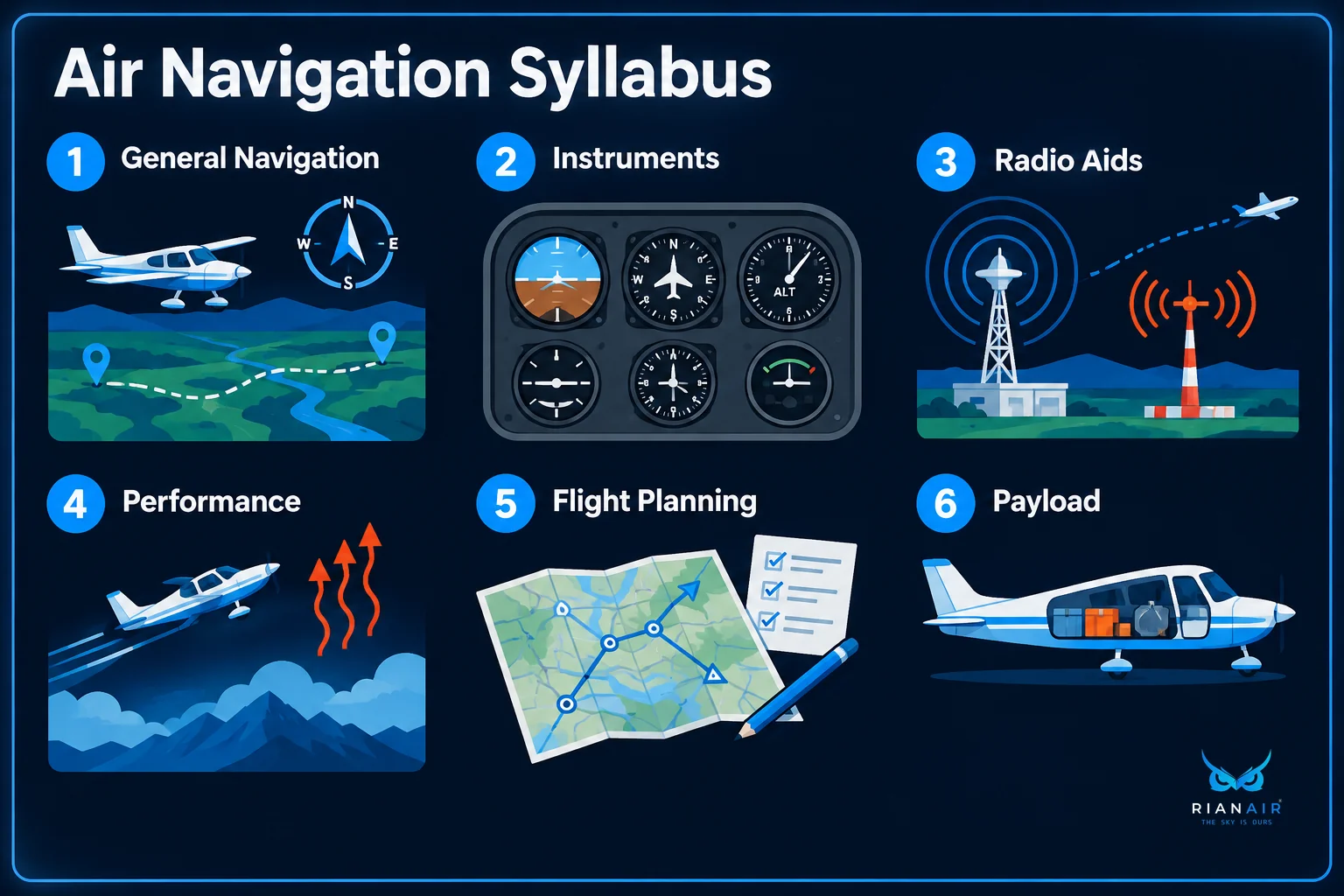
The air navigation syllabus covers six areas: general navigation (the Earth, charts, direction, time and dead reckoning), instruments, radio aids, performance, flight planning and payload. Questions mix theory with short calculations, so students must understand each formula, not only recall it.
The DGCA runs these written papers through its Pariksha examination portal, which handles licence exams for flight crew. The reference book list for the papers is on the DGCA study material list. Confirm the current paper format, marks and pass mark on the portal before you plan your mocks. On RAPT you can set a mock to the exact DGCA format once you know it.
General navigation
This is the largest block. It covers latitude and longitude, great circle versus rhumb line tracks, true, magnetic and compass direction, variation and deviation, time zones, chart projections, and the wind triangle. Speed, time and distance problems run through nearly every other topic.
A worked example (hypothetical numbers) shows the 1-in-60 rule. Track error in degrees = distance off track ÷ distance flown × 60. Closing angle in degrees = distance off track ÷ distance to go × 60. You are 10 NM off track after flying 120 NM. Track error is 10 ÷ 120 × 60 = 5°. With 60 NM to go, the closing angle is 10 ÷ 60 × 60 = 10°.
The heading change to reach the destination is the track error plus the closing angle, so 5° + 10° = 15°. Turn 15° toward track. Questions on this rule usually hide the answer inside a unit or distance trap.
Instruments
Expect questions on the magnetic compass and its turning and acceleration errors, the gyroscopic instruments (directional indicator, artificial horizon, turn coordinator), and the pitot-static group: airspeed indicator, altimeter, vertical speed indicator and Machmeter. Know what blocked pitot or static ports do to each reading.
Altimeter settings are a favourite. Be clear on QNH, QFE and QNE, and on what each one makes the altimeter read on the ground. Students who learn this as a table of "what reads what" lose fewer marks than those who memorise the three letters alone.
Sample question: with the static port blocked in a climb, what does the airspeed indicator do? Answer: it under-reads, because the trapped static pressure is lower than the true static pressure at the new height. The altimeter freezes at the height where the blockage occurred, and the vertical speed indicator reads zero.
Radio aids
This block covers VOR, DME, NDB and ADF, ILS, radar and secondary surveillance radar, and satellite navigation. Questions ask about frequencies, range, errors and what an indication means in flight.
A common calculation is VHF range, which depends on line of sight. A standard rule of thumb is range in NM ≈ 1.23 × √height in feet. For an aircraft at 9,000 ft over a ground station at sea level, that is 1.23 × 94.9, about 117 NM. If the question gives both heights, add the two square-root terms before multiplying.
Sample question: what does DME measure? Answer: slant range, not ground distance, so the reading is largest in error when the aircraft is close to the station at high altitude. Directly overhead, it shows the height above the station in nautical miles.
Performance
Performance questions ask you to read charts and tables: take-off and landing distance, climb, cruise and endurance. You apply corrections for weight, pressure altitude, temperature, wind and runway slope. Most marks are lost by reading the wrong chart line or applying a headwind correction as if it were a tailwind.
Sample question: a landing distance chart gives a figure for still air. How does a tailwind change it? Answer: it lengthens the distance, so a correction must be added, not subtracted. Always check which direction the chart's wind scale treats as positive.
Flight planning
Here you build fuel and time plans: trip fuel, contingency, alternate and final reserve, plus en-route concepts such as the point of no return (PNR) and the critical point. The PNR time formula is E × H ÷ (O + H), where E is safe endurance, O is groundspeed out and H is groundspeed home.
Take E = 4 h, O = 100 kt and H = 140 kt. Then 4 × 140 ÷ 240 = 2.33 h. Check it: 100 kt for 2.33 h is 233 NM out, and returning at 140 kt takes 1.67 h, so the total is 4.0 h. Always run this check; it catches swapped O and H values.
Payload (mass and balance)
Payload questions test mass, fuel weight conversions and centre of gravity (CG). Fuel is usually given in litres or gallons, so you convert with density. At a density of 0.72 kg per litre, 1,000 litres weighs 720 kg. Mixing US and imperial gallons is a classic trap.
For balance, CG equals total moment ÷ total mass. Suppose 800 kg sits at an arm of 1.0 m and 200 kg at 2.0 m. Moments are 800 and 400, total 1,200, over 1,000 kg, so the CG is 1.2 m. Then compare it with the limits in the loading table.
Sample navigation practice questions
- You are 10 NM off track after 120 NM. What is the track error? Answer: 5°, from 10 ÷ 120 × 60.
- With 60 NM to go, what is the closing angle for the same 10 NM error? Answer: 10°, from 10 ÷ 60 × 60.
- Safe endurance 4 h, outbound 100 kt, home 140 kt: PNR time? Answer: 2.33 h, from 4 × 140 ÷ 240.
- How much do 1,000 litres weigh at 0.72 kg per litre? Answer: 720 kg, density times volume.
- 800 kg at 1.0 m and 200 kg at 2.0 m: CG? Answer: 1.2 m, since 1,200 ÷ 1,000.
- What does DME measure? Answer: slant range.
- Does a tailwind lengthen or shorten the landing distance? Answer: it lengthens it.
How do you use an air navigation question bank, step by step?
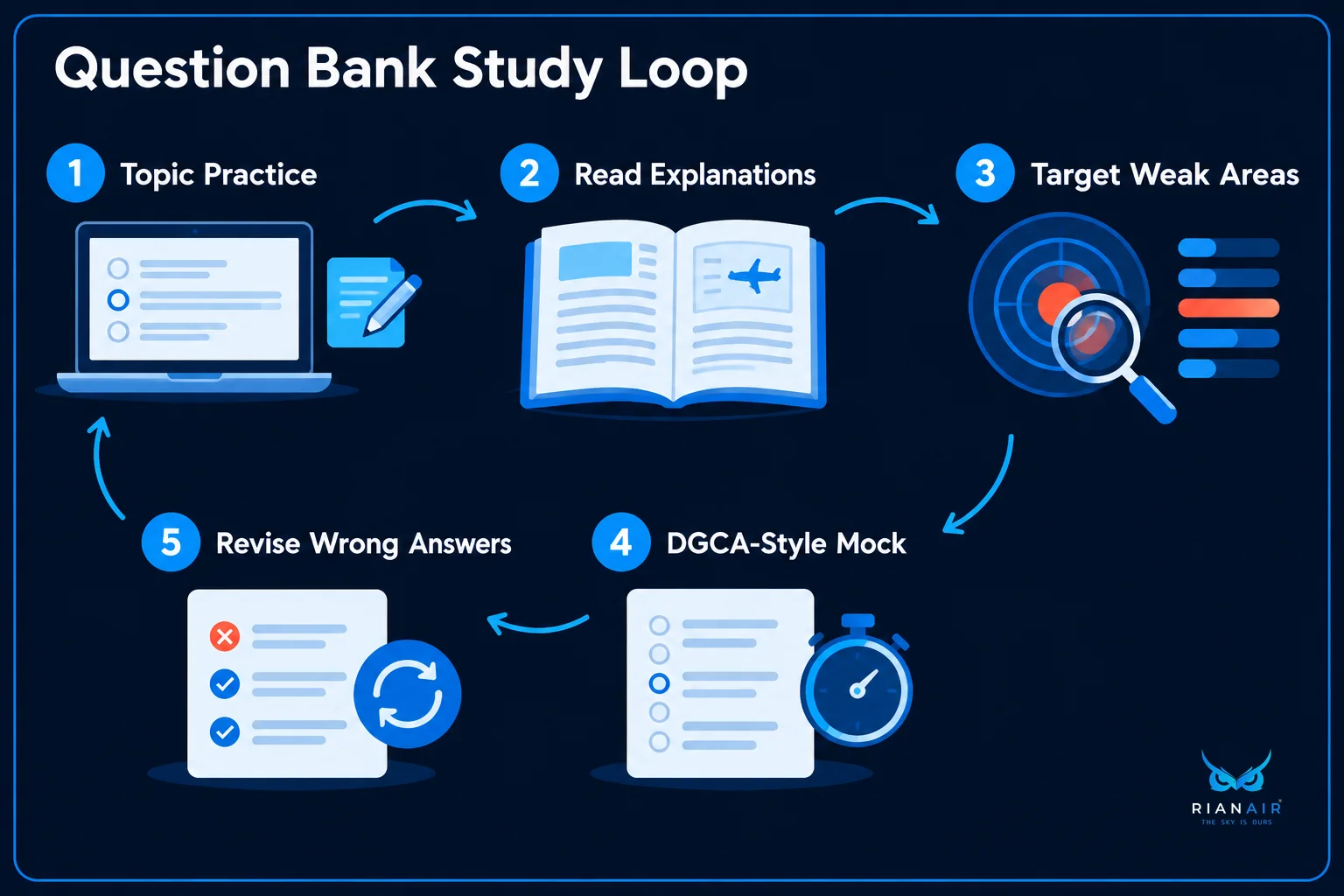
Use it as a loop: practise one topic, read every explanation, tag the topics you miss, sit a timed DGCA-styled mock, then re-attempt each wrong question before the next mock. Repeating this loop turns scattered practice into measurable improvement in each syllabus area.
- Practise by topic in study mode. Pick one area, for example radio aids, and answer 20 to 30 questions with explanations visible. The aim is understanding, not speed.
- Read the explanation even when you are right. A correct guess hides a gap. If you cannot explain why the other options are wrong, mark the question for review.
- Flag weak areas. If you miss the same topic in two separate sessions, stop practising questions and return to the chapter. Practice cannot fix a concept you never learned.
- Sit a DGCA-styled mock under exam conditions. Use a fixed time, no pausing and no reference notes. A mock that you pause is only another practice set.
- Revise wrong questions again. Re-attempt every miss after a gap of a few days. Walk away from a bank that cannot show you your own wrong answers in one list.
- Repeat, then check the official format. Compare your mock scores with the DGCA's current pass mark on the Pariksha portal, and aim to clear it with room to spare.
A sample weekly study schedule
| Day | Task |
|---|---|
| Monday | General navigation: 20 to 30 questions in study mode, explanations visible |
| Tuesday | Instruments: 20 to 30 questions, then write the "what reads what" altimeter table |
| Wednesday | Radio aids: 20 to 30 questions, with VHF range calculations by hand |
| Thursday | Performance and flight planning: chart reading and a PNR calculation with the check |
| Friday | Payload: fuel density conversions and two CG problems; update your error log |
| Saturday | One timed mock, customised to your weak chapters or set to the DGCA format |
| Sunday | Re-attempt every wrong question from the week; rest otherwise |
Two habits separate students who clear Air Navigation early from those who do not. First, they calculate every numeric question by hand at least once before trusting any shortcut. Second, they keep a short error log: topic, mistake type (formula, unit, chart reading), and the fix.
What an explanation looks like matters. Our sample from another paper shows the format. Question: "The minimum age for a Commercial Pilot Licence in India is: 16, 17 or 18?"
Answer: 18. Explanation: a CPL applicant must be at least 18; a student pilot licence can be held from 16 and a PPL from 17. Every navigation question should carry the same level of reasoning. For a deeper look at that subject, see our air regulations question bank guide.
How does RAPT track progress for students and parents?
RAPT, the Rian Air pilot career intelligence platform on web, Android and iOS, records each practice attempt, mock score and wrong answer. Students see weak topics by chapter, while parents use a separate dashboard to check study activity. A digital logbook keeps training records in one place.

Our RAPT platform guide covers the full feature set. For air navigation, the useful parts are the topic-wise banks, the explanations and the record of wrong answers that you can re-attempt.
How big are the question banks?
By Rian Air's own count, the navigation bank has 5,000+ questions, technical general 5,000+, air regulations 2,500+, meteorology 2,000+, technical specific for various aircraft 2,000+, and RTR Part 1 1,000+. RTR Part 2 includes mock calls. Past questions from all DGCA exam papers are included.
Some questions repeat across papers. We keep them on purpose: a repeated question is one that appeared in a recent exam, so it tells students what the DGCA actually asked. We update the banks after every DGCA exam so recent attempt questions are added.
What students say
Public Google reviews of Rian Air mention the study tools and the instructors. Sachu wrote, “The app is simple to use, informative, and great for aviation students who want to improve their knowledge and preparation.” Abhishek V. wrote, “The trainers are highly experienced, supportive, and always willing to clear doubts with patience.”
What parents get to see
Parents and sponsors often fund training without seeing it. The parent dashboard shows practice activity and mock results so a family can spot a student who has gone quiet before an exam, not after a failed attempt. The digital logbook then carries the record into simulator and flight training.
What should a good air navigation question bank include?
A good bank has topic-wise sorting, a correct answer and a written explanation for every question, a timed mock mode, a list of your wrong answers, and a visible update policy. If a bank misses explanations or never updates after DGCA exams, treat it as a memory tool, not a preparation tool.
| Check | Good sign | Walk away if |
|---|---|---|
| Explanations | Every question explains the method and the wrong options | Only the correct letter is shown |
| Coverage | All six areas, including performance and payload | Only general navigation is covered |
| Updates | Updated after each DGCA exam | No stated update date |
| Mocks | Timed, DGCA-styled, no pausing | Untimed practice only |
| Error tracking | Wrong answers listed for re-attempt | You must remember what you missed |
One honest limit: no question bank replaces a good instructor. Students who learn best from a person should combine the bank with classes. Reviewers of our centres most often praise the knowledgeable, supportive instructors, which is the combination we aim for.
What does DGCA exam preparation cost, and what is the money-back promise?
Delhi ground training costs ₹80,000 per student for air navigation, meteorology, regulations and simulator sessions, with RTR at ₹20,000. The DGCA fee notice sets ₹2,500 per written paper. Our students budget ₹2,500 or ₹5,000 for an exam, depending on whether it is an OLODE or a regular attempt, plus travel. Extra flight hours at a cheaper school are billed at ₹30,000.
Rian Air's money-back promise says that if we fail to get a student through the DGCA exams, the student gets their money back; terms and conditions apply. Ask our academic counsellor for the claim steps and T&C sheet before you pay.
Flight training at partner flying schools ranges from ₹50 lakh to ₹75 lakh, and it varies from student to student. Our guide to pilot training cost and the hidden fees parents miss shows where the extras sit.
Which Rian Air centre should you choose for air navigation?
Choose Thrissur if you live in Kerala and want a C172 fixed-base simulator beside your classes. Choose Delhi if you want hybrid simulators and 5 simulator hours included in ground-training fees. Choose Thane or online classes if you live in Maharashtra and want to start remotely.
The decision rule is simple. If you can attend in person, pick the nearest centre with a simulator, because navigation is easier to learn when you can fly the problem. If you cannot, start online with the same question bank and move to a centre when you can.
To compare routes beyond ground school, explore our training pathways, which cover flight training in India, Tunisia, Malta and New Zealand, and the A320 and B737 type rating options.
Frequently asked questions
What is an air navigation question bank for pilots in India?
It is a structured collection of multiple-choice questions for the DGCA Air Navigation paper, grouped by topic, with correct answers and explanations. Good banks add timed mocks and a list of your wrong answers. Students use it to find weak areas and practise until calculations feel routine.
How many questions does RAPT have for air navigation?
Rian Air's RAPT platform holds 5,000+ air navigation questions by our own count. Other banks include technical general with 5,000+, air regulations with 2,500+, meteorology with 2,000+, technical specific with 2,000+, and RTR Part 1 with 1,000+. Past DGCA paper questions are included.
What results have students using the question bank achieved?
Of 38 students who used our question bank, 35 cleared the DGCA Air Navigation paper in the first attempt. This is Rian Air's own figure for that group.
How often is the question bank updated?
We update our question banks after every DGCA exam, so that past question papers and recent attempt questions are included. This matters because students who sat the latest exam usually remember new question styles, and those styles should reach every student quickly.
Do repeated questions in a question bank help?
Yes. Some questions repeat across DGCA papers, and a repeated question is evidence that the examiner values that concept. Repetition also strengthens recall. Still, do not rely on repeats alone: the same topic can appear with different numbers, so practise the method, not the answer.
Is air navigation the hardest DGCA paper?
Many students find it demanding because it mixes theory with calculation, but difficulty varies by person. Students who are weak at arithmetic and unit conversion struggle most. A steady loop of topic practice, mocks and wrong-answer revision is usually enough to build the speed needed.
Can I study air navigation online from Maharashtra?
Yes. Online ground training for aspiring pilots from Maharashtra is already running, and students can later move to our hybrid set-up in Thane for in-person classes and simulator sessions. The same RAPT question bank works online and at the centre, so your progress records carry over.
What happens if I fail an air navigation paper?
You can re-attempt the paper after paying the exam fee again. Use the gap to review your wrong answers by topic, then fix the weakest area first. Rian Air's money-back promise applies if we fail to get a student through the DGCA exams; terms and conditions apply, so ask for the T&C sheet.
What are the question count, duration and pass mark of the DGCA Air Navigation paper?
We do not quote these from memory, because they can change. Check the current question count, duration and pass mark on the DGCA Pariksha portal before planning your mocks.
Which are the top flying schools in India, and how do I compare them?
No single list fits every student, so compare schools on DGCA approval, total cost in writing, simulator access and aircraft availability. Ask each school for its fee breakdown and any extra charges. Rian Air handles ground training and works with partner flying schools for flight training.
The list of pilot training institutes in India notes that the DGCA recognised 35 Flying Training Organisations as of 2023. Later government figures differ, so confirm current approvals on the DGCA's aeronautical training page. Our academy selection checklist turns that into a step-by-step comparison.
Take the next step with your air navigation preparation
Air navigation rewards students who practise a little every week, review every explanation and revisit every mistake. If you want that routine built around a 5,000+ question navigation bank, DGCA-styled mocks and a parent dashboard, start your pilot training enquiry and ask our academic counsellor about the Thrissur, Delhi and Thane options.
For short explainers and updates between study sessions, subscribe to Rian Air on YouTube and follow us on Instagram.