



Meteorology Question Bank for Pilots in India
A meteorology question bank for pilots in India is a topic-wise set of exam-style multiple-choice questions for the DGCA Aviation Meteorology paper. The paper has 50 questions, carries 100 marks, runs for 2 hours and has no negative marking. Practising from a structured bank, whether you study in Delhi, Mumbai or Thrissur, is the fastest way to find weak topics.
Key Takeaways
- Exam format: 50 questions, 100 marks, 2 hours, and no negative marking, so you should answer every question.
- Exam windows: Regular attempts run in March, June, September and December; OLODE (online on-demand) exams cover the other months.
- Question bank size: RAPT holds more than 2,000 questions for CPL and ATPL meteorology practice, with the wider RAPT bank crossing 20,000 questions. These are Rian Air's own figures for its platform.
- Attempts: At Rian Air, about 80% of students clear a subject on the first attempt, and nearly everyone clears it on the second.
- Best method: Understand the concept first, then solve questions by topic, then take timed mocks.
- Access: RAPT has a free trial. Register and speak to the support team.
Meteorology Exam at a Glance
| Item | Detail |
|---|---|
| Paper | Aviation Meteorology (CPL and ATPL levels) |
| Questions | 50 multiple-choice questions |
| Total marks | 100 |
| Duration | 2 hours |
| Negative marking | None |
| Regular attempt months | March, June, September, December |
| Other months | OLODE (online on-demand) exams |
| Typical Rian Air study time | About 1.5 months, run alongside Air Regulations |
Exam format and exam months are set by the DGCA. Check the current syllabus, format and exam calendar on the official DGCA website before you plan your attempt.
Why Does Meteorology Matter Beyond the Exam?
Meteorology matters because weather is the most common reason a pilot changes a plan. It decides whether you depart, which route you fly, where you divert and how much fuel you carry. The exam checks the same judgement you will use as a first officer.
Think about a monsoon departure from a coastal city. The sky looks workable, but the forecast shows thunderstorms building after midday. A pilot who understands convection reads that as a deadline, not a detail. A pilot who only memorised definitions sees a line of codes.
That gap is what the question bank is built to close. A good meteorology question does not ask you to recite. It gives you a situation, such as a front approaching, a falling pressure trend or a low-level temperature inversion, and asks what happens next.
Real decisions that rest on weather knowledge
- Go or no-go: Reading METAR and TAF reports to judge visibility, cloud base and wind before departure.
- Route and altitude: Avoiding thunderstorm clouds, icing layers and strong turbulence.
- Alternates and fuel: Planning a diversion when fog or low cloud may close the destination.
- Landing technique: Handling crosswinds, gusts and wind shear near the runway.
Researchers have also taken the question of testing weather knowledge seriously. A paper titled Validated Question Bank for Assessing Pilot Knowledge of Aviation Weather in the Collegiate Aviation Research and Instruction journal builds a question set for exactly this purpose. The idea is simple: well-built questions reveal real understanding.

What Does the DGCA Meteorology Syllabus Cover?
The DGCA meteorology syllabus covers the atmosphere, pressure, temperature, wind, moisture, clouds, precipitation, visibility, air masses, fronts, turbulence, icing, thunderstorms, weather charts and aviation weather reports and forecasts. Always confirm the current syllabus on the DGCA website before you start.
The list below groups the topics the way most students study them. Your instructor or question bank may split them differently, but the content is the same.
Core topics to prepare
- Atmosphere and pressure: Layers of the atmosphere, the standard atmosphere, pressure systems and altimetry basics.
- Temperature and moisture: Lapse rates, stability, humidity, dew point and why fog forms.
- Wind: Pressure gradient, Coriolis effect, jet streams, sea and land breezes, and mountain winds.
- Clouds and precipitation: Cloud types, how they form, and what weather each one brings.
- Hazards: Thunderstorms, turbulence, wind shear, icing and reduced visibility.
- Air masses and fronts: Warm, cold and occluded fronts and the weather along each.
- Charts and reports: Significant weather charts, METAR, TAF, SIGMET and how to decode them.
- Regional weather: Climate patterns relevant to flying in India, including the monsoon.
Charts and reports are where many students lose marks. They need practice, not just reading. A weather code decoded slowly in a calm study session becomes a guess in a timed exam, so repeat these questions until they feel automatic.
RAPT error data does not single out one weak topic. Our finding is that every topic is important and none can be skipped. Skipping or underestimating a topic leads to failure.
Exam Format: Questions, Marks, Duration and Marking
The DGCA Aviation Meteorology paper has 50 questions for 100 marks and runs for 2 hours. There is no negative marking, so a wrong answer costs nothing more than a blank one. Never leave a question unanswered.
That works out to a little over two minutes per question, which is comfortable if you know the material. Time pressure usually comes from chart questions, so do those with a clear head rather than rushing them at the end.
When can you sit the exam?
Regular DGCA attempts are held in March, June, September and December. In the other months, candidates can take OLODE, the online on-demand exam. This means a student who is ready in, say, August does not have to wait for September.
Plan backwards from your target month. If you aim for a June attempt, start timed mocks about six weeks before, and keep the last week for revision of weak topics only.
The no negative marking rule in practice
Because wrong answers do not lose marks, the smart approach is a two-pass method. First, answer every question you are sure of. Second, return to flagged questions and eliminate options. Before time ends, pick an answer for anything still open.
How Should a Meteorology Question Bank Work?
A good meteorology question bank sorts questions by topic, shows a clear explanation for every answer, records what you get wrong and offers timed mock tests. It should match the DGCA exam style, so practice feels like the real paper rather than a random quiz.
RAPT, the Rian Air platform, holds more than 2,000 meteorology questions for CPL and ATPL preparation, and the wider RAPT question bank passes 20,000 questions across subjects. Both counts come from Rian Air's own RAPT platform, not from an outside survey. You can read how the bank is organised in our guide to the DGCA question bank for CPL and ATPL.
Features to look for
- Topic filters: Practise only fronts, or only METAR decoding, until the weak spot is gone.
- Explanations: A wrong answer should teach you why the right one is right.
- Error tracking: The tool should show which topics repeatedly cost you marks.
- Timed mocks: 50 questions in 2 hours, to train pace and stamina.
- Progress view: With Rian Air, parents can follow a child's progress live, day to day, through RAPT.
Free PDFs versus a structured bank
Free PDFs and public question sets are useful for extra variety. The FAA, for example, publishes sample questions for the Commercial Pilot Airplane test and states that they are a study guide, not necessarily the exact questions on the exam. That caution applies to any unstructured source.
Other public material exists too. A CPL (A) Aviation Meteorology practice exam is structured to mimic the format of the actual examination. A set of multiple choice questions in Aeronautical Meteorology is aimed at aeronautical meteorology students. Treat both as extra practice.
The weakness of a loose PDF is that nothing tracks you. You do not learn which topic fails you most often. A structured bank closes that loop, and that loop is what raises scores.
How to Access RAPT
RAPT is the Rian Air platform, and it is always available online. There is a free trial, so you can see the meteorology bank before you commit.
- Register: Sign up to create your RAPT account.
- Speak to support: Talk to our support team, who will guide you through the platform.
- Use the free trial: Try the questions, explanations and error tracking yourself.
RAPT is currently exclusive to Rian Air students. Pricing for outside students has not been decided yet, but something big is coming.
Sample Meteorology Questions
These exam-style questions cover METAR and TAF decoding, fronts, icing and clouds. Try each one before reading the answer. Question 1 comes from RAPT. The others are practice questions written for this guide in the same style.
Question 1: Thunderstorm cloud (from RAPT)
Which cloud is associated with thunderstorms and hail? (a) Cirrostratus (b) Altocumulus (c) Cumulonimbus
Answer: (c) Cumulonimbus. Cumulonimbus is the thunderstorm cloud: heavy showers, hail, lightning, severe turbulence and icing.
Question 2: METAR wind group
In a METAR, the group 27015G25KT means: (a) wind from 270 degrees at 15 knots, gusting 25 knots (b) wind towards 270 degrees at 15 knots, gusting 25 knots (c) wind from 150 degrees at 27 knots, gusting 25 knots
Answer: (a). The first three digits are the direction the wind blows from, the next two are the mean speed, and G gives the gust speed.
Question 3: METAR visibility and cloud
A METAR shows BKN008. What does this tell you? (a) Broken cloud with base at 800 feet (b) Broken cloud with base at 8,000 feet (c) Scattered cloud with base at 800 feet
Answer: (a). BKN means broken, which is 5 to 7 oktas. The three digits are the cloud base in hundreds of feet, so 008 is 800 feet. A low broken layer like this is a concern for approach.
Question 4: TAF change group
In a TAF, what does the group TEMPO indicate? (a) A permanent change (b) Temporary fluctuations expected to last less than an hour at a time (c) A cancelled forecast
Answer: (b). TEMPO flags temporary fluctuations in conditions. BECMG, by contrast, signals a gradual change to a new, lasting condition.
Question 5: Cold front weather
Which weather is typical along a fast-moving cold front? (a) Steady drizzle over a wide area (b) Narrow band of showers, possibly thunderstorms, with a sharp wind shift (c) Clear skies with light winds
Answer: (b). The cold air undercuts the warm air and lifts it quickly. That produces cumuliform cloud, a narrow band of heavy showers and a noticeable change in wind direction as the front passes.
Question 6: Warm front weather
Ahead of an approaching warm front, you would expect: (a) Cloud lowering and thickening, with widespread steady rain later (b) Sudden clearing (c) Towering cumulonimbus only
Answer: (a). Warm air rises gently over the cold air. Cirrus thickens to stratiform cloud, the base lowers and steady precipitation follows.
Question 7: Occluded front
An occluded front forms when: (a) A cold front overtakes a warm front (b) Two warm fronts meet (c) A front becomes stationary
Answer: (a). The faster cold front catches the warm front and lifts the warm sector off the ground.
Question 8: Icing conditions
Airframe icing is most likely when flying in: (a) Clear air well above the freezing level (b) Cloud or precipitation with temperatures at or below freezing (c) Dry air at high temperature
Answer: (b). Ice needs liquid water that freezes on contact with the airframe, so visible moisture with sub-zero temperatures is the key combination.
Question 9: Supercooled water
Supercooled water droplets are: (a) Droplets that remain liquid below 0 degrees Celsius (b) Ice crystals (c) Water vapour
Answer: (a). They freeze instantly on striking the aircraft, which is why they are a major cause of structural icing.
Question 10: Fog formation
Radiation fog is most likely on: (a) Clear, calm nights with high humidity (b) Windy, overcast nights (c) Hot afternoons
Answer: (a). Clear skies let the ground cool, calm air keeps the cooling shallow, and humid air reaches its dew point easily.
Worked METAR Decoding Example
Suppose you are given this made-up report for practice. It is not a real observation.
VABB 151030Z 24012G22KT 4000 RA BKN010 OVC030 27/25 Q1004
- Station: VABB is the four-letter airport code.
- Time: 151030Z is day 15 at 1030 UTC.
- Wind: 24012G22KT is wind from 240 degrees at 12 knots, gusting 22 knots.
- Visibility: 4000 is 4,000 metres.
- Weather: RA is rain.
- Cloud: BKN010 is broken cloud at 1,000 feet. OVC030 is overcast at 3,000 feet.
- Temperature and dew point: 27/25 means a 2-degree spread (27 minus 25), so the air is close to saturation.
- Pressure: Q1004 is a QNH of 1004 hectopascals.
Reading it as a pilot: low broken cloud, reduced visibility, rain and gusts make this a poor approach day. The small temperature spread points to persistent low cloud rather than quick clearing.
Common errors on METAR questions
- Misreading cloud height: Students read BKN010 as 10,000 feet. The digits are hundreds of feet.
- Confusing wind direction: Wind direction is where the wind comes from, not where it goes.
- Ignoring the temperature spread: A small gap between temperature and dew point signals fog or low cloud risk.
- Mixing up QNH units: Q means hectopascals.
Because RAPT shows that no topic can be skipped, we recommend repeating METAR and TAF questions until each group reads on sight.
Cloud Comparison Explainer: Cumulus vs Cumulonimbus vs Stratus
Cloud identification is a favourite exam theme because each type signals a different flying risk. This small explainer compares the four cloud types students mix up most often. Learn what each looks like, what it brings and what it means for a pilot.
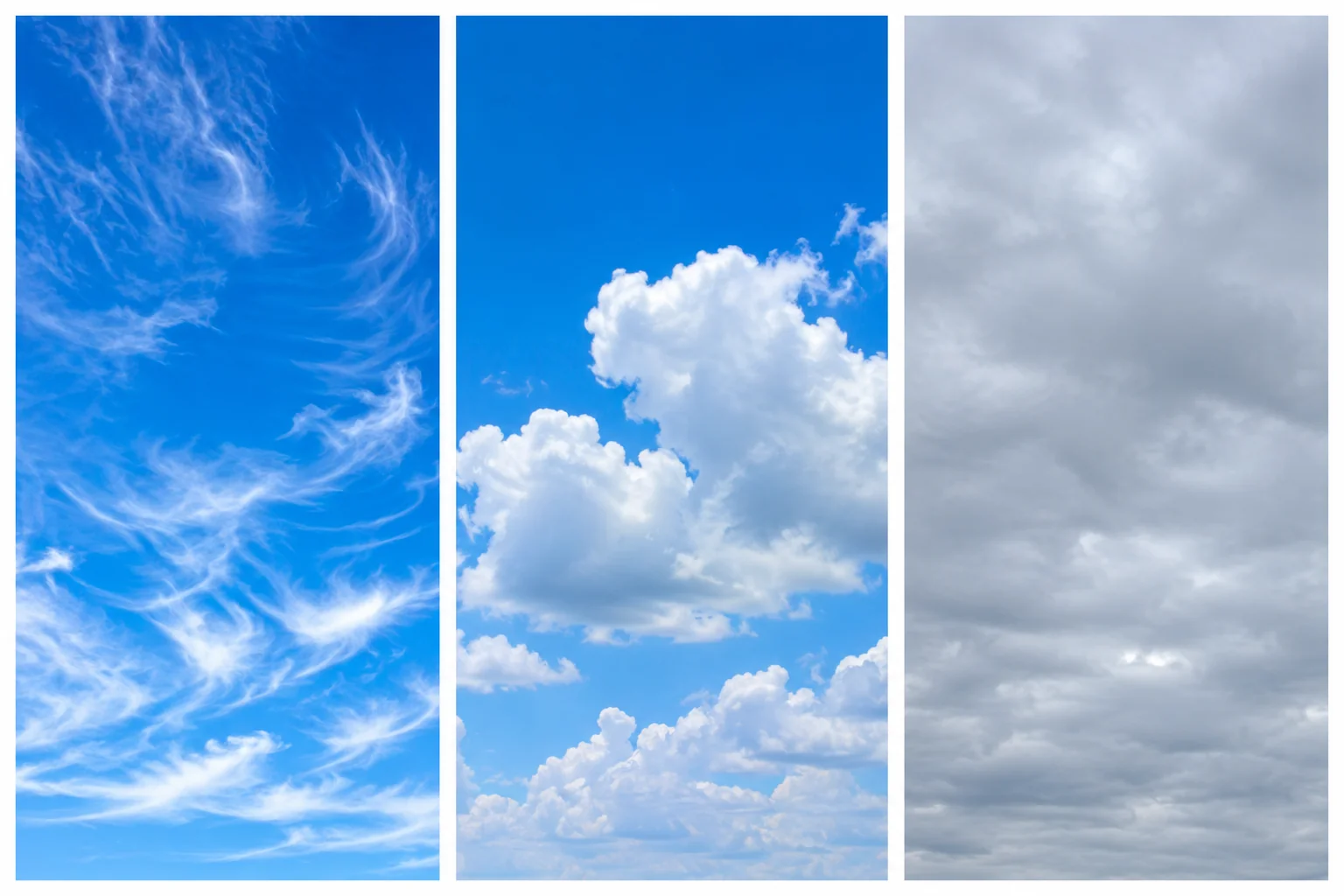
| Cloud type | How it looks | Typical weather | What it means for a pilot |
|---|---|---|---|
| Cirrus | High, thin, wispy streaks of ice crystals | Often fair, can signal an approaching front | Little hazard; a hint that weather may change within a day |
| Cumulus | Puffy, flat-based, cotton-like heaps | Fair weather; can grow if the air is unstable | Some bumpiness in the lower levels; watch for vertical growth |
| Stratus | Low, flat, uniform grey layer | Drizzle, mist, low visibility | Low ceiling and poor visibility, a concern for approach and landing |
| Cumulonimbus | Towering, anvil-topped, dark base | Thunderstorms, heavy rain, hail, lightning | Severe turbulence, icing and wind shear; avoid by a wide margin |
Notice the method in Question 1 above. Do not hunt for a memorised line. Ask what physical process each option involves, and the answer follows. Stratus forms in stable air and gives low cloud, so it cannot be the source of strong vertical motion.
A Six-Month Study Plan for Meteorology
At Rian Air, ground training typically takes about 6 months. Meteorology is usually studied alongside Air Regulations over roughly 1.5 months, after or during Air Navigation, which takes about 2 to 2.5 months. RTR takes around 15 days because part of it is covered during navigation.
Some students take 6 to 12 months in total, and some finish much faster. One of our students, Bharat, cleared all his exams in 4 months, including medicals and other formalities. He also got his visa done and now holds a CPL from Tunisia.
A week-by-week rhythm for the meteorology block
- Weeks 1 and 2: Atmosphere, pressure, temperature and moisture. Solve topic questions after each class.
- Weeks 3 and 4: Wind, clouds and precipitation. Build your own cloud comparison sheet.
- Week 5: Fronts, air masses and hazards such as turbulence, icing and thunderstorms.
- Week 6: METAR, TAF and chart reading, followed by two or three timed 50-question mocks.
Our approach puts less weight on endless revision and more on solving once the concept is clear. A library and revision sessions are available, but the real gain comes from working questions and studying every wrong answer.
How many attempts should you expect?
At Rian Air, most students clear a subject on the first attempt, about 80%, and almost everyone clears it on the second. Barely one or two students so far have needed a third attempt. Some have left the programme for reasons outside academics, such as family bereavement or loan problems.
Treat those numbers as a guide, not a promise. Your result depends on how consistently you practise, and a student who skips mocks is more likely to need a retake.
Common Mistakes When Practising Meteorology Questions
Most students lose marks in meteorology for a few repeatable reasons. They memorise answers without understanding, skip chart and report questions, and take mocks without reviewing errors. Parents also make a mistake when comparing institutes. Fixing these habits matters more than adding extra hours.
Mistakes students make
- Memorising answer keys: If the question changes slightly, a memorised answer fails. Learn the reason behind it.
- Avoiding METAR and TAF practice: Decoding speed comes only from repetition.
- Skipping error review: A mock score alone teaches little. The wrong answers are the lesson.
- Leaving blanks: With no negative marking, an unanswered question can only hurt you.
- Studying all papers together: Splitting attention slows everything. One subject at a time works better for most students.
The mistake parents make
Parents often look for the school with the best marketing instead of the school with the best results. Check for real results, not celebrity faces or funny reels. Ask how many students clear on the first attempt and how progress is shown. Our guide on online ground training, subject by subject explains what to compare.
Where Can You Study Meteorology in Delhi, Mumbai and Thrissur?
You can study meteorology online through Rian Air's ground training, with RAPT available online at all times. Simulator and flight training are always in person. Our centres serve students in Delhi, Mumbai and Thrissur, so you can attend theory from home and travel only for hands-on training.

Online ground training covers Air Navigation, Meteorology, Regulations, Technical General, Technical Specific, and RTR Part 1 and 2. In Kerala, simulator training runs during the instrument portion of Air Navigation and again just before students leave for flight training, so procedures stay fresh. See ground training for pilots in Kerala for more.
Thrissur centre details
- Address: 2nd floor, Pottekkat Building, Thrissur Round East, adjacent to Parammekkavu Temple, Thrissur, Kerala 680001.
- Batches: 10 am to 1 pm and 2 pm to 5 pm, with only 2 batches of 12 students each.
- Next intake: The next Air Navigation batch starts in November.
Fees and what they include
Our ground training for Navigation, Meteorology, Regulations and RTR, with 5 hours of simulator sessions, costs ₹1.25 lakh plus taxes, which comes to ₹1,47,500. There are no miscellaneous charges, and paperwork is handled for every student.
Technical General is optional for students flying abroad, and Rian Air does not cover it. Partner flying schools in India, such as Indian Flying Academy, cover Technical General and Technical Specific, with Airmanship Aviation Academy coming soon. We have trained 200+ pilots to date, and 48 students have joined so far this year.
Our money-back promise says that if Rian Air fails to get a student through the DGCA exams, the student gets their money back; terms and conditions apply, so ask our academic counsellor for the T&C sheet. If you want to see how this fits a wider plan, explore the training pathways from ground school to flight training.
Frequently Asked Questions
What is a meteorology question bank for pilots in India?
It is a collection of multiple-choice questions on aviation weather, arranged by topic and written in the DGCA exam style. Students use it to practise atmosphere, wind, clouds, fronts, hazards and weather reports. A good one also explains answers and tracks the topics where you lose marks.
How many questions are in the DGCA meteorology exam?
The DGCA Aviation Meteorology paper has 50 questions. Together they carry 100 marks, and you get 2 hours to finish. That leaves a little over two minutes per question, which is enough if you have practised chart and report questions beforehand.
Is there negative marking in the DGCA meteorology paper?
No. There is no negative marking, so a wrong answer costs nothing beyond the lost chance of a correct one. Answer every question. If you are unsure, remove the options you know are wrong and pick from what remains.
When are DGCA exams held?
Regular attempts are held in March, June, September and December. In the other months, candidates can sit OLODE, the online on-demand exams. Plan your preparation backwards from the month you want, and leave the final week for weak-topic revision.
How long does the meteorology exam last?
The exam lasts 2 hours. You answer 50 questions for 100 marks. Practise full 50-question mocks under a 2-hour timer so that pace and focus feel normal on the day.
How many meteorology questions does RAPT have?
RAPT holds more than 2,000 questions for CPL and ATPL meteorology practice. The wider RAPT question bank crosses 20,000 questions across subjects. Students can filter by topic, take timed tests and review their errors in one place.
Is there a free trial for RAPT?
Yes. You can register and speak to our support team to use the free trial. RAPT is currently exclusive to Rian Air students.
How long does it take to prepare for meteorology?
At Rian Air, meteorology is typically studied alongside Air Regulations over about 1.5 months. Overall ground training takes around 6 months. Some students need 6 to 12 months, and a few have finished in as little as 4 months with steady practice.
Can I pass meteorology on the first attempt?
Yes, many students do. At Rian Air, about 80% of students clear a subject on the first attempt, and nearly everyone clears it on the second. Barely one or two students so far have needed a third attempt. Consistent practice is the deciding factor.
Which topics are hardest in aviation meteorology?
Most students find weather charts, METAR and TAF decoding, and fronts hardest, because they need pattern recognition rather than memory. Thunderstorms and icing also trip up students who skip the reasoning. Repeated topic-wise practice and error review fix most of these.
Can I study DGCA meteorology online?
Yes. Ground training for Meteorology is available online, along with Air Navigation, Regulations, Technical General, Technical Specific and RTR Part 1 and 2. The RAPT platform is always online. Simulator and flight training are always in person.
Do parents get to track a student's progress?
Yes. With Rian Air, parents can follow every step of a child's progress live, day to day, through RAPT. This includes practice and results, so families see real progress rather than waiting for an end-of-course report.
Are free question PDFs enough for meteorology?
They help for variety but rarely enough alone. Loose PDFs do not track your weak topics or time your mocks. Use them as extra practice on top of a structured bank, and always check them against the current DGCA syllabus.
What does Rian Air ground training cost?
Ground training for Navigation, Meteorology, Regulations and RTR, plus 5 hours of simulator sessions, costs ₹1.25 lakh plus taxes, a total of ₹1,47,500. There are no miscellaneous charges, and paperwork is done for all students.
Can I join from Delhi or Mumbai?
Yes. Theory is available online, so students in Delhi, Mumbai and elsewhere can attend without relocating. The Thrissur centre runs in-person batches in Kerala, and simulator and flight training are always in person.
Start Practising Meteorology the Right Way
Weather knowledge is a safety skill first and an exam topic second. Practise by topic, review every mistake, and take timed mocks until 50 questions in 2 hours feels routine. Ready to begin? Start your pilot journey with a counsellor who can explain batches, fees and the T&C sheet.
For daily tips and student stories, follow Rian Air on Instagram and subscribe on YouTube. If you are still deciding between routes, our guide on how to become a commercial pilot in India after 12th maps the full path.