


Technical General Question Bank For Pilots In India
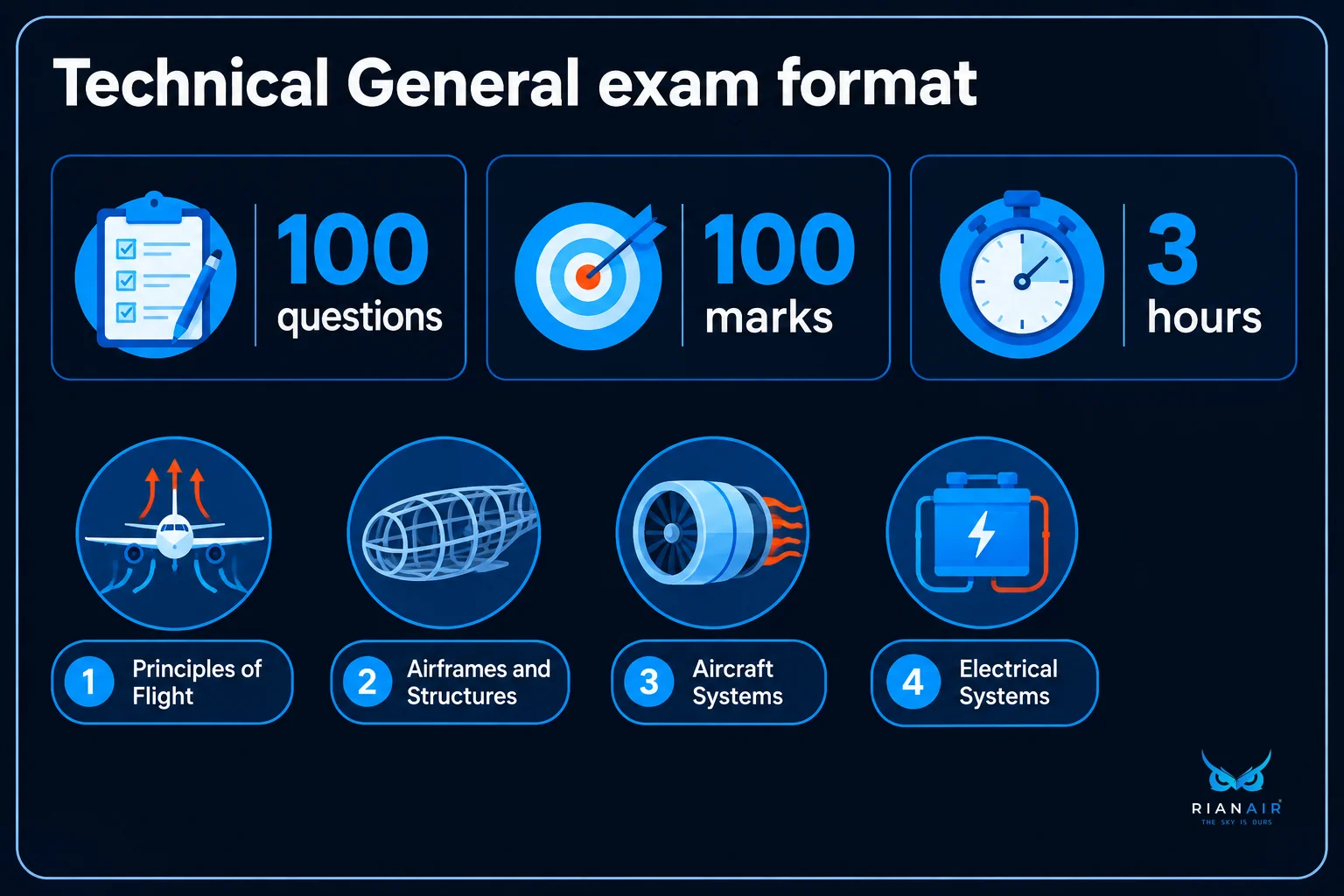
A Technical General question bank for pilots in India is a topic-wise set of exam-style questions for the DGCA Technical General paper, which has 100 questions, carries 100 marks and runs for 3 hours. It covers four core subjects: principles of flight, airframes and structures, aircraft systems, and electrical systems. Students in Delhi, Mumbai and Thrissur can practise it on RAPT, and you can try the free demo practice set first.
Key takeaways
Exam format: Technical General has 100 questions for 100 marks in 3 hours, so you have under two minutes per question.
Four core subjects: Principles of Flight, Airframes and Structures, Aircraft Systems and Aircraft Electrical Systems carry the whole paper.
Attempt fees on RAPT: the monthly OLODE attempt costs INR 5,000 per exam; a regular attempt in March, June, September or December costs INR 2,500 per exam.
Who sits it: students training in India must clear it. Students flying at foreign FTOs are exempt, and so are foreign licence holders converting to a DGCA CPL.
Technical General at a glance
Item | What to know |
|---|---|
Paper format | 100 questions, 100 marks, 3 hours |
Pass mark | 70% (70 out of 100) |
Core subjects | Principles of Flight, Airframes and Structures, Aircraft Systems, Electrical Systems |
Who must sit it | Students training for a DGCA CPL in India |
Who is exempt | Students flying at foreign FTOs; foreign licence holders converting to a DGCA CPL |
OLODE attempt | Every month, INR 5,000 per exam |
Regular attempt | March, June, September, December, INR 2,500 per exam |

What is a Technical General question bank for pilots in India?
A Technical General question bank is a large collection of multiple-choice questions grouped by topic, covering how an aeroplane flies, how it is built, how its systems work and how its electrics run. You practise them with answers and explanations before sitting the DGCA paper.
Technical General is one of the theory papers a student needs for a Commercial Pilot Licence. The exams are conducted by the DGCA, and the regulator's own Pariksha portal page explains that it runs examinations for flight crew licences under Rule 38 and Schedule II of the Aircraft Rules 1937. A question bank is not the exam. It is practice material that teaches you the pattern before the real paper.
Lift, drag, hydraulics and generators are not hard, but the questions are precise, and a vague understanding fails. Repeated, timed practice turns vague understanding into recall you can trust.
Where it sits among the DGCA papers
Alongside Technical General, a CPL student also clears Air Navigation, Meteorology, Air Regulations, Technical Specific and RTR(A). We have separate guides for the Air Navigation, Meteorology and Air Regulations banks, and the routes you can take after the papers are on our pathways page.
What does the DGCA Technical General exam look like?
The DGCA Technical General exam is a computer-based paper of 100 questions worth 100 marks, with 3 hours allowed. The pass mark is 70%, so you need 70 marks. Candidates register and appear through the DGCA Pariksha portal, where the user manual shows Technical General as one of five paper sections.
The Pariksha notice board lists admit cards and results for each session, so check it for the dates that apply to you. Sessions change, and a date remembered from last year is a risk. Our rule for Delhi, Mumbai and Thrissur students is simple: confirm the session on the portal before you pay for any attempt.
Time per question and a pacing plan for 180 minutes
With 100 questions in 180 minutes you get 1.8 minutes each. That sounds generous. It is not, once you reread a tricky aerodynamics option twice. Use this plan, which only divides the 180 minutes already allowed:
Phase | Minutes | What to do |
|---|---|---|
First pass | 120 | Answer what you know; flag anything that needs a second read |
Flagged questions | 45 | Return to flagged items, eliminate options, commit to an answer |
Final check | 15 | Confirm no question is blank; recheck only answers you doubt |
The three phases total 120 + 45 + 15 = 180 minutes. Checkpoint: at the 60-minute mark you should be near question 50.
Who must sit this exam, and who is exempt?
Students training for a DGCA CPL in India must clear Technical General. Students who do their flying at foreign FTOs are exempt from it, and so are foreign licence holders converting to a DGCA CPL, where Technical General and Technical Specific are both exempt.
Eligibility for pilot training itself starts earlier. As Employment News notes, candidates need 10+2 with Physics and Mathematics as compulsory subjects. At Rian Air we also ask students to be medically fit, and the top 12 scores in the 12th grade get the seat.
The four core subjects in the Technical General syllabus
Technical General rests on four subjects. Each one has its own question style, so a good question bank splits practice by subject instead of mixing everything on day one.
1. Principles of Flight (Aerodynamics)
This is the physics block: lift, drag, thrust and weight, airflow over a wing, stalls, stability and control. Expect questions on what changes when angle of attack, airspeed or flap setting changes. Learn the cause and effect in words first. Formulas help, but most questions test whether you can predict a result.
2. Airframes, Structures and Materials
Here you study how the aircraft body is built: fuselage and wing construction, loads, fatigue, corrosion and the materials used. Questions often ask why a design choice was made. A good habit is to sketch a wing box or fuselage section once and label the loads. That single drawing answers many questions.
3. Aircraft Systems
This block covers hydraulics, fuel, landing gear, brakes, pneumatics, pressurisation, air conditioning, ice protection and engines. It is the widest subject, and it rewards a system-by-system routine: what it does, how it is powered, what fails, and what the pilot sees when it fails.
4. Aircraft Electrical Systems
Electrics is often the topic students fear most. It covers batteries, generators and alternators, buses, circuit protection and basic AC and DC ideas. Start with simple circuits and the path of current. Once the flow is clear, the aircraft-specific questions feel much less abstract.
Reference books prescribed for the syllabus
The DGCA prescribes reference titles for this paper, and our content team works from the same list. It includes Aircraft General Knowledge volumes 1, 2 and 3 from Oxford, Airframes and Systems from Nordian, Electrics from the Nordian Aircraft General Knowledge series, and Powerplant from the same series. For aerodynamics, it lists Principles of Flight from Nordian and Oxford, and the JAR ATPL and CPL Principles of Flight by Keith Williams.
The regulator also publishes a list of study material for the PPL, CPL and ATPL exams on Pariksha. Read it once. Then use a question bank to find out what you actually remember from those books.
RAPT question bank: specifications, attempts and fees
RAPT is Rian Air's pilot career intelligence platform, available on web, Android and iOS. It holds a DGCA-aligned question bank of 20,000+ questions across subjects, and it records your attempts so weak topics show up early. For Technical General, the bank holds more than 1500 questions per subject, and Rian Air keeps adding questions. Rian Air has not given us a separate count for each of the four subjects, so we do not quote one.
For Technical General, RAPT offers two kinds of exam attempt. The monthly OLODE attempt runs every month and costs INR 5,000 per exam. The regular attempt runs in March, June, September and December and costs INR 2,500 per exam. Our full guide to the RAPT platform DGCA question bank shows how the other subjects work.
Which attempt should you choose?
Choose the regular attempt if you can wait for the next window. Choose the monthly OLODE attempt only when the timing matters more than the saving. Because INR 5,000 is double INR 2,500, a student who rushes every month pays twice as much per exam as one who plans around the four windows.
A hypothetical example: a student scores 62 in a practice paper in January. The regular window is March. Booking the March regular attempt costs INR 2,500 and leaves eight weeks of focused revision. Booking an OLODE attempt in February costs INR 5,000 and leaves only a few weeks. Unless a flying slot depends on the result, the March attempt is the better call.
Mock-score thresholds by attempt choice
Rian Air says students usually pass at 85%+ on the first attempt, so most should not need a second. Use this table to decide when to book. The 70 is the pass mark; the other thresholds are our working guidance, not DGCA rules.
Your recent full mocks | Suggested action |
|---|---|
Below 70 | Do not book. Add a loop on your weakest subject. |
70 to 74 | Not yet. This is the pass mark with no buffer for nerves. |
75 or higher, consistently | Book the regular attempt (INR 2,500) if the window suits you. |
75 or higher and a flying slot depends on the result | The monthly OLODE attempt (INR 5,000) is justified by timing. |
Asked what score students reach before booking, Rian Air says it aims for 100%. Students can reattempt wrong questions after a mistake, so errors are eliminated by exam day.
What each cost covers, and who you pay
Cost item | Amount | Who is paid |
|---|---|---|
Monthly OLODE attempt | INR 5,000 per exam | DGCA, paid directly to the DGCA |
Regular attempt (Mar, Jun, Sep, Dec) | INR 2,500 per exam | DGCA, paid directly to the DGCA |
The DGCA sets examination fees per paper under Rule 48 of the Aircraft Rules 1937. Check the Pariksha FAQ for the current fee before you pay.
For a wider view of the full budget, read our breakdown of pilot training cost in India and the hidden fees parents miss.
Medical first, then exams
Do the Class 2 medical before you commit to ground training, because a student who is not medically fit cannot go on to fly. Rian Air guides students through creating the eGCA ID, the Class 2 tests plus the doctor appointment.
How to prepare with a question bank, step by step
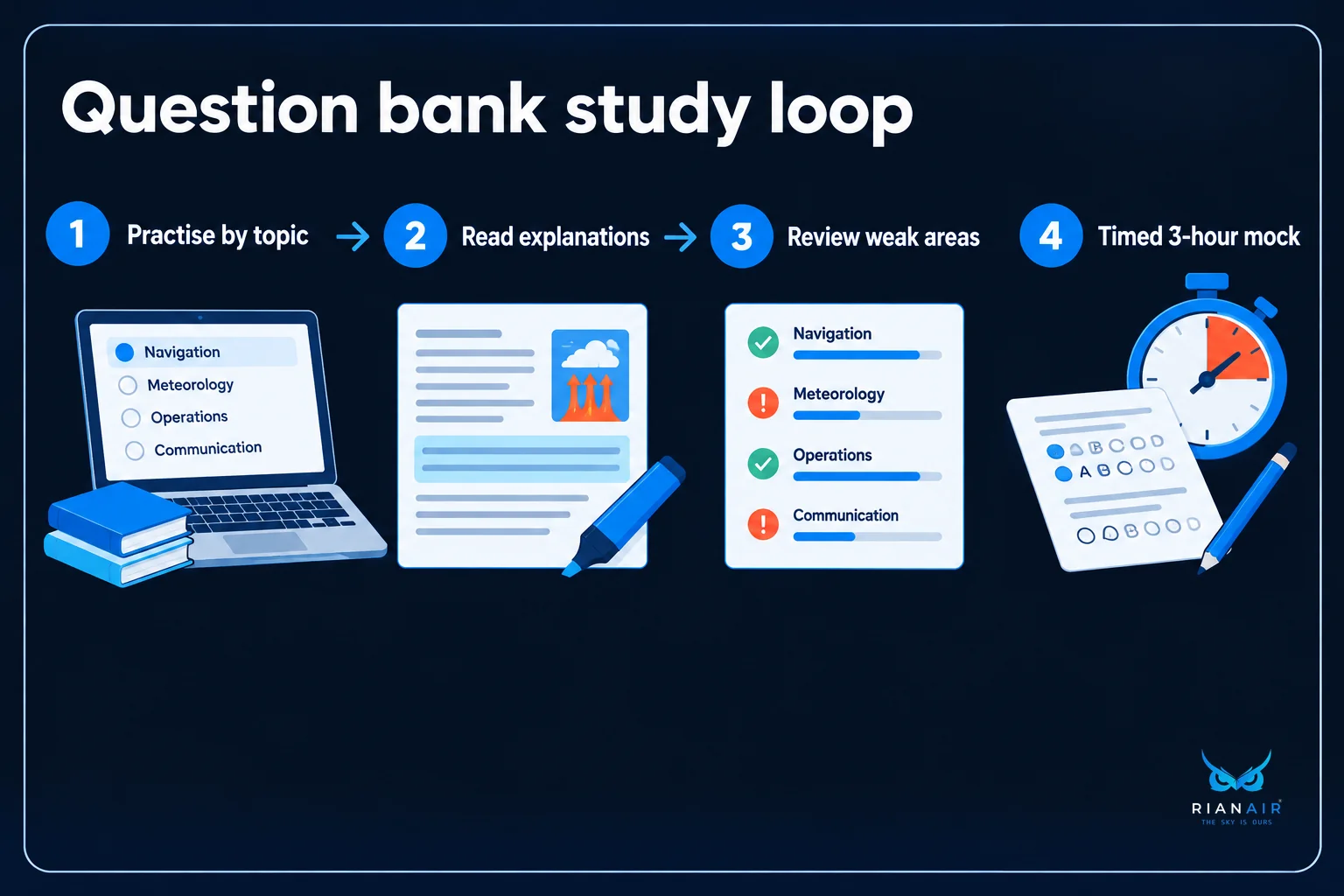
Prepare by working through the question bank in a loop: practise one subject by topic, read every explanation, review your weak areas, then sit a timed 3-hour mock. Repeat the loop until you score comfortably above the 70% pass mark.
Read first, then test. Spend the opening weeks with the prescribed books, one subject at a time. Attempting hundreds of questions before reading teaches you wrong guesses.
Practise by topic. Do 20 to 30 questions on one topic, such as hydraulics or stalls. Stop when you can explain each answer aloud.
Read every explanation. Do this even for right answers. Lucky guesses hide gaps.
Log weak topics. RAPT tracks which topics you miss. Revisit those immediately, not two weeks.
Sit full mocks. Take at least two complete 100-question papers in 3 hours, in silence, with no notes.
Book the attempt. Choose the regular window or the monthly OLODE attempt only after your mock scores are consistently above 70.
A 10-week schedule with hours per subject
This is a suggested plan for a student with no other paper to study, not a DGCA rule. It assumes 10 hours a week. Each subject gets 20 hours of reading and topic practice, which totals 80 hours across the four subjects. The last two weeks hold mocks and review, 20 hours in all. Total: 80 + 20 = 100 hours.
Weeks | Focus | Hours |
|---|---|---|
1 to 2 | Principles of Flight: read, then topic practice | 10 + 10 = 20 |
3 to 4 | Airframes, Structures and Materials | 10 + 10 = 20 |
5 to 6 | Aircraft Systems (widest subject) | 10 + 10 = 20 |
7 to 8 | Aircraft Electrical Systems | 10 + 10 = 20 |
9 | Weak-topic review from RAPT logs, plus one full timed mock | 10 |
10 | Second full timed mock, fix errors, decide whether to book | 10 |
If you are short of time, keep the order and stretch the weeks rather than mixing subjects. If your mocks stay below 70 after week 10, do not book. Add another loop on the weakest subject instead.
Sample questions with worked answers
These are practice-style examples of the question types, written for this guide. They are not DGCA paper questions.
Principles of Flight
Q1. What happens when angle of attack increases past the critical angle?
A. Lift keeps rising. B. The airflow separates and lift falls. C. Drag falls sharply. D. The wing becomes more stable.
Answer: B. The wing stalls even though the nose is high.Q2. Which force opposes thrust in steady level flight?
A. Lift. B. Weight. C. Drag. D. Load factor.
Answer: C. Drag opposes thrust; weight opposes lift.
Airframes and Structures
Q3. Why sketch the loads on a wing box?
A. To list the avionics. B. To show which skin and spars carry bending and shear. C. To find fuel capacity. D. To size the tyres.
Answer: B. This answers most "why this design" questions.Q4. Which term describes cracking from repeated cyclic loading?
A. Fatigue. B. Creep. C. Corrosion. D. Buckling.
Answer: A. Fatigue is damage from repeated load cycles.
Aircraft Systems
Q5. A hydraulic system loses pressure. What is the first step in your routine?
A. Ignore it. B. Recall what the system does and how it is powered. C. Switch off the battery. D. Reset the brakes.
Answer: B. Work through what it does, how it is powered, what fails, and what the pilot sees.Q6. Which system is covered by pressurisation and air conditioning?
A. Pneumatics and cabin environment. B. Landing gear only. C. Fuel only. D. Radio.
Answer: A. Both sit in the Aircraft Systems block.
Aircraft Electrical Systems
Q7. When a generator fails, where does current flow from?
A. The battery, through the buses. B. The fuel tank. C. The pitot tube. D. The flaps.
Answer: A. Trace the path from the battery through the buses to the loads.Q8. What does a circuit breaker do?
A. Raises voltage. B. Protects a circuit from overload. C. Stores charge. D. Converts AC to DC.
Answer: B. It is circuit protection.
On RAPT, Rian Air keeps updating past question papers as well. Rian Air also has a free demo practice set. Sign up with your name, email, phone number and DOB, set your password from the link sent to your email, and solve 500+ questions across multiple subjects. If it suits you, you can then commit to our ground classes.
Rian Air says students usually see an 85%+ pass rate in the first attempt, nearly everyone passes in the second, and only one or two students barely reach a third.
Asked which subject students fail most, Rian Air says they do not miss any one topic once they are consistent, and that students fail Technical General as a whole through lack of practice. Capt. Vikas Vikramdas Nair puts it simply: everything is difficult if you do not practise, and easy if you practise consistently. Treat every topic as equally important.
Common mistakes to avoid
Memorising answers: question order changes, and numbers or options get reworded. Understand the reason.
Skipping electrics: it feels dry, yet it is a full core subject.
Studying all four subjects together: finish one at a time so you can see progress.
Ignoring time: a student who knows the content can still run out of time. Practise pacing.
Our Delhi ground training roadmap explains how Technical General fits in with the other subjects, so you do not sit several papers at once.
Foreign FTO students and licence conversions
Students who fly at foreign FTOs are exempt from Technical General. That is why many families compare training in India with options abroad. Our guide to CPL training in India vs Malta vs Tunisia sets out the differences.
If you hold a foreign licence from an ICAO contracting state and want a DGCA CPL, Technical General and Technical Specific are exempt. You still need Air Navigation, Meteorology, Air Regulations and RTR(A), ideally cleared before you leave India. Otherwise Air Navigation and Meteorology become one composite exam of 100 marks and 100 questions in 3 hours. Skipping the DGCA exams before departure can more than double the cost of conversion, so clear them first.
Frequently asked questions
1. How many questions are in the DGCA Technical General exam?
The DGCA Technical General exam has 100 questions, carries 100 marks and allows 3 hours. That works out to 1.8 minutes per question. Students usually do a first pass quickly, flag the hard questions, and use the last hour to return to them with a calm head.
2. What is the pass mark for Technical General?
The pass mark is 70%, which means 70 marks out of 100. Because the paper is precise and unforgiving of half-knowledge, aim for mock scores of 75 or higher before you book an attempt. A small buffer protects you from nerves on the day.
3. Who needs to take the Technical General exam?
Students training for a DGCA Commercial Pilot Licence in India need to clear Technical General. It is one of the theory papers that sit between ground school and flight training, so most students in Delhi, Mumbai and Thrissur plan it alongside their other subjects.
4. Is Technical General exempt for foreign FTO students?
Yes. Students who do their flight training at foreign FTOs are exempt from Technical General. Foreign licence holders converting to a DGCA CPL are also exempt from Technical General and Technical Specific. They still clear Air Navigation, Meteorology, Air Regulations and RTR(A).
5. What are the four core subjects?
The four core subjects are Principles of Flight (aerodynamics), Airframes, Structures and Materials, Aircraft Systems, and Aircraft Electrical Systems. Aerodynamics is about forces and airflow, structures about the aircraft body, systems about hydraulics, fuel and engines, and electrics about power supply and circuits.
6. Which books does the DGCA prescribe?
The prescribed list includes Oxford Aircraft General Knowledge volumes 1, 2 and 3, Nordian Airframes and Systems, Nordian Electrics, Nordian Powerplant, and Principles of Flight from Nordian and Oxford. It also names the JAR ATPL and CPL Principles of Flight by Keith Williams.
7. How much does a Technical General attempt cost on RAPT?
The monthly OLODE attempt costs INR 5,000 per exam. The regular attempt, offered in March, June, September and December, costs INR 2,500 per exam.
8. When can I take a Technical General attempt?
The OLODE attempt is available every month. Regular attempts run four times a year, in March, June, September and December. Check the DGCA Pariksha notice board for current session details before you commit, because the regulator publishes admit cards and results by session.
9. How long does preparation take?
Plan roughly 8 to 10 weeks of focused study if Technical General is your main paper. Students who sit several papers together usually need longer for each. Finish reading one subject, complete topic practice, then use full mocks to confirm you are ready.
10. Should I do the medical before the exams?
Yes. A student who fails the Class 2 medical may never fly, so it is wise to know early. Rian Air asks for medical fitness before enrolment. Some findings are temporary and can clear in 2 weeks to 6 months or more, but a permanent finding such as colour blindness cannot.
11. Is Technical Specific the same as Technical General?
No. Technical Specific is a separate DGCA paper. Technical General covers principles shared by all aircraft, such as aerodynamics, structures, systems and electrics. For foreign licence conversions, both Technical General and Technical Specific are exempt.
12. What if I do not pass?
DGCA has a 42 days cool off period after which the student can apply again after ample amount of practise. Use that time to review results topic by topic and retake timed mocks (the demo practice set is a good place to start), and rebook only when your mock scores are consistently above the 70% pass mark. Confirm the current cool-off and pass mark on the Pariksha FAQ page before you rebook.
13. Can I practise on my phone?
Yes. RAPT is available on web, Android and iOS, so you can practise topic questions on a phone and take longer mocks on a laptop. Use a laptop for the full 3-hour paper to match the real exam screen and pacing.
Take the next step with Rian Air
Passing Technical General is mostly a matter of order: medical first, books second, topic practice third, timed mocks last. Not sure yet? Start the free demo practice set and solve 500+ questions before you commit to ground classes.
If you want a clear plan for your own situation, start your enquiry with Rian Air and our academic counsellor will walk you through the subjects, attempt windows and fees. You can also see how ground training connects to simulator and flight training on our pathways page.
For exam tips and updates, follow us on Instagram and watch our lessons on YouTube. For the full DGCA paper list, read our DGCA question bank for CPL and ATPL guide.