



Air Regulations Question Bank for Pilots in India
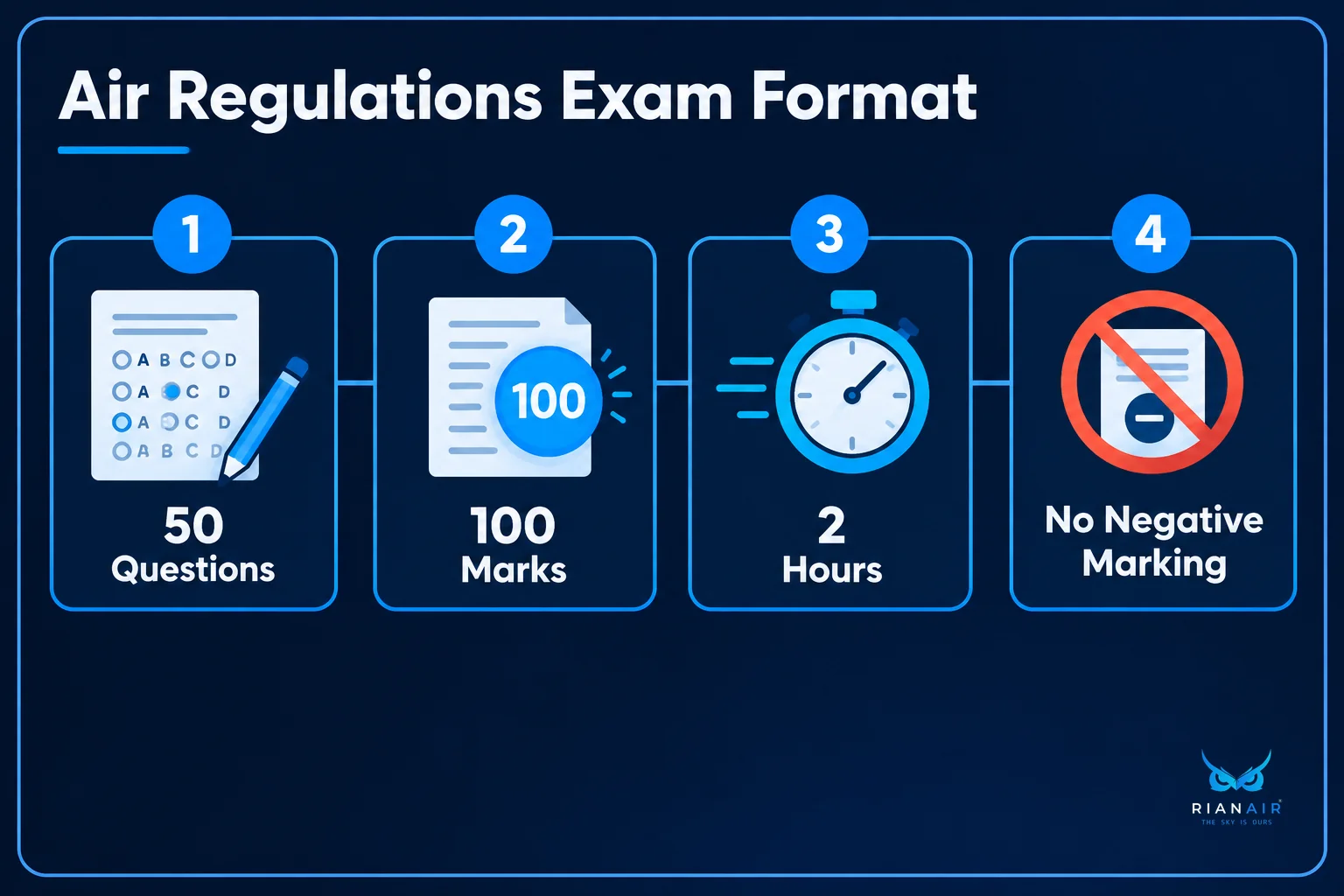
An air regulations question bank for pilots in India is a topic-wise set of exam-style multiple-choice questions for the DGCA Air Regulations paper. The paper has 50 questions, carries 100 marks, runs for 2 hours and has no negative marking. Students in Delhi, Thane and Thrissur clear it best by practising rules in a structured bank and learning the reason behind each answer.
Key takeaways
- Exam format: 50 questions, 100 marks, 2 hours, and no negative marking, so every question is worth attempting.
- Bank size: The RAPT Air Regulations bank holds 2500+ questions, and it is updated after every DGCA exam and whenever DGCA changes a rule.
- Method: Rules are learned by concept, not by memorising answer keys. Every topic matters and none can be skipped.
- Timeline: At Rian Air, Air Regulations and Meteorology run together over about 1.5 months inside a 6-month ground school plan.
- Attempts: Most of our students pass each subject on the first attempt, and nearly all of the rest pass on the second.
Air Regulations exam at a glance
| Item | Detail |
|---|---|
| Number of questions | 50 multiple-choice questions |
| Total marks | 100 |
| Time allowed | 2 hours |
| Negative marking | None |
| RAPT Air Regulations bank | 2500+ questions, including past DGCA paper questions |
| Bank updates | After every DGCA exam and every DGCA rule change |
| Time on this subject at Rian Air | About 1.5 months, studied alongside Meteorology |
| Typical attempts per subject | 1 to 2 at most |
What is an air regulations question bank for pilots in India?
It is an organised collection of practice questions built around the DGCA Air Regulations syllabus. Each question has options, the correct answer and an explanation. A good bank sorts questions by topic, tracks your mistakes and refreshes whenever the rules or the exam papers change.
Air Regulations is one of the written papers DGCA sets for pilot licences. DGCA licenses pilots in India and conducts the examinations in core subjects, including Air Regulations.
A loose PDF of 50 questions is not the same thing. It does not update itself, it rarely explains why an option is wrong, and it cannot tell you which topic keeps costing you marks. That gap is where repeat attempts come from.
Why rules are different from other subjects
Navigation can be worked out on paper. Meteorology follows physical logic. Regulations are written rules, and a rule is either known or not known. That makes this paper unforgiving for students who skim, which is why a structured bank matters more here than in most subjects.
What is the DGCA Air Regulations exam format?
The DGCA Air Regulations paper has 50 multiple-choice questions worth 100 marks in total. Candidates get 2 hours. There is no negative marking, so a wrong answer costs nothing beyond the missed marks. Confirm the current pass mark on the official DGCA examination portal before your attempt.
Two hours for 50 questions gives you more than two minutes per question. Time is rarely the problem. The real risk is a confident wrong answer on a rule you only half remember.
Because there is no negative marking, never leave a question blank. If you are unsure, remove the options you know are wrong and choose from what is left. Practising this elimination habit inside the question bank is a skill by itself.
What does the Air Regulations syllabus cover?
The Air Regulations syllabus covers Indian aviation law and international ICAO standards. Main areas include airspace classification, Rules of the Air, Air Traffic Services, DGCA Civil Aviation Requirements (CARs), pilot certification, aircraft airworthiness and flight safety regulations. Every area can appear in the exam.
ICAO is the United Nations agency that helps 193 countries cooperate on international civil aviation, and its standards sit behind many national rules. DGCA then applies them through Indian rules and CARs. Students need to know both layers, because questions can touch either.
Topic areas and what each one trains
- Airspace classification: Which airspace you are in decides what clearances and equipment you need.
- Rules of the Air: Right of way, minimum heights, signals and flight rules.
- Air Traffic Services: How controllers and pilots share responsibility.
- CARs: The detailed DGCA requirements that change most often.
- Pilot certification: Ages, medical validity, licence privileges and limits.
- Airworthiness and flight safety: Documents an aircraft must carry and what makes it fit to fly.
Sample Air Regulations question with explanation
Question: The minimum age for a Commercial Pilot Licence in India is: 16, 17 or 18?
Answer: 18.
Explanation: A CPL applicant must be at least 18. A student pilot licence can be held from 16 and a PPL from 17. Notice that the question tests three licences at once. A student who only memorised "18" would struggle if the question asked about the PPL.
That is the pattern across the paper. Related rules sit side by side, and the wrong options are usually correct rules for a different licence. A bank with explanations teaches you to separate them.
Why do rules need understanding and not mugging up answers?
Because the exam changes the wording, the licence type or the situation, and a memorised answer key fails the moment it does. Concept-based learning lets you rebuild the answer from the rule. At Rian Air, we treat every topic as important, since skipping or underestimating one leads to failure.
Mugging also breaks down when DGCA updates a rule. A student who learned "answer B" from an old PDF has no way to know that B is no longer correct. A student who learned why B was correct can spot the change.
Our RAPT error data points to the same lesson. We cannot name one topic that is safe to skip, because marks are lost across the syllabus. Rules reward steady, complete coverage.
Signs you are mugging, not learning
- You remember the option letter but not the rule behind it.
- You score well on one PDF and badly on a new set of questions.
- You cannot explain why the three wrong options are wrong.
- You skip topics because they "rarely come".
How does RAPT help students clear Air Regulations by concept?
RAPT, the Rian Air platform, pairs a 2500+ question Air Regulations bank with explanations, topic-wise practice and progress tracking. It nudges students to understand each rule first and then solve questions. The bank is updated after every DGCA exam and every rule change.
For regulations, the set includes past questions from DGCA exam papers. Some questions repeat across papers. That is useful, because a recent exam question shows how DGCA actually frames a rule. You can read more in our guide to the RAPT platform DGCA question bank for CPL and ATPL.
What the platform does for you
- Topic-wise practice: You work through one area of the syllabus at a time.
- Explanations on every question: You learn why an answer is right, not just which one it is.
- Live progress tracking: Parents can follow every step of a child's progress, day to day, through RAPT.
- Always online: The RAPT platform is available online at all times.
- Free trial: You can register and speak to our support team to try it.
The same method works in Meteorology, where we use a similar bank structure. See our Meteorology Question Bank for Pilots in India to compare how both papers are handled together.
The role of the classroom and library
The bank does not replace teaching. Our instructors explain a rule first. Then students solve questions on it. Revision sessions are allowed, but the focus stays on solving once the concept is clear. A library is also available for students who want a quiet place to practise.
How to study the question bank step by step
Study one rule area at a time: learn the rule, practise topic questions, read every explanation, retest your weak topics, then sit full mock papers under exam timing. Repeat until your scores are steady. This loop builds recall and judgement together.
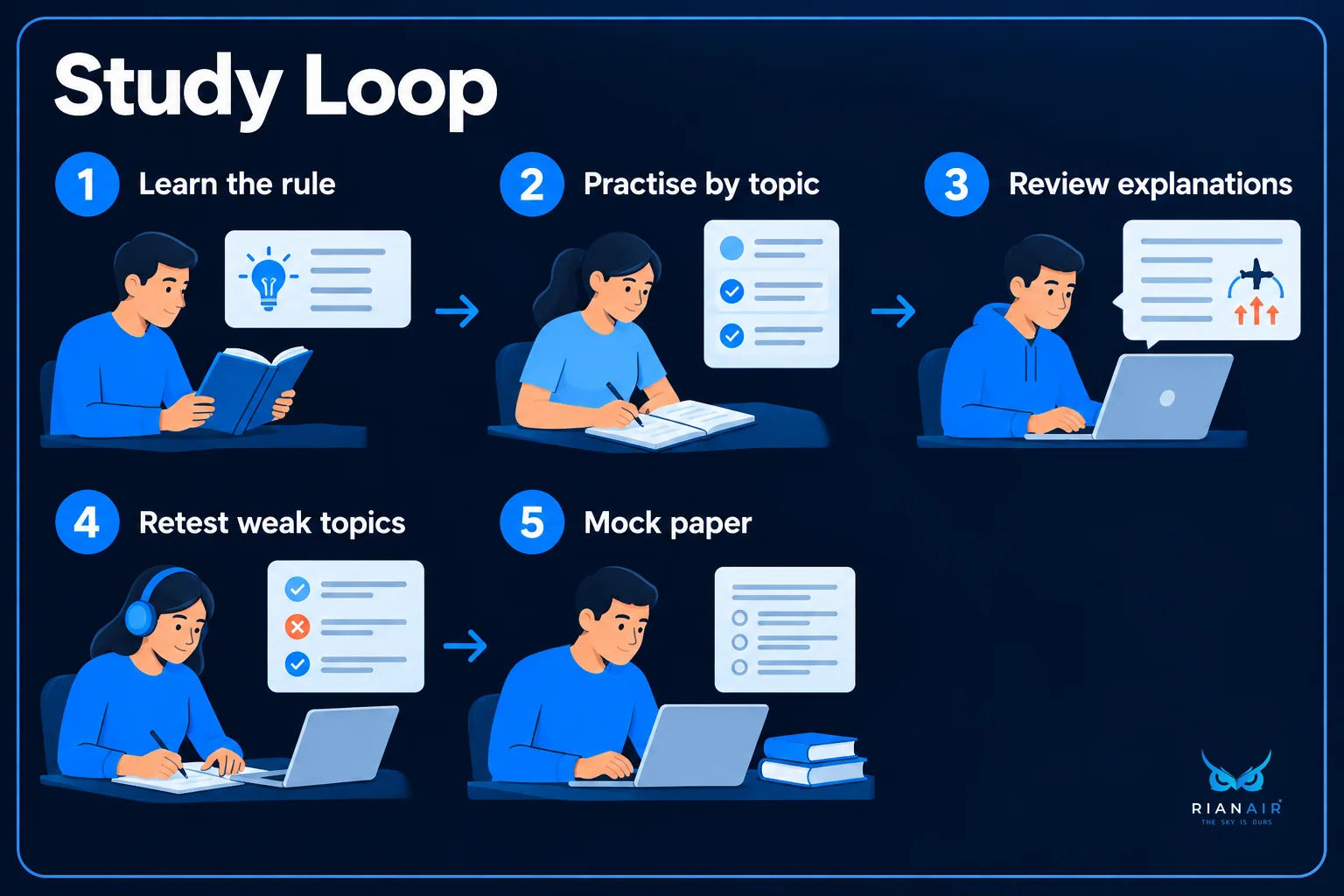
- Learn the rule first. Attend the class or read the topic. Do not start with questions on a topic you have never seen.
- Practise by topic. Solve questions on that one area. Aim to understand each option, including the wrong ones.
- Read every explanation. Do this even when you answered correctly. A lucky guess is not knowledge.
- Retest weak topics. Return to any area where you slipped. Keep going until the mistake stops repeating.
- Sit full mock papers. Use 50 questions in 2 hours, with no breaks, so exam day feels familiar.
- Re-check after rule changes. When DGCA updates a rule, practise the updated questions right away.
What to do when your mock scores stay low
If one topic keeps dropping your score, stop doing full papers and go back to that topic's rule. Read the source material, then solve only that topic until you get it right repeatedly. Jumping between mocks without fixing the gap is the commonest reason students need a second attempt.
Many students also lose time because they study every subject at once. Our guide on ground training for pilots in Delhi explains how a one-subject-at-a-time plan keeps this under control.
Streamlined syllabus across Rian Air centres in India
Rian Air teaches the same DGCA syllabus and uses the same RAPT bank at every centre, so a student in Delhi, Thane or Thrissur prepares from identical material. Online ground training also lets students outside these cities attend, then move to in-person facilities for simulator work.

One syllabus, one question bank and one progress dashboard mean a student can start online in one city and continue in another without relearning anything. Online study covers Air Navigation, Meteorology, Regulations, Technical General, Technical Specific and RTR Part 1 and 2. Simulator training and flight training are always in person.
Thrissur classes run in two slots, 10 to 1 and 2 to 5, with two batches of 12 students each. The next batch for Air Navigation starts in November. For Kerala-specific details, see our Kerala ground training guide, or use the enquiry link below for current batch details.
Technical subjects and partner flying schools
Rian Air does not cover Technical General and Technical Specific in the same way as the other subjects. Partner flying schools in India cover Technical General and Technical Specific for single and multi engine aircraft for all Rian Air students. Technical General is optional for students flying abroad, and it can be done during flight training in India.
How long does it take to clear all papers?
The full ground school at Rian Air takes about 6 months. Air Navigation takes 2 to 2.5 months, Regulations and Meteorology run together over 1.5 months, and RTR takes about 15 days because part of it is covered during Navigation. Technical General takes 2 to 2.5 months.
Some students finish faster. One of our students, Bharat, cleared all his exams in 4 months, including medicals and other formalities, got his visa done and now holds his CPL from Tunisia. He will convert his licence soon. Most students take 6 to 12 months in total.
Navigation, Meteorology, Regulations and RTR are typically cleared in the first 6 months. Technical Specific takes about a month, right before flight training. For a wider view of the CPL pathway, read why DGCA ground classes take too long in India.
Start your Air Regulations preparation with Rian Air
If you are ready to build real rule knowledge instead of memorising answers, start your pilot journey with Rian Air. Register for the free RAPT trial and speak to our support team. You can also explore pathways from ground school to flight training, follow us on Instagram and subscribe on YouTube for study tips.
Frequently asked questions
1. What is the Air Regulations exam pattern for DGCA CPL?
The paper has 50 multiple-choice questions worth 100 marks, and candidates get 2 hours. There is no negative marking. Questions cover Indian rules, DGCA CARs and ICAO standards, so you need to prepare every part of the syllabus.
2. Is there negative marking in the DGCA Air Regulations exam?
No. The Air Regulations paper has no negative marking. A wrong answer does not reduce your score, so you should attempt all 50 questions. When unsure, eliminate options you know are wrong and pick the best of the rest.
3. How many questions are in the RAPT Air Regulations bank?
The RAPT Air Regulations bank has 2500+ questions. It includes questions from past DGCA papers, and some questions repeat across papers. That repetition is useful because recent exam questions show how DGCA frames rules.
4. How often is the question bank updated?
We update the RAPT bank after every DGCA exam, so past papers and recently attempted questions are included. We also update it whenever DGCA changes a rule, so students never practise outdated answers.
5. Which Air Regulations topics should I skip?
None. Every topic is important, and skipping or underestimating any of them can lead to failure. Rules reward complete coverage, so study airspace, Rules of the Air, ATS, CARs, certification, airworthiness and safety equally.
6. How long does it take to prepare for Air Regulations?
At Rian Air, Regulations and Meteorology run together over about 1.5 months. The whole ground school usually takes 6 months. Some students have cleared everything in as little as 4 months and started flight training.
7. How many attempts do students usually need?
Usually 1 to 2 attempts per subject at most. About 80% of our students pass on the first attempt, and nearly everyone else passes on the second. Only 1 or 2 students so far have needed a third attempt.
8. Can I study Air Regulations online?
Yes. Rian Air offers online ground training for Air Navigation, Meteorology, Regulations, Technical General, Technical Specific and RTR Part 1 and 2. The RAPT platform is always online. Simulator and flight training happen in person.
9. Does Rian Air offer a free trial of RAPT?
Yes. There is a free trial. You can register and speak to our support team, who will explain how the question bank works. RAPT is currently exclusive to Rian Air students, and plans for wider access are still being decided.