


Free DGCA Question Bank Demo for CPL and ATPL Pilots (RAPT)
Only the demo is free. The RAPT demo account gives you 500 exam-style DGCA questions for CPL and ATPL subjects with answers and explanations at no cost, while full RAPT access depends on your course: CPL access is provided only to students attending ground training for that subject, and ATPL access is ₹500 per month per subject.
RAPT, the Rian Air Pilot Training platform, holds a large bank of questions for CPL and ATPL papers, and students in Delhi, Mumbai, Kerala and online batches use it to prepare for their DGCA exams.
What Free Options Exist, and How Does This Demo Compare?
Unlimited free DGCA question banks do exist online, and they suit a quick, no-commitment look. Before you rely on any of them, run this short checklist:
Source: do the questions come from past DGCA papers or from a reliable, named origin, and are they updated after each exam?
Per-subject count: how many questions cover each subject you need, not just the total?
Explanations: does every answer explain why the other options are wrong?
Here is how the RAPT demo measures up on the same points.
Question count: 500 questions in the demo, not the full bank.
Subjects: CPL and ATPL subjects, with separate demo links. Rian Air has not published a per-subject split of the 500.
Explanations: every question has the correct answer and an explanation.
Cost: the demo is free. Full access is not free: it comes with CPL ground training for that subject, or ₹500 per month per subject for ATPL.
If you only want unlimited free questions, a fully free bank will give you more volume. If you want explanations and a clear check of your level before you pay for training, the demo is a fair place to start.
DGCA Question Bank at a Glance
Item | What you need to know |
|---|---|
Question volume on RAPT | A large bank, with answers and explanations |
Free demo | 500 questions with answers and explanations. The only free part; full access is paid. |
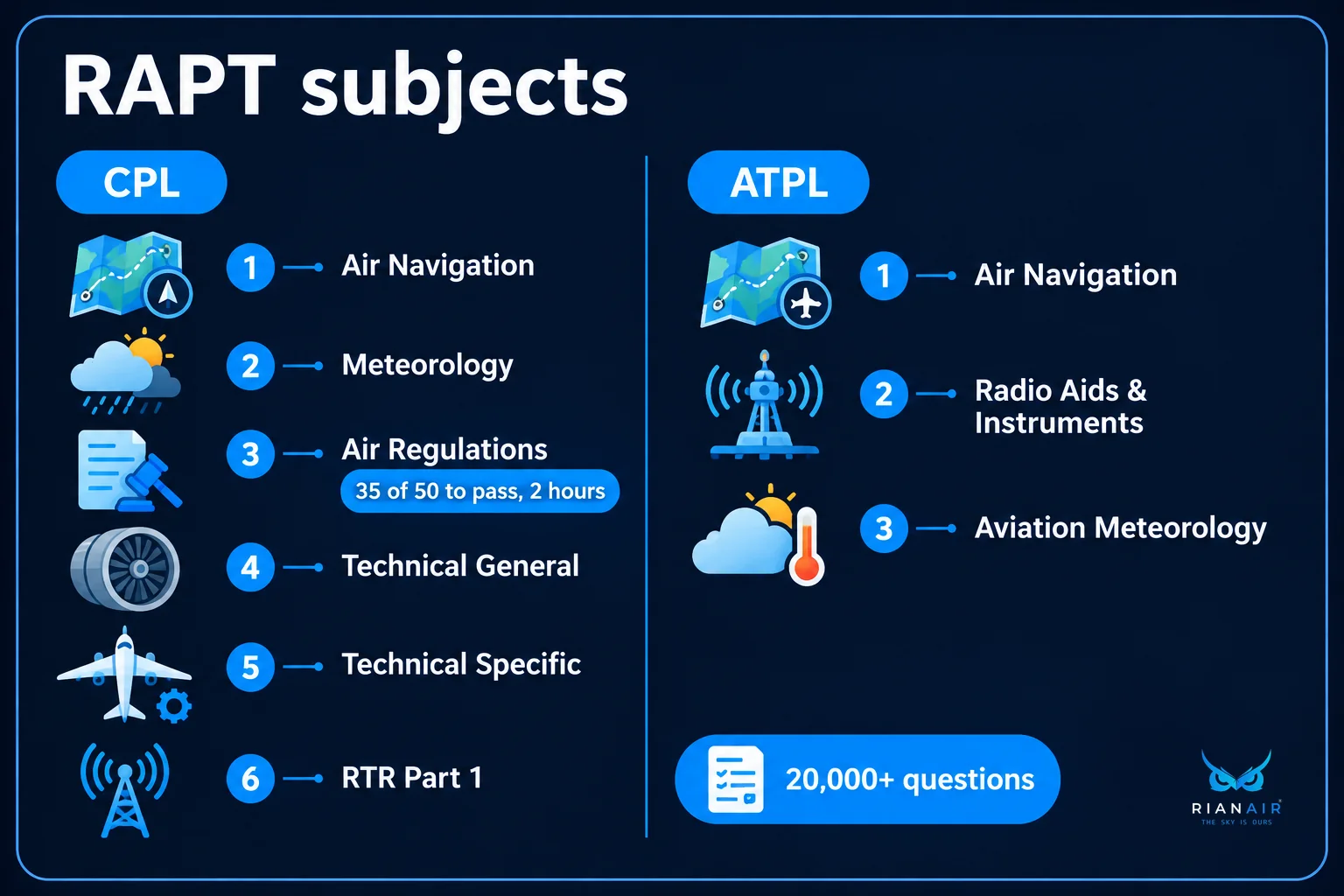
CPL subjects covered | Air Navigation, Meteorology, Air Regulations, Technical General, Technical Specific (various aircraft), RTR Part 1 |
ATPL subjects covered | Air Navigation, Radio Aids and Instruments, Aviation Meteorology |
Air Regulations paper | 50 questions, 2 hours, 35 correct answers (70%) to pass |
RTR Part 1 bank | 754 questions in the RAPT bank (625 RTR questions plus 129 from past papers); the DGCA pattern is 50 questions |
RTR Part 1 and Part 2 duration | 2 to 4 weeks combined |
ATPL class format | Mostly one-on-one, scheduled around the pilot's flight roster |

What Is a DGCA Question Bank and Why Does Practice Decide the First Attempt?
A DGCA question bank is a large set of exam-style multiple-choice questions, grouped by subject and topic, that lets pilots practise the way DGCA tests them. Repeated practice shows which topics you misread, so you fix weak areas before you pay for and sit the real paper.
The exam asks questions in a different way from the textbooks. A bank trains you to read the question, spot the trap and choose fast. That is why we built RAPT around questions first, and notes second.
Before you practise, you also need your exam admin sorted. DGCA runs its written exams through the Pariksha portal, and every flight crew candidate needs a computer number to register. Registration windows for each flight crew session change, so we do not list dates here. Check the Pariksha home page for the current session and its opening and closing dates before you plan.
What Does the Free RAPT Demo Include?
The demo gives you 500 exam-style multiple-choice questions, each with the correct answer and an explanation. There are separate demo links for CPL and ATPL, so you test the subjects that match your licence goal.
From the demo to full access
No questions are free beyond the 500-question demo. Once you finish them and are satisfied, the next step depends on your licence.
For ATPL, access is a subscription of ₹500 per month per subject, with no need to attend classes. We recommend one subject at a time, starting with Meteorology. Online classes to fit your roster are available at an additional cost.
One concrete CPL access path
For CPL, RAPT is provided only if you attend ground training for that particular subject. The ground training fee for that subject is what you pay, and RAPT access for the subject comes with attending it. The fees we have on file are ₹20,000 for Air Regulations and ₹40,000 for Air Navigation.
Create your free CPL demo account and attempt the 500 questions.
Note the subjects where you lose the most marks.
Request a demo online class, or visit any of our nearest training centres if you want offline classes.
Choose online or offline ground training for each subject you want.
Pay the ground training fee for that subject and start RAPT for it.
For ATPL, create your free ATPL demo account, pick one subject (ideally Meteorology), subscribe at ₹500 per month, and add the next subject once the first is done. One-on-one classes around your roster cost extra.
What the Free Demo Leaves Out
The demo is a 500-question sample, not the full bank. It leaves out full-bank access for CPL subjects, ATPL subscription access, classes and simulator time. Rian Air has not published a per-subject split of the 500 demo questions, and the demo covers CPL and ATPL subjects together. The full RAPT bank currently holds 4,848 General Navigation, 2,757 Radio Navigation, 1,688 Instrument Navigation, 2,840 Air Regulations, 1,258 Meteorology, 3,488 Technical General and 972 Technical Specific questions, and the counts grow after every DGCA exam.
What Does the RAPT Question Bank Cover for CPL?
For CPL, RAPT covers six areas: Air Navigation, Meteorology, Air Regulations, Technical General, Technical Specific for various aircraft types, and RTR Part 1. Each question comes with the correct answer and an explanation of why the other options are wrong.
You can read more about how the platform is organised on our page for the RAPT platform DGCA question bank for CPL and ATPL. Here is what each subject asks of you.
What a demo question looks like
Every question is multiple choice with one correct answer and an explanation. This is an illustrative example of the format, not a question taken from the RAPT bank.
Question: Which cloud type is most closely associated with thunderstorms? (A) Stratus (B) Cirrus (C) Cumulonimbus (D) Altostratus
Answer: C, Cumulonimbus.
Explanation: Cumulonimbus clouds are deep, vertically developed clouds with strong updrafts, which is what produces thunderstorms. Stratus is a flat, layered cloud, cirrus is high and wispy, and altostratus is a mid-level layer, none of which build the vertical development a thunderstorm needs.
Air Navigation and Meteorology
Navigation questions test calculation speed and chart reading, while meteorology questions test how well you link cloud, pressure and weather reports to flight decisions. In both subjects, the explanation matters more than the answer key. A wrong answer you understand becomes a right answer next week.
Air Regulations
The Air Regulations paper has 50 questions and runs for 2 hours. You need 35 correct answers, which is 70%, to pass. The subject currently has 23 chapters, per Rian Air's own records.
Students struggle most with the annexures in class, and we teach memory tricks for them. In RAPT, the topics with the highest error rate are separation methods and minima, and human factors. If your mock scores dip, check those two first.
Technical General and Technical Specific
Technical General covers how aircraft are built and how their systems work. Technical Specific is tied to the aircraft type, which is why the bank includes questions for various aircraft. We teach Technical General through partner flying schools, and RAPT supports it with practice questions and explanations.
RTR Part 1
The RTR (Radio Telephony Restricted) written paper follows the DGCA pattern of 50 questions. The RAPT RTR Part 1 bank holds 754 questions: 625 RTR questions and 129 from past papers (625 + 129 = 754). RAPT lets you build practice sets with different permutations and combinations, so you do not memorise a fixed order.
RTR has a spoken Part 2 as well. Our guide to the RTR exam, Part 1 question bank and Part 2 mock calls explains both parts.
How Does RAPT Help Working Pilots Clear ATPL Papers?
RAPT helps working pilots by combining one-on-one classes, timed around their flight rosters, with a question bank for the three ATPL subjects: Air Navigation, Radio Aids and Instruments, and Aviation Meteorology. Sessions focus on doubts, while RAPT handles questions, answers and explanations for the rest.

DGCA sets the framework. Its Civil Aviation Requirement on the ATPL examination says an applicant must pass a written examination and an oral examination to hold an ATPL for aeroplanes. Another DGCA requirement says ATPL oral examinations are held at Chennai, Mumbai and New Delhi, or at other places decided by the Director General.
Why one-on-one classes suit a roster
A first officer flying for an airline, a cargo operator or a charter company cannot sit in a fixed evening batch. So ATPL is usually taught one on one, and we schedule each session around that pilot's roster. You study on rest days and between trips, and the class fits your week.
The classes cover three DGCA papers, and most sessions are doubt sessions. You do the reading and practice on RAPT, then bring the questions you could not solve.
For a wider view of planning, read what commercial pilots need to know early about ATPL preparation in India.
Which RAPT Features Let You Learn Anywhere, Anytime?
RAPT runs on the web, Android and iOS, so you can practise on a phone during a commute, a laptop at home or a tablet in a crew room. Your questions, explanations and progress sit in one place, and you can resume where you stopped.
Here is what the platform gives you in practice:
A large question bank for navigation, meteorology, regulations, Technical General, Technical Specific and RTR Part 1.
Answers with explanations, so every wrong attempt teaches something.
Flexible practice sets for RTR, built from various permutations and combinations of the same bank.
Digital logbook and performance analytics, so your academics and training records sit together.
Parent dashboard for families who sponsor training and want to see progress.
A Part 2 self-practice tool for RTR mock calls is under development. We will announce it once it is ready, so we do not list it as live today.
Related reading: why a 24x7 library for pilots changes how you prepare for DGCA exams.
What Is a Good Week-by-Week Practice Plan Using Mock Tests?
The most common first mistake students make on RAPT is not re-trying the wrong answers immediately. Many also lack the patience to solve longer chapters in one sitting, so we are introducing a save progress button that lets them take off from where they left off.
A good plan has you take a mock test in week one, find your weak topics, spend week two removing repeated errors, and aim for scores above 90 by week three. For RTR Part 1, a sensible target is to move from your baseline to above 70 within a week.
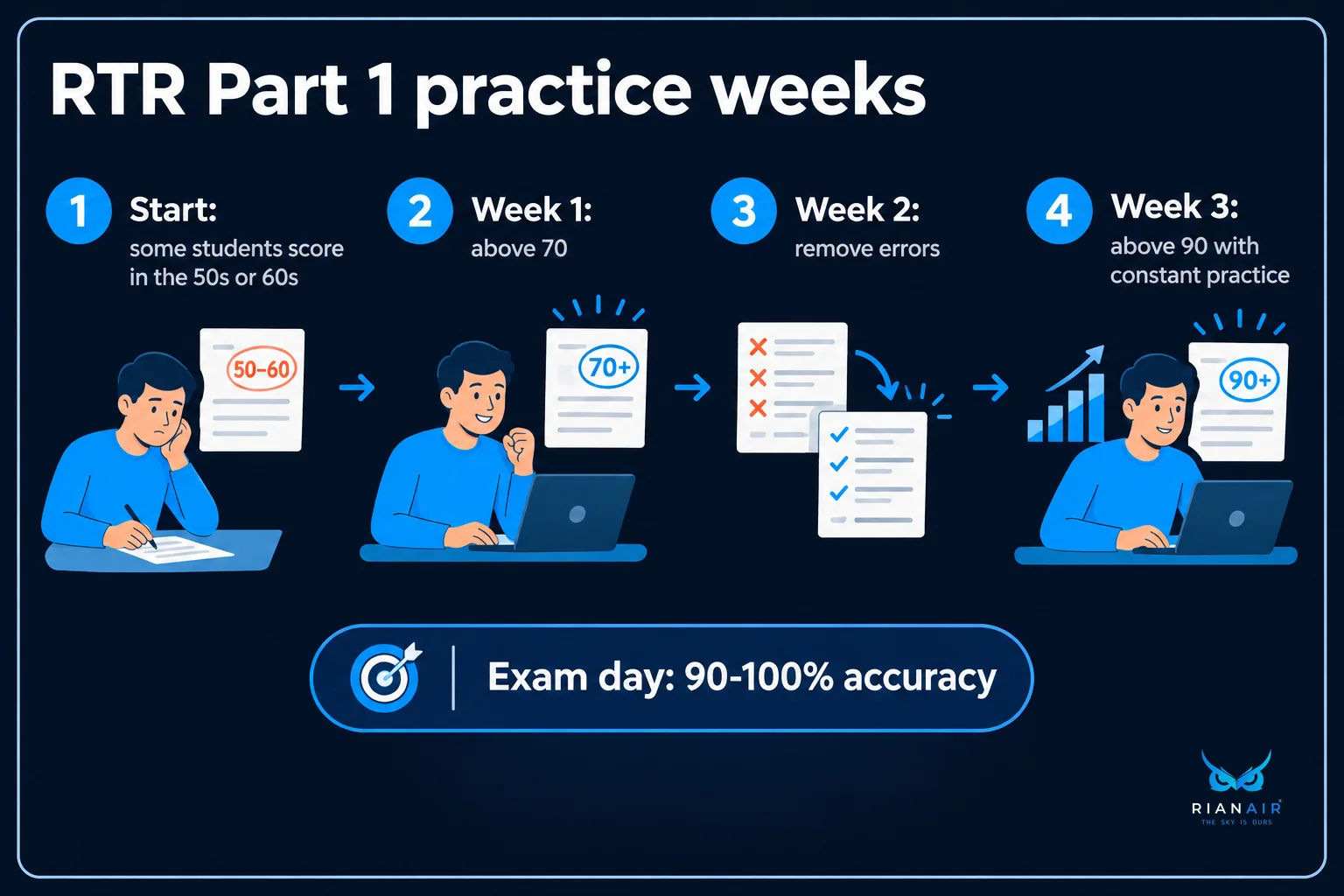
These figures are illustrative targets for RTR Part 1 mock tests on RAPT, not a measured average of Rian Air students.
What students typically see on RTR Part 1 mocks
Rian Air reports that some students begin in the 50s or 60s. Practice gets them over 70 in a week, and week two is crucial for removing errors.
By week three, constant practice brings more than 90. Students' mock scores range from as low as 43% to 100% for the top scorers. By the time of their exams, Rian Air's students typically reach 90-100% accuracy. The same method applies to Air Regulations, where separation methods and minima, and human factors, have the highest error rates in RAPT.
Worked example: from baseline to booking
This is a hypothetical walk-through of the pattern above, not a named student's record. Suppose a student's baseline RTR Part 1 mock is in the 50s or 60s.
Week 1: after a week of practice, the score moves over 70.
Week 2: the student re-tries every wrong answer immediately and sorts errors by topic, which removes repeated mistakes.
Week 3: timed mocks reach the 90s with constant practice.
Booking: the student books only once those 90s hold across several mocks, aiming for 90-100% accuracy by exam day.
Steps to follow
Take a baseline mock first. Do it before any revision, so your score is honest. A low first score is normal.
Sort errors by topic. Write down every topic where you lost marks, not just the question numbers.
Read each explanation. Do this for correct answers you guessed as well as for wrong ones.
Use week two to remove errors. We see week two as the most important week, because repeated mistakes are cheaper to fix now than on exam day.
Retake timed mocks in week three. Sit the full time allowed, such as 2 hours for Air Regulations.
Book the exam only when scores hold. Wait for consistent high scores, not one good day.
A decision rule for when to book
If your last few timed mocks are steadily above the pass mark, with no topic repeatedly failing, book the paper. If one topic keeps dragging your score down, such as separation minima in Air Regulations, spend another week on it first. We would rather you wait a week than pay for a retake.
For a full RTR study cycle, 2 to 4 weeks covers Parts 1 and 2 together. Some RTR content is covered during Air Navigation for full-course students, so their time is shorter.
How Does In-Person Simulator Practice Help RTR Part 2?
In-person students practise RTR calls while flying a simulator, so they learn to speak radio phraseology under pressure. Our RTR Part 1 and Part 2 package is ₹20,000 and includes 2 hours on a simulator. Additional simulator hours are charged extra, and we recommend 3 to 5 hours in total.
This option is only for in-person students, and it is not mandatory. You can train at our Kerala, Delhi or Thane centres. The Part 2 mock call course runs 3 to 4 weeks, with up to 12 students per batch. The aim is simple: after practising calls under pressure, the DGCA oral feels familiar.
For full course packages, 5 hours on the simulator are included in the total package. Extra hours beyond those are ₹1,500 per hour with a dedicated instructor.
Try RAPT Free: Separate Demo Links for CPL and ATPL
The demo is the quickest way to see where you stand. Pick the path that matches your licence goal, create a free demo account and attempt a few questions.
If you are a CPL aspirant
Choose this if you are working through Air Navigation, Meteorology, Air Regulations, Technical General, Technical Specific and RTR. Start the free RAPT demo for CPL and see which subject needs work first.
If you are an ATPL candidate
Choose this if you already hold a CPL and fly as a first officer, or plan to. Start the free RAPT demo for ATPL and test yourself on Air Navigation, Radio Aids and Instruments, and Aviation Meteorology.
FAQs on the DGCA Question Bank, Pass Marks and Exam Format
1. Is there a DGCA question bank free for pilots?
Yes, you can start with a free RAPT demo account of 500 questions, with answers and explanations. Only the demo is free.
2. How many questions does the RAPT question bank hold?
The free demo has 500 questions, and the RTR Part 1 bank has 754 (625 RTR questions and 129 from past papers). The full bank also holds 4,848 General Navigation, 2,757 Radio Navigation, 1,688 Instrument Navigation, 2,840 Air Regulations, 1,258 Meteorology, 3,488 Technical General and 972 Technical Specific questions, updated after every DGCA exam.
3. What is the DGCA pass mark for Air Regulations?
You need 35 correct answers out of 50, which is 70%. The paper runs for 2 hours. Since the pass mark is a fixed share of the paper, aim for steady mock scores well above 70% before you book your slot.
4. How long should I practise before my first attempt?
For RTR, plan 2 to 4 weeks for Parts 1 and 2 combined. For the larger CPL subjects, plan by your mock scores, not the calendar. Book the paper when timed mocks stay above the pass mark and no topic keeps failing.
5. Which topics do students find hardest?
In Air Regulations class, annexures give students the most trouble, and we teach tricks to remember them. In RAPT, separation methods and minima, and human factors, show the highest error rates. Revisit these topics early, and retest them every few days.
6. Can a working first officer prepare for ATPL around a roster?
Yes. ATPL classes are usually one on one, and we schedule them around the flight rosters of first officers flying for airlines, cargo operators and charter companies.
7. Which ATPL subjects does RAPT cover?
RAPT covers three ATPL subjects: Air Navigation, Radio Aids and Instruments, and Aviation Meteorology.
8. How do I register for DGCA written exams?
Register through the DGCA Pariksha portal, which is used for flight crew and AME examinations. Candidates need a computer number, which is a unique ID used to track your exam and result history. Check session dates on the portal before you plan.
Ready to see where you stand? Start your DGCA exam plan with a Rian Air counsellor. You can also subscribe on YouTube or follow us on Instagram for study tips and student updates.
Recommended Resources
Start Your Pilot Journey Try Our Free RAPT Demo Now Home Rian Air