




DGCA Exam Fail: What Happens and How to Prepare in 42 Days
A DGCA exam fail is a setback with a clear procedure: you retake the subject you did not pass, and under the current DGCA rule you can apply for that next attempt only after a 42-day cool-off period.
Those six weeks are enough to revise one subject thoroughly if you plan them well. This guide is written for students and parents in Delhi, Mumbai, Thrissur and across India.
At Rian Air, we teach DGCA ground training with our RAPT™ platform, which has a 20,000+ question bank, timed mock tests, and now an offline mode and save-progress feature. Below you will find what the cool-off means, why students fail, and a revision plan you can start the day you see your result.
What Happens When You Fail a DGCA Exam?
When you fail a DGCA exam, the paper you did not pass must be taken again, while subjects you passed are not repeated. The current DGCA rule is a 42-day cool-off period, so you can apply for the next attempt only after it ends. Use those weeks to find your gaps and rebuild accuracy and speed.
The pass mark we work to for Air Regulations is 35 out of 50 questions, which is 70%, in a 2-hour exam. The pass mark for each other paper is published in the DGCA notices on the portal, and we have not confirmed those figures, so check the notice for your session.
For the 42-day rule itself, the source to check is the Bhartiya Vayuyan Niyam 2026 PDF and the notices on the Pariksha DGCA home page. Those pages are where the 42-day rule is published.
Nothing else about your training stops. Your passed subjects stay on record and you can keep studying. What changes is the calendar: the next realistic attempt falls on the first exam session after the cool-off ends.
The written flight crew exams are registered and conducted through the DGCA Pariksha portal, which is where you will see your result and later apply again. Multiple reattempts are possible, and every DGCA exam you pass is valid for 5 years. Keep your own record of every attempt and pass date, because losing track of validity is one of the easiest ways to end up repeating a subject you had already cleared.
How Does the 42-Day Cool-Off Work?
The 42-day cool-off is a waiting period after a failed DGCA exam, and it is the current DGCA rule. Until then, you cannot apply again for that paper before it ends, so your next attempt is the first exam session available after day 42. Count the days carefully, then work backwards from that session to plan your revision.
Sessions are announced on the portal. Its home page lists session notices, venue lists, admit card downloads and examination instructions, for example for OLODE Session 08 of 2026. Check it often as day 42 approaches, because the application window is when you act.
Steps to follow on the Pariksha portal:
Note your exam date and result date. Write the earliest day you can apply again on a calendar.
Log in to the portal with your existing computer number details. Your result for each subject appears there.
Watch the home page for the next session. Notices state dates, venues and instructions.
Apply for the failed subject once the cool-off is over. Pay the fee for that session month (see the FAQ below).
Download the admit card when it is released. The venue list is published separately, and we only learn the centre when the roll number is published.
The exact screens and field names are explained in the flight crew user manual, and the flight crew FAQ page covers fees and rejected forms.
Which Subjects Can You Fail? The CPL Papers and ATPL Exams
You can fail any DGCA written paper, and each subject is retaken on its own. For a commercial pilot licence (CPL), the core papers are Air Regulations, Air Navigation, Aviation Meteorology, Technical General, Technical Specific and Radio Telephony (RTR). The ATPL has its own written papers.
The table shows what each CPL paper tests and where students usually slip. For the full official list and syllabus of each paper, read the syllabus on the DGCA Pariksha site, and use our printable CPL subjects checklist to track chapters.
Paper | What it tests | Where students slip |
|---|---|---|
Air Regulations | Rules, procedures and licensing requirements | Confusing similar rules and conditions; memorising without context |
Air Navigation | Charts, wind, time, distance and flight planning | Slow calculation under time pressure |
Aviation Meteorology | Weather systems, reports and forecasts | Skipping chapters that look easy, then losing marks on detail |
Technical General | Aircraft principles, structures and systems | A large syllabus revised only once |
Technical Specific | The aeroplane type you train on | Studying general theory instead of the type |
Radio Telephony (RTR) | Radio procedures, with a written part and an oral part of live calls | Reading phraseology but never speaking it aloud |
Our subject guide to DGCA ground training explains how each of these maps to real cockpit skills. If you are unsure whether your own training plan includes every paper, ask your ground school for the paper list in writing.
Air Navigation and Meteorology if you leave for training abroad
We recommend clearing Air Navigation, Meteorology, Air Regulations and RTR(A) before you leave for flight training abroad. If Air Navigation and Meteorology are not cleared before you go, they merge into one composite exam of 100 questions in 3 hours.
Multiple reattempts are possible for the composite exam too. Even so, one combined paper is a bigger task than two separate ones, so clearing both subjects before departure is the safer plan.
ATPL exams after a viva-free change
For active pilots, the Gazette notification dated 26 October 2026 (G.S.R. 957(E)) eliminated the ATPL oral viva. The ATPL knowledge requirement now rests on written examinations in Air Regulations, Air Navigation, Avionics, Aviation Meteorology, and Aircraft and Engines, plus a Signals (Practical) test. Our post on the ATPL viva elimination and free RAPT access covers what remains.
We have not found a DGCA statement on whether the 42-day cool-off applies to ATPL papers in the same way. Check the current notice on the portal before you plan an ATPL retake around it.
Either way, a failed written ATPL paper means a gap before the next try, so revise early. For 2026, RAPT is free for all active pilots in India so they can prepare for the December 2026 attempt, and you can sign up for the free ATPL question bank for active pilots.
Why Do Students Fail DGCA Exams?
Students most often fail a DGCA exam because of how they studied, not because the subject is beyond them. The usual causes are memorising answers without understanding, slow calculation under time pressure, unfamiliarity with the exam format, and patchy revision with no record of weak topics.
Capt. Vikas Vikramdas Nair puts it this way: there is no single subject students fail, they fail Technical General as a whole for lack of practice, and everything is easy if you practise consistently.
Look at your own attempt honestly against this list:
Memorising instead of understanding. A changed wording in the question exposes the gap.
No speed work. You know the method but run out of time, especially in navigation-style papers.
Unfamiliar pattern. Students who never sat a full timed paper before exam day lose marks to nerves.
Distracted or interrupted study. Notifications and poor connectivity break concentration.
Repeating the same mistakes. Without a record of wrong answers, the same questions cost marks again.
How to read your result by subject
Your result is a list, one line per subject. The published result list shows your roll number, computer number, licence category, subject, aircraft, objective marks and essay marks. Use it in three steps:
Separate passed from failed subjects. Only the failed ones go on your revision list.
Compare your objective marks with the pass mark. For Air Regulations that is 35 out of 50. Suppose you scored 31: you are 4 questions short, so the job is accuracy on a few topics, not a restart.
Rank failed subjects by gap and by workload. Start with the paper where you are closest to the mark. If you failed two, give the first weeks to the one with the larger gap, since each is retaken on its own.
Then match your errors to the causes above. Calculation errors need speed drills, wording errors need understanding, and repeated errors need a wrong-answer list.
Our parents' guide to passing the DGCA exam in the first attempt goes deeper on prevention. For now, the point is simple: each cause on this list can be fixed inside 42 days.
How to Prepare in 42 Days: A Revision Plan
Solve the full RAPT question bank for your failed subject three times, set a daily question target, take a short test every day, and then sit DGCA-format mock tests one by one. This builds accuracy, speed and familiarity with the exam pattern, and 42 days is enough to complete the revision thoroughly.
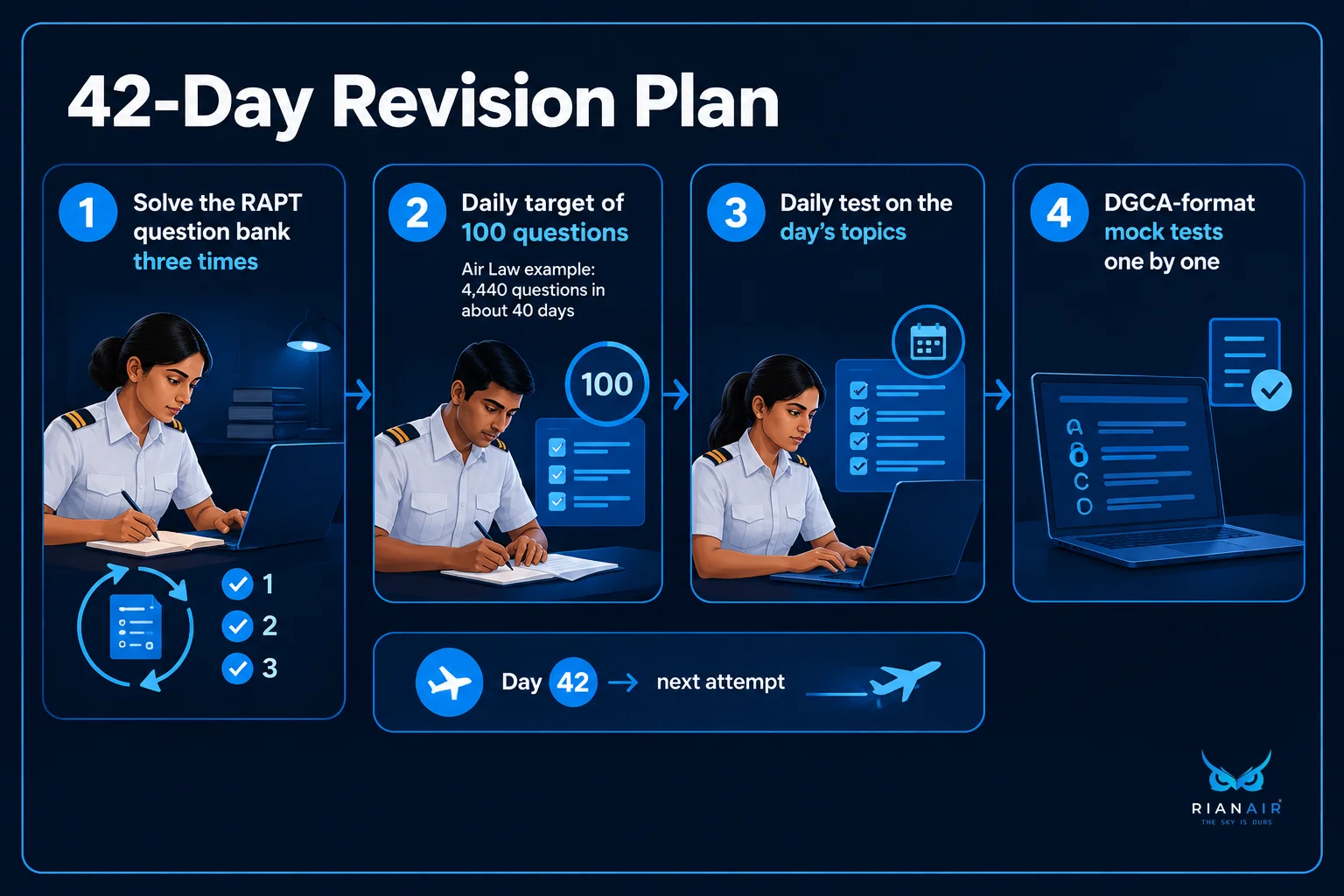
Step 1: Solve RAPT three times
The first pass finds what you do not know. The second pass, taken mostly on the questions you got wrong, fixes it. The third pass checks that the fixes stuck. RAPT lets you attempt wrong questions again after a mistake, so errors are removed one by one instead of being buried in a score.
Step 2: Follow a 42-day Air Navigation calendar
A target of questions per day works better than a target of hours, because it forces progress. Here is a worked example for a student who failed Air Navigation. The daily numbers are illustrative targets, not a rule; change them to fit your pace and your own question bank.
Days | What you do | Illustrative daily target |
|---|---|---|
1 to 12 | Pass 1: work through new questions chapter by chapter, with a short test each evening | 100 questions a day |
13 | Review day: redo every wrong answer from the first twelve days, no new questions | Wrong-answer list only |
14 to 25 | Pass 2: focus on questions you got wrong, plus slow calculation drills | 80 questions a day |
26 | Mock test 1: full timed paper in DGCA format, then review every error | 1 full mock |
27 to 33 | Pass 3: mixed questions from all chapters to check the fixes stuck | 100 questions a day |
34 | Mock test 2, then review | 1 full mock |
35 to 37 | Weak topics only, found from your mock errors | 60 questions a day |
38 | Mock test 3, then review | 1 full mock |
39 | Review day: wrong-answer list and formulas, no new material | Wrong-answer list only |
40 | Mock test 4, timed, then a short review | 1 full mock |
41 to 42 | Light revision, check your portal login and admit card, rest well | 30 questions a day |
If a mock shows the same error twice, add that topic to the next few days before you move on. Treat the calendar as a frame you adjust each week, not a promise that every day will go to plan.
Step 3: Take a test every day
Finish each day with a short test on what you just practised. This catches mistakes while they are fresh, so they are not repeated in the exam hall. Our aim in practice is 100%, because wrong questions can be attempted again until the mistakes are gone by exam day.
Step 4: Move to mock tests, one at a time
Once the passes are done, take mock tests in the DGCA standardised format, one after another. Review each before starting the next. Over time you build accuracy and speed, and you get used to the exam pattern, so the real paper feels like a repeat of something you have already done many times.
Step 5: Protect the last few days
In the final days, do not start new material. Re-read your wrong-answer list, take one timed mock, and sleep properly. If you do an RTR attempt, practise spoken calls aloud with a trainer. Our RTR exam guide covers Part 1 and Part 2.
Can You Study Without Internet? Offline Mode and Save Progress on RAPT
Yes. RAPT now has an offline mode and a save-progress mode in study sessions. You download the subject or chapter you want, turn off the internet to avoid notification distractions, study, and save your progress. Next time you open the app, you continue from exactly where you left off.
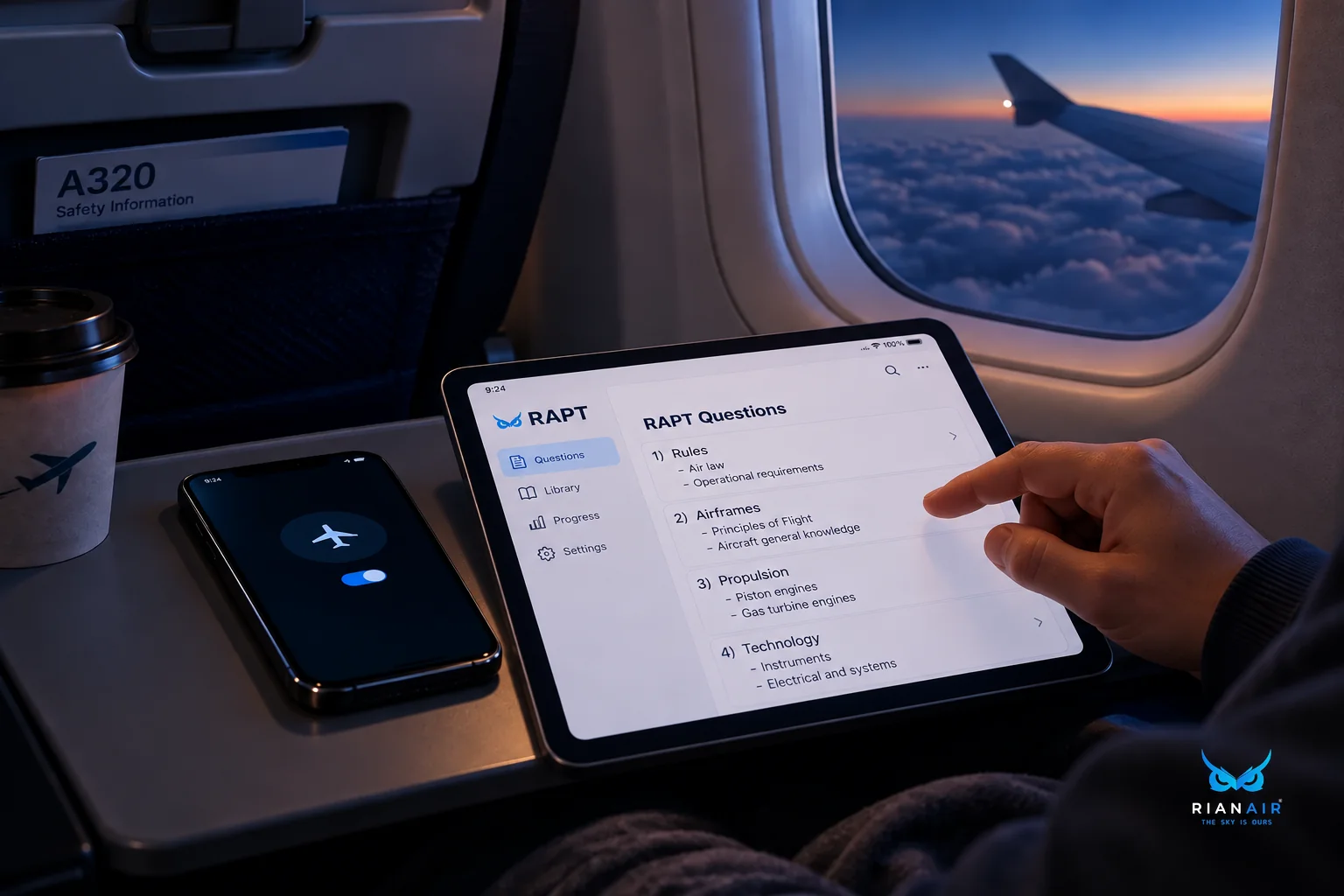
This helps in ordinary places: a long commute in Mumbai, a power cut in Thrissur, a hostel room with weak signal in Delhi. It also helps with focus. With the internet off, messages and alerts cannot interrupt a 100-question block.
One student review on Google puts it this way: “The app is simple to use, informative, and great for aviation students” (Sachu, 5★, Google review). You can see the question screens and practice flow yourself on the free RAPT demo.
What Else Should You Sort Out During the 42 Days?
Check that your DGCA login works and your documents are in order. A problem found on the last day of the application window can cost you a session. Settle it now, not after the next result arrives. If you are stuck, the portal's contact page lists the flight crew helpline (011-26106091, 09:30 AM to 06:00 PM, Monday to Friday).
Read the instructions to flight crew licence candidates before you apply again. They list the conduct rules for the exam room, such as not leaving without permission or ignoring the invigilator, and breaking them can cost you the paper.
Check Where You Stand Before the Next Attempt
Do not wait until day 40 to find out whether the plan is working. Start the free RAPT demo signup as a progress check: it shows where you stand now, so you can adjust your daily target while there is still time.
If you would like a ground training plan for DGCA exams in Delhi, Mumbai or Thrissur, you can ask Rian Air about ground training and exam preparation.
One of our students wrote “I've cleared my exams” (Karan R., 5★, Google review), and the same method of practice, review and retry is what we encourage for every attempt. In our latest batch, most students attempted Navigation in the September attempt, and 13 of 21 students cleared their exams.
For exam updates and study tips, follow Rian Air on Instagram and subscribe on YouTube. More about our training is on the Rian Air website.
Frequently Asked Questions After a DGCA Exam Fail
How do I find out which subject I failed?
Your result is published on the DGCA Pariksha portal, where you log in and see the outcome for each subject you attempted. Note every subject marked as not passed, then compare it with the chapters you remember struggling with, so your revision plan starts from facts instead of guesses.
Results are posted as session-wise lists on the portal, such as the Flight Crew Licence Examination result for session OLODE 02 of 2026, which shows how a result list is laid out.
Will I need a new computer number to reappear?
No. Your computer number identifies you across DGCA flight crew exams, so you keep using the same one when you apply for the next session. Avoid creating a second registration. Log in with your existing details and apply for the failed subject once the cool-off ends.
Is the exam fee charged again?
Yes, each application for an exam session carries the exam fee, because you are registering for a new attempt. The fee depends on the month of the session:
Regular attempt (March, June, September and December): Rs 2,500 per exam.
Other months (on-demand or OLODE, Online On Demand Exam): Rs 5,000 per exam.
RTR Part 1: Rs 2,000.
RTR Part 2: Rs 500.
ATPL exam fees are the same as CPL: Rs 2,500 for a regular attempt and Rs 5,000 for an on-demand or OLODE attempt. The portal's flight crew FAQ page also answers what happens to a fee if a form is rejected.
What if I miss the first session after day 42?
You wait for the next session that DGCA announces. Sessions are announced on the Pariksha portal, so keep checking it near day 42 and keep your documents ready. Missing a window costs you waiting time, so keep revising with mock tests instead of stopping.
Can I keep studying other subjects during the cool-off?
Yes. The cool-off stops you from applying again for the failed paper, but nothing stops you from studying. You can use the time to begin the next subject as well. Read the current exam notice before you apply, because it states which subjects can be taken in a session.
How many times can I reattempt a subject?
Multiple reattempts are possible, and every DGCA exam you pass is valid for 5 years. Apply for each new attempt through the DGCA Pariksha portal, and keep your own record of attempts and pass dates for each subject.
Can I reattempt after returning from training abroad?
Yes. Students get multiple attempts even after coming back from a foreign country. But if you do not submit your documents to DGCA within 6 months, you must repeat recency training, which is roughly 18 to 22 extra hours of flying on the aircraft.
That is why we advise clearing the exams first and then leaving the country for flying.
Should I change my ground school after failing?
Compare your result by subject with the causes listed earlier before deciding. If you do compare providers, look at question-bank depth, mock tests in DGCA format, and fee terms given in writing.
How can parents help without adding pressure?
Agree on the daily question target, not the score. Ask to see the progress screen once a week and keep conversations on the plan for the next 42 days. Rian Air's parent dashboard shows a student's progress, so parents do not need to quiz them every evening.
Will one failed attempt end my airline chances?
One failed paper delays you by a cool-off, but it does not close the path to an airline. Airline selection runs through its own rounds: a written exam, psychometric test, group discussion and panel interview. Clear the subject first, then prepare for those rounds.
For another failure-and-retake process, see our post on what happens if you fail and whether you can retake it.
What mock score should I reach before applying again?
We aim for 100% in practice, because RAPT lets students retry wrong questions until the mistakes are gone by exam day. Treat that as a target, not a pass mark. Apply when your recent mocks are consistently high and the same errors no longer repeat.
Recommended Resources
Start Your Pilot Journey Try Our Free RAPT Demo Now Home Rian Air