




DGCA Class 2 Medical: What Happens If You Fail and Can You Retake It
A DGCA Class 2 medical is the basic fitness check an aspiring pilot in India completes with a DGCA-authorised medical examiner before ground training. If you fail, the result is not automatically final. The examiner gives one of three outcomes: medically fit, temporarily unfit or permanently unfit. Ask for the reason in writing, then follow the route for your finding. Students in Kerala, including Thrissur, and in Delhi should confirm this before paying training fees.
Key takeaways
Three outcomes: Medically fit means good to go. Temporarily unfit means something can be improved. Permanently unfit means no go.
Temporary findings can be fixed: BMI, a urine infection or a low platelet count are typical. A temporarily unfit finding usually lasts from about 2 weeks to 6 months, or even longer, depending on the case.
Permanent findings cannot: Colour blindness and night blindness are the usual examples. DGCA can still review a permanent finding if you disagree with it.
Medical first: Do the DGCA Class 2 medical before you commit to ground training fees.
Class 2 is not the end of it: A Class 1 medical is a separate, stricter step before flight training. Confirm the exact sequence in DGCA's own documents.
No promises from us: Rian Air cannot decide your medical result. We help you plan the steps in the right order.
DGCA Class 2 medical at a glance
Question | Short answer |
|---|---|
Who conducts it? | A DGCA-authorised medical examiner |
Where do you start? | Register on the DGCA's eGCA portal and generate your pilot medical record (PMR) number |
When should you do it? | Before paying for ground training or any large deposit |
What to do before seeing the examiner? | Complete the required tests at an NABL-approved lab or NABH-approved hospital and carry originals and copies |
What does it check? | General fitness, eyesight, hearing, blood pressure, medical history |
Possible outcomes | Medically fit, temporarily unfit, permanently unfit |
Temporarily unfit timeline | Usually about 2 weeks to 6 months, or even longer, depending on the case |
Booking time | Varies by examiner. Check availability on the DGCA examiner list and confirm your date directly with the examiner |
Next medical | Class 1 medical, needed before flight training |
Validity | A DGCA Class 2 medical is valid for 2 years |
Fees | The doctor's fee is Rs 3,000. The tests at the medical test centre are approximately Rs 5,000 to 8,000, depending on the centre |
What does the DGCA Class 2 medical involve?
The DGCA Class 2 medical is a physical and medical history check by a DGCA-authorised examiner. You register online, attend the examination, and your results go to DGCA for review. It covers general health, eyesight, hearing and blood pressure. A Class 2 assessment letter follows if DGCA accepts the findings.
The DGCA medical section lists the examiner categories and the medical records process. Treat that page, not a coaching brochure, as the final word on forms and requirements.
The steps in plain order
Create your account. Register on the eGCA portal and generate your PMR number. Keep your ID, date of birth and passport-size photographs ready.
Get your tests done at an approved facility. Before you see the examiner, complete the required tests at an NABL-approved lab or an NABH-approved hospital. Collect both the original reports and photocopies.
Book a DGCA-authorised medical examiner. Use the examiner list on the DGCA site. Do not book with a clinic that cannot show its DGCA authorisation. Carry the originals and copies of your test reports to this appointment.
Attend the examination. Bring your test reports, plus your glasses or lenses if you wear them, and tell the examiner about every past illness, surgery and medicine. Hiding history is a bigger risk than the condition itself.
Wait for DGCA processing. The examiner uploads your data, and DGCA reviews the file before issuing the assessment letter.
Keep the letter safe. You will need it when you enrol and when you later apply for a student pilot licence.
One detail trips up many first-timers. For anyone aiming at a Commercial Pilot Licence, the DGCA Pariksha FAQ says applicants other than PPL candidates must have passed 10+2. The medical is only one of several gates.
Which tests are part of the DGCA Class 2 medical?
The examination covers the areas below, and the vision, hearing and blood pressure limits for each are set out further down in this guide. The full list is in the Class 2 medical document.
General physical examination and medical history review
Eyesight, including colour vision
Hearing
Blood pressure
Blood tests, including platelet count
Urine tests
Body weight and BMI
Which tests must the student undergo?
Every student must go through the full examination by the DGCA-authorised examiner. Before that, we ask all students to complete a series of tests at an NABL-approved lab or an NABH-approved hospital. The ones we stress most:
Colour vision test: Do this first, with an optometrist using an Ishihara-type test.
Eye check and updated prescription: Note whether your vision corrects to the required standard.
Blood and urine tests: These catch issues such as a urine infection or a low platelet count.
BMI check: Body weight is a common reason for a temporary finding.
Do these tests before you book the examiner, and carry both the original reports and copies to the DGCA-authorised doctor. If a problem shows up, you know before you spend on anything else.
What are the three DGCA medical outcomes?
DGCA sorts every result into three outcomes. They are separate categories, not steps on one scale.
Medically fit
Fit means good to go. The data goes to DGCA, the assessment letter follows, and you can move on to enrolment and ground training.
Temporarily unfit
This covers things that can be improved. Usual reasons include body weight or BMI, a urine infection and a low blood platelet count. The examiner asks you to improve the parameter and come back.
A temporarily unfit finding usually takes from about 2 weeks to 6 months, or even longer, depending on the case. One of our students had a urine infection, and it took about a month to clear. Weight changes usually take longer. Ask the examiner when you can return.
Permanently unfit
Permanently unfit means no go. The usual reasons are colour blindness and night blindness. Retaking does not change a permanent finding.
Here is an anonymised case. Our student Mr. A failed his medical because he could not pass the Ishihara test, and the doctor declared him permanently unfit, colour blind. Mr. A has quit pilot training permanently. He has taken up another aviation programme that does not involve pilot training and focuses on the management side. This is why we ask students to do the colour vision test first.
If the medical examiner declares a student permanently unfit, the student only needs to email Rian Air the assessment issued by DGCA. Rian Air then refunds 100% of the amount paid within 30 calendar days. This is Rian Air's refund policy for a permanent medical unfit finding. It is separate from the money-back promise on DGCA exams, which has its own terms and conditions.
Which conditions can disqualify you from a Class 2 medical?
Conditions that affect vision, hearing, heart health, blood pressure, blood sugar, the nervous system or mental health can lead to an unfit or deferred result. A condition on this list does not always mean permanent disqualification. Many depend on severity, treatment and test results.
The exact limits sit in the DGCA civil aviation requirements and the Class 2 medical document, so read the paragraph for your finding there.
The doctor's fee is Rs 3,000, paid to the doctor directly. The remaining cost depends on the medical test centre, and the tests are approximately Rs 5,000 to 8,000. Check with your examiner which payment applies to your appointment.
Areas where findings most often arise
Eyesight: Refractive error, colour vision and eye disease. What matters is the corrected result and the type of defect.
Hearing: Reduced hearing in one or both ears, or ear conditions that affect balance.
Blood pressure and heart: High readings on the day, or a history of a heart condition, can trigger extra tests.
Metabolic conditions: Diabetes or other conditions that need long-term medicine.
Neurological and mental health history: Seizures, fainting episodes, or conditions treated with certain medicines.
Substance use and past surgery: Both must be declared honestly.
DGCA Class 2 medical standards: vision, hearing and blood pressure
A DGCA Class 2 medical is valid for 2 years. The limits below are the ones students ask about most. Your examiner makes the final call, so confirm them against the Class 2 medical document.
Vision
Distant vision: 6/9 or better in each eye separately, and 6/6 or better with both eyes together, with or without glasses or contact lenses.
Near vision: N5 at 30 to 50 cm and N14 at 100 cm.
Hearing
500, 1000 and 2000 Hz: maximum pure-tone hearing loss of 35 dB per ear.
3000 Hz: maximum pure-tone hearing loss of 50 dB per ear.
Eye conditions that are initially disqualifying
Active keratitis or severe corneal opacities
Retinal detachment or progressive retinal degenerations
Glaucoma (mild or controlled cases may be evaluated individually)
Optic neuritis or optic atrophy
Unresolved complications from cataract or refractive surgery
Blood pressure
Blood pressure consistently above 160 mm Hg systolic or 95 mm Hg diastolic, with or without treatment, or symptomatic low blood pressure, is assessed as unfit. A reading of 140/90 mm Hg is generally treated as the upper limit of normal.
What happens if you fail the DGCA Class 2 medical?
If you fail, the examiner records the finding and the case goes through DGCA's medical process. Ask for the reason, and for the specific report or test needed, in writing.
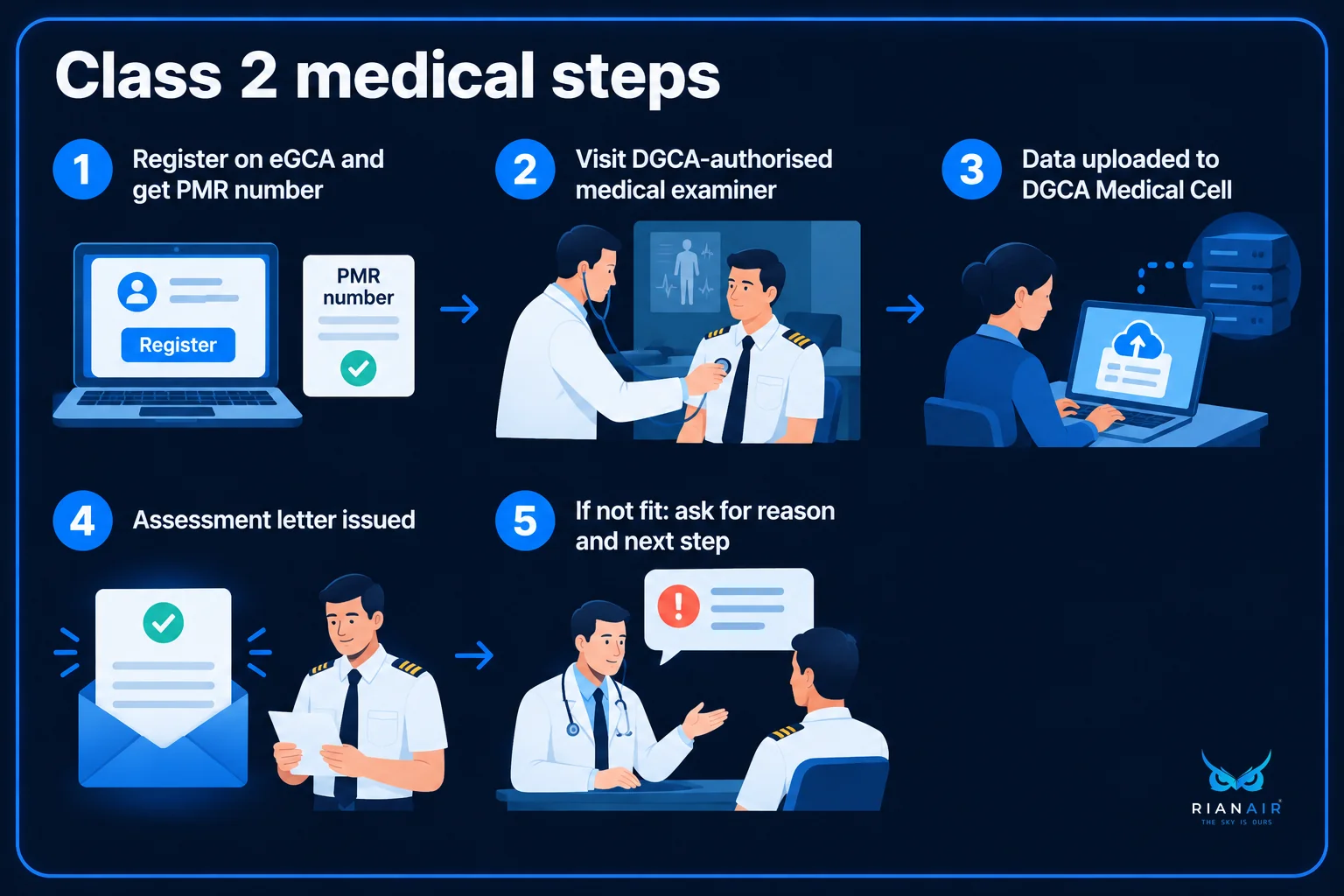
The route differs by outcome:
Temporarily unfit: The examiner asks you to improve the parameter, such as body weight or BMI, a urine infection or a low platelet count, and come back for re-examination. Treat it, collect the reports, and return to the examiner once the parameter has improved. Typically this takes 2 weeks to 6 months or more. The limit for each parameter is in the Class 2 medical document linked above.
Permanently unfit: This is a no-go finding, such as colour blindness or night blindness. Retaking does not change it. A permanent finding can still be reviewed by DGCA if you believe it is wrong.
Disagree with the decision: Write to the DGCA medical section and attach your reports and the examiner's assessment. The section and its medical records process are listed on the DGCA medical page. We cannot quote a time limit for a review, so check that page for the current process and deadlines.
Do not pay a deposit to any institute until you know your result. Our own article on pilot training cost in India and the hidden fees parents miss shows how quickly money gets committed once a student has enrolled.
A sensible first week after a fail
Get the reason in plain words. Ask which test, which finding, and whether it is permanent, temporary or undecided.
Get a copy of every report. You will need them for any reassessment or review.
See the right specialist. An eye doctor for vision, an ENT for hearing, a physician for blood pressure. Choose a recognised hospital and keep the paperwork.
Read the DGCA rules for your finding. Check the DGCA medical requirements instead of forum posts.
Pause all payments. Hold off on deposits, bookings and loan applications until you know where you stand.
Can you retake the DGCA Class 2 medical or appeal the result?
In many cases yes, but the route depends on why you failed. A temporary issue, such as a high BMI or an untreated infection, is re-assessed after you improve it. A permanent finding is not fixed by retaking, although DGCA can review it.
For practical help, appointment availability varies by examiner, so check the examiner list on the DGCA medical page and confirm your date directly with the examiner. Before the exam, get your series of tests done at an NABL-approved lab or NABH-approved hospital.
Read the rules in DGCA's civil aviation requirements, which hold the medical standards for each condition. Then ask the examiner and the DGCA medical section which route applies to you, and write down the answer.
Worked example: a correctable finding
Suppose a student is found temporarily unfit because of a high BMI or a urine infection. In our experience, the sequence runs like this:
The examiner records the finding, and the student asks for the reason in writing.
The student sees the right doctor at a recognised hospital and gets a full report.
The student checks the standard in the DGCA requirements and confirms with the examiner that a re-examination is allowed.
The student returns with every report, is re-examined, and the data goes to DGCA for the assessment letter.
Only after that does the student pay the remaining training fees.
Retake versus appeal: how to decide
Your situation | Usual direction | What to do |
|---|---|---|
Temporarily unfit (for example, BMI, urine infection, low platelet count) | Reassessment after improvement | Treat it, collect reports, ask the examiner when you can come back |
Correctable finding (for example, vision that needs correction) | Re-examination with the correction in place | Get a proper eye check and bring the updated prescription |
Unclear or pending result | Further tests or a specialist report | Ask exactly which report DGCA needs and from whom |
You think the decision is wrong | Review through the DGCA medical section | Gather every report and write to DGCA |
Permanently unfit (for example, colour blindness, night blindness) | No-go for pilot training, though DGCA can review it | Plan other aviation roles before spending on pilot training |
If the finding is permanent, a review may use up months you could spend on a different plan. Only the DGCA medical process can tell you which category you are in.
How does Rian Air coordinate your DGCA Class 2 medical?
We charge Rs 2,500 as a token of confirmation before enrolment. In return, we give complete guidance on creating your eGCA ID, on the Class 2 medical tests, and on scheduling your appointment with a doctor.

If the student is medically unfit: the entire Rs 2,500 is refunded.
If the student is medically fit: the student pays the remaining fees to attend ground and simulator training with Rian Air.
We cannot grant or predict a medical result. What we can do is lay out the order of steps so money follows certainty. As one reviewer, Al S., put it in a 5★ Google review: “They help us plan the entire CPL journey, offering personalized mentorship and strong pathways for flight training.”
A pre-payment checklist
Medical result known: Pass mark: you know whether you are fit, temporarily unfit or permanently unfit before paying large fees.
Documents ready: Pass mark: ID, 10th and 12th mark sheets, and photographs are ready, and you meet the 10+2 requirement for CPL.
Written fee structure: Pass mark: every cost is listed. Walk away if the person will not put it in writing.
Clear terms on what happens if plans change: Pass mark: you can read them before paying. Ask for the T&C sheet.
Order of spending: Pass mark: medical first, ground training second, flight training third.
Where our centres fit in
Our Thrissur centre serves Kerala students, and Kerala is where our C172 fixed-base flight simulator, the first of its kind in the state, is based. Kerala students can plan the Class 2 medical, ground training and simulator sessions in one place. Our Delhi centre is at G-94, Rian Air Building, Ramphal Chowk Road, Dwarka.
For the full order of the CPL path, see our guide to how to become a commercial pilot in India after 12th. You can also compare routes on our pathways page.
Class 2 medical versus Class 1 medical: what is the difference?
The Class 2 medical is the earlier, general check that students complete before ground training, while the Class 1 medical is the stricter assessment required before flight training and a commercial licence. Passing Class 2 does not guarantee Class 1.
Confirm the current sequence with DGCA, whose own wording on the medical page and in the Class 2 document governs. Our article on the importance of the DGCA Class 2 medical before ground training explains why we ask students to do it early. For the later stage, read about DGCA Class 1 medicals before flight training.
What does a medical failure mean for your timeline and budget?
A medical delay can add weeks or months before you can enrol, which pushes back exams and flight training. It rarely costs money if you have not paid anything yet. That is the practical reason to put the medical first. Our typical conversion case takes 2.5 to 3 years from ab initio to final DGCA licence, so an early temporary finding is far cheaper to fix than a late one.
You can also review our enquiry process while you wait.
Frequently asked questions about the DGCA Class 2 medical
What does a search for "dgca medical" usually mean?
Most people searching "dgca medical" want the Class 2 check needed before pilot training, or the Class 1 check needed before flight training. Both are done by DGCA-authorised medical examiners. Start with Class 2, because it is the first gate.
Can I retake the DGCA Class 2 medical after failing?
For a temporary finding, yes. You are re-assessed after you improve the parameter. A permanent finding is not fixed by retaking, but DGCA can review it.
Which tests should I do before the medical?
Before going to the DGCA-authorised doctor, complete a series of tests at an NABL-approved lab or NABH-approved hospital. Update your eye prescription and carry both originals and copies of the reports to the appointment.
How long is a DGCA Class 2 medical valid?
A DGCA Class 2 medical is valid for 2 years.
What vision standard does the Class 2 medical require?
Distant vision must be 6/9 or better in each eye separately and 6/6 or better with both eyes together, with or without correction. Near vision must be N5 at 30 to 50 cm and N14 at 100 cm.
What blood pressure makes a student unfit?
Blood pressure consistently above 160 systolic or 95 diastolic, with or without treatment, or symptomatic low blood pressure, is assessed as unfit. 140/90 mm Hg is generally the upper limit of normal.
How early should I book the medical appointment?
Appointment availability varies by examiner. Pick a DGCA-authorised examiner from the list on the DGCA medical page, ask for the earliest slot, and book only after your tests from an NABL or NABH approved facility are done.
Who pays the DGCA medical fee, and how much is it?
The doctor's fee is Rs 3,000, paid to the doctor directly. The rest depends on the medical test centre, where tests are approximately Rs 5,000 to 8,000. Check with your examiner which applies to you.
What does Rian Air charge to coordinate the medical?
We charge Rs 2,500 as a token of confirmation before enrolment. It includes guidance on creating your eGCA ID, the Class 2 medical tests and scheduling your doctor appointment.
Should I tell the examiner about past illnesses?
Yes. Declare every past illness, surgery and medicine. Hiding a condition can create bigger problems later than the condition itself, especially at the Class 1 stage.
Does Rian Air guarantee that I will pass the medical?
No. Medical decisions belong to DGCA-authorised examiners and DGCA. We can help you plan the order of steps before you commit fees, but we cannot promise a result.
Take the medical step before the money step
If you are worried about your DGCA Class 2 medical, book it early and plan around the result. Whether you are in Thrissur, elsewhere in Kerala or in Delhi, the Rian Air team can help you with your eGCA ID, the tests and your appointment before you commit fees.
For updates and student stories, follow us on Instagram or subscribe on YouTube.