


DGCA ATPL Viva Eliminated: What Remains and Free RAPT Access
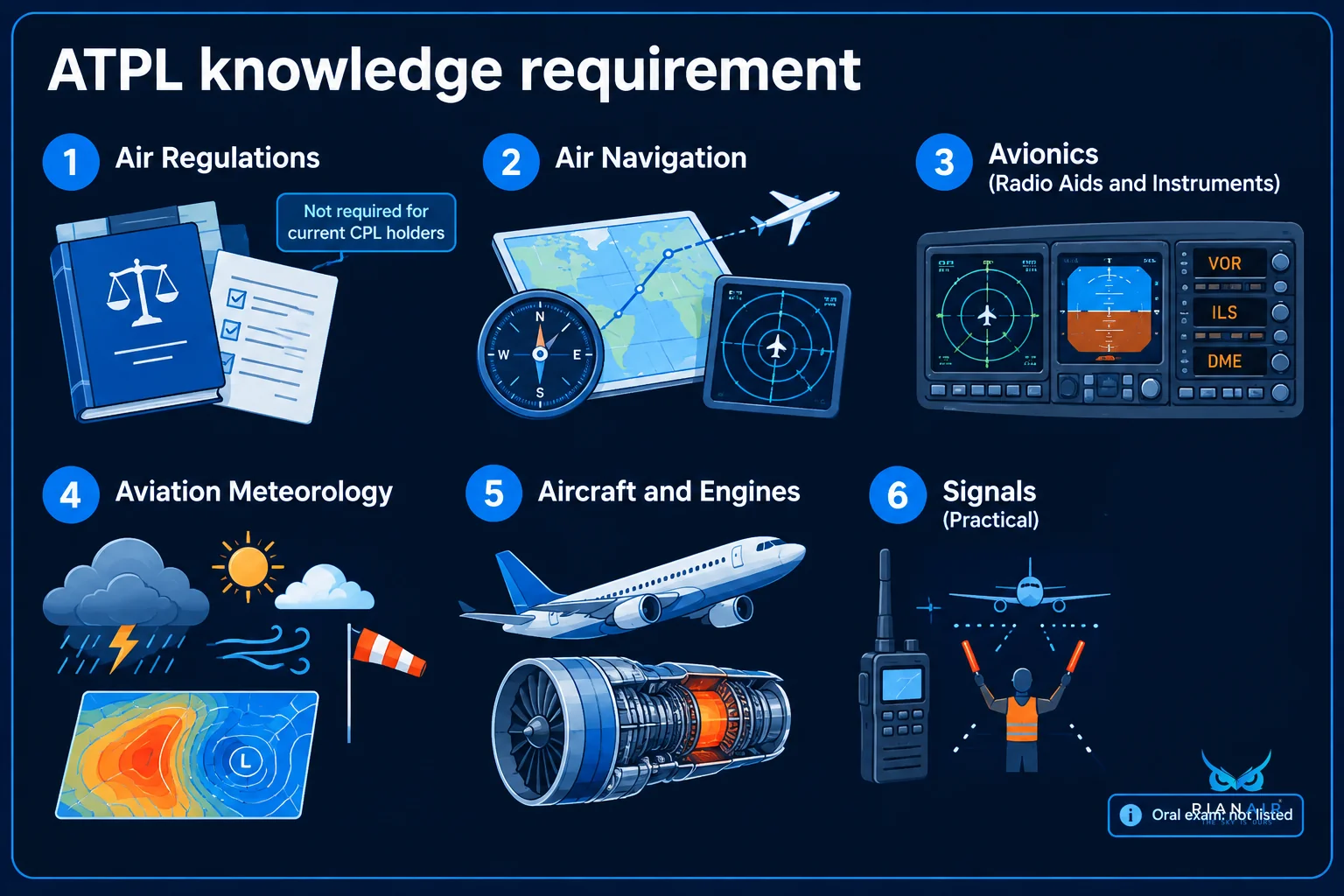
DGCA ATPL oral exams eliminated: the Gazette notification dated 26 October 2026 (G.S.R. 957(E)) sets the ATPL knowledge requirement as written examinations in Air Regulations, Air Navigation, Avionics, Aviation Meteorology and Aircraft and Engines, plus a Signals (Practical) test, with no oral listed. For 2026, Rian Air is giving RAPT free to all active pilots in India. ATPL pilots can start at https://rianair.in/signup/atpl.
Key takeaways
The oral is not listed: The circular's knowledge clause names written papers and a Signals (Practical) test only, while the older CAR on ATPL theory ended its list with an "Oral" as applicable.
Five written subjects: Air Regulations, Air Navigation, Avionics (Radio Aids and Instruments), Aviation Meteorology, and Aircraft and Engines. Current CPL holders are exempt from Air Regulations.
70% in every paper: Each ATPL paper is passed or failed on its own, so one strong subject cannot rescue a weak one.
RAPT is free for active pilots in 2026: We are giving it free so you can clear your DGCA exams in the December 2026 attempt. Almost 1,000 questions are free on the RAPT demo. ATPL pilots need only a basic sign-up to see all subjects at no cost until 31 December 2026, and the offer may be extended.
Verify before you book: The text does not explain transition rules or the Signals (Practical) format, so check DGCA's notices and your Pariksha profile once before registering.
ATPL at a glance
Item | What applies |
|---|---|
Oral examination | Not listed in the circular's knowledge clause |
Written papers | Air Regulations, Air Navigation, Avionics, Aviation Meteorology, Aircraft and Engines |
Practical test | Signals (Practical): interpretation of aural and visual signals |
Minimum age | 21 years on the date of application |
Education | Class 12 with Physics and Mathematics, or equivalent |
Total flight time | Not less than 1,500 hours as pilot of an aeroplane |
Pass mark | 70% in each written paper |
RAPT for active pilots in 2026 | Free, all subjects, until 31 December 2026 (may be extended) |
If the oral is gone, what exactly is left to clear? This guide answers from the circular text itself, then shows how to prepare for what remains, what it costs, and where the text leaves questions open.
The 26 October 2026 notification: ATPL oral exams eliminated
For years the ATPL had two layers: computer-based written papers, then an oral. DGCA's older CAR on flight crew licensing lists the ATPL theoretical knowledge examination across Air Navigation, Aviation Meteorology, Air Regulation, Radio Aids and Instruments and aircraft subjects, and the same list ends with an Oral, as applicable.
The notification dated 26 October 2026, G.S.R. 957(E) under the Bharatiya Vayuyan Niyam, 2026 (read the notification text), words the knowledge requirement differently. Clause (d) says the applicant shall pass a written examination in Air Regulations, Air Navigation, Avionics (Radio Aids and Instruments), Aviation Meteorology, and Aircraft and Engines, plus a Signals (Practical) examination for interpretation of aural and visual signals, as per the syllabus the Director General prescribes.
No oral appears anywhere in that clause. That is the basis for our statement that ATPL oral exams are eliminated, and we rest it on the circular text only. The oral's removal was also part of the discussion around the draft Bharatiya Vayuyan Niyam, 2025, but we are not adding detail beyond what the circular text shows.
What the text leaves open
Two things are not settled. The text does not say how candidates already part-way through the old process are treated, and it gives no format for the Signals (Practical) examination. Both need a check of DGCA's current notices and your Pariksha profile. As of this update, we have not found any published notice on transition arrangements or on the Signals (Practical) format, and we are waiting for the new CAR on the Signals (Practical) test. When it is published, we will update this post.
Our working position is simple. Plan for written papers plus the Signals (Practical) test, and verify once, just before you register. Pilots who prepared oral answers for months should not waste that knowledge, but they should now spend the next hour on question accuracy, because that is where the marks are.
What changes in your preparation
An oral rewarded explaining a concept aloud to an examiner. A multiple-choice paper rewards recall under time pressure and the ability to spot a distractor.
Those are different skills, and they respond to a different method: many repetitions, immediate feedback, and a record of which topics keep costing you marks.
ATPL requirements in the circular, clause by clause
Passing the theory papers does not by itself grant the licence. The circular sets out requirements in sequence, and an application is only complete when every one is met. Here is each clause in plain language.
Age, education and medical fitness
The applicant must be at least 21 years old on the date of application. Education is Class 12 with Physics and Mathematics, or an equivalent examination from a recognised Board or University. DGCA Pariksha's FAQ asks for the same 10+2 with Physics and Mathematics when registering as a flight crew candidate, with an exception for PPL.
Medical fitness is shown through a certificate in the prescribed proforma from an approved Medical Board, on the basis of the requirements notified under rule 78. DGCA recognises three outcomes at medical: fit, temporarily unfit and permanently unfit.
A temporary finding can be improved and re-examined; a permanent one, such as colour blindness, ends the path.
On timing, a DGCA-approved private medical examiner can be booked in about 7 days, while an Air Force centre appointment is best booked at least 2 months ahead. Do the medical early so a surprise finding does not stall an otherwise ready application.
Knowledge: the written papers
The circular lists five written subjects and one practical test. The proviso matters for most readers: a holder of a current Commercial Pilot's Licence is not required to pass Air Regulations. For a typical Indian CPL holder, that leaves four written papers and the Signals (Practical) test.
Extending an aircraft rating to another class or type also calls for the written paper in Aircraft and Engines, followed by approved training and a skill test as DGCA specifies. Keep that in mind if your airline moves you between fleets.
Experience: the hours you must show
The experience clause is long, so here it is as a table. All figures come from the circular text.
Requirement | Minimum in the circular |
|---|---|
Total flight time as pilot of an aeroplane | 1,500 hours |
Pilot-in-command (PIC) | 500 hours as PIC under supervision of a check-pilot-qualified pilot, or 250 hours as PIC, or at least 70 hours as PIC plus further PIC under supervision to make up 250 |
Cross-country | 200 hours, of which at least 100 as PIC or PIC under supervision |
Night | 100 hours |
Instrument time | 75 hours, of which at least 50 in actual flight |
Recent flying | 20 hours within the six months before the date of application |
One note affects airline first officers directly. Where an aeroplane needs a co-pilot under its flight manual, no more than 50% of co-pilot time counts towards total flight time. Full credit applies for flight time already counted as PIC under supervision, as the note's wording sets out.
Other requirements and the skill test
The applicant must hold a Commercial Pilot's Licence, though this does not apply to an armed forces pilot who otherwise meets the requirements. A current instrument rating on multi-engine aircraft is required, and so is a current Flight Radio Telephone Operator's Licence.
The skill requirement asks you to show competency by day and by night, on the multi-engine aeroplane type the application relates to, within six months before applying. DGCA may allow skill tests or part of them on an approved level D (or higher) zero flight time training simulator.
Current CPL holders do not need general flying tests for the ATPL if the licence is issued on a multi-engine type already in the CPL's aircraft rating. They must also hold 10 hours as PIC or 20 hours as co-pilot on at least one such type within the preceding six months.
Validity, renewal and privileges
Validity follows rule 79. Renewal needs a medical examination, a current FRTOL, a current multi-engine instrument rating, and either 10 hours as PIC in the previous six months (50% of co-pilot time counts) or the day and night flying tests again.
An ATPL holder may act as PIC in commercial air transport of an aeroplane certificated for more than one pilot, once command upgrade training is done and an instrument rating is current. On reaching 65, privileges narrow to those of a Private Pilot's Licence.
The written papers: format, pass mark and the Signals (Practical) test
The pass mark is 70% in each ATPL written paper. Because each paper stands alone, a 95% in Meteorology does nothing for a 62% in Air Navigation. Treat every paper as its own exam with its own revision plan.
The circular calls the subject Avionics and puts Radio Aids and Instruments in brackets, so expect that paper to cover both. Aircraft and Engines is the technical paper. DGCA publishes a list of study material for PPL, CPL and ATPL examinations, and advises candidates to follow the topics in the prescribed syllabus.
Signals (Practical) is the item people overlook. The text describes it only as an examination for interpretation of aural and visual signals. It is separate from the Radio Telephony (RTR) exam. No format is published in the material we have reviewed, so check the syllabus once it is defined, and do not assume a question bank covers it. The same applies to pilots mid-process: the notification text gives no transition rule, so confirm your own case on your Pariksha profile before you register.
DGCA conducts these examinations under rule 41A of the Aircraft Rules 1937, and the Pariksha user manual describes how the Central Examination Organization handles registration and results.
Register for the exam on DGCA Pariksha
Confirm you meet the age, education, licence, rating and hours requirements above.
Check DGCA's current notices for transition arrangements and the Signals (Practical) format.
Register through DGCA Pariksha as a flight crew candidate, using your 10+2 with Physics and Mathematics.
Confirm the exam fee on the portal, since fees can change.
RAPT for ATPL theory preparation, free for active pilots in 2026
With the oral out of the picture, the written papers decide the outcome, and that is a practice problem. RAPT is our platform for it. For ATPL it carries General Navigation (4,900 questions), Radio Navigation (3,250), Instrument Navigation (1,697) and Meteorology (3,072), including past DGCA questions, and we keep adding questions after every DGCA exam. Every wrong answer can be attempted again.
That retry loop is the point. We aim for 100% on practice sets because a mistake you can repeat until it is fixed does not survive to exam day. For the RTR Part 1 question bank, students start in the 50s and 60s, pass 70 within a week, and reach the 90s by week 3 with constant practice. Week 2 is where errors get eliminated.
That progression is our RTR experience, not an ATPL statistic. The method carries over: attempt, read the explanation, retry what you missed, and return to weak topics. For a wider view of the subject, see our guide on ATPL preparation in India.
Free demo versus full access
For 2026, RAPT is free for all active pilots in India so they can clear their DGCA exams in the December 2026 attempt. Almost 1,000 questions are free on the RAPT demo. ATPL pilots use the ATPL sign-up link below, which needs only a basic sign-up and shows all subjects at no cost until 31 December 2026. The date may be extended if pilots still need access: https://rianair.in/signup/atpl.
We are celebrating DGCA's elimination of the ATPL viva by giving all the questions free to active pilots. Check the sign-up page for the current offer status.
You need no classes to use it. If you want live teaching that fits your roster, we provide online classes at an additional cost. Our ATPL app guide explains the flexibility in more detail.
What RAPT does not do
RAPT is a practice platform, so it does not set the exam, supply flying hours or issue a medical. It also does not replace the Signals (Practical) test. We are waiting for DGCA's new CAR on the Signals (Practical) test, and we will add it to our curriculum as soon as the syllabus is defined.
We would not tell a pilot that any tool guarantees a pass. What we can say is that for the written papers, structured repetition is the most reliable preparation, and RAPT is designed around it.
A step-by-step ATPL theory plan with RAPT
This plan runs from first check to exam booking. Work through it in order, and stop at any step where the check fails.
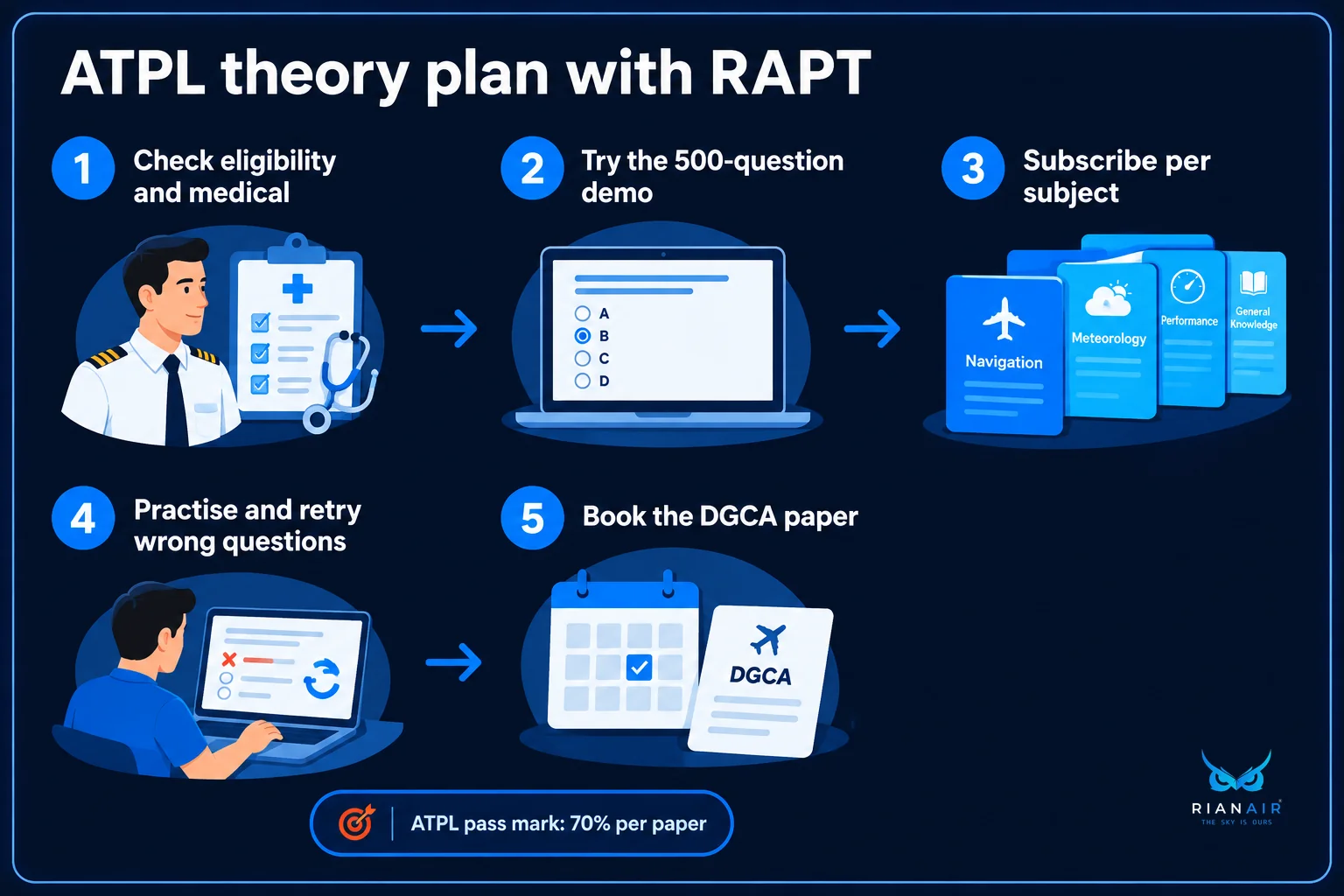
Step 1. Confirm you are eligible. Check age 21, Class 12 with Physics and Mathematics, a Commercial Pilot's Licence, a current multi-engine instrument rating and a current FRTOL. Then check your hours against the experience table. If any item is missing, fix that first, because passing theory early does not make the licence issue sooner.
Step 2. Book the medical. Use a DGCA-approved private examiner if you need speed, or an Air Force centre if you can wait. If you get a temporary unfit result, improve the flagged parameter and be re-examined. If you get a permanent one, stop spending on the licence and speak to a counsellor about alternatives.
Step 3. Check where you stand. Take the free RAPT demo as a progress check on RAPT. Note your score by subject. Your weakest subject tells you where to start.
Step 4. Sign up for ATPL access. Use the ATPL sign-up page for a basic sign-up and access to all subjects at no cost until 31 December 2026. Current CPL holders can skip Air Regulations. If your duty roster is heavy, start with one or two subjects rather than starting all and finishing none.
Step 5. Run the retry loop. Practise daily in short sessions. Retry every wrong question until it is right. Expect the second week to feel hardest, since that is when errors surface and get removed.
Step 6. Add online classes by a clear rule. If a subject stays below 70% on mixed sets after two weeks of retry loops, add online classes for that subject as per your roster. If it is above 70%, keep practising instead.
Step 7. Set your own exit mark. The pass line is 70%, but our target is 100%. If you are still scoring in the 70s on mixed sets, you are only a few marks from failing on a bad day. Wait until your scores are consistently well above the pass line.
Step 8. Prepare the practical and book. Confirm the Signals (Practical) format with DGCA, check for any new notice on transition arrangements, and register through DGCA Pariksha using the steps above.
ATPL theory preparation cost with RAPT
The cost of preparing for ATPL theory is now small for active pilots. These are the figures we can state, each with its basis.
Item | Amount | Basis |
|---|---|---|
RAPT demo | Free | Almost 1,000 questions free on the demo |
RAPT for ATPL, all subjects | Free for active pilots | Basic sign-up on the ATPL page, until 31 December 2026 (may be extended) |
Online ATPL theory class: Meteorology, Instruments and Radio Navigation | ₹80,000 plus taxes | Class fee per student |
Online classes as per your roster | Additional cost | Optional, on top of RAPT access |
Most pilots who are comfortable studying alone will spend far less on practice than on classes, which is why we put practice first and classes second. If a topic keeps defeating you, add classes for that subject only.
The DGCA exam fee itself is not in our figures, so check Pariksha for the current amount. For the wider picture of licence costs, our pilot training cost breakdown lists the fees families commonly miss.
ATPL theory for working airline pilots
The pilots who benefit most from a written-only ATPL are those already flying. A first officer with a roster full of early departures and night sectors cannot commit to a fixed classroom timetable. Self-paced practice on web, Android or iOS fits between duties.
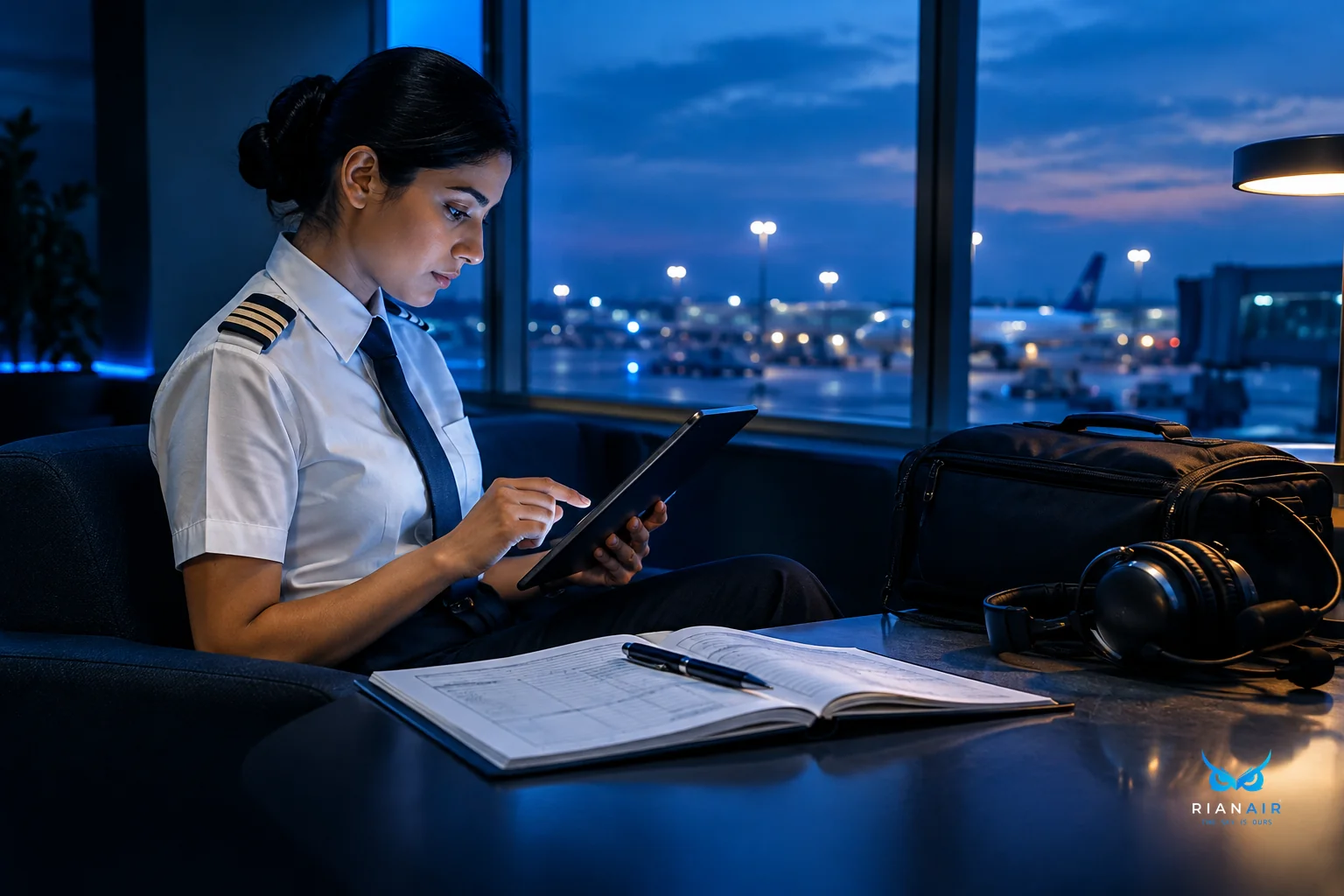
Your log is the real gatekeeper. The 1,500-hour total, the PIC requirement and the 20 recent hours in six months all have to be provable. Our digital logbook and RAPT sit on the same platform, so your hours and your theory progress stay together.
Wherever you are based, the options are the same: study online, add online classes as per your roster, or visit the nearest training centre if you want in-person sessions. Commanders-to-be should also remember the command upgrade training that the privileges clause requires after the licence is issued.
Frequently asked questions
Has DGCA eliminated the ATPL oral exam?
The notification text dated 26 October 2026 (G.S.R. 957(E)) lists written examinations and a Signals (Practical) test under ATPL knowledge, and it lists no oral examination. On that reading the oral is gone. Check DGCA's website and your Pariksha profile for the latest notice, because transition rules are not in the text.
Which written exams does the ATPL circular list?
The knowledge clause lists Air Regulations, Air Navigation, Avionics (Radio Aids and Instruments), Aviation Meteorology, and Aircraft and Engines, plus a Signals (Practical) examination. Holders of a current Commercial Pilot's Licence are not required to pass Air Regulations.
What is the pass mark in each ATPL paper?
The pass mark is 70% in each ATPL written paper. You must clear every paper on its own. Our practice target is far higher, because a score only a few marks above 70% leaves little room on exam day.
How many flying hours are needed for an ATPL in India?
The circular requires at least 1,500 hours as a pilot of an aeroplane. That includes 200 hours of cross-country, 100 of night, 75 of instrument time (50 in actual flight) and 20 within the six months before application, plus the PIC hours specified.
How much does RAPT cost for ATPL pilots?
For 2026, RAPT is free for all active pilots in India. A basic sign-up on the ATPL page gives all subjects at no cost until 31 December 2026, and the date may be extended.
How many questions are free in the RAPT demo?
Almost 1,000 questions are free on the RAPT demo. Use it as a progress check to see where you stand, then move on to full ATPL access through the ATPL sign-up page.
Can working airline pilots prepare for ATPL theory around a roster?
Yes. You can practise on web, Android or iOS at times that suit your duty pattern, without attending classes. If you prefer live teaching, online classes can be arranged as per your roster at an additional cost.
Check where you stand: ATPL oral exams eliminated, RAPT free
With DGCA ATPL oral exams eliminated, written papers carry the weight, and you can see your position today. Sign up at https://rianair.in/signup/atpl for free access to all subjects for a limited time, note your score in each subject, and add classes only where a subject stays below 70%.
You can also try the RAPT platform and see how the retry loop works on your own phone. If you want a plan for your hours, medical and theory together, send us an ATPL enquiry, or browse the rest of Rian Air.
For short explainers on DGCA exam changes, follow us on Instagram or subscribe on YouTube. Always confirm the latest position on DGCA's own notices before you register for an exam.
Recommended Resources
Start Your Pilot Journey Try Our Free RAPT Demo Now Home Rian Air