



DGCA Ground Training for Pilots: What Each Subject Actually Prepares You For
DGCA ground training for pilots is the classroom and exam phase that comes before flying. It teaches six theory areas, Air Navigation, Meteorology, Air Regulations, Technical General, Technical Specific and Radio Telephony (RTR), and each one maps to a real cockpit skill. Rian Air runs it online and in person for students in Delhi, Thane and Thrissur.
Key takeaways
Each subject trains one cockpit habit: Navigation is route planning, Meteorology is weather judgement, Regulations is rule discipline, Technical papers are aircraft knowledge, and RTR is clear radio communication.
Question volume only helps with explanations: RAPT holds 20,000+ questions, and its banks are updated after every DGCA exam so recent papers are included.
Structure lowers dropout risk: a paper-by-paper plan, topic-level practice data and visible progress for parents remove the main reasons students quit.
Plan for costs beyond tuition: DGCA exams are billed extra at ₹2,500 or ₹5,000, and extra flight hours at ₹30,000, so ask for these in writing.
You can start from anywhere: online classes are running for Maharashtra students, with hybrid and simulator options in Delhi, Thane and Thrissur.
DGCA ground training at a glance
Subject | What it covers | What it prepares you for | RAPT questions (Rian Air) |
|---|---|---|---|
Air Navigation | Charts, instruments, radio aids, performance, flight planning | Planning and tracking a route | 5000+ |
Aviation Meteorology | Clouds, fronts, pressure systems, thunderstorms, icing | Reading weather before and during a flight | 2000+ |
Air Regulations | Licensing, rules of the air, airspace, operating rules | Flying within the law and passing licence checks | 2500+ |
Technical General | Airframe, engines, systems, instruments, principles of flight | Understanding how any aircraft works | 5000+ |
Technical Specific | Systems of particular aircraft types | Knowing the aircraft you will fly | 2000+ (various aircraft) |
RTR Part 1 and Part 2 | Radio phraseology and procedures, mock calls | Talking to air traffic control correctly | 1000+ (Part 1), mock calls for Part 2 |
What Is DGCA Ground Training for Pilots?
DGCA ground training is the theory course a student pilot completes to clear the Directorate General of Civil Aviation's written and oral exams for a Commercial Pilot Licence. It covers navigation, weather, regulations, aircraft systems and radio telephony, and it is usually finished before or alongside flight training.
The regulator's own requirement is that an applicant passes written and oral examinations on a syllabus prescribed by the DGCA. Ground school is how you prepare for that syllabus without learning it by trial and error.
It is also the cheapest stage of a pilot's career to get right. Flying hours are billed by the hour, so entering the aircraft already confident in theory means those hours go into flying, not catching up.
Before you enrol, get your medical sorted. Our note on why a DGCA Class 2 medical matters before ground training explains why, since a medical problem found late is the most expensive surprise in the whole process.
How Long Does Ground Training Take, and How Do the DGCA Exams Work?
Rian Air's ground training usually takes 4-6 months for the entire programme: Navigation, Meteorology, Regulations, RTR and simulator sessions. Technical General and Technical Specific are optional if the student wants to fly in India, and they can be completed during flight training in India.
Pace varies a lot by student. Some students have cleared everything, including all DGCA exams, in as little as 3.5 months. Others who lose focus take more than a year, and by then their batchmates are already flying.
The DGCA examination portal groups papers into five sections: General, Oral, Technical General, Technical Specific and Technical Performance. The candidate selects papers from that list on screen, and passed papers are shown there too. The DGCA Pariksha guide explains how to reach that paper list.
The DGCA also states that the list of admitted and rejected candidates is displayed on its website about 10 days before the exam date. Check it so you know your status before you travel.
The DGCA's own notice on issuing licences under Schedule II of the Aircraft Rules, 1937 sets out how theory examinations feed into licence issue. Exam schedules, passing marks and how long a passed paper stays valid are set in current DGCA notices, so confirm them there before you book.
The basic DGCA passing mark is 70, but we never ask our students to aim for it. We ask them to aim for 90+, or rather 100% accuracy.
DGCA fees are paid directly to the DGCA. OLODE exams are ₹5,000 per exam and regular exams are ₹2,500 per exam.
A subject-order plan inside the 4-6 month course
Rian Air's course covers Navigation, Meteorology, Regulations, RTR and simulator sessions in 4-6 months. We do not publish a fixed number of weeks per paper, because pace depends on the student. The order below is a sensible sequence, not a timetable.
Air Navigation first: it is the paper students fear most and it rewards repetition, so start it early. Most students in our latest batch attempted Navigation in the September attempt.
Aviation Meteorology next: it is conceptual, so sketch fronts and thunderstorm cells as you go.
Air Regulations alongside or after: it is rule-heavy, and every topic matters.
RTR preparation and simulator sessions: practise mock calls aloud and use the simulator hours in your plan.
Technical General and Technical Specific: optional if you want to fly in India, and they can be done during flight training.
Split the 4-6 months across these papers with your instructor, and clear one or two papers at a time rather than sitting all of them cold.
Results from our latest batch
In our latest batch, most students attempted Navigation in the September attempt, and 13 of 21 students cleared their exams. Two students scored 69 and six scored in their 60s. The top score was 89%, by Mr. Divyansh from our Delhi Training Centre, and the highest score at our Kerala training centre is 84%. Most of our students fall in the 80+ bracket.
In Technical General, usually 85%+ of students pass on the first attempt. Pass rates for Navigation, Meteorology and Regulations are not published separately; the batch figures above are what we can state.
What Does Each DGCA Ground Subject Actually Prepare You For?
Each DGCA subject trains one cockpit habit: Navigation teaches you to plan and track a route, Meteorology to read weather, Regulations to follow the rules, Technical papers to understand the aircraft, and RTR to communicate clearly. The exam tests these habits through questions, so understanding beats memorising.
The full DGCA ground school syllabus lists the topics under each paper. The sections below explain what those topics are for. The DGCA publishes its own syllabi for examinations, which is the final authority.
Air Navigation
Navigation is the paper students fear most because it mixes arithmetic with reasoning. It covers charts, heading and track, wind effect, instruments, radio navigation aids, performance, flight planning and payload.
In the cockpit, this is the skill of knowing where you are, where the wind is pushing you, and whether you have enough fuel to get there. A student who only memorises formulas freezes when the question is worded differently. A student who has drawn the wind triangle a hundred times does not.
Rian Air's navigation bank has 5000+ questions, the largest set alongside Technical General, because this paper rewards repetition with feedback.
Aviation Meteorology
Meteorology prepares you to decide whether to fly, divert or stay on the ground. It covers the atmosphere, clouds, fronts, pressure systems, visibility, icing, turbulence and thunderstorms. The paper is conceptual, so sketching a front or a thunderstorm cell helps more than rereading notes.
Here is a sample question from our meteorology bank:
Which cloud is associated with thunderstorms and hail? (a) Cirrostratus (b) Altocumulus (c) Cumulonimbus
Answer: Cumulonimbus. It is the thunderstorm cloud: heavy showers, hail, lightning, severe turbulence and icing.
Notice what the explanation does. It links one cloud name to the hazards a pilot would actually face. That link is what you want to remember at the exam and in the air. The meteorology bank holds 2000+ questions.
Air Regulations
Regulations is the rulebook paper. It covers licensing, rules of the air, airspace classes and operating requirements. It feels dry, but it is the paper where one missed detail changes the answer.
Here is a sample question from our regulations bank:
The minimum age for a Commercial Pilot Licence in India is: (a) 16 (b) 17 (c) 18
Answer: 18. A CPL applicant must be at least 18. A student pilot licence can be held from 16 and a PPL from 17.
These minimum ages (CPL 18, PPL 17, student licence 16) come from our question bank. The DGCA's licensing requirements (CAR Section 7, Series B, Part I) govern the licence categories, so confirm the ages there before you rely on them.
Our RAPT error data does not show one weak topic that students can safely skip. Our instructors' view is plain: every topic matters, nothing should be skipped, and the rules are the point. The regulations bank holds 2500+ questions.
Technical General and Technical Specific
Technical General covers how aircraft work in principle: airframes, engines, electrical and hydraulic systems, instruments and principles of flight. It prepares you to troubleshoot, brief and understand any aircraft you meet. Our bank has 5000+ questions here.
Technical Specific narrows to the type you will fly. A student training on a single-engine trainer studies those systems, and multi-engine candidates study theirs. Our bank has 2000+ questions across various aircraft. Treat it as the bridge between theory and the specific aircraft you will sit in.
RTR Part 1 and Part 2
Radio Telephony Restricted (RTR) prepares you to speak to air traffic control in standard phraseology. Part 1 is theory and procedure, with 1000+ questions in our bank. Part 2 is the practical radio exercise, supported by mock calls.
Radio mistakes are rarely about vocabulary. They come from hesitation. Mock calls practised aloud, until the phrases come without thinking, are the fix.
How Does a Large Question Bank Build Exam Readiness Instead of Rote Learning?
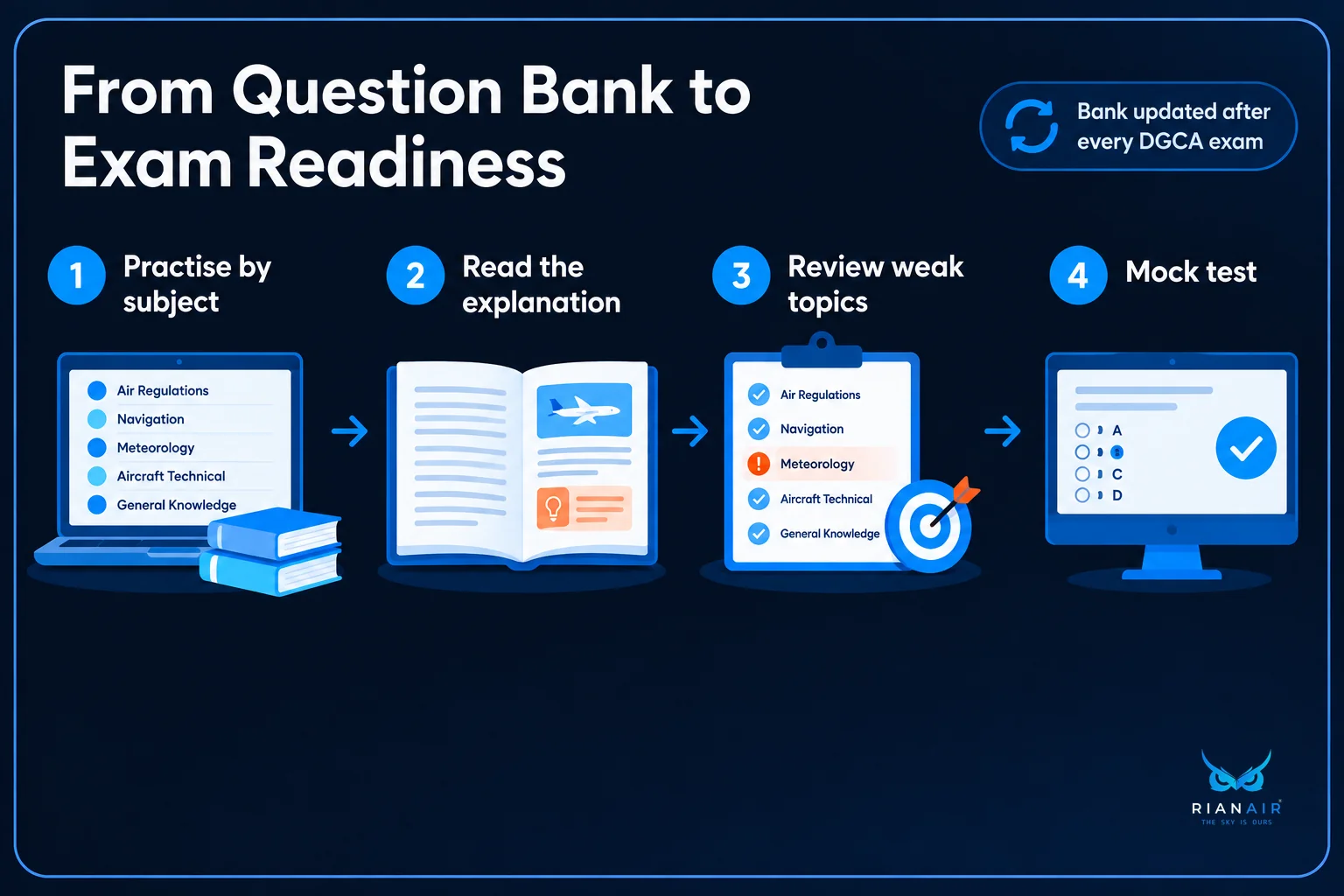
A large question bank builds readiness when each question comes with an explanation, is tagged by topic, and is refreshed with recent exam papers. You stop memorising answer letters and start spotting why an answer is right. RAPT holds 20,000+ questions and is updated after every DGCA exam.
The 20,000+ figure is the sum of the subject banks above, built from past DGCA papers and recent attempts. We are open about one thing: some questions repeat across papers. That is useful for students, because a repeated question is one that the DGCA has recently asked.
Volume alone does not prevent rote learning. A bank of 5000 questions memorised by letter is still rote. What changes behaviour is the loop: practise a topic, read the explanation, see which topics keep going wrong, then retest.
RAPT tracks that practice data so a student and a mentor can see weak topics instead of guessing. If you want to see how your own preparation measures up, the free RAPT demo gives you 500+ questions to find out where you stand.
Students typically see their mock scores climb: 60-70% initially, then 70-80%, then upwards of 90s. We aim for 100% before the real attempt, because students can reattempt wrong questions after a mistake, which gradually eliminates errors by exam day.
Students describe this in their own words. One Google reviewer, Sachu (5★), wrote: “The app is simple to use, informative, and great for aviation students who want to improve their knowledge and preparation.” You can see how the banks are organised in our guide to the DGCA question bank for CPL and ATPL.
A simple weekly routine that works
Study one chapter from the class notes or recorded lesson.
Answer that chapter's questions in study mode, reading every explanation, including the ones you got right.
Write down each wrong answer's reason in one line.
Two days later, retest only the weak topics.
At the end of each subject, attempt a full mock under exam conditions before booking the real paper.
The pass mark for this routine is simple. If you repeat the same mistake on the retest, you have not understood the concept, and you should ask an instructor rather than do more questions.
How Does Structured Ground Training Reduce Dropout Risk?
Structured ground training reduces dropout risk by removing the causes that make students quit: unclear sequencing, repeated failures with no diagnosis, isolation, and surprise costs. A paper-by-paper plan, topic-level practice data, instructor support and visible progress for parents keep the effort manageable and the family informed.
Students rarely quit because the subjects are impossible. They quit after a failed paper they cannot explain, a timeline that keeps stretching, or a bill that grew. Our piece on common mistakes DGCA aspirants make during ground school covers the study errors behind many of these.
What structure looks like in practice
A subject order: clear one or two papers at a time, rather than sitting all of them cold.
Diagnosis after a miss: RAPT practice data shows which topics caused the loss.
Human support: Abhishek V. (5★, Google review) wrote that “the trainers are highly experienced, supportive, and always willing to clear doubts with patience.”
Parent visibility: the parent dashboard shows progress, so sponsors are not left guessing.
Quiet study space: a library for focused hours outside class.
Another reviewer, Al S. (5★, Google review), wrote: “They help us plan the entire CPL journey, offering personalized mentorship and strong pathways for flight training.”
Not everything is settled here. How many attempts a student needs depends on the person, and no academy can promise a number. Rian Air reports that usually 85%+ of students pass Technical General on the first attempt, usually everyone passes by the 2nd attempt, and only a student or two barely goes to a 3rd. What a good structure can promise is that you will always know why you missed.
Medical and Eligibility: eGCA ID, Class 2 and What If You Are Unfit
Rian Air requires students to be medically fit and to have 10+2 with Physics and Mathematics. The DGCA Pariksha FAQ likewise says applicants other than PPL must have passed 10+2 with Physics and Mathematics. For the Delhi and Kerala seats, the top 12 scores in the 12th grade get the seat.
The Class 2 medical comes first. Rian Air charges Rs 2,500 as a token of confirmation before enrolment. That covers complete guidance on creating the eGCA ID, the Class 2 medical tests and scheduling a doctor appointment.
Pay the Rs 2,500 token and create your eGCA ID with our guidance.
Do pre-tests at a NABL-approved lab or NABH-approved hospital. Start with an Ishihara-type colour vision test from an optometrist, update your eye prescription and carry a recent report.
Book the examiner. For an Air Force centre, book at least 2 months ahead. For a private DGCA-approved examiner, appointments can be booked within 7 days.
Attend the exam. The doctor's fee is Rs 3,000, and the medical tests are approximately ₹5,000 to ₹8,000 depending on the test centre.
There are three outcomes. Fit means good to go. Temporarily unfit means something can be improved, such as BMI, a urine infection or blood platelet count, and the examiner asks the student to improve it. Permanently unfit means no go, for example colour blindness or night blindness.
A temporary unfit finding usually lasts from 2 weeks to 6 months or even more, depending on the case. One student with a urine infection took about a month to clear it. If the student is fit, they pay the remaining fees to attend ground and simulator training.
If the student is medically unfit, the entire Rs 2,500 is refunded. If the DGCA assessment declares a student permanently unfit, Rian Air refunds 100% of the student's amount. One student, Mr. A, failed the Ishihara test and was declared permanently unfit as colour blind. He has quit pilot training and taken up an aviation management programme instead.
Online, Hybrid or In-Person: Delhi, Thane and Thrissur
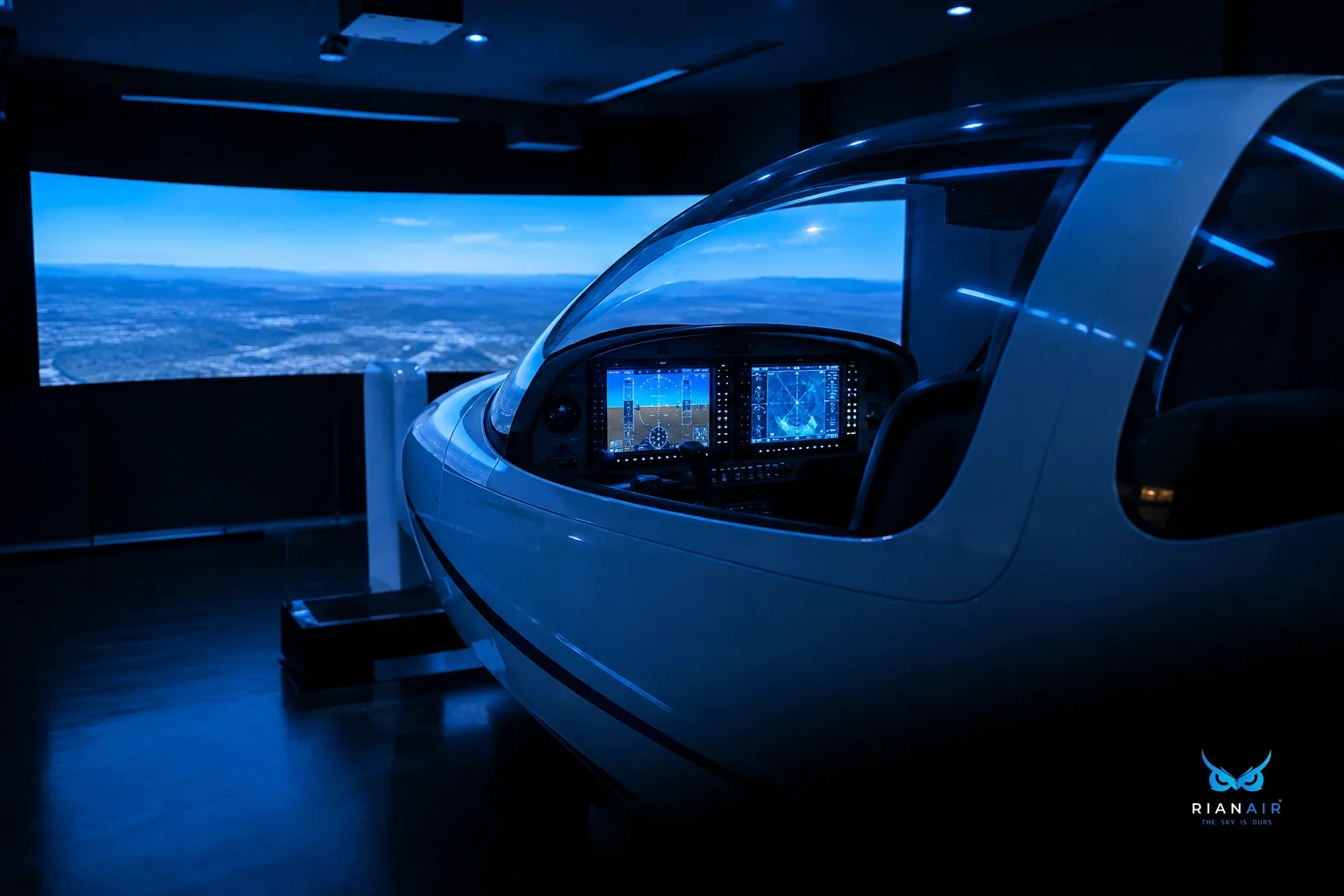
You can start ground training online from almost anywhere, then add in-person classes and simulator sessions where we have a centre. The table compares what is available at each location.
Option | What you get | Best for |
|---|---|---|
Online ground training | Live and recorded classes with RAPT practice from home | Students outside our centres, including aspiring pilots from all over India |
Delhi | Classes with hybrid simulators; Delhi ground-training fees include 5 simulator hours | Students who want classroom time and early simulator exposure |
Thane, Maharashtra | Centre with a library and a DA40/42 hybrid simulator with original glass cockpit G1000 and canopy | Maharashtra students who start online and move to in-person classes |
Thrissur, Kerala | C172 fixed-base simulator, Kerala's first | Kerala students who want a physical simulator before flying |
The Thane centre is at Rian Air, opposite Shree Bhagyalakshmi Bungalow, Anand Park, Thane West, Maharashtra 400601. It is in Thane, not Mumbai proper. Online ground training for aspiring pilots from Maharashtra is already running, and they can move to the hybrid set-up for in-person classes and simulator sessions.
For deeper local detail, read our comparison of ground classes in Mumbai, Delhi and Kerala. A student reviewer, Sarah D. (5★, Google review), put it this way: “Being in Rian air institute is one of the best experiences of my life.”
What Does Ground Training Cost, and What Comes After?
Rian Air's Delhi ground-training tuition is ₹80,000 for Air Navigation, Aviation Meteorology, Air Regulations and 5 hours of simulator training on a DA40/42 simulator. RAPT is included during training. RTR preparation is ₹20,000 extra, and taxes are extra. The course takes 4-6 months.
Item | Fee (taxes extra) |
|---|---|
Delhi tuition: Nav, Met, Regs, 5 simulator hours, RAPT | ₹80,000 |
RTR preparation add-on | ₹20,000 extra |
Delhi including RTR | ₹1,00,000 (introductory price) |
Thane | ₹1,00,000 (introductory price) |
Kerala (Thrissur) | 125000 |
Class 2 medical coordination | Rs 2,500 token, fully refunded if unfit |
After ground training, the main costs are flight training, DGCA exam fees and any extra hours. Partner flying schools charge 50 lakh to 75 lakh per student, varying by student. DGCA exams are billed extra at ₹2,500 or ₹5,000 depending on the attempt type, plus travel.
Those are the figures students tell us surprise them most when they pick a cheaper school. Rian Air's guidance is to ask for the following in writing:
Flight training fee: 50 lakh to 75 lakh at our partner flying schools, varying from student to student.
Extra flight hours: billed at ₹30,000.
DGCA exam fees: ₹2,500 or ₹5,000 extra, depending on whether it is an OLODE or a regular attempt, plus travel expenses.
Simulator hours: Delhi ground-training fees include 5 simulator hours.
For the stage after that, our entry-level A320 type rating is ₹15 lakh through channel partners and runs 50 days. Type-rating courses generally take 8 to 10 weeks depending on student performance, with 36 to 44 simulator hours during the program. Read our A320 type rating preparation guide if you want to plan that far ahead.
Decision Rules: How to Pick a Ground Training Setup
Use these checks before paying anyone, including us. Each has a pass and a walk-away answer.
Is a DGCA-recognised pathway explained in writing? Pass: a subject-by-subject plan. Walk away: vague timelines.
Do practice questions come with explanations and topic tracking? Pass: yes, with data on weak topics. Walk away: a PDF of answers only.
Is the bank updated after each exam? Pass: the provider says when and how. Walk away: no update policy.
Are extra costs listed? Pass: exam fees, extra hours and travel are itemised. Walk away: only a headline fee.
If you are anywhere in India, start online now and move to Thane for simulator work. If you are in Kerala, a physical simulator in Thrissur is worth a visit before you commit. If you are comparing in Delhi, see our beginner's roadmap to ground training in Delhi.
Women aspirants can look at the Women Empowerment Program: zero* fee DGCA ground training for aspiring women pilots based on merit, with a refundable commitment deposit of ₹80,000 applying.
Frequently Asked Questions
What is a DGCA question bank?
A DGCA question bank is a topic-wise set of exam-style multiple-choice questions with answers and explanations. A good one includes past-paper questions and updates after each exam. Rian Air's RAPT holds 20,000+ questions across Navigation, Meteorology, Regulations, Technical General, Technical Specific and RTR.
Can I join pilot ground school online from Maharashtra?
Yes. Online ground training for aspiring pilots from Maharashtra is running now. Students can later move to the hybrid set-up at the Thane centre to attend in-person classes and simulator sessions, so the start does not depend on living next to a campus.
Do I need a DGCA medical before ground training?
A Class 2 medical is the usual first step before ground training, because it confirms you are fit to continue. A Class 1 medical is needed for the commercial licence itself. Completing medicals early avoids discovering a problem after you have paid for training.
Start Your DGCA Ground Training With a Plan
Ground school is where a pilot's habits are built, and it goes better when each subject has a purpose, each question has an explanation and your family can see progress. If you are ready, start your pilot journey with an enquiry and our academic counsellor will walk you through the subject plan, fees and terms.
Want to see where you stand before you commit? Take the free RAPT demo: sign up with your name, email, phone number and date of birth, set your password from the email link, and start solving 500+ questions across subjects. Not sure of the route yet? Explore the pathways from ground school to type rating.
For daily study tips and simulator clips, follow Rian Air on Instagram or subscribe on YouTube.