



DGCA CPL Ground Classes in Kerala: Parents' Checklist
Before you pay for DGCA CPL ground classes in Kerala, check seven things at the institute: its DGCA approval, batch size and instructor numbers, whether ground classes and exams finish before any flying commitment, simulator access, live progress visibility, a written cost breakdown, and warning signs such as reel-heavy marketing and inflated scholarship claims.
At Rian Air, we run DGCA ground training on our RAPT platform, which gives parents a live progress dashboard, and our C172 fixed-base simulator is Kerala's first. This guide is written for parents in Thrissur and across Kerala who have no aviation background and want to judge any institute, including ours, on facts.
What DGCA CPL ground classes cover, how long they take and when the exams are
DGCA CPL ground classes prepare your child for the written DGCA papers: Air Navigation, Aviation Meteorology, Air Regulation, and Technical General and Technical Specific, plus a performance paper for heavier aeroplanes and the separate RTR radio telephony exam. DGCA runs four regular exam sessions a year (March, June, September and December) and on-demand sessions in other months, so most students plan their classes backwards from a target session.
At Rian Air, DGCA ground training typically takes 4 to 6 months. The exact time depends on how many subjects your child studies at once and which session they aim for. A practical plan: pick the exam month, split the subjects into batches, and leave room for a retake, since a failed paper can be re-attempted only after the 42-day cool-off. DGCA publishes session dates and they can change, so confirm them before you book.
Ground classes first, flying later: how the pathway works
Ground classes are the theory stage of a Commercial Pilot Licence (CPL). No aircraft is involved. Your child studies for written DGCA exams, then moves on to flight training, where the 200 hours of flying required for a CPL are logged.
DGCA conducts the exams itself. According to the DGCA eligibility rules for crew licence examinations, CPL theory papers cover Air Navigation, Aviation Meteorology, Air Regulation, and aircraft and engine knowledge (general and specific), with a performance paper for heavier aeroplanes. These rules sit in DGCA's CAR Section 7, Series B, Part I, available on the DGCA website. The institute only prepares your child; it does not set or mark the papers.
A good institute teaches well, shows you its numbers and tells you honestly what it cannot control.
1. Is the institute DGCA approved, and how do you confirm it?
Ask the institute for its DGCA approval in writing and check it against DGCA's own records. DGCA approves flying training organisations, and its rules require an approved organisation to display its approval certificate where the public can see it. A ground classes institute should clearly say which approval its classes sit under.
The DGCA requirement for flying training organisations (CAR Section 7, Series D, Part I, Issue III) says no person may operate as an approved training organisation without, or in violation of, an approval certificate. It also says the certificate must be displayed at the principal place of business. So on your visit, ask to see it with your own eyes.
DGCA's own assessment criteria for flying training organisations also score a dedicated ground school and at least one simulator, and they state that the ground school must be DGCA approved and included in the organisation's latest approval documents. Treat those as the questions to put to any institute.
Questions that expose vague approval claims
- Which DGCA-approved organisation do these ground classes belong to, or what exactly is the institute's own approval?
- Can we see the certificate and the date it was issued?
- Does the institute claim affiliation with any government body? If yes, can that body confirm it?
The last question matters. In June 2025, Kerala's Information and Public Relations Department published a caution notice on its official website in which the secretary of a state government flying academy said it has no affiliation with private ground schools. Any claim of an official tie should be checked with the body named.
You can also write to DGCA directly. The DGCA contact page lists the Flight Crew Training and Licensing and Flying Training directorates.
Here is how it works at Rian Air. We are a private organisation that runs DGCA ground classes. A DGCA-approved flying training organisation is permitted to conduct ground training only for students who will continue their flight training with it, and some students prefer to fly abroad for flight training.
So our ground classes do not need a DGCA approval of their own, and we say so plainly. Whatever the institute, ask which of these two cases applies to it.
2. How many students per batch and how many instructors?
Ask any institute for the exact number of students in each batch and the instructors teaching each subject, in writing. Small batches let an instructor notice who is struggling, while large batches with one instructor covering several subjects often leave doubts unanswered.
At Rian Air, each batch has 12 students, and at least 3 instructors are at our facility at any given time, each teaching different subjects. At present:
- Air Navigation: Capt. Malavika teaches the subject, while Capt. Jasir, a flight instructor from the USA, covers the instrumentation portion, which is also part of navigation.
- Meteorology: taught by Capt. Bliss.
- RTR: taught by Capt. Gokul.
- Simulator sessions: Capt. Vikas runs a few sessions with each student.
Whichever institute you choose, push for specifics instead of "experienced faculty":
- Students per batch, and whether that number changes in exam season.
- Who teaches each subject (Air Navigation, Meteorology, Air Regulations, Technical General and Technical Specific), and their flying background.
- Who answers a doubt the same week, and how.
- Whether your child can try the free RAPT demo or sit a demo class before committing.
Among the Google reviews of our institute, one reads: "personalized attention through small batches" (Elbin S., 5★, Google review). Another says: "The trainers are highly experienced, supportive, and always willing to clear doubts with patience." (Abhishek V., 5★, Google review). Those are reviewers' words, not ours, so also read the full review page and form your own view.
3. Why must ground training and DGCA exams come before any flight commitment?
Because unfinished exams are the most expensive thing to carry abroad or into a flying school. Students who skip DGCA exams before departure can pay far more on return (our own figures below put conversion at about 4 to 5 lakh rupees normally versus 9 to 12 lakh with recency training), and if documents are not submitted to DGCA within 6 months, they repeat recency training of roughly 18 to 22 extra flying hours.
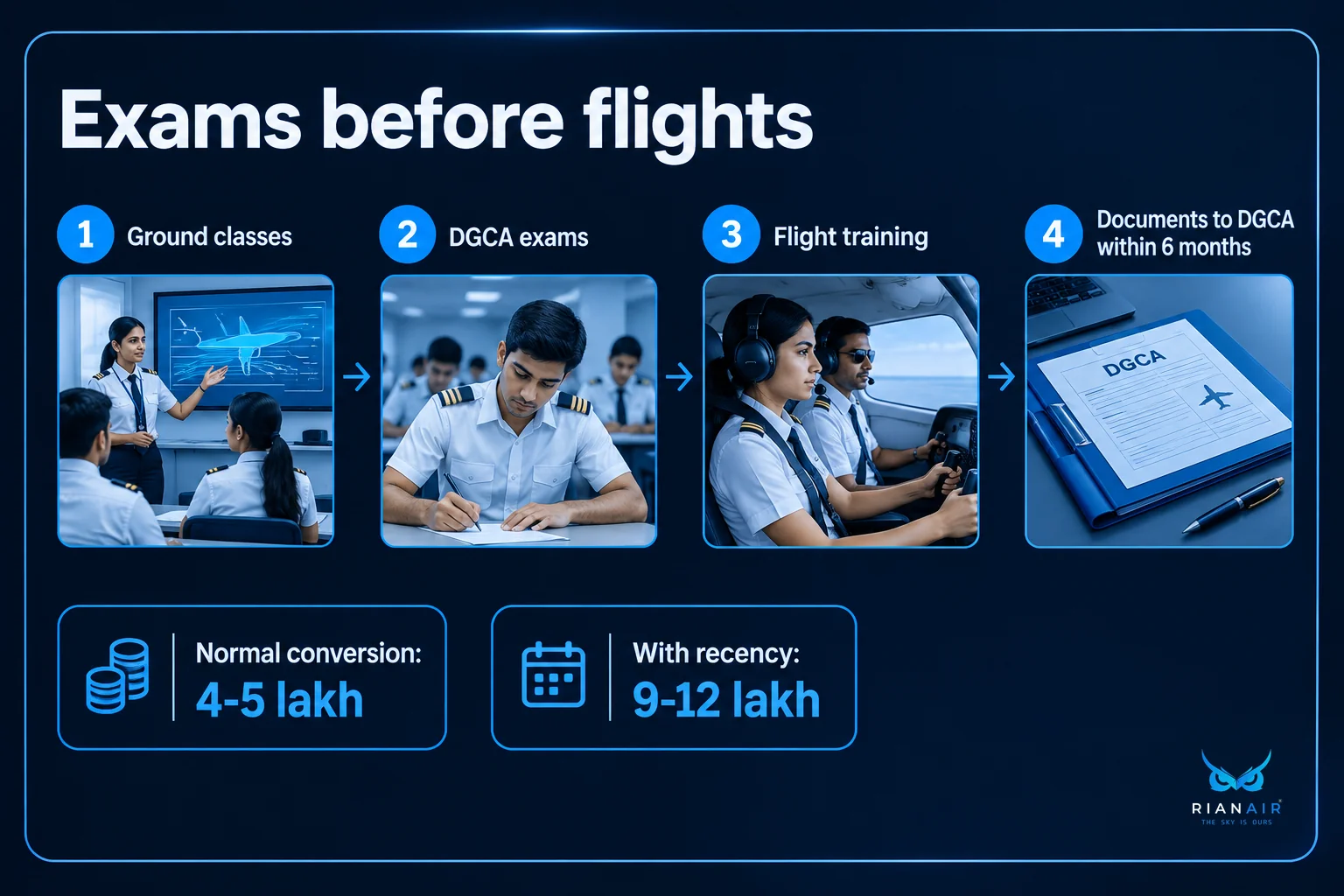
Parents are often told, "Send the child for flying now, exams can wait." This reverses the safe order. DGCA's own type rating requirement (CAR Section 7, Series B, Part XIX) says a trainee pilot should have passed all requisite written examinations before commencing simulator training, and that these must stay valid throughout training and checks.
What it costs when a student returns from abroad unprepared
We offer CPL training in India or abroad through Tunisia, Malta and New Zealand. Either way, we advise clearing exams before leaving. Our conversion figures show why:
- Normal conversion costs about 4 to 5 lakh rupees.
- Conversion with recency training costs 9 to 12 lakh rupees, depending on aircraft and hours.
- Checks take 2 to 3 weeks; recency takes 1 to 1.5 months.
- If Air Navigation and Meteorology are not cleared before going abroad, they merge into one composite exam of 100 questions in 3 hours.
Students do get multiple attempts after returning, but the 6-month document window is the pressure point. Our guide to hidden fees parents miss in pilot training costs goes deeper into where else money leaks.
What exam results should you ask about?
Ask any institute for its recent pass numbers and what they count. In our latest batch, most students attempted Air Navigation in the September attempt, and 13 of 21 students cleared their exams. That means 8 did not clear that attempt, and we tell parents so.
Each paper can be retaken after a cool-off. The 42-day cool-off is the current rule; DGCA might remove it in future. Every passed DGCA exam stays valid for 5 years.
4. Does the institute give simulator access before flight training?
It should, and you should ask exactly when. At Rian Air, Capt. Vikas runs a few simulator sessions with each student on our C172 fixed-base simulator, Kerala's first, either during the Air Navigation ground subject or just before the student departs for flight training. These sessions make students aware of the airspace and the airport where they are about to begin flight training. Ask any institute for the same timing.
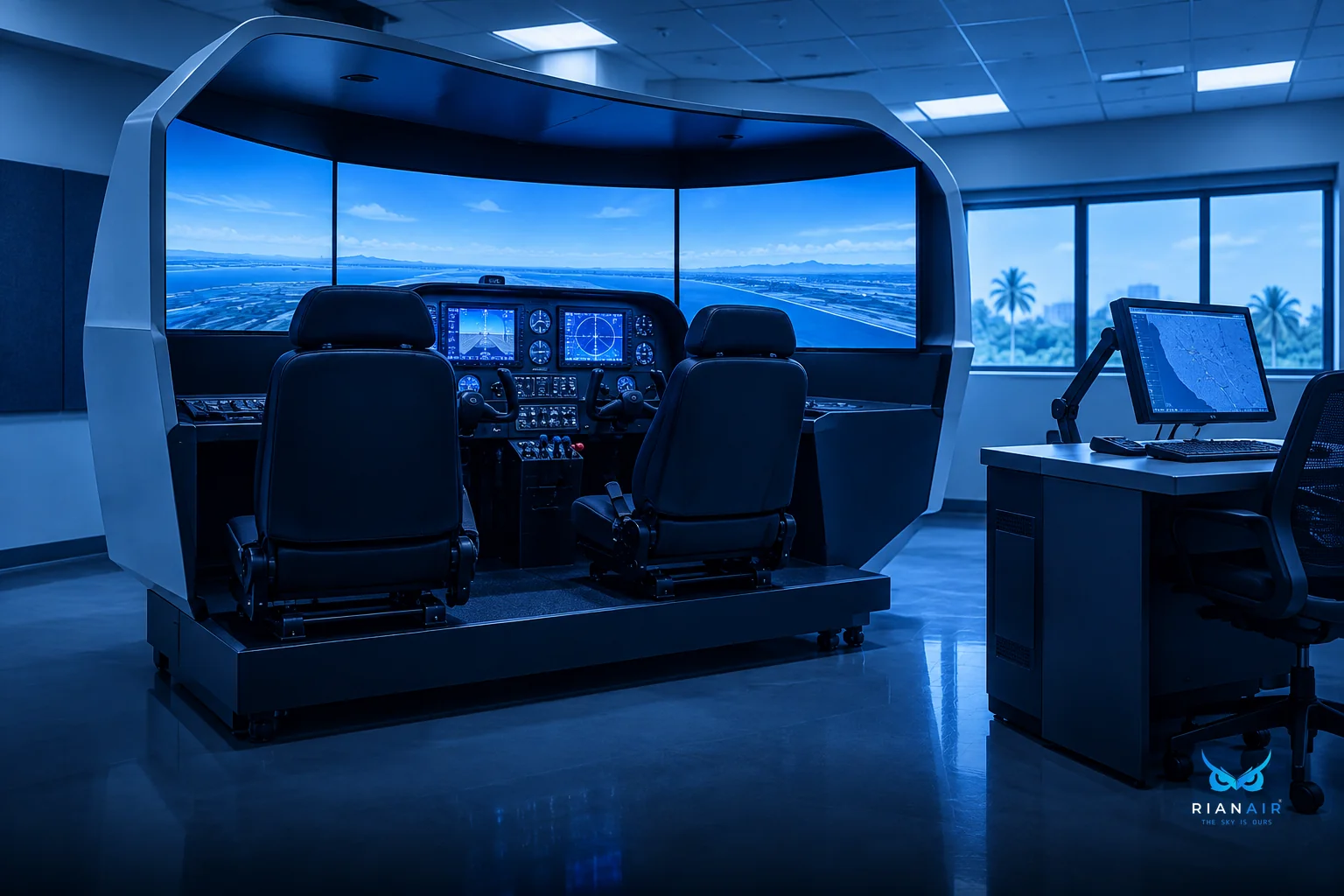
A simulator is not a replacement for flying. Its value is that a student meets checklists, instrument scans and radio calls on the ground, where a mistake costs nothing. Reviewers on Google praise our simulators, infrastructure and dedicated study facilities.
When you visit, ask whether the simulator is used inside the course or sold as a paid extra, how many students share it, and what a session covers. Do not accept "yes, we have a simulator" as a full answer.
5. How can parents see their child's progress?
Parents should get live, day-to-day visibility, not just a phone call after a failed paper. With Rian Air, parents track every step of their child's progress live through RAPT, our platform with a 20,000+ question bank, performance analytics, a parent dashboard, a mentoring loop and a digital pilot logbook.

This matters because most parents cannot judge aviation content themselves. You can, however, judge whether a number is moving. Ask any institute what you will see, how often it updates, and whether you get access or only a monthly summary.
How the digital logbook is handled
The logbook later becomes the record for your child's CPL application, so honesty in it matters. Our logbook runs on an honour system with no instructor approval step. Falsified entries are highlighted, a student can correct an error, and the time stamp of the correction is highlighted too.
Before entries are uploaded to the eGCA portal, a Rian Air representative reviews each one so that problems do not surface during licence issue or conversion. We encourage students to fill the logbook right after the post-flight briefing.
A free way to see where your child stands
Your child can take a free RAPT progress check to see where they stand today. They sign up with their name, phone number, email and date of birth, get an email with a link to set a password, then log in and start solving.
The free demo covers roughly a quarter of the CPL question bank. The rest for CPL is included during ground training with us. You can also try the free RAPT demo to see how the practice questions and explanations feel before you decide.
Reviewers describe the app this way: "The app is really good, there are a lot of questions in it." (Mihir F., 5★, Google review).
6. What should a transparent cost breakdown include?
It should separate three things: the institute's ground training fee, DGCA's own exam fees, and later costs such as flight training and conversion. DGCA exams cost Rs 2,500 per paper in March, June, September and December, and Rs 5,000 in other months. Ask for every line in writing before paying.
These are the figures we can state, so you can compare them with any quote:
| Item | Figure | Note |
|---|---|---|
| DGCA exam, regular attempt | Rs 2,500 per exam | March, June, September, December |
| DGCA exam, other months (on-demand) | Rs 5,000 per exam | Also called OLODE |
| RTR Part 1 | Rs 2,000 | Radio telephony paper |
| RTR Part 2 | Rs 500 | Practical radio calls |
| ATPL exam fees | Same as CPL | For later study |
| Foreign licence conversion, normal | 4 to 5 lakh rupees | Checks 2 to 3 weeks |
| Conversion with recency | 9 to 12 lakh rupees | Depends on aircraft and hours; recency 1 to 1.5 months |
The institute's own ground training fee is the item that varies. At Rian Air, the ground training fee is 1.25 lakh rupees plus GST. It covers Air Navigation, Aviation Meteorology, Air Regulations, RTR and 5 hours of simulator training. We do not split the fee by subject. Whichever institute you choose, ask for a written breakdown of what its fee includes.
Look at the full pathway too. A Times of India guide to becoming a pilot puts overall pilot training in India at roughly ₹35 to ₹50 lakh, depending on the institution and what is included. A low ground fee tells you little about that total.
Get the agreement in writing
DGCA has issued Flying Training Circular 02 of 2026, containing guidelines for agreements between flying training organisations and trainees. Ask the institute whether its admission agreement follows them. Read the refund conditions, what is and is not included, and what extra charges could apply, before you pay anything.
7. What are the warning signs at a ground classes institute?
Warning signs include marketing that leans on reels and celebrity faces instead of facts, scholarship claims that sound too large, guaranteed exam results, pressure to pay quickly, and approval claims that cannot be shown on paper. DGCA conducts the exams, so no institute can honestly guarantee a pass.
A polished reel costs little, while a verifiable certificate, a named instructor and a written fee sheet take real work. Weigh the second kind of evidence more.
- Reels and celebrity faces: a famous face tells you nothing about batch size or approval.
- Inflated scholarship claims: some ground schools advertise scholarships of 3 to 10 crore rupees. In our observation, the real benefit is often only about $3,000 (USD) at a flight school the ground school recommends, not a cash scholarship, and the student cannot choose their own flight school. Ask:
- Who qualifies, and how many seats exist?
- Is it paid in cash, or only discounted at one named flight school?
- Can it be used at a flight school you choose?
- What deposit applies, and where are the written terms?
- "Pay today" deadlines: a sound institute lets you visit, ask and think.
- Flying commitments before exams: see section 3.
- No simulator timing, no dashboard, no fee sheet: vague answers are an answer.
Parent's checklist for DGCA CPL ground classes in Kerala
Print this table and take it to each institute you visit. A clear answer in the middle column is what you want; the right column is what should make you pause.
| What to check | A clear answer looks like | Warning sign |
|---|---|---|
| DGCA approval | Certificate shown, and the approval it falls under is named | "We are DGCA approved" with nothing on paper |
| Batch and instructors | Exact numbers per batch and per subject | "Experienced faculty" only |
| Exams and flying order | Exams first, with clear reasons | Pressure to commit to flying before exams |
| Simulator | When it is used and by how many students | Simulator seen only in photos |
| Parent visibility | Live dashboard or regular written updates | Updates only when something goes wrong |
| Costs | Written line items showing what the fee includes, refund terms | One lump sum, no breakdown |
| Results | Recent pass numbers with what they count | "100 percent success" style claims |
| Scholarships | Stated criteria and written terms | Crore-sized claims that turn out to be a small credit at one recommended flight school, with no free choice of school |
For more questions to ask, our guide to comparing ground training institutes in Kerala adds more questions you can ask.
Thrissur, Kerala, Delhi and Thane: where classes are held
We serve students in Thrissur, Kerala, as well as Delhi and Mumbai, Maharashtra. Our Delhi address is listed on Google. Our Thane centre opens in December and will be a full-fledged facility.
Our Thrissur centre is at Rian Air, 2nd Floor, Pottekkat Building, Round East, Thrissur, Keralam - 680001. Classes run in two batches: a morning batch from 10 am to 1 pm and an afternoon batch from 2 pm to 5 pm. New batches start every month, with limited seats in each, so it is worth asking early.
Online ground training for aspiring pilots from Maharashtra is already running. Those students can later move to a hybrid set-up to attend in-person classes and simulator sessions. For CPL, students who need offline classes can visit their nearest training centre, and anyone can ask for a demo online class first.
If your child is happy to study online, location matters less. If you want classroom batches and simulator sessions, ask where the simulator is placed and how often your child can use it.
Beyond Thrissur, families in Kochi, Thiruvananthapuram, Kozhikode and other Kerala cities should apply the same checks to any institute near them: visit in person, see the approval certificate, ask where the simulator is, and ask whether your child would travel daily or need a hostel. Travel and living costs can change the real cost of a batch as much as the fee.
Reviewers also mention guidance: "The student counselors are helpful and guiding." (Arun E., 5★, Google review). Others describe help with course planning and practical steps such as medicals and DGCA procedures.
Frequently asked questions from parents
Medicals, subjects and duration
When should my child take the DGCA medical?
A Class 2 medical is taken early, before ground training, and a Class 1 medical is needed before flight training and the CPL, as set out in DGCA's medical requirements (CAR Section 7 on the DGCA website). Taking medicals first avoids paying for ground classes and then learning your child is unfit to fly. Check current requirements with a DGCA-approved medical examiner.
Our article on why a DGCA Class 2 medical comes before ground training explains the order.
How long do DGCA CPL ground classes take?
There is no single DGCA-fixed duration, because DGCA sets exams, not class length. The exam calendar fixes the timeline: four regular sessions a year (March, June, September, December), on-demand sessions in other months, and a 42-day cool-off before a failed paper can be retaken. A typical plan works backwards from the target session: choose the exam month, spread the subject papers across batches before it, and keep a gap for one possible retake.
Ask the institute for a subject-wise timetable with the target exam month, instead of a single "number of weeks" in a brochure. A passed paper stays valid for 5 years, so finishing subjects in stages works as long as flight training starts within that window.
Which subjects come in the DGCA CPL exams?
CPL theory covers Air Navigation, Aviation Meteorology, Air Regulation, and technical papers on aircraft and engines (general and specific). A performance paper applies to aeroplanes above 5,700 kg maximum take-off weight, as listed in DGCA's CAR Section 7, Series B, Part I. A radio telephony exam, RTR, is separate and sits outside the DGCA papers.
For a subject-by-subject view, see our CPL ground classes in Kerala syllabus and timeline guide.
Exams, validity and online classes
Can my child attend ground classes online from Kerala?
Yes, online ground classes are available for CPL and ATPL students, and students who want in-person classes can use a nearby centre. Online suits students who cannot relocate, but ask how doubts are cleared and whether recorded sessions exist for missed classes.
What happens if my child fails a DGCA paper?
Your child retakes only the failed subject after the cool-off. The current rule is 42 days, though DGCA might remove it in future. Other passed papers are not affected, and each pass stays valid for 5 years, so a failure is a delay rather than a restart.
How long is a passed DGCA exam valid?
Every passed DGCA exam is valid for 5 years. That is why timing matters: if your child passes early but starts flight training late, a paper could lapse. Ask the institute to map exam dates against the planned flying start.
RAPT, ATPL and logbook
Does the free RAPT demo contain the whole question bank?
No. The demo covers roughly a quarter of the CPL question bank. The rest for CPL is included during ground training, or you can contact us for pricing. It is meant for checking how questions and explanations feel, not for completing the syllabus.
My child will study ATPL later. Do they need classes?
Not necessarily. For ATPL, after the first 500 questions, a student can subscribe for 500 rupees per month per subject and skip classes. If they want online classes that fit their flying roster, we can provide them at an additional cost.
Who checks my child's logbook entries?
The student fills the logbook, and there is no instructor approval step. Edits are time-stamped and highlighted. Before the Excel export to the eGCA portal, a Rian Air representative reviews every entry, so errors are caught before DGCA licence issue or conversion.
Flying hours, fees and paperwork
How many flying hours come after ground classes?
After the exams, a CPL needs 200 hours of flight time as pilot of an aeroplane under DGCA's Schedule II rules, with set minimums for solo, cross-country, night and instrument flying. Ask the institute which flying school the hours will be completed with, and where.
What is the RTR exam and what does it cost?
RTR is the radio telephony exam pilots need to use aircraft radios. It has two parts: Part 1 costs Rs 2,000 and Part 2 costs Rs 500. These amounts are separate from the Rs 2,500 or Rs 5,000 charged per DGCA ground paper.
Do institutes help with medicals and paperwork?
Good ones do. Reviewers describe receiving guidance on course planning and practical steps such as medicals and DGCA procedures from our team. Ask any institute who your family's point of contact will be and how quickly they reply.
Your next step as a parent
Visit at least two institutes, bring the checklist above and ask for every answer in writing. If you would like to see how ours holds up, start your pilot training enquiry for DGCA CPL ground classes in Kerala, or learn more about the academy on the Rian Air website.
Recommended Resources
Start Your Pilot Journey Try Our Free RAPT Demo Now Home Rian Air