



Airline Interview Readiness After CPL: 8 Gaps Most New Commercial Pilots Overlook
A CPL gets you into the pool, but airline interview readiness after CPL depends on eight things most new pilots in Delhi, Mumbai and Thrissur overlook: treating the CPL as the finish line, technical recall from ground school, a clear type rating answer, medical and licence validity, clean documents and logbook, rusty simulator skills, psychometry, ADAPT or Compass and group discussion, and soft skills and communication. Recruiters test all eight, and the licence itself covers none of them.
For pilots who are not yet type rated, the airline sequence is: written exam, psychometry test, ADAPT or Compass test (depending on the airline), group discussion, a final panel interview, then a medical test that includes a drug test.
What each round is there to test:
Written exam: technical recall of your CPL subjects.
Psychometry: consistency, temperament and how you respond under pressure.
ADAPT or Compass: multitasking, working memory, spatial orientation and coordination under load.
Group discussion: communication, listening, teamwork and collaborative decision-making.
Simulator assessment (type-rated pilots): how you scan, recover from mistakes and handle workload.
Panel interview: judgment, motivation and professionalism.
Medicals: fitness to fly, including the drug test.
Type-rated pilots instead face a written exam, psychometric evaluation, group discussion, an aircraft-specific simulator assessment, a panel interview and medicals. Technical questions usually come from the CPL subjects, for example: what factors affect a take-off in a crosswind, how do you read a METAR, or what does a given regulation require.
Below, each gap is explained with what interviewers tend to probe, how to check yourself, and what to fix first. The advice draws on what our students and first officers tell us at Rian Air, and on the DGCA's own published licensing material.
1. Treating the CPL as the finish line
The CPL is a qualification, not a job offer. A CPL requires at least 200 hours of flying, passed DGCA exams and a medical fitness certificate. Every other fresh CPL holder in the market has cleared the same bar.
Airlines therefore look past the licence. They want to know whether you are trainable, disciplined and safe to put through their own type-specific programme. Selection usually runs in stages: application screening, aptitude tests, a technical round, psychometric tests, simulator assessment and an HR conversation.
The practical fix is to stop thinking of the weeks after your licence as a rest period. Treat them as the preparation window for each stage. If an interview call has not come yet, that is normal and not a verdict on you. We cover that waiting period in detail in what to do after CPL if the interview call has not arrived.
2. Fading technical recall from ground school
Technical rounds probe fundamentals, not obscure trivia: aircraft systems, weather, navigation principles and standard operating procedures. Many new pilots passed their papers months ago and have not looked at the material since. The recall has faded by the time the panel asks.
The DGCA's Civil Aviation Requirement for flight crew licensing lists the CPL theory subjects as Air Navigation, Aviation Meteorology, Air Regulations, and aircraft and engines (instruments in general, specific and performance where applicable). Those are the subjects an interviewer can reach back into, so revisit all of them, not only your favourite.
What do sample technical questions look like?
Model answers are short and structured. Two examples, using the question types above:
"What factors affect a take-off in a crosswind?" A strong answer names the crosswind component against the aircraft's limit, gusts, runway surface condition and width, and the technique used to keep the aircraft aligned during the roll and lift-off.
"How do you read a METAR?" A strong answer goes in order: station and time, wind, visibility, weather, cloud, temperature and dew point, then pressure setting, and says what each means for your operation.
Practise saying answers like these aloud, in order, without notes.
How fast can revision bring scores back up?
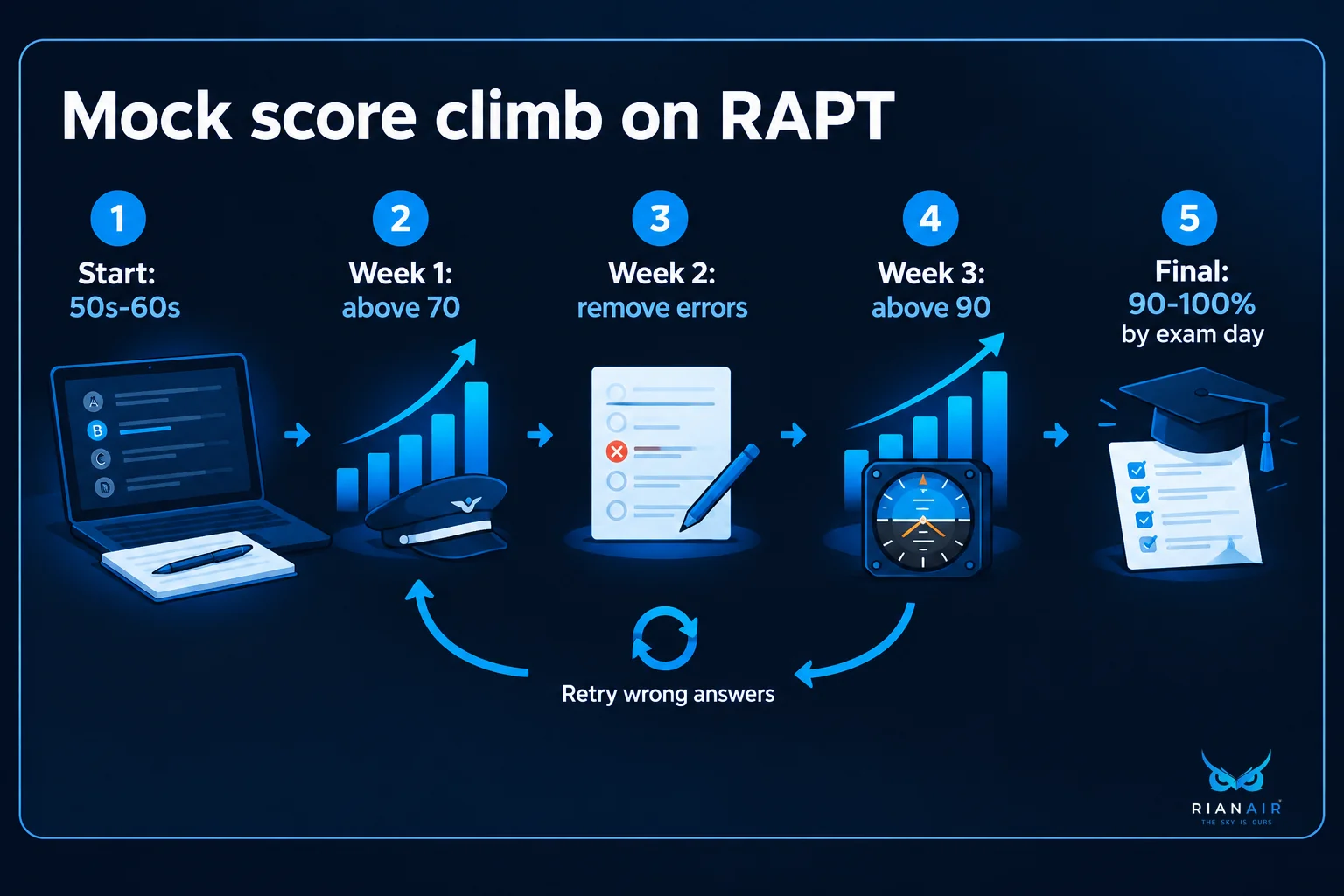
With consistent daily practice, mock scores climb quickly. On the RTR Part 1 mock tests, our students often start in the 50s or 60s, pass 70 within a week and cross 90 by week three. By exam time, every student reaches 90 to 100% accuracy.
Week two matters most, because that is when repeated errors get eliminated. The RTR Part 1 question bank has about 800 questions, so it is manageable if you revise well. The method that works is simple: retry wrong answers immediately instead of moving on.
The most common mistakes we see are skipping that retry and lacking patience with longer chapters. That is why we are adding a save-progress button to RAPT, so you can resume exactly where you stopped.
There is no single Technical General subject that students fail more than the others. As Capt. Vikas Vikramdas Nair puts it, everything is difficult if you do not practise and easy if you practise consistently. Treat every topic as equally important. Our Technical General question bank holds more than 1,500 questions per subject, and we add questions after every DGCA exam, every month.
For a free check of where you stand, the RAPT demo gives 500 exam-style questions. That is only the demo; the full bank is larger and access to it depends on your course. Take the free demo as a progress check: you sign up with your name, phone number, email and date of birth, then set your password from the email link and start solving.
3. Not having a clear answer on the type rating
Interviewers often ask how and when you plan to complete your type rating, and fresh pilots frequently answer vaguely. The reason is a surprise: an airline in India does not offer type rating sponsorship nowadays. It is completely sponsored by the student, including students who take a type rating after getting a job.
Some schools do sponsor it, but with a 3 to 5 year bond after instructor rating. Weigh that bond carefully against the cost of paying yourself.
What does a type rating cost, and what do the quotes include?
Quotes vary and are often short-term offers. The figures below are indicative quotes we noted in November 2026, not fixed prices: one Indian training organisation quoted a limited-time 13 lakh for a type rating against its usual 17 lakh.
A newer Mumbai organisation presently charges 13.5 lakh with accommodation. In Tunisia, one centre charges 14,000 euros, with stay at 25 euros per day per person including transport and breakfast. In some countries, such as New Zealand, a year of accommodation is included.
Always ask what the fee covers. Simulator hours differ by aircraft type and course. The type rating CAR from DGCA requires every approved course to cover all mandatory elements in the aircraft's OSD/FSB document, so ask each centre for its simulator hours and skill-test count in writing.
Prices change, so confirm current quotes with each centre. If a student performs below par, extra hours and extra skill tests can add roughly 3 to 4 lakh rupees. An additional simulator hour with a dedicated instructor is 1,500 per hour at Rian Air.
Check that the examiners and instructors are approved
This is the mistake we most want students to avoid. Before the COVID lockdown, a group of students sponsored through a very reputed Indian airline discovered that their examiner was not approved. They had to return to the South-East Asian country where they trained to redo their skill tests. Confirm in writing that the type rating instructors and the examiners are approved before you pay.
4. Leaving medical and licence validity checks late
A lapsed medical or an out-of-date rating can stop an application cold, however strong your interview. Check the validity dates on your medical certificate and your ratings today, and note the renewal dates in a calendar.
Use only DGCA-approved medical examiners. We keep a list of them and contact them on a student's behalf, so an appointment is arranged as soon as possible.
If you hold a Class 1 medical, know the exact expiry date. The type rating CAR from DGCA says your licence and medical must be current for all training and checks on aeroplanes, although they need not be current for training and checks on simulators. If a result ever comes back as temporarily unfit, handle the follow-up immediately and do not wait for an interview call to force the issue.
It also helps to know where you sit among career options. Airlines are not the only destination, and our comparison of airline, charter and flight instructor pathways after CPL shows what each route asks of you.
5. Messy documents and an unready logbook
Recruiters check paperwork as carefully as answers. A good application pack contains your personal details, licence numbers, ratings, medical certificate, total hours, aircraft types flown and recent flying activity, all consistent with each other.
Before you apply, check that you hold each of these, with scanned copies and originals ready:
Licence: your CPL, with licence number and any ratings endorsed.
Medical: your current medical certificate, with the class and expiry date clearly visible.
RTR: your Radio Telephone Restricted licence.
Passport: valid, with its expiry date noted.
Mark sheets: your DGCA exam results and your Class 10 and 12 mark sheets.
Logbook: hours summarised by category, matching your application form.
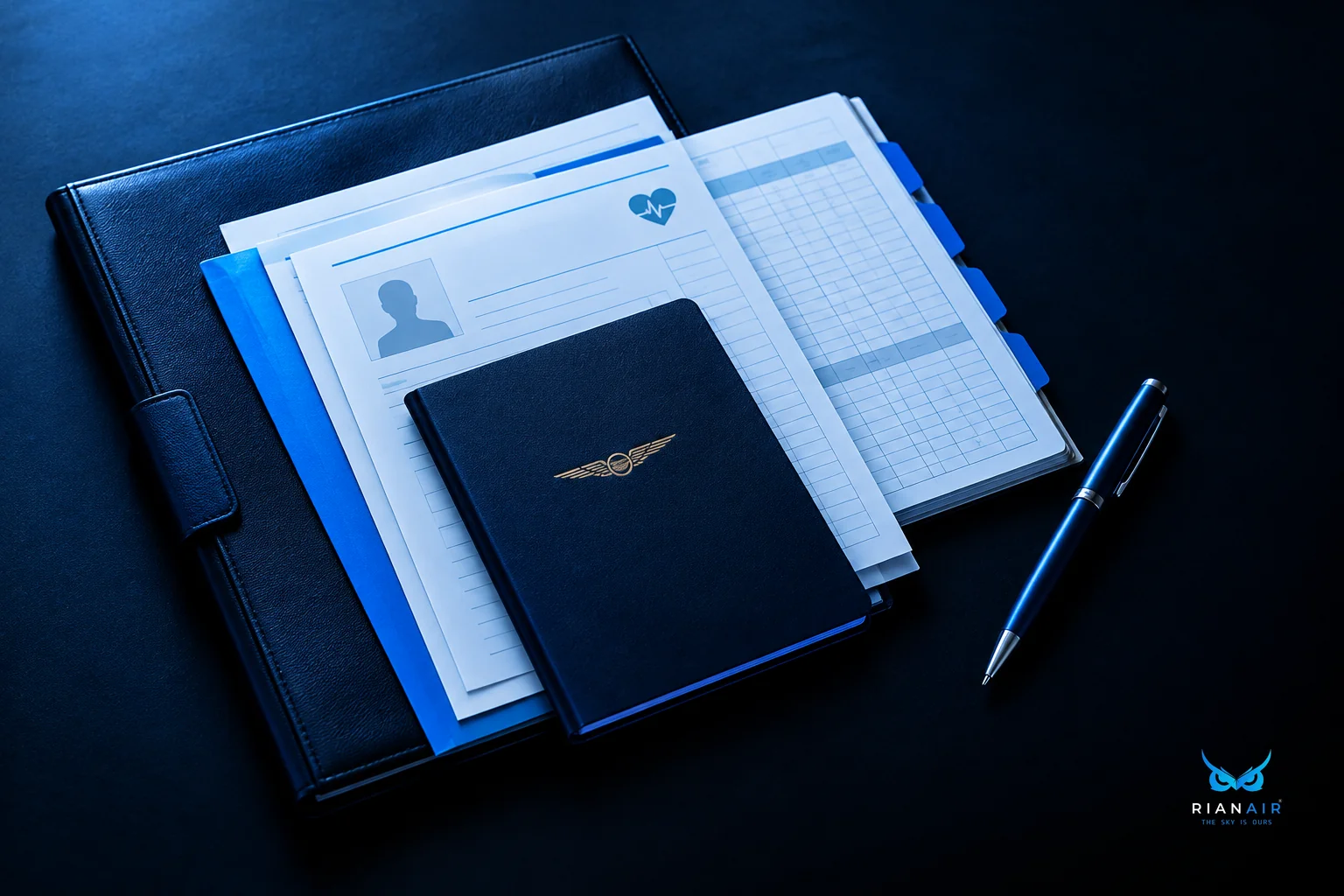
Inconsistencies are the usual problem. Hours in the logbook that do not match your application form, or a gap of months with no explanation, make a panel doubt your discipline. Keep scanned copies of every document in one labelled folder, and keep a running summary of hours by category.
A digital logbook makes this easier, since totals add up automatically and entries cannot be misread. If you have had a break from flying, be ready to say what you did in that time, such as exam practice, simulator sessions or type rating preparation.
6. Rusty simulator and instrument skills
Many airlines run a simulator assessment, and fresh pilots who have not touched a flight deck since their last check ride struggle with instrument scans and basic procedures. The assessors are not looking for perfect flying. They look at how you scan, how you recover from mistakes and how you handle workload.
Keep your hands in. Our C172 fixed-base simulator in Kerala and our hybrid simulators in Delhi are built for this kind of recurrent practice. Extra simulator hours with a dedicated instructor are 1,500 per hour, which is a small amount compared with losing a selection round. Even a few sessions focused on instrument flying, checklists and callouts will sharpen the skills a simulator assessment tests.
7. Underpreparing for psychometry, ADAPT or Compass and group discussion
These three stages sit between the written exam and the panel, and they are where many candidates are dropped. Rian Air's interview preparation covers ADAPT, GD and psychometry.
Psychometry: answer consistently and honestly. Practise timed tests so you stay calm under pressure.
ADAPT or Compass: which one you face depends on the airline. Check the airline's format directly, not through middlemen, and practise multitasking and instrument-style scanning. These tests measure capacity rather than knowledge: multitasking, working memory, spatial orientation, hand-eye coordination and reaction speed under workload.
Group discussion: listen, speak briefly, build on others' points and stay courteous. Practise with peers on aviation topics. Assessors typically watch communication clarity, teamwork and whether you steer the group towards an outcome without dominating it.
8. Weak soft skills, communication and decision-making
Technical judgment, communication, documentation, decision-making and professional behaviour are all assessed across stages. Most new pilots rehearse technical answers silently and never speak them aloud. In the room, a correct answer delivered in a rambling or hesitant way scores worse than a clear one.
Practise out loud. Answer questions such as why you want this airline, what you would do if you disagreed with a captain, and how you handled a mistake in training. Keep each answer to a clear structure: situation, action, result, lesson. A strong answer to "why this airline" names its fleet and routes.
To "disagreeing with a captain", a strong answer states the concern calmly, uses standard callouts and respects the final decision while keeping safety first. To "a mistake in training", it owns the error and names the lesson. Research the operator's fleet and routes so your answers show you did your homework.
Sample strong answers to common HR questions (illustrative structures: swap in your own details):
"Tell me about yourself." "I completed my CPL and have kept my technical knowledge fresh through daily practice and simulator sessions. I am now looking for a first officer role in a structured operation where I can keep learning."
"Why this airline?" "I want to build my career on your fleet and network. I have studied your aircraft types and route structure, and I value flying inside standardised procedures and a strong safety culture."
"Tell me about a mistake in training." "On one sortie I [describe the specific slip]. I told my instructor straight away, corrected it and added a checklist pause before that phase. The lesson was to speak up early."
"What is your biggest weakness?" "I used to rush preparation. Now I follow a written checklist and take a deliberate pause before each stage, so I catch gaps before they matter."
"Where do you see yourself in five years?" "Operating confidently as a first officer, building experience and consistent performance with the aim of working towards command."
Notice the pattern: each answer is short, honest and ends on what you learned or what you will do next.
Radio communication is part of this too. If you want a spoken-practice habit, our RTR exam guide explains how Part 2 mock calls build the clarity that interviewers notice. Record yourself, listen back and cut filler words.
How should a new CPL holder close these gaps in 30 days?
Spend the first week on a self-check and documents, the second and third on daily technical revision and simulator practice, and the fourth on spoken mock interviews. Sort medical validity and the type rating plan in week one so nothing blocks you later.

In week one, gather your documents, check every expiry date and take a baseline mock test. In weeks two and three, practise daily, retry every wrong answer and book a few simulator sessions. In week four, run spoken mock interviews and settle your type rating plan, including who the approved examiners are.
Placement is not instant for anyone. In our latest placement period, four of our type-rated students joined an airline, with more awaiting in 2026 or early 2027. Thirteen working airline pilots have also cleared their written exams with us so far. Steady preparation tends to pay off, but timing depends on airline hiring cycles.
Frequently asked questions about airline interview readiness after CPL
Is it normal to wait months for an interview call after getting my CPL?
Yes. Airline hiring runs in cycles, so a quiet period is not a verdict on you. Use it for revision, simulator sessions and tidying your documents.
Can I apply to airlines before I finish my type rating?
Yes. Pilots who are not yet type rated follow a separate selection sequence, which starts with a written exam and psychometry and ends with a panel interview and medicals.
Is ADAPT the same as Compass?
No. They are different aptitude tests, and which one you face depends on the airline. Both measure capacity under workload rather than textbook knowledge, so confirm the format with the airline itself.
Should I rehearse interview answers silently or aloud?
Aloud. A correct answer delivered in a rambling or hesitant way scores worse than a clear one, so record yourself, listen back and cut filler words.
Will a gap in my flying hurt my application?
A gap of months with no explanation can make a panel doubt your discipline. Be ready to say what you did in that time, such as exam practice, simulator sessions or type rating preparation.
Do my logbook hours need to match my application form?
Yes. Mismatches between the logbook and the form are a common paperwork problem, so keep a running summary of hours by category.
Do I need a valid passport for an airline application?
Keep a valid passport in your document folder with its expiry date noted, along with your licence, medical certificate, RTR and mark sheets.
Is the RAPT demo really free, and how many questions does it have?
The demo is free and gives 500 exam-style questions. It is only a demo: the full question bank is larger and access to it depends on your course.
Which simulators can I practise on for the simulator round?
Rian Air has a C172 fixed-base simulator in Kerala and hybrid simulators in Delhi. Extra simulator hours with a dedicated instructor are 1,500 per hour.
How long should I spend preparing before applying?
A 30-day plan is a sensible start: documents and a self-check first, then daily revision and simulator practice, then spoken mock interviews. Timing still depends on airline hiring cycles.
Ready to see where you stand? Try the free RAPT demo as a progress check to check your technical recall, and use our enquiry page to plan your next step in pilot training. You can also follow practical tips on Instagram and YouTube, or visit the Rian Air home page for the full range of training options.
Recommended Resources
Start Your Pilot Journey Try Our Free RAPT Demo Now Home Rian Air