


Pilot Age Limit in India: Is There a Cut-Off to Start CPL Training?
There is no pilot age limit in India to start CPL training. The DGCA eligibility framework sets a minimum age for each licence, not a maximum. The minimums are 16 for a Student Pilot Licence, 17 for a Private Pilot Licence, and 18 for a Commercial Pilot Licence.
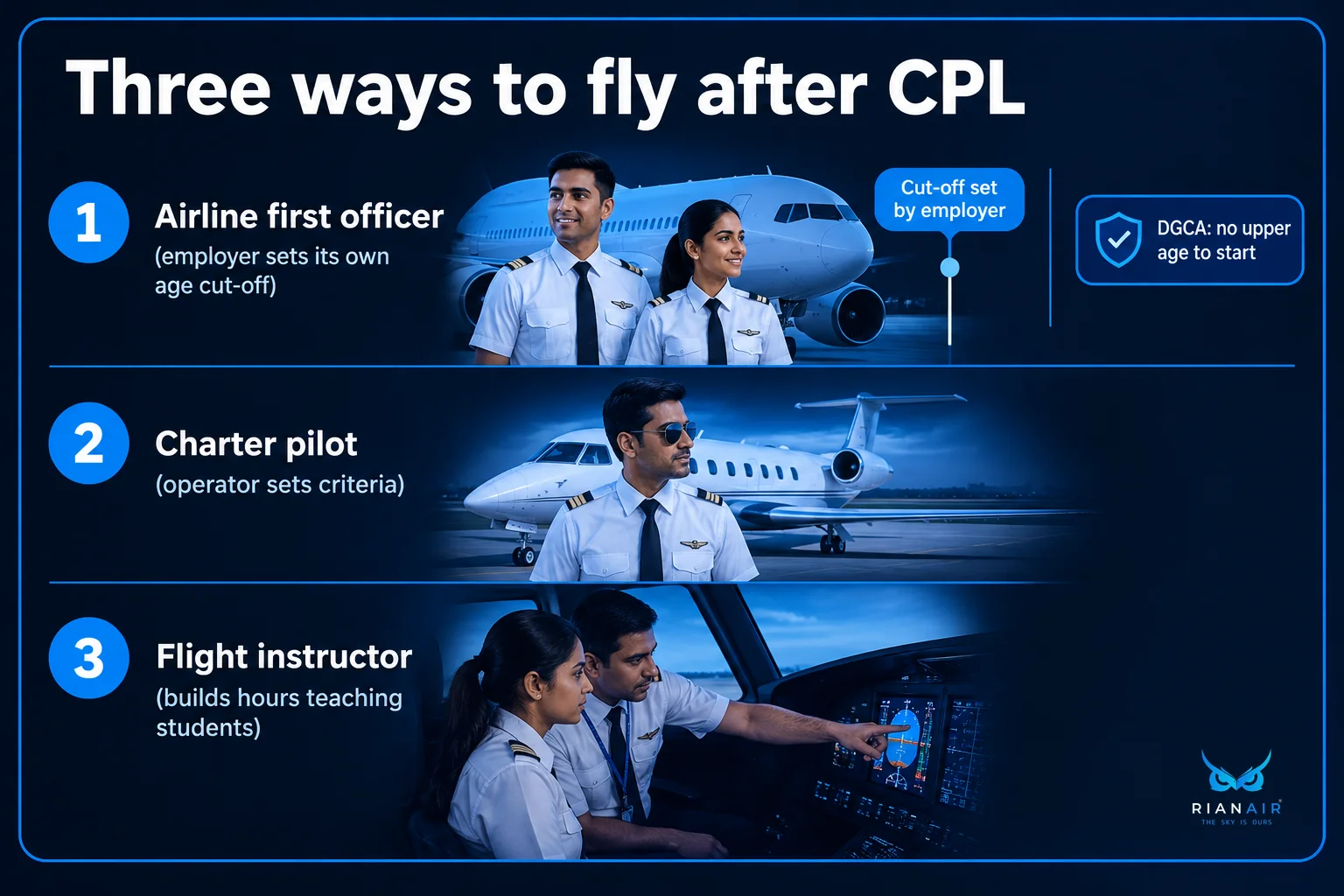
What stops many career-switchers is not the regulator, but an individual airline's hiring preference. That is a business decision an employer can change at any time. The caps we found range from 30 for Air India's cadet programme to about 40 to 42 for Akasa and 40 for Air India's experienced A350 hiring. So, a first officer upper age of roughly 30 to 40 is typical, depending on the route (sources in the table below).
At Rian Air, we train aspiring pilots across Delhi, Mumbai and Thrissur. Our training includes ground school, simulator sessions, flight training and type rating preparation. A fair share of our enquiries come from people in their late twenties and thirties asking the same question: "Am I too old to start?"
The honest answer depends less on your date of birth and more on your medical fitness. It also depends on how many flying years you have left to recover the cost, and whether you are aiming at an airline cockpit, a charter operation, or flight instructing.
Is there a pilot age limit in India to start CPL training?
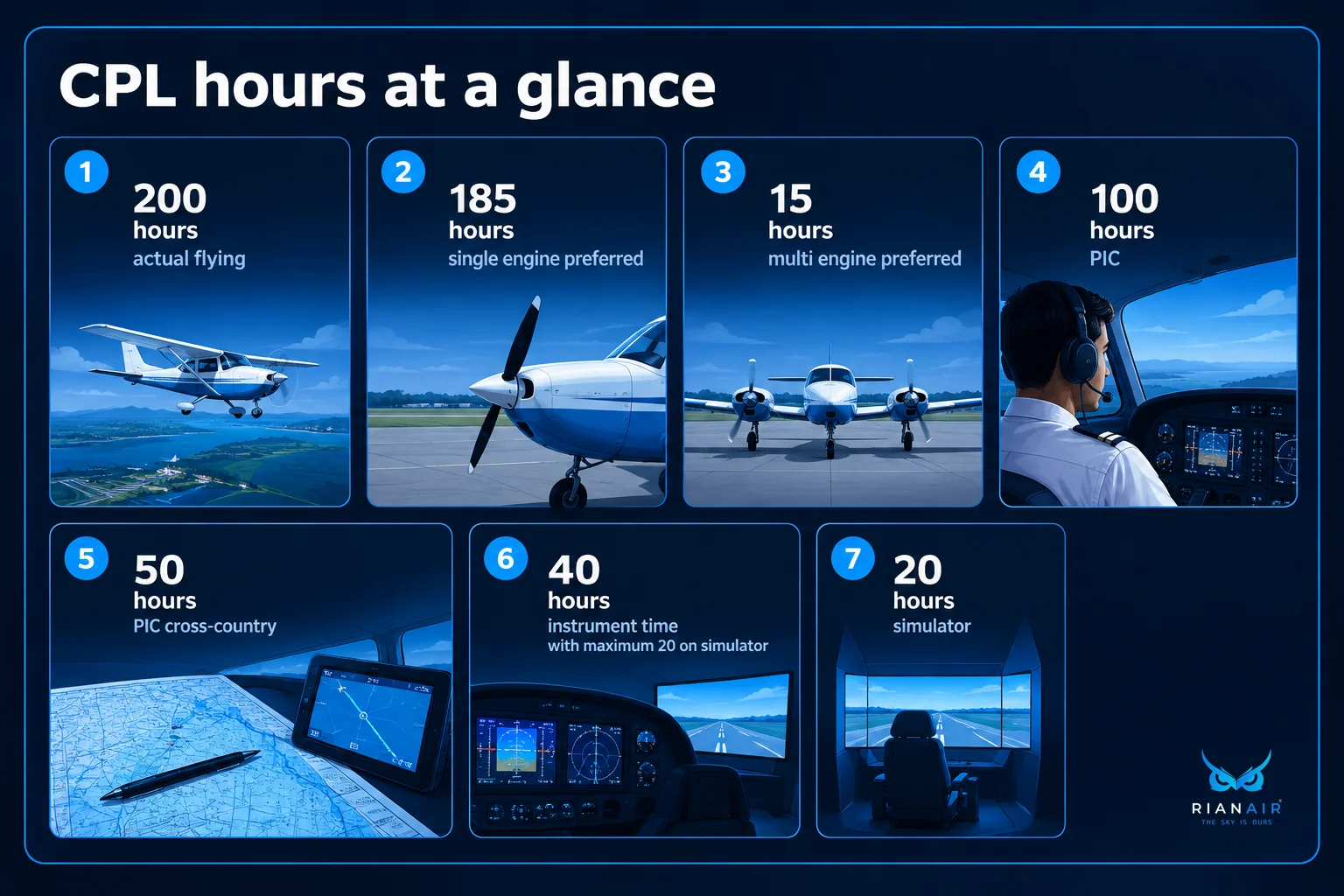
No. DGCA does not set an upper age limit for Student Pilot Licence, Private Pilot Licence or Commercial Pilot Licence training, and it never has. A 35-year-old and an 18-year-old sit the same DGCA exams. They fly the same 200 hours and pursue the same licence under the same rules.
Instead, there is a minimum age at each stage, set in Schedule II of the Aircraft Rules, 1937: 16 for a Student Pilot Licence, 17 for a PPL, and 18 for a CPL. Published tables of the same Schedule II minimums also give 16 for the SPL. So, the figure is consistent across sources.
You can hold a Student Pilot Licence from age 16, a Private Pilot Licence from 17, and apply for a CPL once you turn 18 and meet the other requirements. Beyond that floor, the regulations do not ask how old you are. They ask whether you are medically fit, educationally qualified, and able to clear the required exams and flying hours.
This distinction matters because most anxiety around "pilot age limit in India" actually concerns a different question: what age will an airline hire you at? These are two separate systems. One is set by the government, and the other by individual employers. Conflating them is where many career-switchers talk themselves out of trying.
What DGCA actually sets: minimum ages, medical and exams
DGCA's crew licensing rules build around five things: age, basic educational qualification, medical fitness, passing the required examinations, and logging the required flying experience. Age is the smallest of the five hurdles. It only has a floor.
Licence | Minimum age | What it permits |
|---|---|---|
Student Pilot Licence (SPL) | 16 | Supervised flight training with an instructor |
Private Pilot Licence (PPL) | 17 | Pilot-in-command on non-commercial flights |
Commercial Pilot Licence (CPL) | 18 | Paid flying work, airline and charter employment |
A CPL in India needs 200 actual flight hours, not the 250 figure many guides still quote. Every DGCA exam you pass stays valid for five years. If you fail a paper, the current rule requires a 42-day cool-off before your next attempt on that subject. DGCA can revise that window in future.
Exam fees are ₹2,500 per paper in the regular March, June, September and December sessions. An on-demand (OLODE) attempt in other months costs ₹5,000. RTR Part 1 is ₹2,000 and Part 2 is ₹500.
Education requirement: Physics and Mathematics at 12th
Every applicant except those in the PPL category must have passed 10+2 with Physics and Mathematics from a recognised board or university, or its equivalent. This is according to DGCA's flight-crew FAQ. This is a fixed CPL requirement, whatever your age or prior career. Check your 12th-grade subjects before anything else.
None of this changes with your age. A medical certificate, on the other hand, genuinely can. That is why the next section matters more than your birth year.
How do airline hiring age cut-offs work in India?
Airlines in India set their own hiring age preferences for first officer intake. These criteria sit outside DGCA's rulebook, so they vary by airline and can change from one recruitment cycle to the next. There is no single national cut-off that applies across carriers.
A 28-year-old with a clean medical is not fighting a law. They are dealing with one employer's preference for this hiring round.
Airline age limits at a glance
Airline and route | Age band reported | Source (date published) |
|---|---|---|
IndiGo Cadet Pilot Programme | 18 to 32 on IndiGo's own page; partner academies set their own caps, up to 40 at Skyborne | Published hiring reports, 2026 |
Air India Cadet Pilot Programme | 18 to 30, Indian citizens and OCI holders | Aviation India notice summary (17 Apr 2026) |
Akasa Air first officer (junior routes) | Reported upper limit of about 40 to 42, depending on the intake; the reports differ, so confirm on the current notice | Published hiring reports, Nov 2026 |
Air India Express first officer (type-rated, experienced) | Posting is based on A320 type rating and experience; no age band stated in the summary we read | Air India Careers posting (8 Nov 2026) |
Treat this table as a starting point. The airlines' own pages were not readable when we checked. These bands come from published summaries of their notices, and partner academies set their own caps per intake.
Akasa's cap is reported as about 40 in some places and 40 to 42 in others, so treat 40 as the safe planning figure. Confirm the exact limit on the IndiGo and Air India careers pages, and on Akasa's own notice, before you plan around it.
Air India's experienced A350 first officer posting reportedly caps age at 40. We could not find an age band in the Air India Express postings (Aviation India, 15 Oct 2026).
If you are considering an airline cadet programme instead of self-sponsored CPL, know that fees typically run from ₹89 lakh to ₹1.5 crore. The airline and its affiliated training partners control your training pace. It can be faster when the airline needs pilots and slower when it does not. A student assessed as not up to the mark during training can be terminated from the programme.
After CPL, some airlines also require ATPL exams to be cleared before type rating begins. Reported cadet fees run ₹89.5 lakh to ₹1.5 crore including type rating.
A cadet seat often carries a five-year service commitment, starting from your final Letter of Intent. Airlines publish no bond terms, though. ALPA India said in July 2026 that cadet bonds run three years or more, so get the exact term in writing.
Can you still fly professionally if you miss an airline cut-off?
Yes. Airline first officer hiring is one entry point, not the only one. Flight instructing or charter flying let you keep building hours and income, even if you have passed a particular airline's current cut-off.
Flight instructing is often the most practical route. You teach ground-up students, log dual-given hours, and stay current while hiring conditions at individual airlines shift. Charter operators set their own, separate hiring criteria. They often value total hours and type experience over a strict age band.
Among the roles our own graduates have gone on to, charter pilot and flight instructor sit alongside airline first officer. This reflects how varied the pilot career path is beyond scheduled carriers.
One caution worth repeating: whichever path you choose for building hours or for type rating, confirm that your examiner or type rating instructor holds current approval for the exact check you need.
There have been real cases of Indian trainees abroad discovering their examiner was not approved for the skill test. That forced them to return to that country later to redo it. Ask for proof of current approval in writing before you pay for a slot.
If you are weighing a cadet programme against training on your own and building hours independently, our comparison of cadet pilot programmes versus self-sponsored CPL walks through both paths in more depth.
Why medical fitness matters more than your birth year
A Class 1 medical certificate, not your age, is what actually decides whether you can hold and keep a CPL. DGCA requires it to be current for any flying or check conducted on an actual aircraft. Age can make certain medical conditions more likely to surface. But a fit 40-year-old passes the same exam as a fit 20-year-old.
The medical authority is DGCA itself. The rules sit in its Civil Aviation Requirement, Section 7, Series C, Part I. Initial Class 1 assessments are done only at DGCA-authorised centres.
Validity shifts with age. A Class 1 is valid for one year for a pilot under 60 in multi-crew commercial air transport. It is valid for six months for a pilot over 40 in single-crew commercial air transport or instructional duties (Revision 7 of 1 October 2025).
One guide also reports formal DGCA assessments every three years up to 40, every alternate year from 41 to 50, and annually from 51 to 65. Check the current CAR for your exact interval.
A Class 1 medical typically costs ₹8,000 to ₹15,000. A Class 2 for student pilots costs ₹3,000 to ₹6,000, with extra tests billed separately.
Book your Class 1 medical early, before you commit to expensive flight training abroad. A medical issue discovered after you have paid for an overseas course is a far costlier problem than one caught at the planning stage.
This is also where career-switchers tend to have an advantage over fresh school leavers. By your thirties, you usually know your own health baseline. That means fewer surprises at the medical centre and a clearer sense of how many flying years you can realistically plan around.

Is starting late worth it? Working out the return on your remaining flying years
Starting CPL training in your thirties or even forties can still make financial sense. What determines your return is the number of flying years left before the retirement age of 65, not the age you began training. Pilots who began in their thirties make the same point: there is no fixed age for changing careers.
Under rule 28A of the Aircraft Rules, a pilot aged 60 or over may fly commercial air transport only in a multi-crew cockpit where the other pilot is under 60. At 65, CPL privileges drop to those of a PPL.
A pilot who starts at 22 and one who starts at 35 both have a long professional runway ahead. The second one simply has less slack for delay.
CPL training in India costs ₹42 lakh to ₹59 lakh for the middle half of 22 schools, before tax. Another guide puts a full conventional pathway at ₹55 lakh to ₹75 lakh.
For Rian Air's India CPL pathway, the figure we can state is around ₹60 lakh for CPL and around ₹15 lakh for type rating. All-in with overheads, it comes to 72 to 75 lakh.
Training abroad runs ₹50 lakh to ₹70 lakh depending on the country, plus the cost of converting a foreign licence to a DGCA CPL once you return. Tunisia-based training, including miscellaneous costs, has run around ₹50 lakh to ₹55 lakh. New Zealand-based training, including miscellaneous costs, has run closer to ₹70 lakh to ₹75 lakh.
Type rating itself, independent of where you trained, varies widely. A self-sponsored A320 runs ₹15 lakh to ₹30 lakh and a B737 ₹10 lakh to ₹20 lakh. Open-market, mostly simulator-only deals are reported at ₹11 lakh to ₹18 lakh.
Consider this hypothetical illustration: a career-switcher starts CPL at 33 and reaches the cockpit by 36. They still have roughly three decades of flying ahead before a typical retirement age near 65. That is more than enough time to recover training costs through an airline, charter, or instructing career, provided the medical stays current year on year.
Here is a hypothetical cost-recovery sum. Assume ₹55 lakh for CPL plus ₹15 lakh to ₹30 lakh for type rating, about ₹70 lakh to ₹85 lakh in all. A junior first officer is reported to earn ₹1.5 lakh to ₹2.5 lakh a month. That is ₹18 lakh to ₹30 lakh a year before tax.
That is roughly 2 to 5 years of gross pay, before tax, loan interest and living costs. A 33-year-old has well over two decades left to recover it. A switcher starting at 45 reaches the cockpit near 48 and has about 17 years to 65. They need a medical every six months for single-crew flying over 40, so should weigh the cost more carefully.
Hiring itself is not instant. In recent placements of type-rated pilots, hiring has typically taken around 6 to 8 months from application to offer. No Indian airline currently sponsors type rating for new pilots, so that cost sits with the candidate either way. For a broader look at what a cockpit career pays over those remaining years, see our breakdown of pilot salary in India.
A practical plan for career-switchers over 30
Treat age as a planning variable, not a barrier. Sequence your steps so the expensive commitments come after the cheap checks. Book your Class 1 medical first. It is the one thing on this list that can genuinely stop you, and it costs a fraction of what flight training does.
A rule of thumb by age (our reading of the caps above, not a regulation): at 28, every cadet programme and direct route is still open, so compare fees and pace.
At 35, Air India's cadet cap of 30 has passed. Look at partner-academy cadet routes with higher caps, self-sponsored CPL, and airlines hiring up to about 40. At 45, plan around charter flying or instructing, check each employer's current criteria first, and budget for the more frequent medicals.
Get your Class 1 medical done before spending on ground school or flight training.
Clear as many DGCA exams as possible in India before flying abroad. Students who clear all exams first typically convert their foreign licence within 3 to 4 months of returning. Those who do not clear them beforehand get only one or two attempts at the DGCA exams after they arrive back in India, and timing becomes hard to predict.
Submit your documents to DGCA within 6 months of returning from training abroad. Miss that window and you repeat recency training, roughly 18 to 22 extra flying hours.
Verify examiner and instructor approvals before paying for any type rating slot, in India or abroad.
Decide your target early: airline, charter, or instructing and check that specific employer category's current criteria rather than training first and hoping.

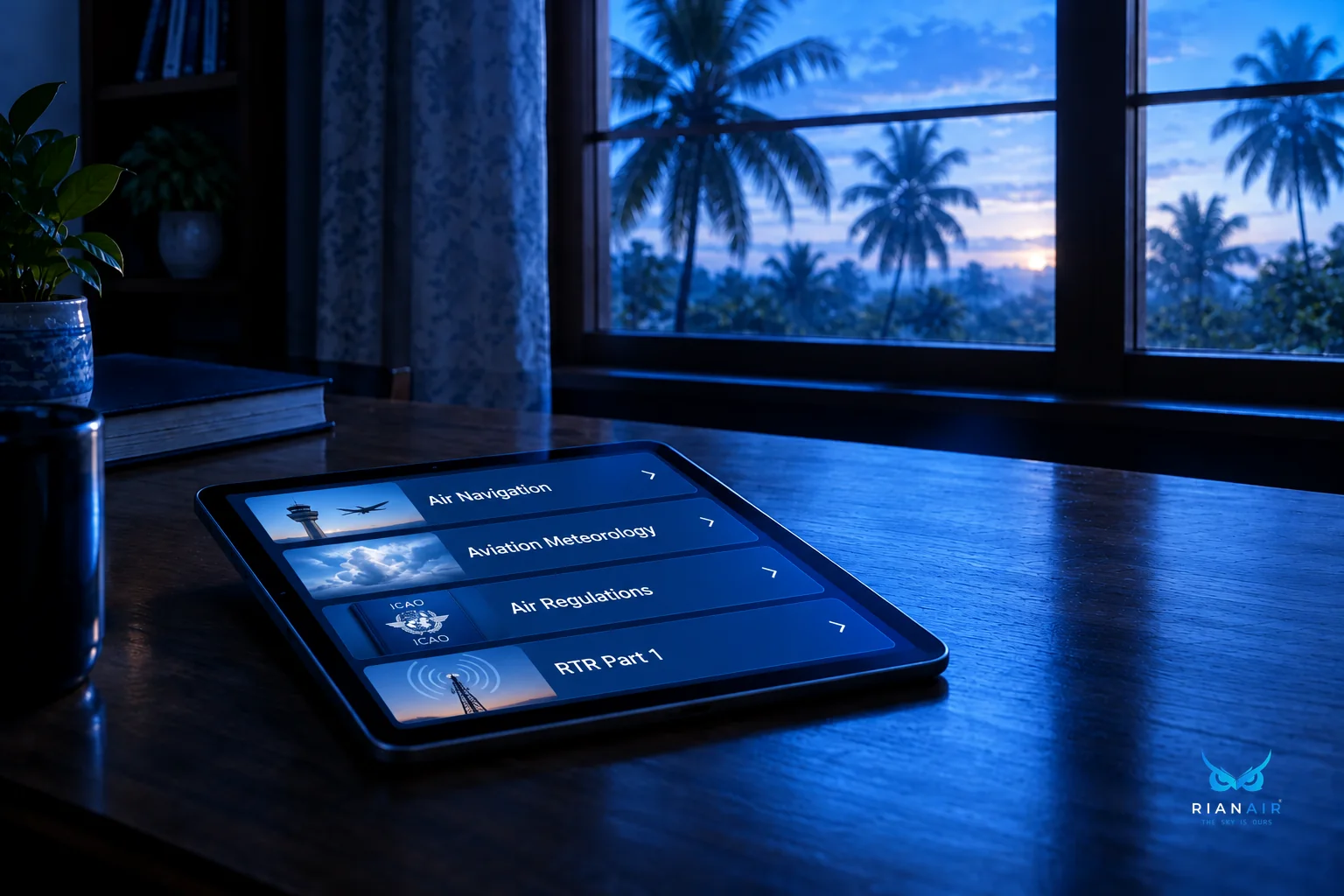
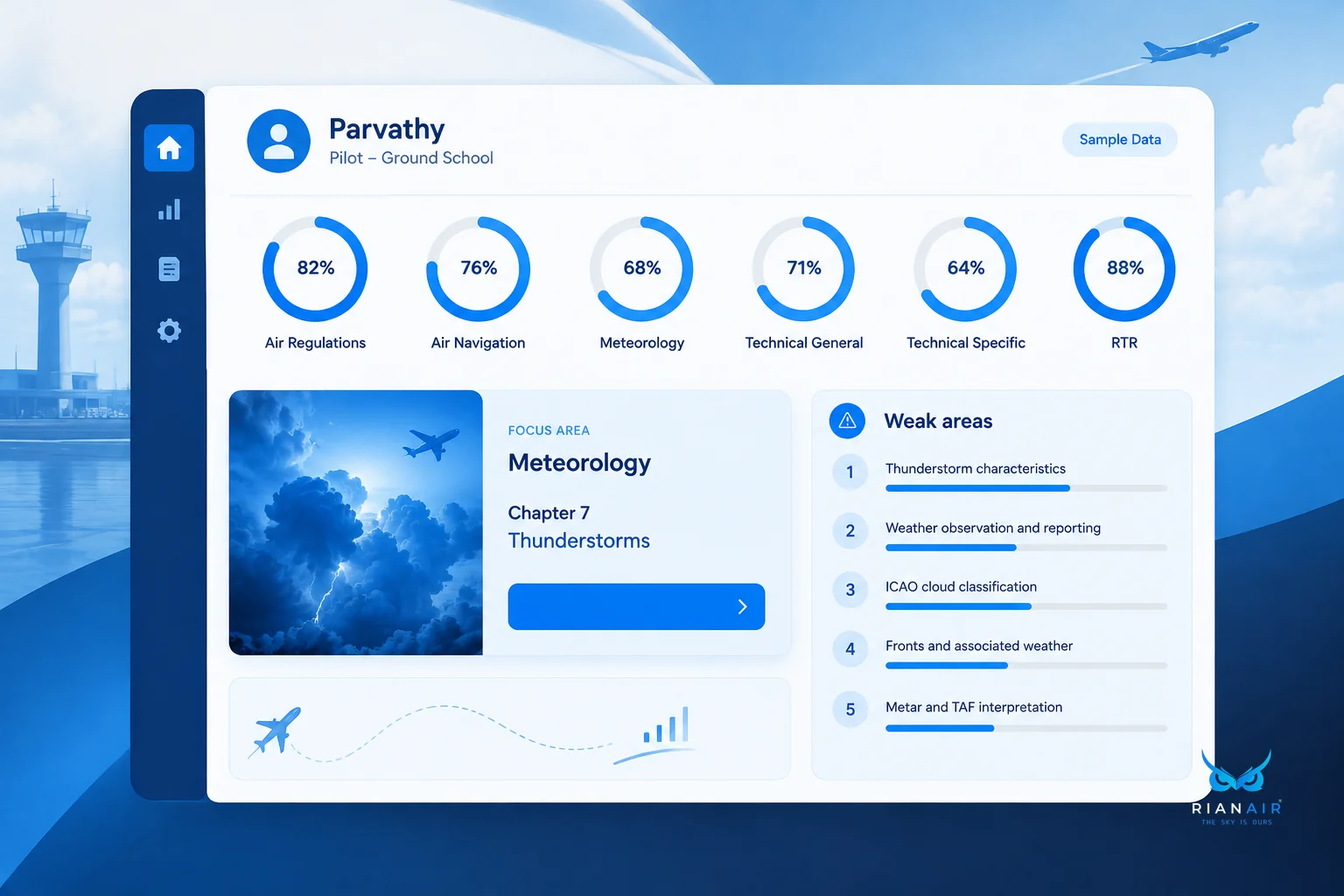
A good way to test your own readiness before committing financially is our free RAPT demo. It gives you a feel for the DGCA ground subjects and lets you see where you genuinely stand.
You can then plan your training timeline around that, rather than an age that may not be the obstacle you think it is. If you would rather talk through your specific situation, you can start your pilot training enquiry with Rian Air directly.
For a wider view of the full qualification sequence from medical to licence, our pilot qualification checklist for India lays out every checkpoint in order. If cost is your main constraint at this stage, our pilot training cost breakdown covers the fees most guides leave out.
Frequently asked questions
Can I start pilot training in India at 35?
Yes. DGCA sets no upper age limit on CPL training at any stage, so a 35-year-old can enrol in ground school, flight training and exams exactly like an 18-year-old. They must hold a valid medical: Class 2 for student flying and Class 1 for the CPL.
Is there a minimum age to start flying lessons before SPL?
You can hold a Student Pilot Licence from age 16, which is the earliest point you can legally begin supervised flight training in India. This includes your first solo flight once your instructor clears you.
Do airlines in India ever hire first officers over 40?
Some do, depending on the airline and the hiring cycle. Akasa Air's reported upper limit is around 40 to 42, depending on the intake (see the table above), so check the current notice.
What happens if I fail my Class 1 medical at an older age?
You discuss the specific finding with the examining authority. Some conditions allow a re-test or a restricted certificate, while others do not. This is exactly why booking the medical before paying for flight training matters most for older aspirants.
Can I become a flight instructor if I'm past an airline's age cut-off?
Yes. Flight instructing has its own eligibility route, separate from airline hiring criteria. It lets you keep logging flying hours and earning while airline opportunities at specific carriers open or close over time.
Is it worth starting CPL training at 40 given the cost?
It depends mainly on your remaining flying years before the typical retirement age of around 65. It also depends on securing work (airline, charter, or instructing) soon after licensing. That determines how much of the multi-lakh investment you can recover.
Do I get fewer attempts at DGCA exams if I train abroad and I'm older?
Age does not change your attempts. But if you fly abroad without clearing DGCA exams first, you typically get only one or two attempts at those exams after returning to India, regardless of your age. Clearing exams beforehand is the safer route at any stage of life.
Can a career-switcher with no science background still start?
CPL eligibility depends on meeting DGCA's educational and medical requirements and clearing the required exams, not on your prior career. Many career-switchers come from non-aviation backgrounds and build their ground school knowledge from scratch. Physics and Mathematics remain mandatory in India to become a commercial pilot as per the rules set forth by the DGCA.
Whatever your age, the fastest way to find out where you genuinely stand is to test your readiness rather than guess it. Try the free RAPT demo to see how you handle real DGCA-style questions. Follow our training updates on Instagram and YouTube, or visit Rian Air to plan your specific path into the cockpit, the charter cabin, or the instructor's seat.
Recommended Resources
Start Your Pilot Journey Try Our Free RAPT Demo Now Home Rian Air