


DGCA Demo Question Bank Free For Pilots In India: RAPT for CPL and ATPL
The DGCA demo question bank on RAPT gives pilots in India about 987 free exam-style questions for CPL and ATPL subjects (the number grows every month), with answers and explanations. You sign up with your name, phone number, email and date of birth, then log in and start solving. The DGCA pass mark is 70%, so the demo shows you where you stand.
Key takeaways
Free demo: RAPT gives you about 987 questions at no cost, a number that grows month by month and is under 5% of the full 20,000+ question bank, with answers and explanations. Only the demo is free; full access depends on your course.
Simple sign-up: You need your name, phone number, email and date of birth. An email link lets you set a password, and you can start solving after you log in.
Pass mark: The DGCA pass mark is 70%. In Air Regulations that is 35 correct answers out of 50 questions in 2 hours.
Practice pays: Students who practise on RAPT usually start in the 50s or 60s, pass 70 within a week, and reach 90 to 100% accuracy by their exam.
For ATPL and parents: ATPL pilots can subscribe for ₹500 per month per subject, and parents of ab initio students can use a parent dashboard.
At a glance: the RAPT demo and DGCA exam facts
Topic | What to know |
|---|---|
Free demo size | About 987 questions (growing monthly), with answers and explanations. This is under 5% of the full 20,000+ RAPT bank. |
What you need to sign up | Name, phone number, email and date of birth |
DGCA pass mark | 70% |
Air Regulations paper | 50 questions, 35 needed to pass, 2 hours |
Air Navigation + Meteorology composite (licence conversion) | 100 questions, 100 marks, 3 hours |
Full RAPT access for CPL | For students who attend Rian Air ground training; they pay the ground training fee for the subject they attend |
ATPL access after the demo | ₹500 per month per subject, no classes required |
Ground training time at Rian Air | 4 to 6 months for the entire ground training |
What is the DGCA question bank on RAPT?
A DGCA question bank is a large set of multiple-choice questions arranged by subject and chapter, written in the style of the DGCA theory exams. RAPT is Rian Air's platform for this. The full RAPT bank holds 20,000+ questions across all subjects, with answers and explanations. The free demo is a smaller slice of that bank, and works on web, Android and iOS.
If you are in Class 12 and dreaming of the cockpit, think of it as a very patient teacher that never gets tired. You answer a question, see the right answer, read why it is right, and try again later if you missed it.
The DGCA, the Directorate General of Civil Aviation, is the regulator that sets and runs these exams. DGCA's Pariksha pages describe how its Central Examination Organisation conducts examinations for pilot and engineer licences. DGCA does not hand out an official question bank, so a practice platform like RAPT is built around the syllabus and the exam pattern.
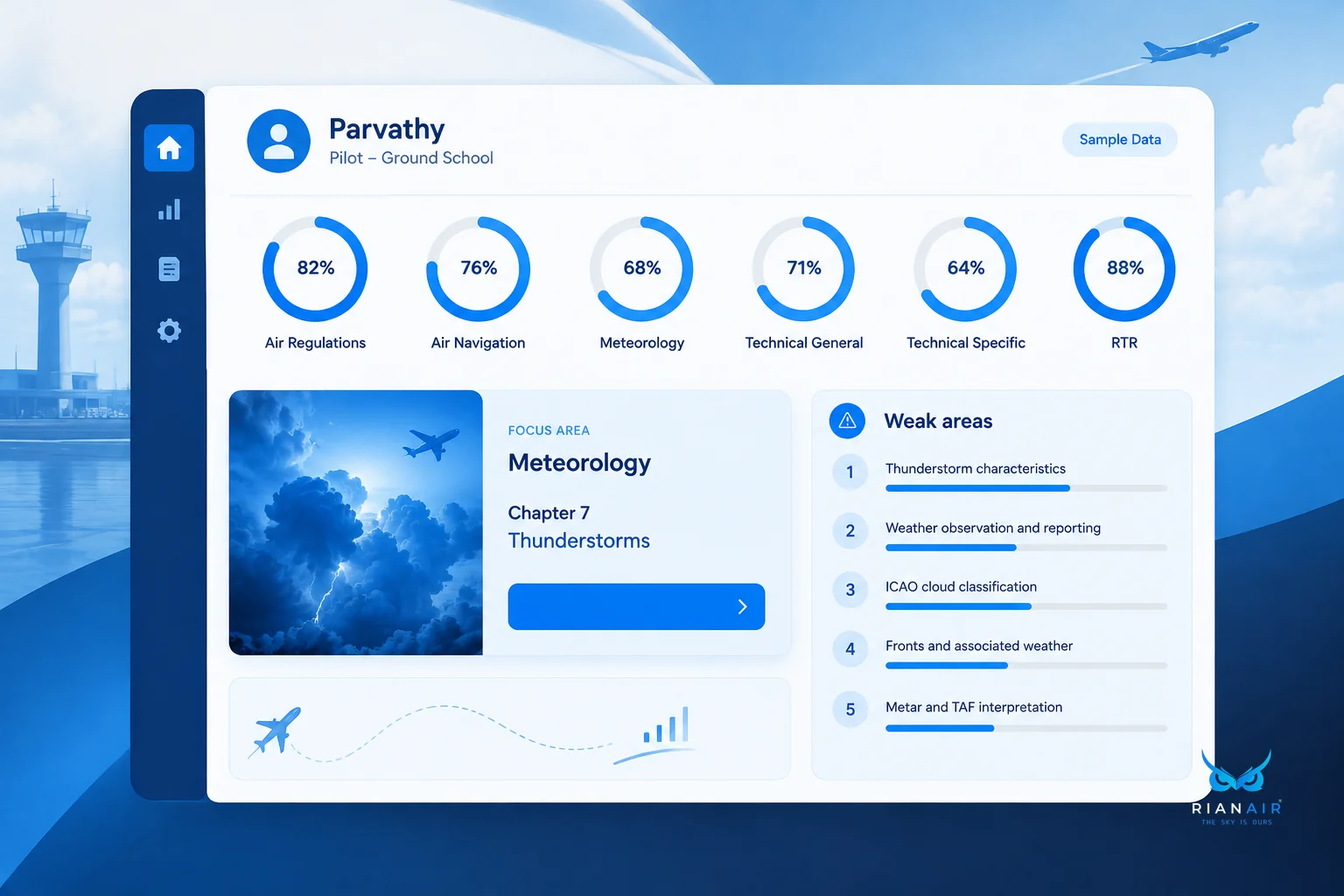
RAPT is more than a bank of questions. It is Rian Air's pilot career platform, linking DGCA academics, simulator data, performance analytics and a digital logbook. This article stays on the question bank, because that is where most students begin.
How do you start the free demo?
Sign up with your name, phone number, email and date of birth. You then get an email with a link to set your password. Reset the password, log in, and start solving. The demo has about 987 questions covering CPL and ATPL subjects, with answers and explanations, and costs nothing. That is under 5% of the full 20,000+ question bank, and we add more free questions to demo accounts every month.
Here are the steps in order:
Open the signup page. Use the free RAPT demo signup as a quick progress check. It tells you where you stand today, not where you must be.
Fill in four details. Name, phone number, email and date of birth. Use an email you check often, because the password link goes there.
Open the email. Look for the message sent to your registered address. If you cannot see it, check your spam folder.
Set your password. Click the link in the email and reset the password.
Log in and solve. Pick a subject, attempt questions, and read the explanation after each one.
There is no card to enter and no long form. A teenager can do it in a few minutes, and parents can sit alongside if they like.
What do CPL exams look like? Subjects, marks, time and pass mark
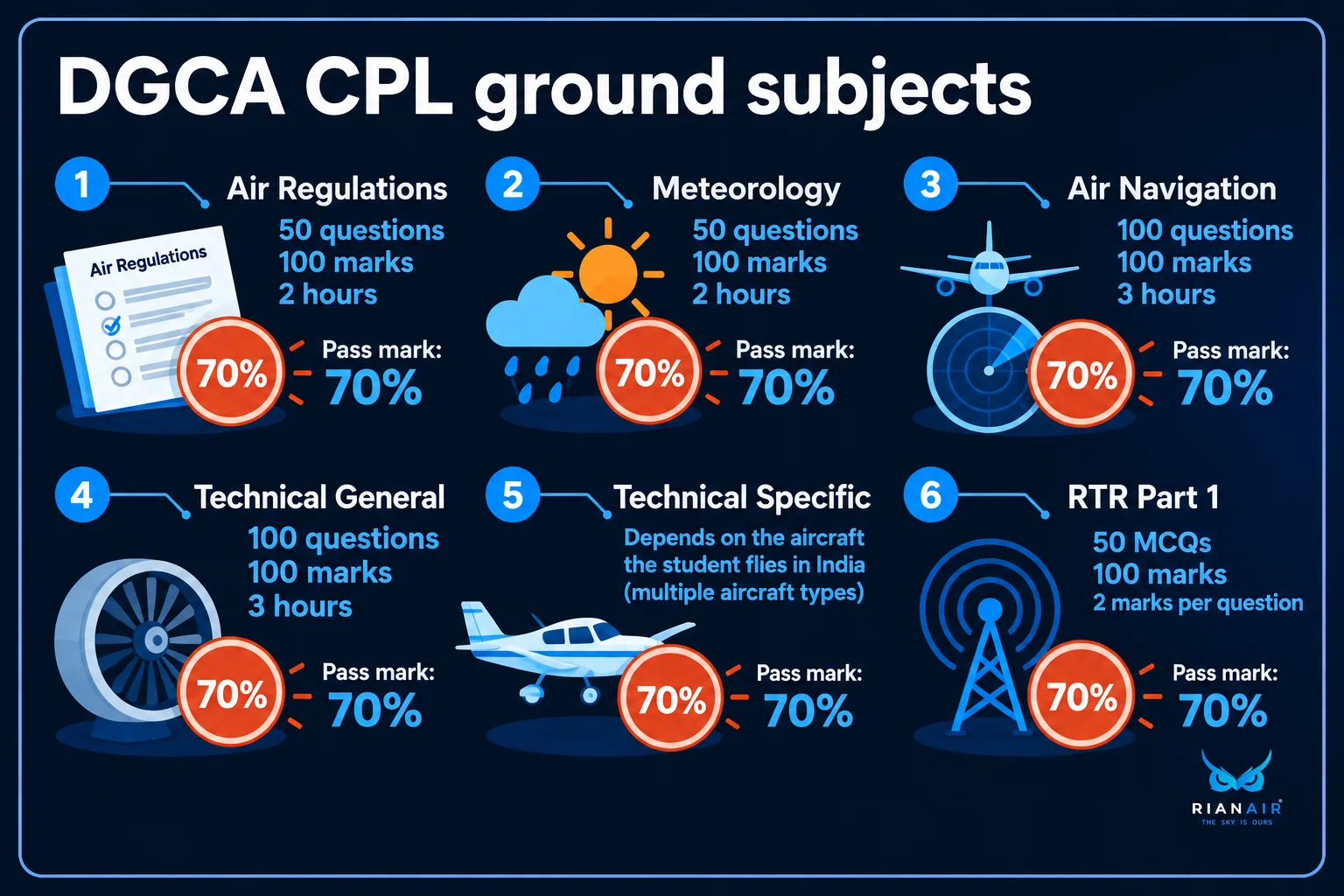
CPL theory exams are computer-based multiple-choice papers in Air Navigation, Meteorology, Air Regulations, Technical General and Technical Specific, plus RTR. The pass mark is 70%. Air Regulations has 50 questions, needs 35 correct, and runs for 2 hours. Details differ by paper, so check each one before you book.
The subject list comes from DGCA's own rules. CAR Section 7, Series B, Part I says the CPL theory examination covers Air Navigation, Aviation Meteorology, Air Regulation, and aircraft and engine or instruments in general, specific and performance where applicable. The performance paper applies to heavy aeroplanes above 5700 kg maximum take-off weight and certain twin-engine types.
Marks, questions and time for the papers we can state
The figures below are the ones we use with students at Rian Air. They match the DGCA format as we teach it. Always confirm the latest paper details on DGCA's portal before you book an attempt.
Air Regulations: 50 questions, 35 correct to pass (70%), 2 hours. Our Air Regulations question bank page goes deeper on this paper.
Air Navigation and Meteorology for licence conversion: pilots with a foreign licence who do not clear these two before departure sit one composite exam. It has 100 questions, 100 marks and runs for 3 hours. Air Regulations and RTR(A) are separate papers.
Technical General and Technical Specific: exempt for conversion candidates. For students who want to fly in India, they are optional in ground training and can be completed during flight training.
RTR Part 1: the DGCA pattern is 50 questions. RAPT lets you build tests in many different combinations.
What if you fail a paper? The cool-off rule
If you miss the 70% mark, DGCA applies a waiting period before you can sit that paper again. We do not quote a number here because the rule can change. Read the current re-attempt rule and fees on the DGCA Pariksha portal, where candidates must register before appearing in any exam. Our other guide on what happens after a failed DGCA exam is a good next read.
The practical lesson is simple. A waiting period costs time, and time is what students feel most. Practising until your mock scores sit well above 70% protects you from that wait.
Which RAPT features help you practise?
RAPT offers DGCA-format mock tests, custom tests filtered by chapter, weak area and easy, moderate or hard level, and explanations for every question. You can retry questions you got wrong. Study and test sessions are unlimited, and mock tests can follow the exact DGCA pattern as often as you like.
Here is how each feature helps a beginner:
Exact DGCA format tests: Sit a paper in the same pattern as the real exam, so the format feels familiar on the day.
Custom tests: Build a test by chapter or by weak area. Choose easy, moderate or hard mode to match your level.
Unlimited sessions: There is no cap on study or test sessions, so you can practise for ten minutes or two hours.
Retry wrong answers: A mistake becomes a second chance. Over time, repeated errors disappear.
Explanations: Every question comes with an answer and a reason, which helps concepts stick.
Subject pages: Our guides for RTR Part 1 and Part 2 mock calls, Air Navigation, Meteorology and Technical General show what each bank covers.
Public Google reviews of the app mention organised study materials, chapter-wise question practice, tests and ease of use. Students also say the app helps them review chapters and understand aviation concepts more clearly.
An offline mode for ATPL is launching soon. It is meant for pilots who study on layovers in places without internet. Most crew stay in hotels with Wi-Fi, so this is a back-up, not a daily need.
A four-week practice plan using RAPT
Scores move in a pattern we see again and again. Most students begin in the 50s or 60s. With regular practice they get past 70 in about a week, and by week 3 they score above 90. Week 2 matters most, because that is when errors get removed.
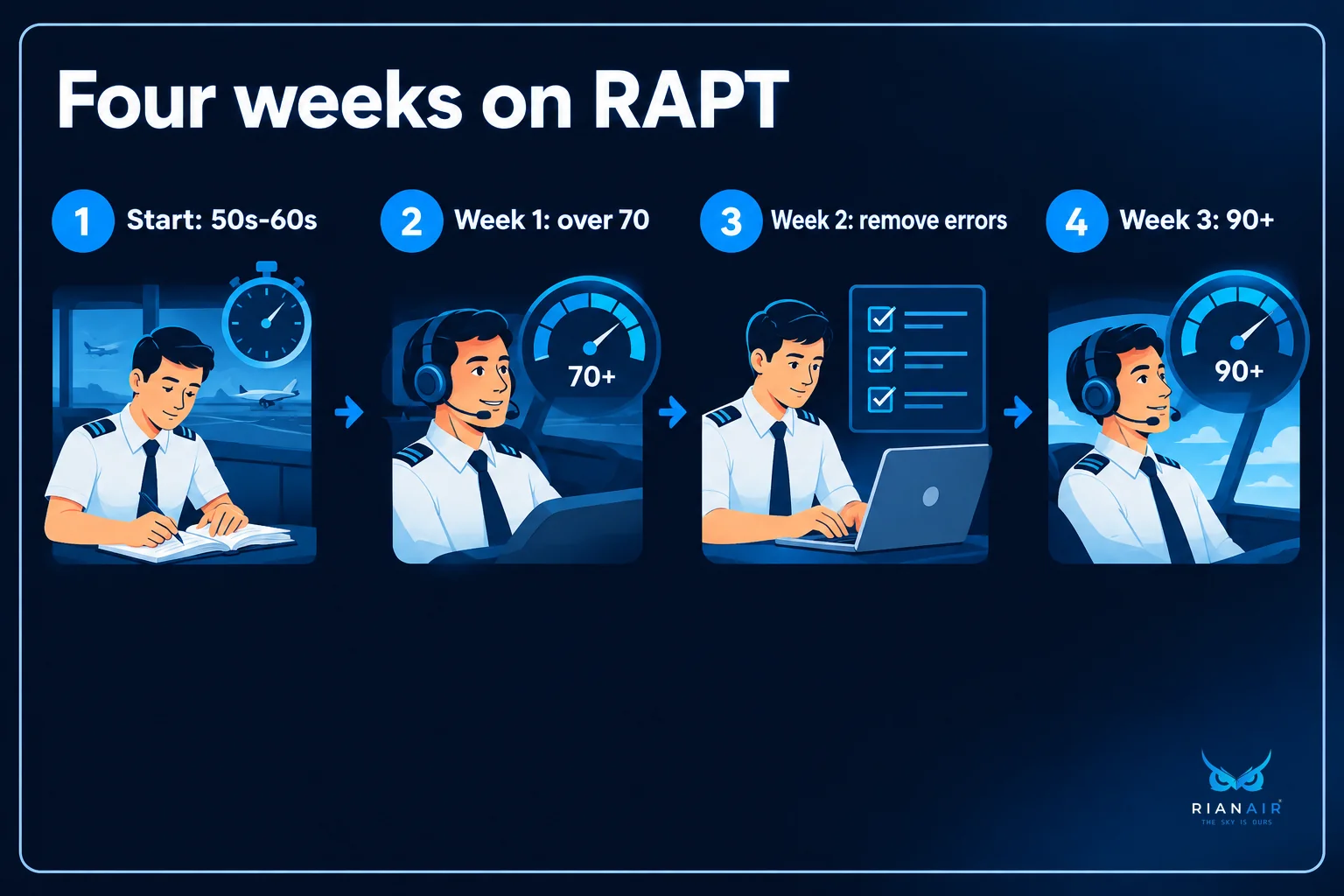
Week 1, find your base. Start the demo and attempt one subject. Do not worry about a low score. Read every explanation, then retry the questions you missed.
Week 2, remove errors. Use the weak-area filter. Repeat the questions you keep getting wrong until you can explain the answer in your own words.
Week 3, build speed. Take full tests in the exact DGCA pattern, with the clock running. By now, scores above 90 are common with constant practice.
Week 4, polish. Mix hard-mode tests with a final pass of weak chapters. By the time of their exams, students reach 90 to 100% accuracy.
The honest limit is this: a question bank cannot make anyone practise. Capt. Vikas Vikramdas Nair puts it plainly. Students struggle in Technical General mostly because they do not practise enough. Everything is difficult if you do not practise, and easy if you practise consistently.
Pace varies a lot. Some students have cleared every DGCA exam in as little as 3.5 months. Others, who lose focus, take more than a year and then see batchmates already flying solo and finishing their PPL.
What about ATPL students and working first officers?
ATPL students can subscribe to RAPT for ₹500 per month per subject and do not need to attend classes. Those who want classes can book one-on-one sessions scheduled around their airline roster, at an additional cost. An offline mode for ATPL is launching soon for areas without internet.
ATPL students are usually first officers flying for airlines, cargo operators or charters. Their schedules change week to week, so we plan classes around their rosters. The ATPL route covers 3 DGCA papers, and classes are mostly doubt sessions, because RAPT handles the rest with questions, answers and explanations.
So far, 13 airline pilots have cleared their written exams with us. For the bigger picture, read our guides on the best ATPL app for pilots in India.
Is there a parent dashboard for ab initio students?
Yes. Parents of ab initio students, meaning students starting from zero flying experience, can use a parent dashboard to follow progress during training. It is available for parents of ab initio students, so working pilots using RAPT for ATPL papers do not need it. Ask the team how it is set up for your child.
rr
Parents often pay for training without seeing what happens in class. A dashboard gives them a clear view, so conversations at home can be about facts rather than worry. If you are a parent, sit with your child during the first demo session. It takes only a few minutes and helps you understand what practice looks like.
If you are curious about where ground training can lead, see how to become a flight instructor in India.
Where to practise: online or at a training centre
You can use RAPT from anywhere, since it runs on the web, Android and iOS. Students who also want classroom teaching can visit their nearest Rian Air training centre. Students in Delhi, Mumbai and Thrissur can choose online or offline classes once they finish the demo and are satisfied.
For CPL, the usual order is simple. Do the free demo questions. If you are happy, sign up or request a demo online class. After that you can join online or offline classes. Pace depends on you, but ground training for navigation, meteorology, regulations, RTR and simulator sessions is usually 4 to 6 months.
One thing is not settled for every student: how many hours of simulator time suit you. For RTR, we recommend at least 3 to 5 hours of simulator practice, though it is not mandatory, so talk it over with the team.
FAQs about the free demo and the exams
Is the DGCA demo question bank really free?
Yes. The RAPT demo gives you about 987 exam-style questions at no cost, and the number grows monthly, with answers and explanations. Only the demo is free. Full RAPT access for CPL subjects comes with Rian Air ground training for that subject, and ATPL students can subscribe for ₹500 per month per subject after the demo.
What happens after I finish the demo questions?
After the demo questions, you decide what comes next. CPL students can sign up for classes or ask for a demo online class first, and ATPL students can subscribe at ₹500 per month per subject. There is no charge for the demo itself and no pressure to continue.
What is the DGCA pass mark for Air Regulations?
The pass mark is 70%. In Air Regulations that means 35 correct answers out of 50 questions. The paper runs for 2 hours. Aim well above the line in practice, because a few careless errors on exam day can cost you the attempt.
What score should I aim for before the real exam?
Aim for 100%. On RAPT you can attempt wrong questions again, so mistakes get removed one by one before exam day. Students usually start in the 50s or 60s, get past 70 within a week, and reach 90 to 100% accuracy by the time of their exams.
Can I use RAPT on my phone?
Yes. RAPT runs on the web, Android and iOS, so you can practise on a laptop at home or a phone on the way to class. You log in with the email and password you set after signing up for the demo. An offline mode for ATPL is launching soon.
FAQs about training time, ATPL and registration
How long does DGCA ground training take?
Rian Air's ground training for navigation, meteorology, regulations, RTR and simulator sessions takes 4 to 6 months. Some focused students have cleared every DGCA exam in 3.5 months, while students who lose focus can take over a year. Technical General and Specific are optional if you plan to fly in India.
Does RAPT explain answers or only mark them?
RAPT gives questions, answers and explanations, so you learn why an option is right. Reviewers on Google praise the app's organised study materials, chapter-wise question practice, tests and ease of use. You can also retry the questions you got wrong until the idea sticks.
Is RAPT useful for working pilots preparing for ATPL?
Yes. ATPL students are often first officers with airlines, cargo or charter operators, and RAPT lets them study around their roster. We have seen 13 airline pilots clear their written exams so far. ATPL classes are usually one on one, and the 3 DGCA papers mostly need only doubt sessions.
Where do I register for DGCA exams?
DGCA exams are booked on the DGCA Pariksha portal, which you must register on before appearing in any exam. You also need a DGCA computer number. Rian Air helps students with course planning, DGCA procedures and computer numbers, so you do not have to work out the steps alone.
The portal itself explains that Pariksha will be used for all future examinations conducted by DGCA's Central Examination Organisation for flight crew and engineers. Check it for current dates, fees and re-attempt rules.
Start with the free demo questions
You do not need to decide your whole career today. Open the demo, solve a few questions, and see what the DGCA style feels like. If you want help choosing a route after that, talk to our team about CPL ground training, or read how the pilot training pathways fit together.
For daily tips and student updates, follow us on Instagram and watch explainers on our YouTube channel. Sign up for the free DGCA demo question bank, practise a little each day, and let the numbers show you how close you are to exam day.