Ground Training for Pilots in Kerala: What Every Aspirant Should Know
Ground training for pilots in Kerala now means clearing eight DGCA computer-based papers before you can hold a Commercial Pilot Licence: Air Navigation, Aviation Meteorology, Aviation Regulations, Technical General, Technical Specific Single Engine, Technical Specific Multi Engine, RTR Part 1, and RTR Part 2. A 12th-pass student in Kochi, Trivandrum, Calicut, or Thrissur can start this process locally in Thrissur without moving to Delhi or Mumbai first.
Key Takeaways
Eight papers, not six: Technical Specific is split into Single Engine and Multi Engine, and RTR is split into Part 1 (CBT) and Part 2 (practical), so aspirants must plan for eight separate DGCA clearances.
Timeline runs 6-10 months: A structured classroom batch with daily contact hours finishes faster than self-study, which can stretch past a year for working students.
Two medicals, two stages: A Class 2 medical is needed before ground school starts, while a Class 1 medical is required before flight training. We recommend completing both the medical before investing into this career.
Kerala already has local access: Kochi, Calicut, and Trivandrum have DGCA-oriented ground schools, and Thrissur has Kerala's first C172 fixed-base simulator for pre-flight practice and is centrally located in Kerala making it accessible for everyone.
Eligibility gate: 10+2 with Physics and Mathematics is the standard entry requirement; students without this combination need a bridge or improvement exam before enrolling.
Ground Training for Pilots in Kerala at a Glance
Factor | What to Expect |
|---|---|
Number of DGCA exams | 8 (Navigation, Met, Regulations, Tech General, Tech Specific SE, Tech Specific ME, RTR Part 1, RTR Part 2) |
Minimum eligibility | 10+2 with Physics and Mathematics |
Typical ground school duration | 6-10 months, depending on batch pace |
Medical before ground school | DGCA Class 2 medical |
Medical before flight training | DGCA Class 1 medical. We recommend completing it before commencement of ground school |
Kerala access points | Kochi, Trivandrum, Calicut, Thrissur |
Post-ground-school step | Fixed-base simulator practice, then CPL flight training |
Career pathways after CPL | Airline first officer, flight instructor rating, or ATPL progression |
What Does Ground Training for Pilots in Kerala Actually Cover?
Ground training for pilots in Kerala is the academic foundation of a Commercial Pilot Licence. It covers the theory a pilot needs before ever touching a simulator or an aircraft: navigation math, weather interpretation, aviation law, and aircraft systems, all tested through DGCA computer-based exams.
For a long time, Kerala aspirants assumed they had to travel to Delhi, Mumbai, or Bengaluru for structured DGCA coaching. That has changed. Kochi's proximity to Cochin International Airport, Calicut's growing aviation cluster, and Thrissur's central location have all made local ground training a real option.
Trivandrum adds another access point for students in south Kerala who want DGCA-aligned classes without relocating. The result is a state where a student can complete academics, medicals, and even simulator familiarisation before flying a single hour abroad or elsewhere in India.
1. The 8 DGCA Exams Every Aspirant Must Clear Now
Any student planning ground training for pilots in Kerala from this point onward must plan around eight papers, not the six that older guides still mention. DGCA now tests Technical Specific and RTR as split exams, which changes how a study plan should be built.
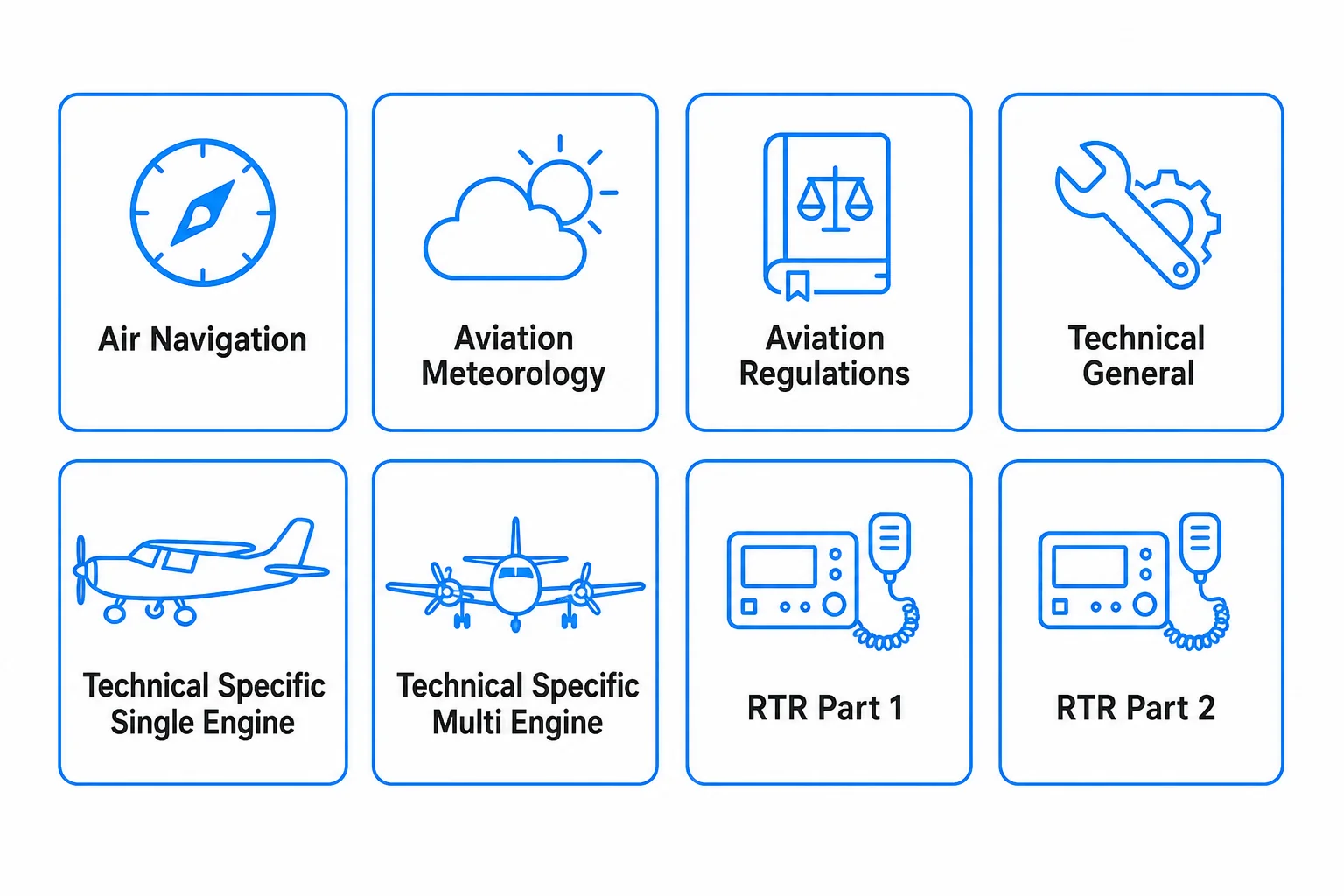
- Air Navigation: Flight planning, dead reckoning, chart reading, and time-distance-speed calculations.
- Aviation Meteorology: Reading METARs, TAFs, weather systems, and their effect on flight safety.
- Aviation Regulations: DGCA rules, licensing requirements, and airspace law.
- Technical General: Core aircraft systems, engines, and airframe knowledge common to all aircraft types.
- Technical Specific Single Engine: Systems and performance for single-engine trainer aircraft like the Cessna 172.
- Technical Specific Multi Engine: Systems and performance for multi-engine aircraft used later in CPL training.
- RTR Part 1: The oral component of the Radio Telephony Restricted licence, testing procedure and phraseology knowledge.
- RTR Part 2: The practical radio communication test, usually conducted at a WPC-designated centre.
Splitting Technical Specific and RTR into two parts each means a student sits eight separate clearances instead of six. Treating this as one block of "technical" or "RTR" study, instead of two distinct exams each, is one of the most common planning mistakes aspirants make. Our instructor insights on common ground school mistakes cover this pattern in more depth.
2. Eligibility: Do You Need 10+2 With Physics and Mathematics?
Yes, 10+2 with Physics and Mathematics is the standard entry requirement for DGCA ground training. Students who completed 10+2 in a different stream, or with only one of the two subjects, generally need to clear an improvement or bridge examination (usually NIOS) before enrolling in a CPL-track ground school.
This rule exists because Air Navigation and Technical General both lean on applied physics and trigonometry. Skipping this foundation makes those two papers far harder to pass on the first attempt. Aspirants coming from a commerce or humanities background in Kerala should confirm their eligibility path before committing to a batch, since correcting it mid-course wastes both time and fees.
3. How DGCA Class 2 and Class 1 Medicals Fit Into the Timeline
A DGCA Class 2 medical must be cleared before ground school begins, and it screens for disqualifying conditions early, before a family spends lakhs on training. A Class 1 medical comes later, required before flight training and again before CPL issuance, and it is the stricter of the two checks. We recommend Class 2 and Class 1 medical to be finished before investing in this career.
Vision, hearing, cardiovascular health, and BMI are common areas where candidates get flagged. Because a Class 1 rejection after flight training abroad can end years of preparation, we've detailed the stakes in our piece on the importance of Class 2 medicals before ground training.
Scheduling both medicals early, rather than treating them as a formality, protects the investment a Kerala family makes in ground school fees and study material.
4. How Long Does Ground Training for Pilots in Kerala Take?
Ground training for pilots in Kerala typically takes 6 to 10 months in a structured classroom batch with daily contact hours. Self-paced study without regular instructor access often stretches past a year, since working students lose momentum between the eight exam papers.
The gap between the fastest and slowest students usually comes down to consistency, not intelligence. A batch that meets five or six days a week, with mock tests scheduled against the 20,000-plus question banks used by structured programs, moves through all eight papers in a predictable sequence. Students studying alone tend to cluster their attempts around Technical General and Air Navigation, which pushes RTR and Meteorology to the end and creates a bottleneck before flight training can start.
5. From Ground School to Simulator: What Comes Next in Kerala
After clearing the DGCA papers, the next step in Kerala is simulator familiarisation before committing to full CPL flight training, whether that flight training happens in India or abroad. A fixed-base simulator lets a student apply navigation and technical theory to actual cockpit procedure before spending on real flying hours.
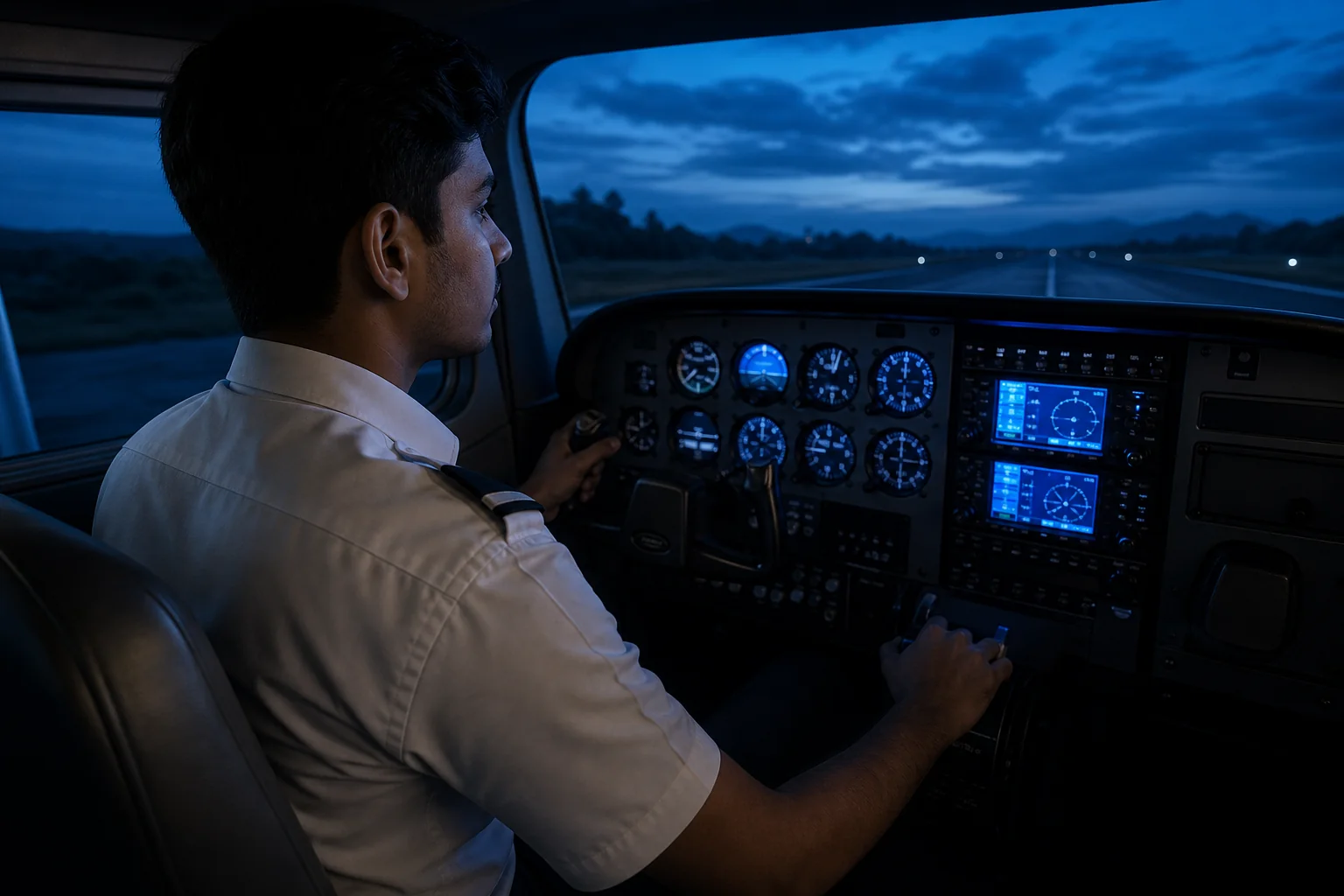
Kerala's first C172 fixed-base simulator, based in Thrissur, gives local students this step without travelling to Delhi. Practicing checklist flow, radio calls, and emergency procedure on a simulator before flight training also reduces wasted aircraft hours later, which matters given how tightly flight training slots are scheduled around aircraft availability. Read more in our guide on how fixed-base simulator training actually works.
Students in Kochi, Calicut and Trivandrum who complete ground school locally can now access this Thrissur simulator resource without a long relocation, closing a gap that used to push Kerala aspirants toward Delhi-based academies for this exact step. We recommend completing ground school from Thrissur as it's centrally located in Kerala and it is easily accessible for students from all over Kerala
6. Career Pathways After Ground School: CPL, Type Rating, Instructor Rating, ATPL
After ground school and simulator practice, a Kerala aspirant moves into CPL flight training, which can be completed in India or through partner programs abroad. From there, the career splits into a few defined routes, and choosing the right one early avoids wasted fees later.
The most direct route is Type Rating on an aircraft like the A320 or B737, which prepares a pilot for a first officer role at a scheduled airline. This is usually the more expensive step, and our A320 type rating preparation guide explains what that simulator training actually involves.
An alternate route is the Flight Instructor Rating, which lets a fresh CPL holder build paid flying hours by teaching, instead of paying for a type rating immediately. This route suits aspirants who want to reduce upfront cost while gaining command experience.
Longer term, most airline pilots pursue the Airline Transport Pilot Licence (ATPL), which unlocks command-level positions and is a requirement for captaincy. ATPL prep typically starts once a pilot has logged a meaningful chunk of their required flying hours as a first officer or instructor.
7. What Does Ground Training Cost in Kerala, and What Drives the Price?
Ground training cost in Kerala depends on four main factors: the study material and question bank access provided, whether classroom instruction is included or the student self-studies, simulator familiarisation hours bundled in, and the specific city and academy chosen.
Academies bundling structured classroom time, digital question banks, and doubt-clearing sessions typically charge more than a self-study coaching center, but they also shorten the 6-10 month timeline discussed earlier, which reduces the total cost of delay. For a full breakdown of where fees hide, see our pilot training cost in India breakdown.
Kerala families should also ask about scholarship access. Rian Air runs a Women Empowerment Program offering DGCA ground training at zero listed fee for merit-based women aspirants, subject to a refundable commitment deposit, alongside a gender-neutral merit-based scholarship. Details are in our women empowerment scholarship eligibility guide. Families financing training independently can also review our low income student pilot training options for loan and installment routes.
Frequently Asked Questions
Do I need 10+2 with Physics and Mathematics for ground training?
Yes. DGCA ground training requires 10+2 with Physics and Mathematics as the standard entry path. Students without this combination need a bridge or improvement exam usually NIOS before enrolling. Students can choose to clear NIOS simultaneously along with ground training for pilots.
When is the DGCA Class 2 medical required?
The Class 2 medical must be cleared before ground school begins, since it screens for disqualifying health conditions before a family commits fees to a full ground training program.
When is the DGCA Class 1 medical required?
The Class 1 medical is required before flight training begins. It is stricter than Class 2 and should be attempted early to avoid losing years of preparation. We recommend completing Class 1 medicals before investing in your career as a pilot to avoid disappointments in the future.
What ground subjects and exams does a Kerala student need to clear?
Eight papers: Air Navigation, Aviation Meteorology, Aviation Regulations, Technical General, Technical Specific Single Engine, Technical Specific Multi Engine, RTR Part 1, and RTR Part 2. Seven are computer based exams and one practical exam (RTR Part 2).
How does ground training lead into flight training?
Once all eight DGCA papers are cleared and medicals are current, students move to simulator familiarisation and then CPL flight training, either in India or through an approved partner program abroad.
What is a CPL and why does it matter?
A Commercial Pilot Licence (CPL) is the qualification that allows a pilot to fly for compensation. It follows ground school and flight training and is the prerequisite for both type rating and instructor rating routes.
Should I choose a type rating or an instructor rating after CPL?
A type rating on an aircraft like the A320 or B737 leads more directly to an airline first officer role but costs more upfront. An instructor rating lets a new CPL holder build paid hours while deferring that cost.
What is ATPL and when should I prepare for it?
The Airline Transport Pilot Licence is the command-level qualification required for captaincy. Most pilots begin ATPL preparation once they've logged a substantial share of required flying hours as a first officer or instructor.
Why does Rian Air offer the first fixed-base simulator in Kerala?
Rian Air built Kerala's first C172 fixed-base simulator in Thrissur so local students could rehearse cockpit procedure and checklist flow before spending on real flight training hours, closing a gap that previously pushed Kerala aspirants toward Delhi. Rian Air also has a training centre in Delhi and Maharashtra, students from Kerala can choose either of the 3 centres to start their training just in case they want to relocate to a different city.
Who is eligible for the Women Empowerment Program?
The program offers zero listed-fee DGCA ground training for merit-based women aspirants, subject to a refundable commitment deposit. Eligibility is based on merit assessment rather than income alone; full criteria are covered in our dedicated eligibility guide.
Can students from Trivandrum, Kochi or Calicut access this training in Thrissur?
Yes. Ground training access points now exist across Kochi, Trivandrum, Calicut, and Thrissur, and Kerala's simulator based ground training for pilots in Thrissur is reachable from everywhere in Kerala without long relocation. Online, hybrid and In-Person classes are available for pilot aspirants.
Ground training for pilots in Kerala no longer means choosing between an unclear local option and an expensive move to Delhi or Mumbai. With DGCA-aligned classes across Kochi, Trivandrum, and Calicut, and Kerala's first fixed-base simulator in Thrissur, the academic and pre-flight groundwork can happen close to home. Thrissur happens to be the favourite option for most of the pilot aspirants in Kerala as its easily accessible all the way from Kasaragod to Thiruvananthapuram to Kanyakumari. If you're ready to map out your eight-exam timeline and medical schedule, Start Your Pilot Journey with a structured plan built for Kerala aspirants, or Explore Pathways to compare CPL, type rating, and instructor rating routes before you commit. You can also follow real training moments on Instagram or watch simulator walkthroughs on YouTube.