DGCA CPL Training in Kerala: Costs, Duration, and What to Expect
A Kerala family planning DGCA CPL training can expect roughly six to eight months of ground school, several months of fixed-base simulator practice, and 200 total flying hours before a Commercial Pilot Licence is issued. The route runs through Air Regulations, Navigation, Meteorology, and Technical papers, followed by flight training either in Kerala or at a partner location abroad.
Key Takeaways
- Ground school first: DGCA mandates theory papers covering Air Navigation, Meteorology, Regulations, and Technical subjects before any flying hours count toward the licence.
- 200 flying hours minimum: DGCA requires exactly 200 total flight hours, including pilot-in-command time, under Aircraft Rules 1937, Schedule II.
- Kerala has a working simulator ecosystem: Rian Air runs a C172 fixed-base simulator in Kerala, used to rehearse procedures before real aircraft hours begin.
- Delays are the biggest hidden cost: aircraft availability, medical rejections, and weak ground-school preparation extend timelines more often than fees do.
- Support structures exist: scholarship routes, installment plans, and a money-back promise on DGCA exams (terms and conditions apply) are available to reduce financial risk.
DGCA CPL Training in Kerala at a Glance
Stage | Typical Duration | What Happens |
|---|---|---|
Ground School | 6-8 months | Seven DGCA theory papers plus RTR practical test |
Class 1 & 2 Medicals | Parallel to ground school | Fitness clearance required before flight training begins |
Simulator Training | 4-8 weeks | Fixed-base C172 sessions to build procedural fluency |
Flight Training | 14-24 months | 200 total flying hours, including 100 pilot-in-command hours |
CPL Issuance | After all hours and exams clear | DGCA reviews logbook and issues the licence |
Type Rating (optional, post-CPL) | 2-3 months | A320 or B737 preparation for airline readiness |
What Does DGCA CPL Training in Kerala Actually Involve?
DGCA CPL training in Kerala moves through five linked phases: ground training, simulator practice, flight training, type rating, and airline readiness. Each phase has to be cleared before the next genuinely starts, even if preparation overlaps on a calendar.
Kerala's position in this journey has changed over the past few years. The state now has its own fixed-base simulator infrastructure, which means students no longer need to travel out of state just to build procedural confidence before touching an aircraft. Thrissur and Kochi have both grown into functional training clusters, alongside long-standing flying schools in Thiruvananthapuram.
Rian Air structures its own version of this journey around CPL ground classes in Kerala, followed by simulator sessions, then flight training routed either domestically or through international partner pathways in Tunisia and Malta.
1. Ground School: The First 6-8 Months
Ground school is where most Kerala aspirants spend their first six to eight months, covering DGCA theory papers in Air Navigation, Aviation Meteorology, Air Regulations, and Technical General and Specific subjects. No flying hours count toward a CPL until these papers are cleared.
Students sit for a batch of DGCA theory exams, plus a separate practical Radio Telephony (RTR) test. The exact paper count has shifted slightly over recent syllabus revisions, so always confirm the current list with your ground school before enrolling.
The single biggest risk at this stage is not the subject difficulty. It is pacing. Aspirants who treat ground school as a self-paced reading exercise, rather than a structured daily study habit backed by a large question bank, routinely take two to three extra months to clear papers. Rian Air's RAPT platform addresses this with a DGCA-aligned question bank built around 20,000-plus practice questions, so students can track weak areas instead of guessing at them.
Before any of this begins, a Class 2 medical clearance is non-negotiable. Skipping this check and paying ground school fees first is one of the most avoidable financial mistakes a family can make.
2. Simulator Training: Why Kerala's C172 Fixed-Base Sim Matters
Fixed-base simulator training lets a student rehearse checklists, emergency procedures, and cockpit flows repeatedly before ever sitting in a real aircraft. This matters because real flight hours are expensive and limited by weather, aircraft availability, and instructor schedules, none of which a simulator session depends on.
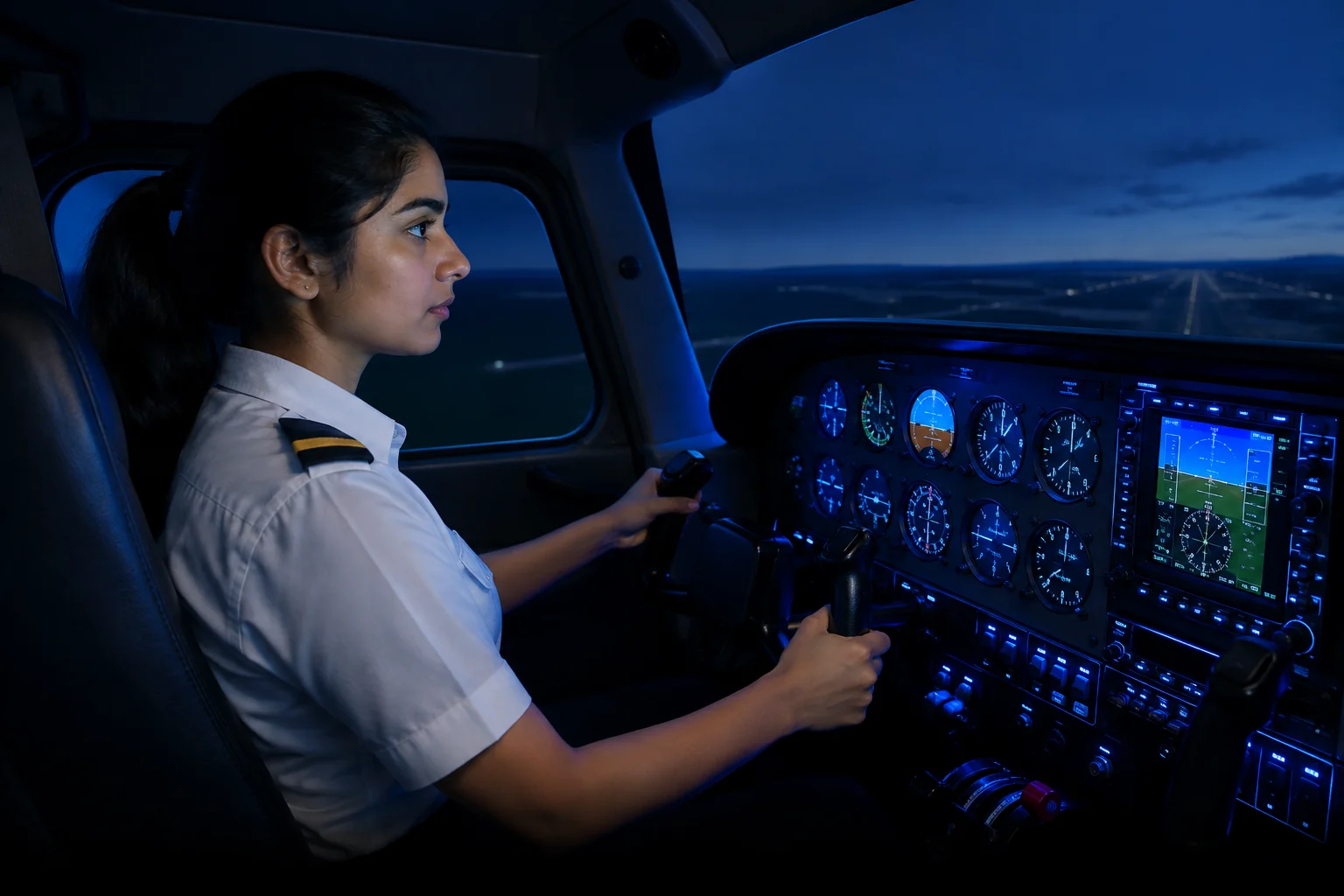
Rian Air operates a C172 fixed-base simulator described as Kerala's first of its kind. Students use it to build muscle memory for standard operating procedures, so that when real flight hours start, the instructor is refining technique rather than teaching basics from zero.
This is also where Kerala has genuinely closed a gap with older training hubs. For years, simulator access meant travel to Delhi or Mumbai. A C172 fixed-base simulator session in Kerala now gives local students the same procedural head start, without relocation costs.
Parents evaluating academies should ask directly whether simulator hours are logged and whether they feed into a digital record. A simulator session that isn't tracked is a session whose value is hard to prove later, whether to an instructor, a loan officer, or an airline recruiter.
3. Flight Training: Hours, Locations, and Realistic Timelines
Flight training for a DGCA CPL requires 200 total flying hours, including 100 hours as pilot-in-command, before a licence can be issued. This single number drives almost every scheduling decision an academy and family make together.
Two hundred hours sounds straightforward on paper. In practice, weather windows, aircraft maintenance downtime, and instructor availability stretch this phase to anywhere from fourteen to twenty four months. Students training in Kerala sometimes split hours between local flying clubs and partner locations abroad.
This is exactly why Rian Air built international pathways into Tunisia and Malta alongside its Kerala and Delhi operations. A student who starts ground school and simulator work in Kerala can finish flight hours wherever aircraft availability is strongest that season. A detailed comparison of CPL training in India, Malta, and Tunisia is worth reading before committing to one location for the full 200 hours.
Families in Delhi, Mumbai, and Thrissur frequently compare notes on this stage, because flight-hour delays are the most common reason a training budget runs over its original estimate, not tuition increases.
4. Type Rating and Airline Readiness
A type rating certifies a pilot to fly a specific aircraft type, commonly the A320 or B737, and is usually pursued after the CPL is issued, once a candidate is actively targeting airline hiring. It is not part of the base CPL requirement.
Deciding between A320 and B737 preparation depends on which operators are hiring in a given year and which simulator access an academy can offer. This decision carries real weight, since switching type rating paths mid-preparation wastes both time and money.
Airline readiness also covers interview preparation, documentation, and logbook accuracy, which is where a digital record built through ground school and simulator stages pays off. Recruiters expect a clean, verifiable training history, not a stack of paper logs assembled at the last minute.
How Much Does DGCA CPL Training in Kerala Cost?
Total cost for DGCA CPL training varies by how much of the flight-hour phase happens in India versus abroad, and by which academy's ground school and simulator packages a student chooses. Rather than quote a single number that may not hold across academies, treat cost planning as four separate line items: ground school and medicals, simulator hours, flight hours, and contingency for delays.
Contingency is the line families underestimate most. Aircraft downtime, repeat exam attempts, and medical re-checks all add cost that a brochure total never shows upfront. A detailed breakdown of pilot training costs and hidden fees is a useful companion read before signing any enrolment agreement.
Rian Air backs its ground training with a money-back promise: if a student does not clear their DGCA exams through Rian Air's programme, the fee is returned, subject to terms and conditions (ask for the T&C sheet directly). For women aspirants, Rian Air also runs a merit-based Women Empowerment Program offering zero-fee DGCA ground training, with a refundable commitment deposit, alongside a gender-neutral merit scholarship for other qualifying students.
Families exploring financing should also look at structured installment plans and education loan eligibility rather than assuming the full cost must be paid upfront. Low-income students in particular have more options today than brochures typically advertise.
Kerala vs Other Training Hubs in India: How Does It Compare?
Kerala competes with Delhi, Mumbai, and international pathways on three real variables: simulator access, flight-hour consistency, and commute convenience for ground school. No single city wins every category.
| Location | Simulator Access | Flight-Hour Consistency | Best Fit For |
|---|---|---|---|
| Kerala (Kochi, Thrissur, Thiruvananthapuram) | C172 fixed-base simulator available locally | Moderate, weather-dependent in monsoon months | Students who want ground school and simulator work near home |
| Delhi | Multiple ground training clusters, hybrid simulators | Higher aircraft density, less weather disruption | Students prioritising ground school speed and batch options |
| Mumbai | Established flying clubs | Coastal weather affects some months | Students near Maharashtra wanting local presence |
| Tunisia / Malta (international) | EASA-aligned simulator infrastructure | Generally higher, fewer scheduling bottlenecks | Students who can complete flight hours abroad after Indian ground school |
A side-by-side read of pilot training in Delhi against the Kerala path helps families with flexible location options make this comparison concretely rather than on reputation alone.
Why Families Choose Rian Air's RAPT Ecosystem in Kerala
RAPT is Rian Air's technology platform, built to connect ground school progress, simulator data, performance analytics, and a digital logbook into one system a student and their family can both see. Rian Air describes RAPT as India's first technology-driven pilot training ecosystem.
For parents financing training from a distance, a parent dashboard replaces guesswork with actual attendance, exam, and simulator-hour data. Rian Air reports a 97% DGCA pass rate and has trained 200+ pilots through this ecosystem to date.
That combination, a tracked record plus a measurable pass rate, is what separates a structured academy from a traditional ground training facility where progress is communicated mostly through phone calls and assumptions.
Common Mistakes Aspirants Make During Ground School in Kerala
Three mistakes account for most of the delays Rian Air instructors see repeatedly among new batches.
- Skipping medical clearance first: paying ground school fees before a Class 1 or Class 2 medical clearance risks losing money if a disqualifying condition surfaces later.
- Treating the question bank as optional revision: students who only read textbooks, without drilling a large question bank, consistently underperform on DGCA papers compared to those who practice daily.
- Underestimating flight-hour scheduling: assuming 200 hours will be logged in a fixed number of months, without accounting for weather and aircraft availability, is the single most common source of budget overruns.
A full walkthrough of how to pass the DGCA exam in the first attempt covers study patterns that reduce the first mistake specifically.
Frequently Asked Questions About DGCA CPL Training in Kerala
How long does DGCA CPL training in Kerala take from start to finish?
Most students complete the full journey, ground school through 200 flying hours, in 18 to 24 months. Delays from weather, medicals, or aircraft scheduling can extend this timeline further.
What is the minimum flying hour requirement for a DGCA CPL?
DGCA requires exactly 200 total flying hours, including 100 hours as pilot-in-command, under Aircraft Rules 1937, Schedule II, before a Commercial Pilot Licence is issued.
Can I complete all 200 flying hours in Kerala?
Yes, but availability depends on aircraft and weather. Many Kerala-based students split flight hours between local training and partner locations abroad to avoid scheduling delays.
Do I need a Class 1 medical before starting ground school?
A Class 2 medical clearance is required early, before ground school fees are committed. A Class 1 medical becomes mandatory before flight training and before a CPL can be issued.
What subjects are covered in DGCA ground school?
Ground school covers Air Navigation, Aviation Meteorology, Air Regulations, and Technical General and Specific papers, plus a practical Radio Telephony test.
Is DGCA CPL training in Kerala cheaper than Delhi or Mumbai?
Costs are comparable across hubs once simulator and flight-hour packages are factored in. The bigger cost driver is delay avoidance, not the city chosen for ground school.
Are there scholarships for women pursuing CPL training in Kerala?
Yes. Rian Air runs a merit-based Women Empowerment Program offering zero-fee DGCA ground training, with a refundable commitment deposit, alongside a gender-neutral merit scholarship.
What happens if I fail a DGCA exam paper?
You can retake the paper in a subsequent exam cycle. Repeated attempts extend ground school duration and add exam fees, which is why structured daily preparation matters.
Is simulator training compulsory before flight training in Kerala?
It is not legally compulsory, but academies like Rian Air use fixed-base simulator sessions to build procedural familiarity before real aircraft hours, reducing errors and instructor correction time later.
What comes after CPL: do I need a type rating immediately?
Not immediately. A type rating, typically A320 or B737, is usually pursued once a candidate is actively targeting airline hiring, not as a default next step after CPL issuance.
Frequently Asked Questions About RAPT
What is RAPT and how is it different from a regular ground school app?
RAPT is Rian Air's proprietary pilot training ecosystem, combining a DGCA question bank, simulator data, performance analytics, and a digital logbook in one platform, rather than separate disconnected tools.
Can parents access RAPT to track their child's training progress?
Yes. RAPT includes a parent dashboard that shows ground school attendance, exam results, and simulator-hour progress, so sponsors can follow training without relying solely on phone updates.
Does RAPT's question bank cover all DGCA CPL papers?
RAPT's question bank is built around 20,000-plus practice questions aligned to DGCA CPL theory subjects, helping students identify weak areas before sitting formal exams.
Is RAPT available outside Kerala?
Yes. RAPT supports students across Rian Air's training locations, including Delhi and Kerala, as well as those on international pathways in Tunisia and Malta.
Does RAPT track simulator hours from the C172 fixed-base simulator?
Yes, simulator sessions on Rian Air's C172 fixed-base simulator in Kerala feed into the same digital logbook used for flight hours, giving students one continuous training record.
DGCA CPL training in Kerala rewards families who plan each stage with real numbers, not brochure estimates. If you are ready to map out ground school, simulator access, and flight-hour scheduling for your own timeline, start your pilot journey with Rian Air today.
You can also explore training pathways across Kerala, Delhi, and international options to see what fits your budget and schedule. For a closer look at life inside the academy, follow Rian Air on Instagram or watch student journeys on the Rian Air YouTube channel.