
Scholarship Scams That Aspiring Pilots and Their Families Should Be Aware Of In Aviation
A written exam that charges every applicant a fee and calls itself a "scholarship" is usually a lead-generation tool, not financial aid. Scholarship scams that aspiring pilots and their families should be aware of in aviation now follow a repeatable pattern across India, and Kerala's ground training market has seen it grow fast in 2026: impossible academic conditions, mass-entry exams that pool lakhs of rupees, and cash-for-discount arrangements dressed up as merit awards.
Key Takeaways
- Impossible terms are a giveaway: A scholarship that requires clearing every DGCA paper with 95%+ marks in the first attempt within five months of starting ground school is written so almost nobody qualifies.
- Entrance-fee scholarships are a revenue model: An academy charging ₹1,000 to 1,000 applicants collects ₹10 lakh while awarding one or two scholarships worth a fraction of that sum.
- A 2026 case ran into crores: A California-based flight school in San Bernardino charged roughly ₹5,000 to more than 10,000 Indian applicants, generating close to ₹5 crore, while offering full training to just one topper and partial discounts to a handful more.
- Cash-based "100% scholarships" hide agent commissions: Some arrangements let parents pay an agent in cash, then have the academy label the same amount as a scholarship, adjusting it against commission the school owed the agent anyway.
- Documentation settles the question: A genuine scholarship provider can show a refund policy for the exam fee, a CSR filing if it claims CSR funding, and a receipt trail. A scam usually cannot produce any of these on request.
At a Glance: Scholarship Scam Red Flags
| Warning Sign | What a Genuine Scholarship Looks Like |
|---|---|
| Eligibility criteria | Realistic academic bar (e.g., pass with above-average marks), not 95%+ in every DGCA subject within months |
| Exam fee | Free or nominal, refundable if scholarship is not awarded |
| Number of exam-takers vs. awards | Ratio disclosed upfront; not thousands paying for one or two winners |
| Funding source | Named CSR filing, trust, or company balance sheet available on request |
| Cash arrangements | None; all fee adjustments show on an official receipt from the flight training organisation |
| Terms and conditions | Written down, dated, and shared before enrollment, not verbal promises |
| Refund policy | Clearly stated in writing for both the exam fee and the training fee |
Why Scholarship Scams Are Spreading Across Ground Training Schools in Kerala
Kerala has one of India's densest concentrations of ground training academies, and 2026 has seen almost every one of them announce a scholarship. That volume alone should raise a question: how many can actually fund merit-based aid without recovering the cost from students?
The tell is in the terms. Several Kerala-based schools now advertise scholarships that require a student to clear all DGCA ground papers with more than 95% marks, in the first attempt, within five months of starting classes. Ground school syllabuses are dense; even strong students often need more than one attempt at a paper like Air Navigation or Technical General. A condition built to fail almost every applicant is not designed to give money away. It is designed to attract enrollment inquiries.
Once a family calls in response to a scholarship ad, the conversation usually shifts to standard admission and full fees within minutes. The scholarship did its job as a hook before the student ever sat an exam. Families researching ground training for pilots in Kerala should treat scholarship terms as a screening test on the academy, not just on the student.
Case Study 1: The ₹10 Lakh Entrance Exam Pool
One recurring model works like this: an institute announces a scholarship exam open to any aspiring pilot, charges ₹1,000 to sit it, and gets 1,000 students to register. That is ₹10 lakh collected before a single scholarship is handed out.
The institute then awards the scholarship to one or two toppers, often covering a small slice of total training cost. The remaining 998 students who paid and did not win have effectively funded the exercise and handed the academy a list of qualified leads it can now call for regular enrollment. The exam wasn't philanthropy; it was a paid database-building event.
Case Study 2: The San Bernardino Exam That Collected Nearly ₹5 Crore From Indian Students
What happened in 2026?
A flight school based in San Bernardino, California, ran a scholarship entrance exam in 2026 aimed at recruiting Indian students. It charged roughly ₹5,000 per applicant, and more than 10,000 Indian students appeared for it.
That volume put the total collected at close to ₹5 crore. The school then offered full pilot training to the single topper and discounts between 10% and 25% to a limited number of other high scorers. Everyone else who paid the exam fee received nothing back.
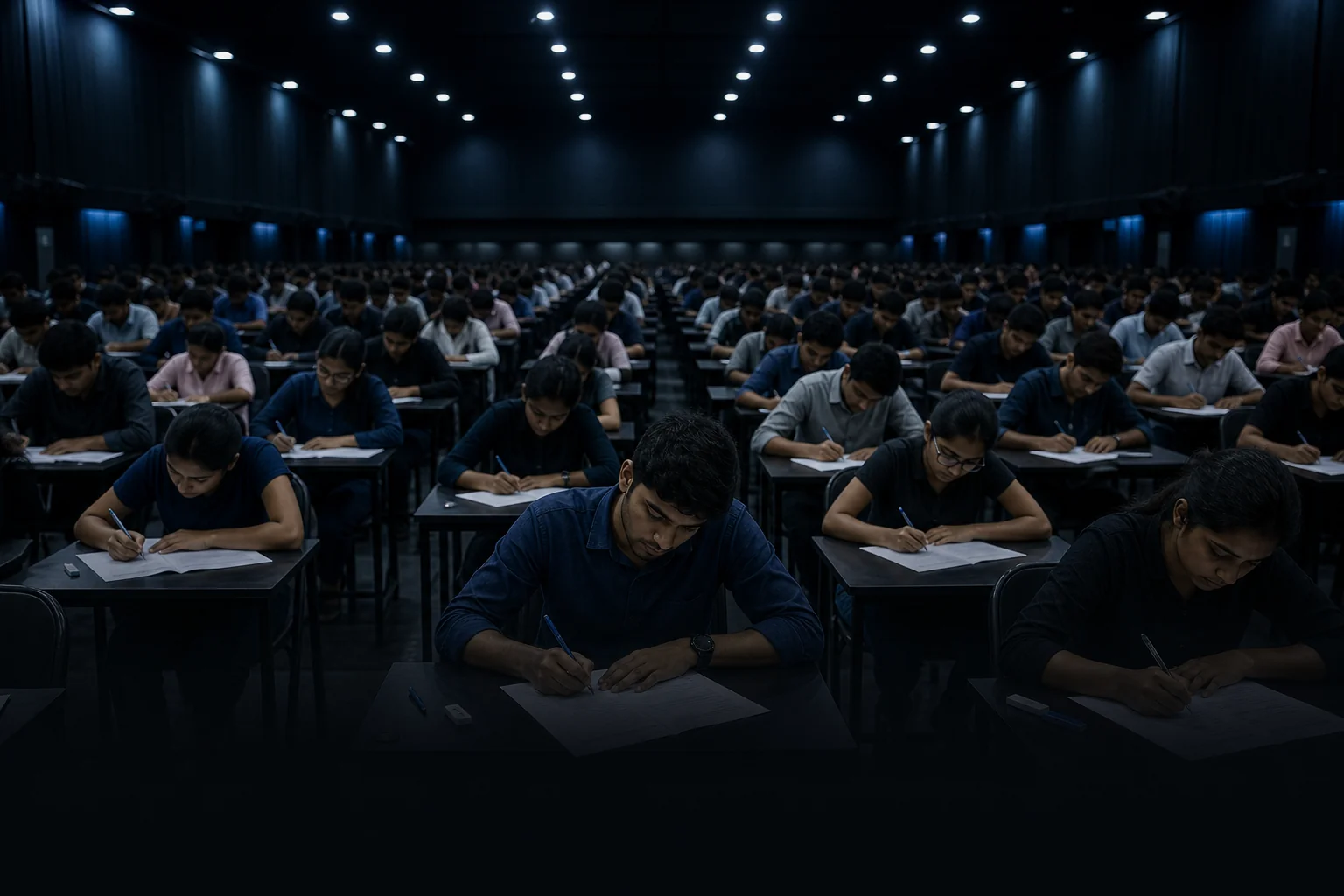
The arithmetic matters more than the marketing. If a school genuinely wanted to fund pilot training for Indian students, it would not need 10,000 people to pay for the privilege of applying. A real donor-funded or CSR-backed scholarship absorbs the cost of running the selection process itself; it does not pass that cost on to 99% of the applicants who will never see a rupee of benefit.
Case Study 3: The Cash-for-Scholarship Route Used by Agents
A third pattern involves parents holding undisclosed income who want to pay a flight school in cash rather than through a bank transfer. Some ground training institutes and agents accommodate this by calling the cash payment a "100% scholarship," with no records maintained for the cash or adjusted against the commission the flight school owes the agent.
Here is how the adjustment works in practice. Say flight training abroad costs ₹50 lakh, and an agent typically earns ₹2.5 lakh per student sent. If the agent sends a group of 20 students, the flight school owes that agent ₹50 lakh in total commission. If one student's parent has already paid the agent in cash directly, the agent can simply absorb that amount into the group commission and label the student's fee as a "scholarship," even though no real donor or CSR fund is involved.
Families in this position should ask for the original receipt issued by the flight training organisation itself, not by the local agent or ground school. If the arrangement is what it claims to be, that receipt will exist and will match the amount actually transferred to the flight school's account. If it does not exist, the "scholarship" is a paperwork label placed over an undisclosed cash transaction, and that carries its own legal risk for the family, independent of the training outcome.
What Questions Should Parents Ask Before Believing a Scholarship Offer?
Parents should ask to see proof of funding, a written refund policy for the exam fee, and the exact number of applicants versus scholarships awarded, before paying anything. An institute that hesitates on any of these three points is signaling a lead-generation exercise, not genuine financial aid.
Beyond those three core questions, a family evaluating any scholarship announcement should call the institute directly and ask:
- Can you show proof of the funds set aside for this scholarship, such as a bank statement or trust account?
- Is this scholarship part of a registered CSR activity, and can I see the CSR filing?
- Why does a scholarship exam charge a fee at all, if the goal is to help students who need financial support?
- If my child does not win, is the entrance exam fee refundable?
- How many students appeared for this exam last year, and how many scholarships were actually awarded?
- Can I see the written eligibility criteria before my child registers, not just a summary in the advertisement?
- Who audits this scholarship program, and is that audit available to applicants on request?
- If the scholarship is merit-based, what happens if my child meets the merit bar but funds have run out that year?
- Is there a written agreement covering what happens if the institute closes or changes ownership mid-course?
- Can you provide the names or registration details of at least one previous scholarship recipient's award letter, with amounts redacted for privacy but terms intact?
A school with a real scholarship answers these without hesitation. A lead-generation exercise usually deflects, delays, or drops the conversation altogether.
How Are Rian Air's Women Empowerment Program and Money-Back Promise Structured?
Rian Air's Women Empowerment Program offers zero-fee DGCA ground training for aspiring women pilots based on merit, with a refundable commitment deposit rather than a hidden charge. Its terms, along with the separate money-back promise tied to DGCA exam outcomes, are recorded on stamp paper in the presence of a lawyer, so the commitment is documented rather than verbal.
That documentation is the exact point where most scholarship advertisements fall apart. A scholarship that exists only as a social media post or a verbal assurance from a counselor gives a family nothing to hold the institute to later. Written terms, reviewed with legal counsel present, give both sides a record of what was promised and under what conditions it applies.

The money-back promise works the same way: if a student enrolled under it does not clear the DGCA exams, terms and conditions apply, and families should ask for the T&C sheet directly rather than relying on what a counselor describes verbally. That single habit, asking for the document instead of the summary, is the difference between a family that can enforce a promise and one that discovers too late it never had a real commitment.
Women considering this route can review the eligibility details on the Women Empowerment CPL Ground Training Scholarship Eligibility page before applying, and compare it against any other scholarship offer using the checklist above.
What Are the Best Aviation Schools in India Doing Differently on Scholarships?
The academies families search for as the "best aviation institute in India" tend to share three habits: they publish exact scholarship numbers, they do not charge for the selection exam, and they put their commitments in writing before a rupee changes hands.
None of that requires a large marketing budget. It requires an institute willing to show its books to a prospective student's parents. Families comparing options across Rian Air vs other ground training academies should weigh this transparency as heavily as fleet size or simulator hours, because a scholarship scam early in the relationship is often a preview of how the rest of the training contract will be handled.
Students weighing income constraints against training costs can also look at broader low income student pilot training options in India, which include structured loans and installment plans that don't rely on winning a scholarship lottery at all.
Frequently Asked Questions
Is every pilot training scholarship in India a scam?
No. Not every scholarship is fraudulent, but a growing share of scholarship advertisements in ground training are lead-generation exams disguised as financial aid. The distinction lies in whether the institute charges an exam fee, discloses applicant-to-award ratios, and puts terms in writing.
Why do so many Kerala ground training schools suddenly offer scholarships?
Ground training is a competitive market in Kerala, and a scholarship announcement generates far more inquiries than a standard admission ad. Many schools use the exam as a funnel: applicants who don't win are converted into regular fee-paying students.
Should I pay a fee to sit a scholarship entrance exam?
Be cautious. A genuine scholarship provider usually absorbs the cost of running a selection exam rather than charging every applicant. If a fee is charged, ask in writing whether it is refundable if your child is not selected.
How can I verify if a scholarship is a real CSR activity?
Ask the institute for its CSR registration details or trust deed and cross-check the organisation's name. A legitimate CSR-funded scholarship will have public filings; an institute that cannot produce these on request likely isn't running one.
What should I do if an agent says my child's fee has been adjusted as a "scholarship" after we paid cash?
Ask for the original receipt issued directly by the flight training organisation for the exact amount transferred. If that receipt does not exist or does not match what was actually paid, the arrangement is not a scholarship and carries financial and legal risk for your family.
What academic conditions are realistic for a merit scholarship?
A realistic condition reflects genuine strong performance, not a near-impossible bar. Requiring 95%+ marks across every DGCA subject in the first attempt within five months of starting ground school is designed so almost no student qualifies, which should be treated as a warning sign rather than a challenge to rise to.
Are foreign flight schools recruiting Indian students through scholarships trustworthy?
Some are legitimate, but the 2026 San Bernardino case shows how a foreign school can collect crores of rupees from thousands of Indian applicants while awarding meaningful aid to only one or two. Verify any foreign scholarship offer with the same questions used for a domestic one, including refund policy and funding proof.
Does Rian Air charge a fee for its Women Empowerment Program exam or selection?
The Women Empowerment Program offers zero-fee DGCA ground training based on merit, with a refundable commitment deposit rather than an exam entry charge. Terms are documented on stamp paper with a lawyer present before enrollment begins.
What happens if my child doesn't clear DGCA exams after enrolling under a money-back promise?
Under Rian Air's money-back promise, terms and conditions apply, and families should request the specific T&C sheet to understand exactly what qualifies for a refund before enrolling, rather than relying on a verbal summary.
Where can I check the actual DGCA exam pass difficulty before trusting a "95% in first attempt" scholarship claim?
Reviewing the actual DGCA exam first-attempt pass guidance for parents shows how demanding the subjects genuinely are, which makes it easier to judge whether a scholarship's academic condition is realistic or designed to exclude nearly everyone.
Should I report a suspected scholarship scam?
Yes. Keep every advertisement, payment receipt, and written communication. These records are useful both for your own protection and if you choose to raise the matter with consumer protection authorities or the institute's regulatory body.
Verifying a scholarship before paying anything is not distrust; it is basic financial diligence, the same diligence any family would apply before signing a loan agreement or a property deal. Parents and students who want to compare training pathways without chasing entrance-exam lotteries can Start Your Pilot Journey with a direct enquiry, or Explore Pathways to see documented fee structures and eligibility for both the Women Empowerment Program and the money-back promise. For ongoing updates on genuine scholarship announcements and training milestones, follow along on Instagram or subscribe on YouTube.