



Aviation English Language Proficiency (AELP) for Pilots: DGCA Level 4 Rule and Test Guide
Aviation English language proficiency for pilots (AELP) is a DGCA-regulated spoken English assessment. You need at least ICAO Operational Level 4 shown on your licence before a Private, Commercial or Airline Transport Pilot Licence can be issued. It is not a written ground paper, so students often discover it only when the licence file is being prepared.
At Rian Air, we help students with AELP training and testing. Classes run online from Monday to Friday, and we arrange the test on Saturdays in Delhi. A student in Thrissur, Mumbai or Thane can attend the classes from home and travel to Delhi only for the test day.
1. AELP in Plain Words: A Spoken English Test for Pilot Licences
AELP stands for Aviation English Language Proficiency. It checks whether a pilot can speak and understand the English used for radio communication with air traffic control, at the level DGCA specifies. It is assessed in a live speaking test, and the result is shown on the licence itself.
This is not the English you studied for Class 10 or Class 12. The test looks at how well you communicate in work situations: routine radio exchanges, and also unexpected ones where you must ask for clarification, explain a problem or confirm what you heard.
The requirement covers aspiring Private, Commercial and Airline Transport pilots, plus flight engineers, flight navigators and air traffic controllers. For a student planning a CPL, it sits beside the medical, the DGCA written papers and the flying hours as one more box that must be ticked.
2. Why Students Overlook Aviation English Until Late
Most students overlook AELP because it follows a separate track from the DGCA written papers. It is delivered by DGCA-approved AELP training and testing organisations, so it never appears in a ground school timetable unless someone puts it there.

Four assumptions cause most of the delay:
- "I studied in English medium, so I am fine." School marks do not decide your level.
- "It is only a formality." A level below 4 is not accepted for licensing.
- "I will do it after my exams." Training hours and a test slot take calendar time.
- "My coaching centre will remind me." Many ground schools do not cover it.
The cost of finding out late is time. Students who realise they have slipped behind watch batchmates move on to solo flying and the PPL while they chase a missing item. Starting AELP early removes that risk at low effort.
3. Where the Official Requirement and Testing Information Comes From
The official source is DGCA's Civil Aviation Requirement, Section 7, Series G, Part III, titled "Aviation English Language Proficiency, Training, Test and Certification". The current version is Issue II dated 18 November 2025, effective forthwith. Read it on the DGCA website rather than relying on a classmate's summary.
The CAR rests on Clause 6A of Section A of Schedule II of the Aircraft Rules 1937. That clause says applicants for the PPL, CPL and ATPL must be able to speak and understand English used for radio communication to the level DGCA specifies. The level is evaluated by DGCA's procedures and indicated on the licence.
The standard is at least ICAO Operational Level 4 on the ICAO Language Proficiency Rating Scale (ICAO Doc 9835), as set out in the DGCA CAR.
DGCA's Flight Crew Licensing pages also carry the list of approved language training organisations and testing service providers, which is the place to check any named organisation, as in the DGCA Flight Crew Licensing list. Redbird, IndiGo and Flytech are among the organisations approved for AELP training and testing.
One caution on timing: the Ministry of Civil Aviation notified the Bharatiya Vayuyan Niyam, 2026 on 26 October 2026 (G.S.R. 957(E)). References in older CARs to the Aircraft Rules may be updated over time, so always check the current CAR text on the DGCA website before you apply.
A short verification routine before you pay anyone
- Open the current CAR on dgca.gov.in and read the sections on training, test and certification.
- Find the organisation on DGCA's approved list of AELP training and testing providers.
- Ask for the minimum training hours, test date options and fee in writing.
- Confirm where the test is held and what identity documents you must carry.
4. The Six Skills and Levels: How Your Score Is Decided
The test rates you on six ICAO skills: pronunciation, structure, vocabulary, fluency, comprehension and interaction. Each gets a rating from 1 to 6. Your final level is not an average. It is the lowest of the six ratings, so one weak skill pulls the whole result down.
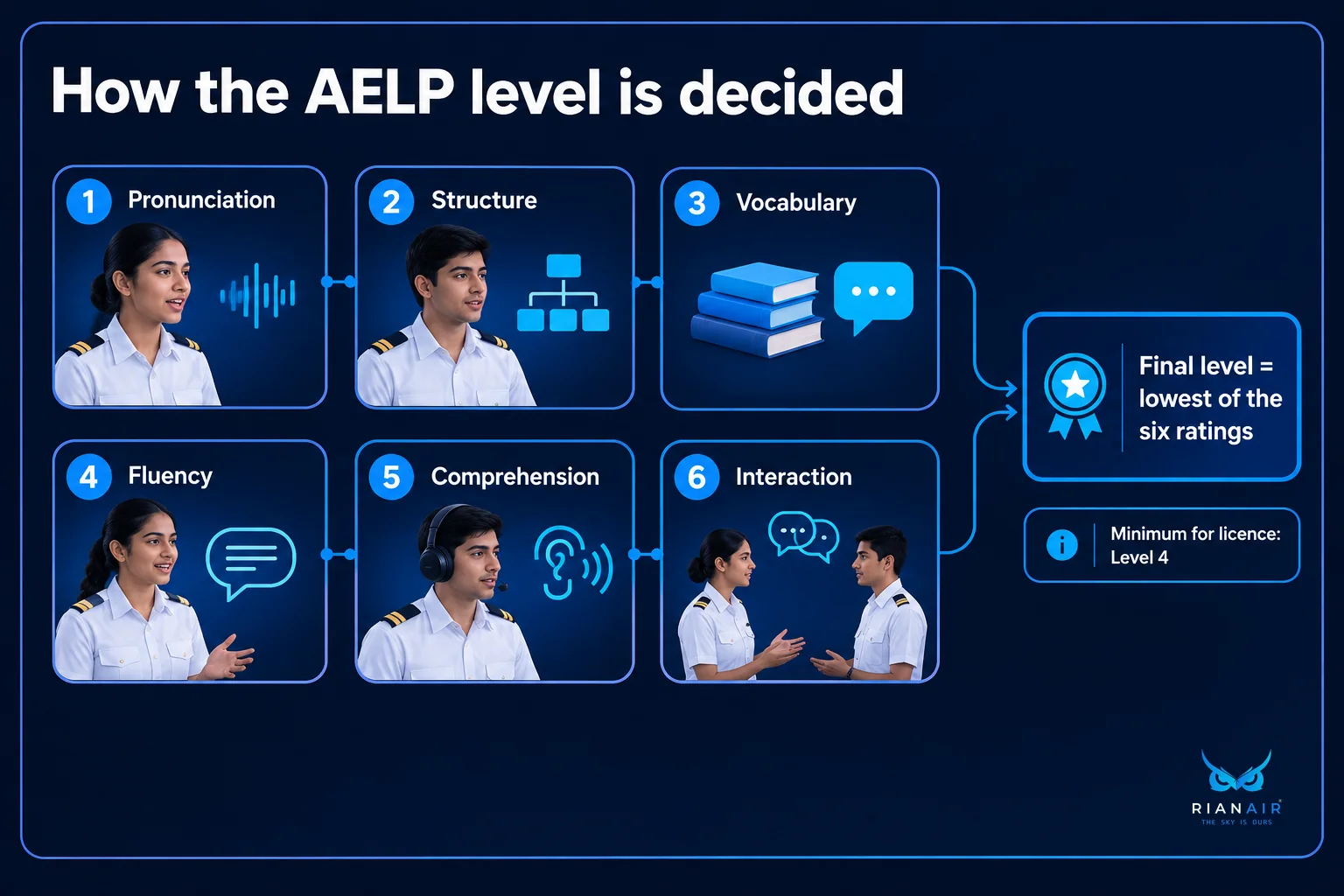
This is why students who speak fluently but struggle to understand a fast question can still land on Level 3. Balanced practice across all six areas matters more than polishing one. The table below shows what each level means for your licence, following the ICAO scale as DGCA applies it.
| Level | Name | Accepted for licence | Re-evaluation |
|---|---|---|---|
| 6 | Expert | Yes | Not required |
| 5 | Extended | Yes | Every 6 years |
| 4 | Operational | Yes | Every 3 years |
| 3 | Pre-operational | No | Further training needed |
| 1 and 2 | Pre-elementary and Elementary | No | Further training needed |
Level 4 is the floor, and a Level 4 holder must be re-tested every three years, as the ICAO Personnel Licensing FAQ sets out for proficiency below Level 6. A student who reaches Level 5 or 6 spends less future time on re-evaluation, though there is no need to chase a higher level to qualify for a licence.
What interlocutor-led tasks look like, and common causes of Level 3
The live test is face to face. An interlocutor leads the conversation and asks you questions, while a two-member rater team, an operational expert and a language specialist expert, rates you. You are not reading from a script. You answer what is asked, which is why comprehension and interaction are rated alongside speaking.
Because the final level is the lowest of six ratings, a Level 3 usually comes from one weak area rather than overall weakness. Common patterns, following the six skills above:
- Comprehension: you answer a different question from the one asked, or cannot follow a fast or unexpected question.
- Interaction: you do not ask for repetition or confirm what you heard, and guess instead.
- Fluency: long hesitations when the topic moves away from routine phrases.
- Vocabulary and structure: you cannot explain a problem, delay or diversion without routine phrases.
- Pronunciation: unclear words that interrupt understanding.
Ask your trainer for skill-wise feedback so you know which of the six is holding your level down.
5. Training Before the Test: Hours, Age and Education
Here is the answer in one place, drawn from the DGCA CAR, Section 7, Series G, Part III:
- Age and education: not less than sixteen years of age on the date of application, and a pass in the Class Ten examination or its equivalent from a recognised Board.
- 30 hours: an applicant who has passed the English exam in Class 10 or 10+2 must undergo offline or online training from a DGCA-approved organisation for a minimum of at least 30 hours before appearing for the test, subject to having passed all written examinations for issue of the licence.
- 200 hours: applicants without that English pass need at least 200 hours of training.
- Standard: at least ICAO Operational Level 4 must be demonstrated to the Director General.
- Validity: Level 4 is re-evaluated every 3 years and Level 5 every 6 years, as in the table in section 4.
Training is not needed again if your licence already carries a valid AELP endorsement and you only need it re-endorsed. For a first-time student, the hours cover the same six skills the test rates, so the course mirrors the exam.
The CAR says the test is run by a test team of an interlocutor plus a two-member rater team, made up of an operational expert and a language specialist expert. It is conducted face to face only, at the approved address of the testing service provider, and is recorded on audio and video. The CAR does not fix a test duration or a fee.
Our fee: training and testing together, with classes Monday to Friday and the test on Saturday, cost INR 35,000 + GST.
Retest: the CAR does not state a waiting period. It says a candidate rated below Operational Level 4 must show evidence of at least 30 hours of fresh aviation English training before a retest, or the training recommended by the language specialist expert rater, whichever is higher.
Documents for test day and how to apply
The CAR does not list identity documents in the text we have quoted, so confirm them in writing with the provider. Carry at least the following, and check the rest with us:
- Proof of identity, as the provider specifies.
- Evidence of your Class Ten pass or equivalent, and of the English pass if you claim the 30-hour route.
- Your training completion record from the approved organisation.
- Proof that you have passed the written examinations for the licence, where the 30-hour route applies.
To apply, send an enquiry to Rian Air through our website. We enrol you in the Monday to Friday online classes and arrange the Saturday test in Delhi. For queries to DGCA directly, the Flight Crew Training and Licensing directorate is listed on the DGCA contact page.
We do not have confirmed upcoming Saturday test dates, a first-attempt pass rate, or a typical wait for a slot to publish here. Ask our counsellors for the next available Saturday and how far ahead it must be booked, and ask any provider the same question before you pay.
6. Online Classes Monday to Friday and Saturday Testing in Delhi
Our setup is simple. AELP classes are held online from Monday to Friday, so you can attend from any city. The test is arranged on Saturdays in Delhi, which means the travel is limited to one day rather than a relocation.
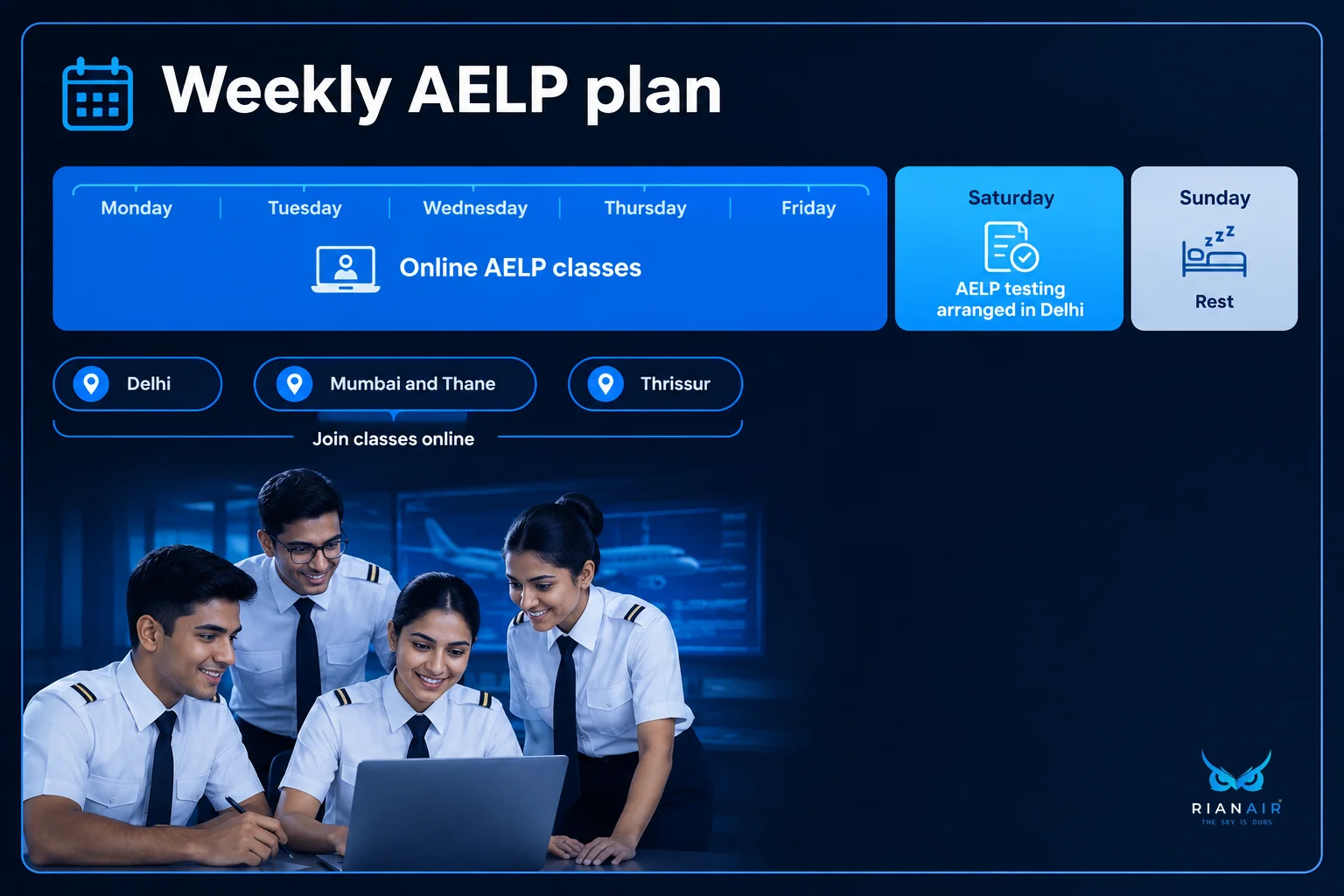
This suits students in our wider service area. Aspirants from Mumbai and Thane, where our Thane centre opens in December and online ground training is already running, can join the classes from home. Students from Thrissur can do the same, then plan one Delhi trip when they are ready to test.
Delhi students have the simplest path, since classes and testing are in the same city. Whichever city you start from, speak to our counsellors about the next available test Saturday so your travel dates are fixed early.
7. Fitting AELP Around Ground Training and Flight Training
Our ground training for Air Navigation, Meteorology and Regulations typically takes 4 to 6 months. Some students clear every DGCA exam in as little as 3.5 months, while unfocused students take more than a year. AELP should be planned inside that window, not after it.
Because AELP classes are online on weekdays, many students can run them beside ground subjects.
A worked timeline (hypothetical)
This example is hypothetical and only shows how AELP can slot into a ground-training schedule. Your dates will differ.
- Month 1: Start ground subjects and begin AELP classes online on weekdays.
- Month 3: Trainer confirms all six skills are at Level 4 or above; book a Saturday test slot in Delhi.
- Month 4: Test taken. A Level 3 result here means more training and a retest, which pushes the endorsement past your exam results.
- Month 5 to 6: Assemble the licence file with medical, exam results and logbook. A Level 3 still unresolved at this point delays the CPL file, because Level 4 must be shown on the licence.
A sensible order looks like this:
- Start AELP classes in the first ground training term, once your subject plan is clear.
- Book the test when your trainer says all six skills are consistently at Level 4 or above.
- Keep the result or certificate with your medical, exam results and logbook pages.
- Check that the level is correctly entered when the licence is issued.
Students training abroad should also watch the clock. If documents are not submitted to DGCA within 6 months of returning, recency training is repeated, roughly 18 to 22 extra flying hours. A missing English endorsement is a costly thing to discover at that stage. If you are comparing destinations, our comparison of CPL training in India, Malta and Tunisia covers the wider decision.
8. Mistakes Students and Parents Make With AELP
The same few errors repeat each batch. Parents often judge an institute on marketing rather than results, and the same habit shows up here: choosing a test provider because it was easy to find, not because it is on DGCA's approved list.
- Treating it as school English. The test rewards clear communication, not literary vocabulary.
- Waiting for the CPL application. Training hours and test slots take weeks.
- Skipping the approval check. Confirm the provider on DGCA's list.
- Memorising scripts. Interaction and comprehension are rated, so you must respond to what is actually asked.
- Ignoring the weakest skill. The lowest rating sets your level.
- Forgetting the validity period. A Level 4 result is re-evaluated every three years.
9. Practice Habits for Test Day and Airline Interviews
Short, daily practice works better than a cram session. Spend ten to fifteen minutes speaking aloud in English about aviation topics: a weather chart, a cross-country route, a pre-flight check. Record yourself, play it back and note hesitations, unclear words and grammar slips.
Practise unexpected situations too. Imagine you must explain a delay, a diversion or a technical fault to someone who has not seen it. The test rewards pilots who can stay clear when the script runs out, and who ask politely for repetition instead of guessing.
The skill pays off again later. Airline selection for non-type-rated pilots includes a group discussion and a final panel interview, and type-rated selection also includes a group discussion and a panel interview. Your AELP level opens the licence; fluent speaking carries you through those rounds.
While you work on English, keep your ground subjects moving too. The free RAPT demo is a quick progress check that shows where you stand on DGCA question practice. If you are still choosing a provider for the whole pathway, our checklist for choosing a pilot training academy in India lists what to compare.
To plan AELP classes and a Saturday test slot in Delhi, send an enquiry to Rian Air through our website and our counsellors will map the dates around your ground training.
Frequently Asked Questions About AELP
Can I take the AELP test before my CPL is issued?
Yes. Some students take the test during ground training, so the endorsement is ready when the licence application is filed. Eligibility rules such as minimum age and completed AELP training hours still apply before you can sit. Confirm the exact timing with your testing organisation before you plan around it.
What happens if I score below Level 4?
A rating of Level 3 or lower is not accepted for licensing, so further training is needed before you test again. Your final level is the lowest of your six skill ratings, so find the weakest skill, train on it and retest. Ask your trainer for skill-wise feedback.
Is an Indian accent a problem in the test?
No. The ICAO descriptors accept a regional or first-language accent as long as it stays easy for an international listener to understand. What gets marked down is unclear pronunciation that interrupts understanding. Speak clearly at a steady pace and review recordings of yourself for words that are hard to follow.
Do I need AELP again if I trained abroad on a foreign licence?
Not always. DGCA may accept English proficiency of Level 4 or above that is endorsed on a licence issued by an ICAO member state. If your foreign licence carries no endorsement, or a lower level, plan for AELP in India. Check your licence page and ask DGCA before assuming either way.
How should an outstation student plan the Saturday test in Delhi?
Treat it as a one-day trip. Attend the Monday to Friday online classes from home in Mumbai, Thane or Thrissur, then travel to Delhi so you arrive rested before the Saturday slot. Confirm the reporting time and required identity documents with our team beforehand, and avoid a very tight return booking.
Does my Class 10 or Class 12 English score count?
No. The CAR requires a pass in the Class Ten examination or its equivalent, and a Class 10 or 10+2 English pass sets the 30-hour training minimum, but the marks do not decide your AELP level. The level comes only from your live speaking performance across six skills. Students with good school marks can still find themselves hesitant when asked unexpected questions.
Can I start AELP training at 16?
Yes. The CAR requires you to be not less than sixteen years of age on the date of application and to have passed Class Ten or its equivalent. That means you can finish AELP before turning eighteen, the minimum age for a Commercial Pilot Licence.
What documents should I keep after the test?
Keep a copy of your AELP result or training certificate with your medical, exam results and logbook pages. DGCA rules say the proficiency level is indicated on the licence, so check that the level is entered correctly when the licence is issued. Raise any mismatch at once, not at renewal.
Can a student who is weak in English still become a pilot?
Yes. Levels below 4 call for further training, not disqualification. A student who starts with hesitant English can attend structured training, practise daily and retest. The earlier you begin, the more room you have to improve before your CPL application is due.
Recommended Resources
Start Your Pilot Journey Try Our Free RAPT Demo Now Home Rian Air