



After CPL What Next If You Still Don't Have an Airline Interview Call
After CPL, what next? If no airline interview call has come yet, use the gap to prepare for a type rating, keep your simulator and instrument skills sharp, and rehearse the written and technical tests airlines run. The wait is common. It is not a verdict on you, and pilots in Delhi and across India fill it with deliberate preparation.
Key Takeaways
- The gap is normal: India does not lack licensed pilots so much as pilots with the right type rating and experience, so a quiet phone after CPL says little about your ability.
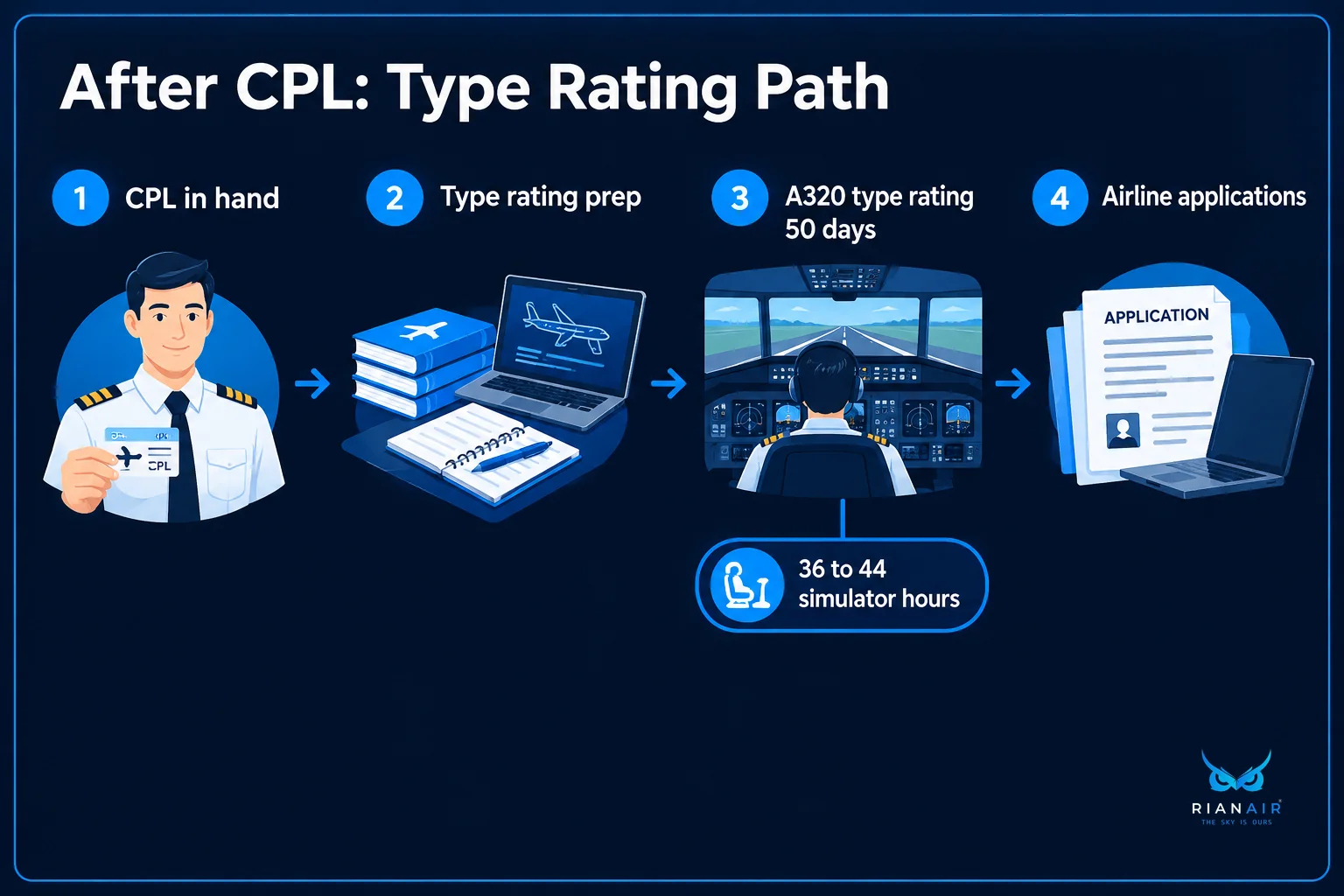
- Type rating timing: Pick A320 or B737 based on the airline you are targeting. Rian Air's A320 programme runs 50 days, and a typical type-rating course takes 8-10 weeks depending on the student.
- Simulator time is where skill shows: A type-rating programme at Rian Air includes 36 to 44 hours on a simulator, so practise instrument scans and procedures before you start.
- Revise theory continuously: RAPT lets you build mock exams in the exact DGCA format or customise them by chapter, weak area and difficulty.
- A type rating is not a job offer: It makes you employable. Airlines still run written, psychometric, simulator, interview and medical rounds.
At a Glance: Your Post-CPL Plan
| Action | When | What it involves | Rian Air detail |
|---|---|---|---|
| Paperwork and currency check | First 2 to 4 weeks | Licence, medical validity, computer number, logbook, CV, airline career portals | Digital logbook on RAPT |
| Theory revision | Ongoing | Chapter-wise question practice and timed mocks | Multiple mock exams in exact DGCA format, customisable filters |
| Choose A320 or B737 | Before booking a course | Match the type to the airline fleet you are targeting | A320/B737 type-rating preparation |
| Type rating course | Typically 8-10 weeks | Ground school plus simulator sessions | A320 programme: 50 days |
| Simulator sessions | During the course | 36 to 44 hours on a simulator | Included in the type-rating programme |
| Type rating fee | Plan before enrolling | Entry-level fee for a type rating through channel partners | ₹15 lakh |
| Interview rounds | Alongside all of the above | Written exam, psychometric test, group discussion, panel interview, medical | Counsellor guidance on readiness |
Why Is There a Gap After CPL With No Interview Call?
The gap exists because airline hiring runs in cycles and favours pilots who already hold a type rating and recent flying. A fresh CPL alone rarely triggers a call. Many new commercial pilots wait several months.
That wait reflects market timing more than personal ability. The Government of India has stated in a PIB release that there is no shortage of pilots in India, but a shortage of type-rated commanders on certain aircraft types. That sentence explains your position well. Airlines hunt for people who can be useful quickly, and a CPL without a type rating sits at the start of that line.
There is also plain paperwork time. The Ministry of Civil Aviation has said the indicative timelines for issue and conversion of a CPL are 20 and 30 working days. Some of your early quiet weeks may simply be the licence reaching you in full.
Here is what is not settled: nobody can tell you when your call will come. Hiring depends on fleet plans, retirements and training capacity. What you can control is whether you are ready on the day it does.
Reframe the gap as preparation time
Pilots who treat the wait as an extension of their training tend to walk into interviews with fresher knowledge and recent simulator hours. Pilots who step away for a long stretch often find the instrument scan and the systems knowledge have gone rusty.
Parents who funded the CPL want to see movement. A written plan with dates, as laid out below, answers that worry better than reassurance does.
After CPL, What Next? Your First 30 Days
In the first 30 days, confirm your documents are in order, keep your medical and logbook current, build a clean CV, register on airline career portals, and fix a revision routine. These small checks stop avoidable delays when a recruiter finally does call.
Check the licence and the basics. Confirm that your CPL, radio telephony endorsement and Class 1 medical are valid and that the details match across documents. A name mismatch or an expiring medical can stall an application at the last step.
The DGCA requires a minimum of 200 hours of actual flying for a CPL, so your logbook should show that clearly.
Tidy the logbook and CV. Recruiters scan hours by type, night, instrument and cross-country. Keep entries consistent and signed where required. If you already log on RAPT, the digital logbook keeps this in one place. Your CV should fit on one page and lead with licence, total hours, medical class and English proficiency.
Register and watch. Create profiles on the career pages of every Indian carrier you would want to join and check them weekly. Hiring windows can be short. Our pathways page lays out the routes available after CPL so you can compare them with your own situation.
Keep your hands in. Even a few hours a month on a simulator is better than none. If you cannot fly, schedule recurring self-study blocks so that the technical syllabus stays fresh.
When Should You Start Type Rating Preparation?
Start preparing now, even before you book a course. Study the aircraft's systems and standard procedures while you wait. Then enrol in the type rating when you have chosen A320 or B737 and arranged the fee.
Preparation itself costs little; the course is the expensive step.
Choose the type before the course
Pick the aircraft that matches the airline you most want to join. In practice, the A320 family is flown by several large Indian carriers, and the B737 by others. Because fleets change, check each airline's current fleet and recent recruitment notices before you commit. Our guides on A320 versus B737 type rating go through the decision in more depth.
What the course looks like at Rian Air
Rian Air's entry-level type rating fee is ₹15 lakh through channel partners, and the A320 programme takes 50 days. More generally, a type-rating course takes 8-10 weeks depending on how the student performs.
During the programme, 36 to 44 hours are spent on a simulator. Accommodation is usually included in the package, at 25 euros per person per day with meals included. We quote these as our programme figures; fees at other providers will differ, so compare the written fee sheet line by line before you pay.
What to do before day one
Arrive knowing the basics, because the course moves quickly. Revise aerodynamics, jet engine basics, the electrical and hydraulic systems at a general level, and standard radio phraseology. Practise reading a flight deck panel from photographs.
Then rehearse the scan: attitude, airspeed, altitude, heading, in that rhythm, until it stops feeling like effort.
One honest caution: a type rating makes you employable, but it does not guarantee a job. Spend the ₹15 lakh only when you have a realistic funding plan. If you are weighing loans, the education loan guides on this site cover what banks ask for. Rian Air's partner banks usually take anywhere from one to three months to sanction a loan, because they need every document before they decide, so start paperwork early.
How Do Simulator Hours and RAPT Practice Build Airline-Ready Skill?
Simulator hours build the hands-on habits airlines test, such as instrument scanning, checklist discipline and handling abnormal situations. Question practice builds the theory behind those habits.
Used together and regularly, they keep you interview-ready and make a type-rating course feel like a continuation instead of a restart.
Simulator practice with a purpose
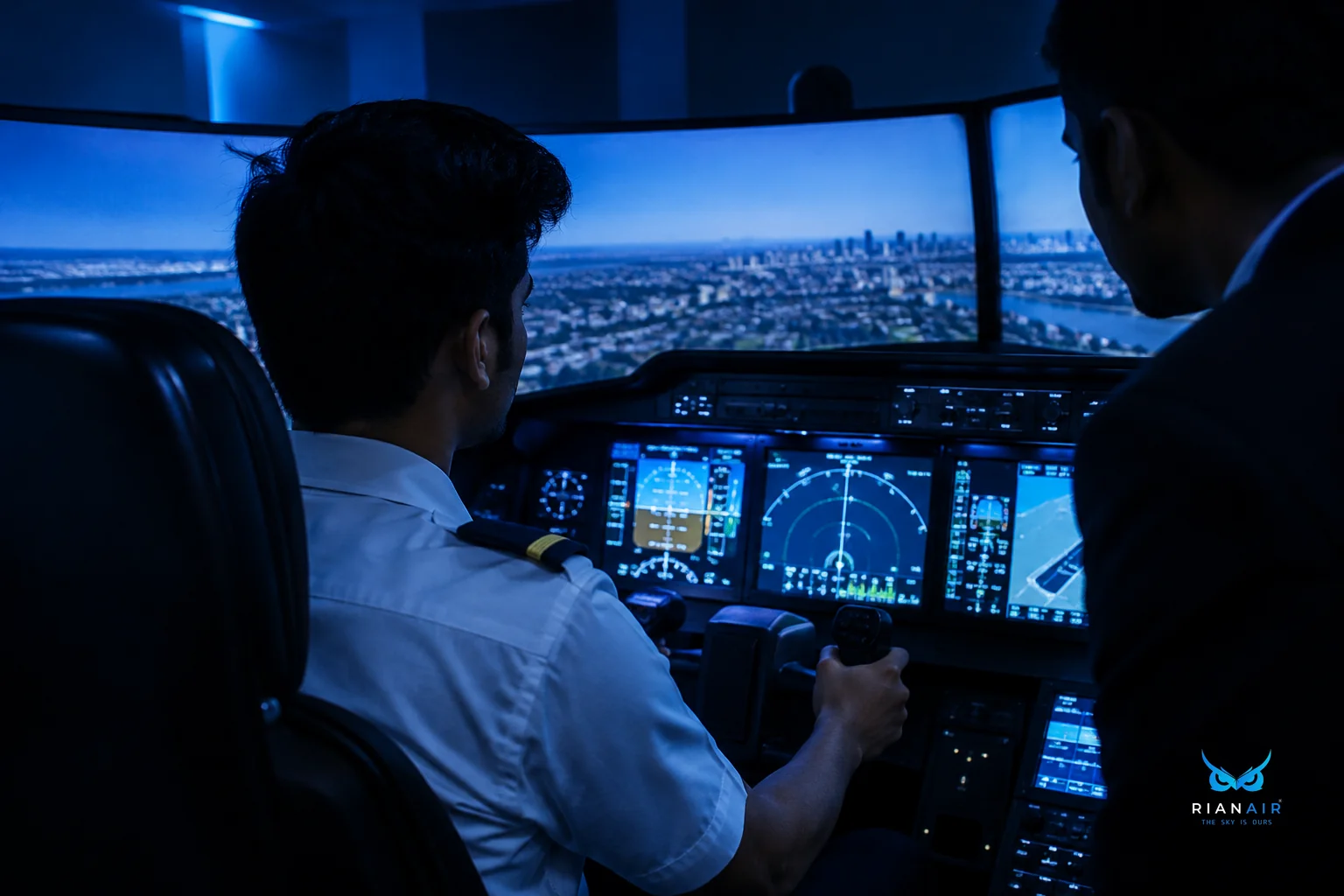
A simulator session without a goal is just flying for fun. Before each session, choose one skill: a clean instrument approach, a go-around, a crosswind landing, an engine failure after take-off. Fly it, review where you drifted, and fly it again.
Rian Air offers hybrid simulators in Delhi and a fixed-base C172 simulator in Kerala. Students in Delhi, Mumbai and Thrissur can ask the team which setup suits their stage. If you want to understand what the fixed-base option actually trains, this explainer on fixed-base simulator training covers it.
Theory practice on RAPT
Airlines still ask technical questions, and your DGCA subjects are the base. RAPT carries a 20,000+ question bank with multiple mock exams. You can run a test in the exact DGCA format or customise it by chapter, weak areas, and easy, moderate or hard mode.
That makes it simple to find the three topics you keep missing and drill them.
Students describe the app in their own words. One reviewer, Mihir F., wrote on Google: "The app is really good, there are a lot of questions in it." Another, Abhishek V., said: "The trainers are highly experienced, supportive, and always willing to clear doubts with patience." These are customer reviews, not our claims, but they match what we hear.
On Air Navigation specifically, 35 of the 38 Rian Air students who used our question bank cleared the DGCA paper in the first attempt. Air Navigation is one of the heavier papers, and the same discipline of timed, chapter-wise practice applies to airline technical tests. You can read about the full RAPT question bank and how its modes work.
What Do Airlines Test Beyond Your Licence?
A licence gets your application seen; the recruitment rounds decide whether you progress. The format differs for non-type-rated and type-rated pilots, and the exact tests vary by airline. Rehearse each round separately.
Non-type-rated CPL holders, in order:
- Written exam. Expect questions drawn from your ground subjects: navigation, meteorology, regulations and aircraft systems. Time yourself and aim to finish with minutes to spare for flagged questions.
- Psychometry test. This looks at personality and judgement. Candidates have reportedly been asked how they would handle a commander who is drunk or incapacitated, or unruly passengers. Practise calm, safety-first answers.
- ADAPT or Compass test. Which one you face depends on the airline. Both are aptitude assessments, so practise multitasking and spatial reasoning on legitimate practice material and on a simulator. We do not have a verified number of practice hours for these tests. A sound routine is short, regular sessions: one skill per session, such as tracking a heading while doing mental arithmetic, then reviewing errors. Ask the airline's recruitment notice or your counsellor which test it uses.
- Group discussion. Listen, contribute clearly and stay respectful of other candidates.
- Final interview with a panel. Prepare short, honest answers about why you chose aviation and how you handle pressure.
- Medical test, including a drug test. Keep your Class 1 medical current and avoid surprises.
Type-rated pilots, in order:
- Written exam
- Psychometric evaluation
- Group discussion
- Simulator assessment based on the specific aircraft you are rated on
- Interview with a panel
- Medical tests
Rian Air counsellor guidance prepares students for the format that applies to their airline. A reported case shows why the psychometric round matters: Air India rejected nearly a fourth of the type-rated pilots it invited for a senior trainee pilot post because they failed the psychometric test, and then turned to CPL holders without a type rating.
For the interview, expect a question on what you did during the gap. "I completed a type rating, logged simulator hours and revised theory weekly" lands far better than a vague "I was waiting".
For a closer look at what panels value, read our piece on what airlines look for in a first officer interview.
What Can You Do After CPL Besides a Type Rating?
A type rating is one route, not the only one. While you wait, you can stay inside aviation through other work. Requirements for each role are set by the employer and by DGCA, so check the current rules and the job notice before you commit.
- Flight instructor. Instruction builds flying hours and keeps your skills current. Instructor ratings (FIC/AFI) are governed by DGCA's Civil Aviation Requirements, Section 7, Series 'B', Part I, which covers flight crew standards, training and licensing. Read the instructor rating section there for the current eligibility conditions, such as licence, experience and training. Then ask the flying school what it requires on top. I have not quoted hours here because they change with each issue of the CAR.
- Ground teaching. Your DGCA theory knowledge in Air Navigation, Meteorology and Regulations is the base. Schools look for subject strength and the ability to explain clearly.
- Charter and other flying jobs. Operators set their own hiring criteria, usually around licence, medical, logbook hours and type experience. Ask each operator directly what it needs.
Our pathways page compares these routes with the type-rating route. If funds are limited, interim work can make more sense than a ₹15 lakh course.
What Does a 12-Week Plan Look Like After CPL?
A workable plan runs about 12 weeks: two weeks for paperwork and a skills check, a few weeks of theory and simulator practice, a type-rating course of roughly 8-10 weeks if you choose to take it, and continuing applications throughout.
The example below is hypothetical, built to show the structure.
Weeks 1 and 2. Imagine a new CPL holder in Delhi. They check the licence and medical dates, update the logbook, build a one-page CV and register on airline career portals. They also take an RAPT mock exam in full DGCA format to find their weakest chapters.
Weeks 3 to 5. They drill those chapters with customised tests, book short simulator sessions each week and read about the airline they most want to join. At the same time, they confirm the type-rating fee and funding.
If a loan is needed, they gather every document the bank asks for, because the bank needs each and every one before sanctioning.
Weeks 6 to 12. They enrol in the type rating, finishing the 36 to 44 simulator hours the programme involves, while keeping a short daily theory block. Applications stay open throughout.
If the call arrives before the course ends, they are already ahead on knowledge. If it arrives after, they carry a type rating and fresh simulator time into the room.
This is one plan, not the only one. If your funds are limited, the weeks spent on a type rating could be spent on instruction or ground-teaching work instead. We would not push anyone into a ₹15 lakh course without a clear funding source.
What Did Past Rian Air Students Do Next?
Past students took different routes into airlines. Capt. Haseen joined AIX after a type rating on a B737. Capt. Aadil joined IndiGo after a type rating on an A320. Capt. Meta was selected by IndiGo first and then completed the type rating. Each path differs in order and aircraft.
The takeaway is not that one sequence is correct. Some pilots take the type rating first and apply as type-rated candidates; others wait for selection and train afterwards. Type rating is a shorter route and airlines do prefer type-rated pilots first, so the line may be shorter, but it is not a job assurance.
Which suits you depends on funding, the airline's hiring style, and whether the airline sponsors training. Ask the airline's recent recruitment notice, not a rumour, before you decide.
We cannot promise that any student will receive a call or a job. What we can say is that these pilots prepared in the gap, and that preparation was part of why they were ready when selection came.
How Does Rian Air Support the Next Step?
Rian Air supports the post-CPL step through type-rating preparation for A320 and B737, simulator sessions, the RAPT platform for question practice and logbook tracking, and counsellor guidance. Reviewers mention help with course planning, DGCA procedures, medicals and computer numbers, all of which feed into airline readiness.
One of our reviewers, Al S., wrote on Google: "They help us plan the entire CPL journey". We quote that as a review, in the reviewer's words. The practical part is simple: a counsellor can review where you stand and suggest a plan with dates.
On money, our promise is limited and specific. If Rian Air fails to get a student through the DGCA exams, the student gets their money back. The conditions and claim steps are not listed here, so ask our academic counsellor for them before you enrol.
This promise concerns the DGCA exams, not airline selection or the type-rating outcome.
Costs elsewhere can surprise families. Extra flight hours are billed at ₹30,000 each at some schools, DGCA exams add either ₹2,500 or ₹5,000 depending on whether the attempt is an OLODE or a regular one, and travel comes on top. Our guide to hidden fees in pilot training costs shows where these surface.
Frequently Asked Questions
How long after CPL does it usually take to get a pilot job?
There is no fixed time. Some pilots are called within months, others wait much longer, because hiring follows airline fleet plans and training capacity. Plan for a range of several months and keep preparing so that you are ready whenever the opening comes.
Do I need a type rating before applying to an airline?
Not always. Some airlines select candidates first and train them afterwards, while others prefer pilots who already hold a type rating. Check the most recent recruitment notice of each airline you want, and decide on the course only after that.
What should I do if no interview call comes?
Keep a weekly routine: theory revision, simulator practice, portal checks and one improvement to your CV or interview answers. Consider interim work in instruction or ground teaching to stay inside aviation while you wait.
Is a type rating worth ₹15 lakh?
It can be, if you have a clear target airline and a funding plan. It makes you employable but does not secure a job. If the money would strain your family, explore airline-sponsored selection or other pathways first.
Take the Next Step With a Plan, Not a Wait
If you are asking what comes after CPL, the strongest answer is a dated plan: paperwork now, theory and simulator practice every week, and a type rating chosen to match your target airline. Talk to a Rian Air academic counsellor about your hours, funding and timeline, and start your enquiry here to get a plan built around you.
For short explainers on type ratings, simulators and interview preparation, subscribe to Rian Air on YouTube, and follow updates on Instagram.
Recommended Resources
Start Your Pilot Journey Try Our Free RAPT Demo Now Home Rian Air