


Boeing 737 vs Airbus A320: How Indian Cadets Should Pick Their First Type Rating
In the Boeing 737 vs Airbus A320 choice, neither aircraft is better for a fresher; the right first type rating is the one flown by the airline you are most likely to join. In India that usually means the A320 family for IndiGo and the Air India group, and the Boeing 737 for Akasa Air.
Key Takeaways
Follow the airline, not the aircraft: Pick the type that your target airline operates, because a type rating makes you employable but does not guarantee a job.
Cockpit philosophy differs: The A320 is fly-by-wire with a sidestick and built-in protections; the 737 uses a conventional control column and leaves more of the flying to the pilot's hands.
Both are safe and employable: Airlines in India have large orders for both families, so the choice is about fit and timing, not prestige.
Do not rush it: Clear your DGCA papers and CPL first. Prepare for the type only when your airline target is clear.
Preparation is where we help: Rian Air offers A320/B737 type rating preparation inside the RAPT platform, with 36 to 44 hours on a simulator during the type rating program and trainers who answer doubts patiently.
Boeing 737 vs Airbus A320 at a Glance
Factor | Airbus A320 family | Boeing 737 family |
|---|---|---|
Control philosophy | Fly-by-wire; computers sit between pilot and control surfaces | Conventional column and yoke; stronger direct link to the controls |
Control device | Sidestick at the side console | Control column and yoke in front of each pilot |
Protections | Flight envelope protections in normal operation | Fewer automatic limits; pilot manages the envelope |
Indian operators a fresher may target | IndiGo, Air India group | Akasa Air, Air India group (B737-8 orders) |
Best for | Students aiming at the largest A320 fleets | Students who like hands-on handling or are aiming at 737 operators |
What it does not do | Does not guarantee a job | Does not guarantee a job |
If you are reading this in Delhi, Thane or Thrissur while deciding what comes after your DGCA exams and CPL, this guide is written for you and your parents. It compares hiring demand and cockpit design, then gives a decision path you can follow.
Which Airlines in India Hire Freshers on the A320 and the 737?
IndiGo flies the Airbus A320 family, and the Air India group has ordered both A320-family aircraft and Boeing 737-8s. Akasa Air operates Boeing 737 aircraft. So fresher demand is not "A320 only" or "737 only"; it depends on which airline's hiring window opens when you are ready.
Start with the fleet facts. IndiGo operates Airbus A320neo aircraft, and the airline has said it is India's largest passenger airline. The Air India group's order book, which a Press Information Bureau release sets out, includes A320/A321 aircraft ordered by the group. For a fleet-by-airline overview, the list of airlines of India shows each carrier's fleet and orders.
Akasa Air is the clearest Boeing-side example. In June 2026 it launched the Akasa SkyCadet programme, which covers ground training, Commercial Pilot Licence flight training and a Boeing 737 MAX type rating, as reported by The Hindu BusinessLine. The same outlet reports that Indian carriers have together placed orders for 1,631 aircraft, including 1,245 Airbus aircraft and 386 Boeing aircraft.
Why fleet size alone is a weak guide
A large A320 fleet does not mean more fresher seats. Airlines hire in waves, and a fresher competes with every other CPL holder in that wave. Fleet orders tell you where the airline is heading, not when it will open applications.
A type rating also does not hire you. Airline selection usually involves an application, written technical tests, aptitude testing, simulator checks and a medical. For what each round looks for, read our guide on what airlines look for in a first officer interview in India.
Cadet programmes versus self-sponsored routes
Under an airline cadet programme, the airline usually decides your type. Akasa's programme is tied to the 737 MAX. If you go self-sponsored, you choose the type yourself, which is exactly why this decision matters. Our airline recruiter insights piece covers the hiring view in more depth.
Where our alumni went
The airlines do not release figures on how many type-rating students they select, so we cannot give you a placement count. What we can share are named outcomes from our students:
Pilot | Airline | Type rating |
|---|---|---|
Capt. Haseen | Air India Express (AIX) | Boeing 737 |
Capt. Aadil | IndiGo | A320 |
Capt. Meta | IndiGo | Selected first; type rating done after selection |
Notice the pattern: the type followed the airline. Capt. Meta shows the other route, where the airline selects you and the type rating comes afterwards.
How Do the Cockpit Philosophies Differ?
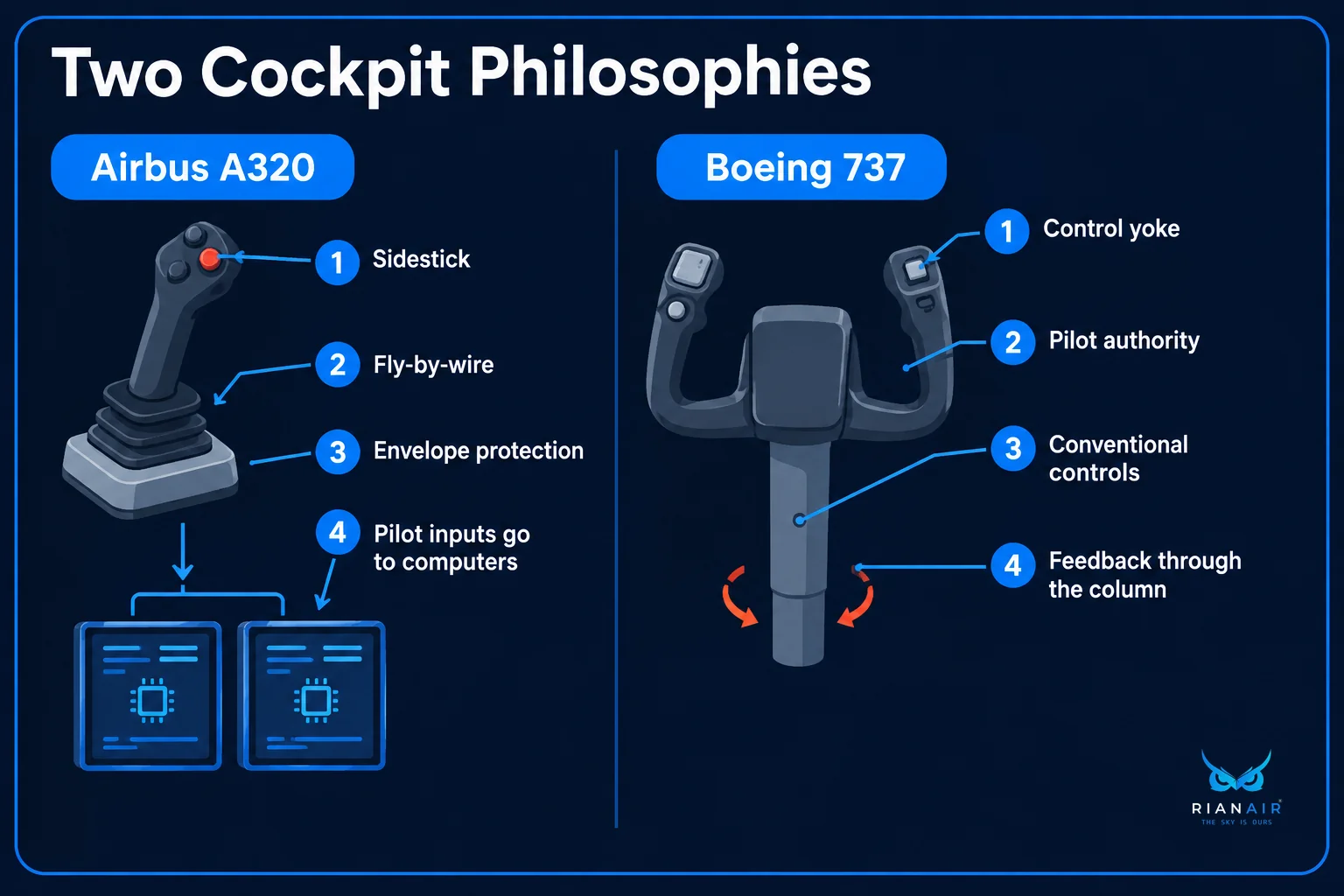
The Airbus A320 is a fly-by-wire aircraft: your sidestick input goes to computers, which move the control surfaces and apply protections against exceeding limits. The Boeing 737 uses a conventional control column and yoke, so the pilot has a more direct, hands-on link and fewer automatic limits.
Think of it as two ideas about who has the final word. Airbus built the A320 so that the computers keep the aircraft inside a safe envelope while the pilot flies. Boeing built the 737 so that the pilot's inputs act more directly on the aircraft.
What it feels like for a new type-rated pilot
On the A320, you spend much of your learning on flight management and understanding what the automation is doing and why. The sidestick is small and sits at your side, so the cockpit layout feels different from the Cessna 172 you flew in training.
On the 737, the yoke and column feel closer to the light aircraft you trained on. Students often find the handling familiar, but the aircraft asks you to manage more of the envelope yourself. Neither is "easier". Each asks you to build a different habit.
Differences you meet in type training
Three differences show up quickly in the simulator:
Thrust levers and flight mode annunciations: The A320 uses fixed detents on its thrust levers, so you set a detent and the automation manages thrust. You read the flight mode annunciator on the primary display to know which mode is active. The 737 has moving thrust levers that follow the autothrottle, so you can see and feel what the system is commanding. Both aircraft show modes on a flight mode annunciator, but the way you confirm thrust differs.
Control laws: A320 training stresses the degree of flight envelope protection that the various flight control laws provide. The Flight Standardization Board report for the A320 lists this as a special emphasis area for initial, upgrade, transition, differences and recurrent ground training.
Control input: A sidestick on the A320 versus a column and yoke on the 737, as in the table above.
Typical course structure and length
A type rating course combines ground school with simulator sessions and ends with a skill test. One public example is an A320 type-rating course tied to Airbus, which runs for a period of 60 days for CPL holders with a valid medical certificate. In our own type rating program, 36 to 44 hours are done on a simulator. Course length varies by provider, so ask each one for its schedule in writing.
Both are safe, and both are standard
Both families are certified under the same regulator rules and flown by Indian airlines every day. The Directorate General of Civil Aviation regulates civil aviation safety in India, whichever manufacturer built the aircraft.
What does differ is the training mindset. A320 training rewards good understanding of systems logic and automation modes. 737 training rewards crisp manual flying and careful scanning. Pick the style that matches how you learn, but let the airline target lead.
How Should You Choose Your First Type Rating?
Choose your first type rating by naming the airline you most want to join, checking which aircraft it flies and recruits freshers on, and then preparing for that type. If you have no target airline yet, wait, because preparing for the wrong type wastes time and money.
Use these steps in order. Each has a pass mark, so you know when to move on and when to stop.
List your top two airlines. Write them down with the aircraft each flies. Pass: both airlines are on the list with a type next to them. Stop: you cannot name an airline, so do not commit to a type yet.
Check each airline's current fresher hiring. Read its careers page and any cadet programme terms. Pass: you find a current or recent opening for first officers who are freshers. Stop: nothing is open and nothing is announced, so keep the choice open.
Confirm whether the airline fixes the type. Cadet programmes usually do. Pass: the programme names the type, so you follow it. Stop: the airline leaves it to you, so go to step 4.
Match the airline's fleet to the type. If both of your airlines fly the same family, the decision is made. Pass: both point to one type. Stop: they point to different types, so rank them by how likely you are to be selected.
Test your learning style. Ask a trainer to walk you through both cockpit styles in a simulator. Pass: one type clearly feels right. Stop: you feel no difference, so go with the airline.
Confirm the cost in writing. Ask the training provider for the total, including simulator hours and examiner fees. Our pilot training cost breakdown shows where hidden fees tend to appear.
A simple decision rule
If your target is IndiGo, prepare for the A320. If your target is Akasa Air, prepare for the 737. If your target is the Air India group, check which fleet it is recruiting for at the time, because it has ordered both families.
If you are undecided, we would not pick on price or on popularity alone. Our advice is to finish your DGCA papers and CPL first, then decide with live hiring information. No one can promise which airline will hire in which year.
What about switching types later?
You can add a second type later, and many pilots move between types during their careers. A switch costs time and money, so treat the first rating as a real investment. Prices differ by aircraft and by provider.
We cannot quote a reliable difference, so do not rely on a number you hear second-hand. One public example is a provider offering discounted rates for A320 and B737 simulator training for a limited enrolment window, which shows that quotes move with time and provider.
Ask any provider for a written quote that lists each of these items separately:
Simulator hours: how many hours are included (ours is 36 to 44 hours on a simulator), and what a repeat session costs.
Ground school: the number of days and whether the exam or certificate is included.
Examiner fee: whether it is in the total or billed separately.
Base training: whether it is required for your route, and its cost if so.
Skill test: the fee, and what a retake costs.
Also ask what happens to the rating's validity if you do not fly the type. Check the current DGCA rules, which you can find through the DGCA rules portal, and get the provider to confirm in writing how a lapse is handled and what renewal would involve.
Worked Example: Two Hypothetical Students
These two students are made up to show the logic. They are not real clients. For real outcomes, see the alumni table above.
Student A is in Delhi, finishing her CPL, and wants to join the largest A320 operator. She checks its fleet, sees the A320 family, and prepares for the A320. Her decision took one afternoon because her target was clear.
Student B is in Thane. He likes hands-on handling, but has no airline in mind. He should not pick the 737 just because it suits his style. He finishes his CPL, watches hiring announcements, and decides once one airline opens applications.
The difference is not talent. Student A had a target; Student B did not. A target turns a guess into a decision.
How Does Rian Air's A320/B737 Type Rating Preparation Fit In?
Rian Air offers A320/B737 type rating preparation inside RAPT, our pilot career intelligence platform, which is always available online on web, Android and iOS. Simulator and flight training are always in person, and trainers answer doubts with patience, as past students say in their reviews. We have not published a fee for the A320 or B737 type rating here, so ask our team for the current written quote.

Type rating preparation sits at the end of a long chain, and the chain is where most students slip. Our timeline for ground training, as we run it, looks like this:
Navigation, Meteorology, Regulations and RTR: typically cleared in the first 6 months.
Technical Specific: completed in about a month, right before flight training.
Technical General: takes about 3 months and can be done during flight training in India.
Simulator work is placed during the instrumentation portion of Air Navigation and right before students leave for flight training, so procedures stay fresh. For a deeper walkthrough, see our A320 type rating preparation simulator training guide.
Where you can learn with us
Our Delhi centre is at Ramphal Chowk, Dwarka, with a hybrid simulator setup. Our Thane centre, in Thane West, is being inaugurated in December 2026 as a full facility, and its simulator is a DA40/42 hybrid setup with a glass cockpit (G1000) and canopy. Online ground training for aspiring pilots from Maharashtra is already running, and students can move to the hybrid setup for in-person classes and simulator sessions.
In Kerala, our Thrissur centre has the C172 fixed-base simulator. Students there can study Air Navigation, Meteorology, Regulations, Technical General, Technical Specific and RTR Part 1 and 2 online.
What students say
One reviewer, Abhishek V., gave us five stars on Google and wrote: “The trainers are highly experienced, supportive, and always willing to clear doubts with patience.” Reviews like this are why we keep the support human, even when the learning is app-led.
Parents can also follow progress live, day to day, through RAPT, so there is no guessing about where a student stands. Our parent-facing explainer is in questions parents should ask about the parent dashboard.
Our money-back promise
If Rian Air fails to get a student through the DGCA exams, the student gets their money back; terms and conditions apply. We have not set out those terms here, so ask for the T&C sheet before you enrol, and read it with your parents.
Common Mistakes When Choosing a Type
Choosing on a rumour. Forum arguments about which aircraft is "better" do not decide who hires you.
Booking before the DGCA papers are done. A type rating is not a shortcut around the CPL and exams.
Judging providers on marketing. Look for real results, not celebrities or funny reels.
Ignoring the cadet programme rules. If an airline fixes your type, your own preference matters less.
Skipping the written fee. Verbal totals hide extra charges.
Fleet mixes and hiring plans change, so keep the decision tied to a named airline and recheck it close to your CPL.
FAQ
Is the A320 easier than the Boeing 737?
Neither is easier overall. The A320 asks you to understand automation and flight management logic, while the 737 asks for more hands-on handling. Students find one style more natural, so try both in a simulator briefing before you decide, and let your target airline guide the final choice.
Can I do my type rating before my CPL?
No. A type rating is an add-on to a licence, so the CPL and DGCA exams come first. You can prepare your knowledge early, but the rating itself follows your licence. Check current rules on the DGCA site before booking any course.
Does a type rating guarantee an airline job?
No. A type rating makes you employable, not employed. Airlines still run applications, technical tests, aptitude tests, simulator checks and medicals. Treat the rating as one part of your readiness, alongside interview preparation and currency in your flying and theory.
Which should a self-sponsored fresher pick if undecided?
Wait. Finish your DGCA exams and CPL, then follow live hiring news and pick the type of the airline opening applications. Picking early on guesswork risks preparing for the wrong aircraft, which costs time and money you cannot easily recover.
Take the Next Step Toward Your First Type Rating
The Boeing 737 vs Airbus A320 question is easiest once you know your target airline. If you want help mapping your DGCA exams, simulator work and type rating preparation, start your pilot training enquiry with Rian Air and speak to our team. You can also explore our training pathways to see where type rating fits.
For daily aviation study tips, follow Rian Air on Instagram, and subscribe on YouTube for walkthroughs of simulator training and ground school.