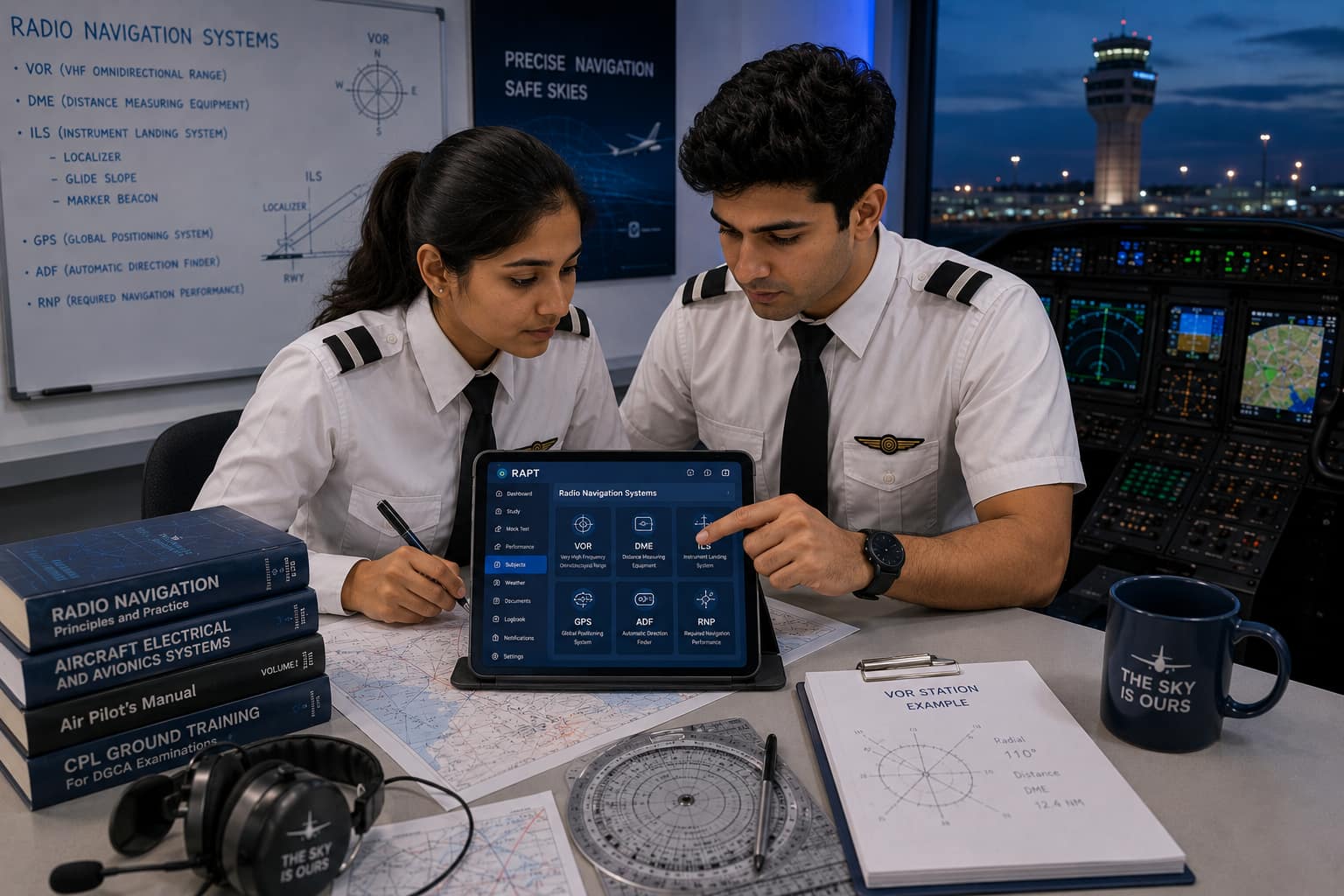
One of the most fascinating developments in aviation history has been the evolution of navigation.
Long before GPS and satellite navigation existed, pilots relied on radio signals transmitted from ground stations to determine their position and navigate safely across vast distances. Even today, despite advancements in satellite technology, radio navigation remains a critical part of aviation training and operations.
Over the years, I have noticed that many CPL students initially find Radio Navigation easier than Air Navigation because it appears more practical and instrument-oriented. However, students quickly realize that understanding how navigation aids function is essential for interpreting cockpit instruments and conducting safe flight operations.
For aspiring Commercial Pilot Licence (CPL) holders in India, Radio Navigation serves as the bridge between theoretical navigation knowledge and real-world navigation systems used by pilots every day.
— Capt. Vikas Vikramdas Nair
What is Radio Navigation?
Radio Navigation is the use of radio signals to determine an aircraft's position and guide it along a desired route.
Unlike Dead Reckoning Navigation, which relies on calculations and estimates, Radio Navigation allows pilots to obtain position information from external navigation aids.
These systems improve accuracy and enhance situational awareness during flight.
Position fixing
Route tracking
Instrument approaches
En-route navigation
Terminal area operations
Flight safety
💡
Radio Navigation transformed aviation by allowing pilots to navigate using external references rather than relying solely on calculations and visual landmarks.
Why Radio Navigation is Important for CPL Pilots
Modern pilots use multiple navigation systems throughout a flight.
Understanding Radio Navigation helps pilots:
Interpret cockpit instruments
Track airways accurately
Conduct instrument approaches
Improve situational awareness
Navigate during poor visibility
Operate safely in controlled airspace
Students who are new to aviation may find it useful to first read our guide on How to Become a Pilot After 12th Commerce in India, which explains the overall CPL pathway before exploring advanced DGCA subjects.
Evolution of Aircraft Navigation
Aircraft navigation has evolved significantly over the past century.
Understanding this evolution helps students appreciate modern navigation systems.
Dead Reckoning Navigation
One of the earliest navigation methods, relying on known position, heading, airspeed, and time.
Students interested in these concepts should also read Air Navigation for CPL Pilots in India: DGCA Complete Guide, where navigation fundamentals are discussed in detail.
Ground-Based Radio Navigation
Ground stations began transmitting radio signals that aircraft could use for navigation.
This dramatically improved navigation accuracy and operational reliability.
Satellite Navigation
Modern aircraft increasingly rely on satellite navigation systems such as GPS and GAGAN for precise positioning and route management.
Fundamental Radio Navigation Concepts
Radio Waves
Radio navigation systems operate using electromagnetic waves transmitted through the atmosphere.
Students learn how radio signals travel and how they are received by aircraft equipment.
Frequency Bands
Different navigation aids operate within specific frequency ranges.
Understanding frequency allocation is important for interpreting navigation systems correctly.
Propagation
Radio wave behavior varies depending on frequency, atmospheric conditions, and terrain.
This directly affects navigation accuracy and coverage.
Navigation Accuracy
Different navigation systems provide different levels of accuracy.
Pilots must understand the capabilities and limitations of each aid.
ℹ️
Many DGCA questions focus on the operating principles, frequencies, and limitations of radio navigation systems.
Non-Directional Beacon (NDB)
The Non-Directional Beacon (NDB) is one of the oldest radio navigation aids still encountered in aviation.
It transmits radio signals in all directions.
Aircraft equipped with an Automatic Direction Finder (ADF) can determine the relative direction of the station.
Automatic Direction Finder (ADF)
The ADF indicates the relative bearing of an NDB station and helps pilots determine aircraft position
Advantages of NDB
Simple system
Wide coverage
Low installation cost
Limitations of NDB
Susceptible to interference
Lower accuracy
Weather-related errors
VHF Omnidirectional Range (VOR)
VOR remains one of the most important radio navigation aids studied during CPL training.
It allows pilots to determine their position relative to a ground station using radials.
Start your journey
Ready to become a commercial pilot?
Our admissions team can help you map out the right training path — from zero hours to a CPL.
VOR stations transmit signals that allow aircraft to determine magnetic bearings relative to the station.
Radials
A radial represents a magnetic line extending outward from a VOR station.
Understanding radials is essential for airway navigation.
Advantages of VOR
High accuracy
Reliable operation
Extensive airway use
Distance Measuring Equipment (DME)
DME provides distance information between an aircraft and a ground station.
Unlike VOR, which provides direction, DME provides distance.
How DME Works
The aircraft interrogates a ground station and calculates distance based on signal travel time.
Slant Range Error
Students learn that DME measures slant range rather than true horizontal distance.
Understanding this limitation is important during approaches.
Instrument Landing System (ILS)
ILS provides precise lateral and vertical guidance during instrument approaches.
It remains one of the most important approach systems used worldwide.
Localizer
Provides lateral guidance to align the aircraft with the runway centerline.
Glide Slope
Provides vertical guidance during descent.
Marker Beacons
Traditionally used to provide distance information during approaches.
⚠️
Understanding ILS principles is essential because instrument approach procedures form a major part of professional flight operations.
Area Navigation (RNAV)
RNAV allows aircraft to fly directly between waypoints without relying solely on ground-based navigation aids.
This significantly improves operational efficiency.
Global Navigation Satellite Systems (GNSS)
Modern aviation increasingly relies on satellite navigation systems.
Students learn about:
GPS
GLONASS
Galileo
BeiDou
These systems provide accurate position information anywhere in the world.
GAGAN and the Future of Indian Aviation
India has made significant progress in satellite-based navigation through GAGAN (GPS Aided GEO Augmented Navigation).
GAGAN improves navigation accuracy and supports modern Performance-Based Navigation procedures.
Students interested in this topic should also read India's GAGAN Milestone: A New Era for Flight Navigation, which discusses India's recent satellite-based approach achievements and their significance for aviation.
🚨
The future of aviation navigation is increasingly dependent on satellite-based systems, but understanding traditional radio navigation remains essential for every professional pilot.
Common Challenges Faced by CPL Students
Students often struggle with:
NDB bearings
VOR radials
DME calculations
ILS interpretation
Frequency memorization
Navigation aid limitations
How to Study Radio Navigation Effectively
1Understand principles before memorizing frequencies.
2Learn one navigation aid at a time.
3Use diagrams frequently.
4Practice DGCA-style questions.
5Understand system limitations.
6Relate theory to real-world operations.
7Revise regularly.
Modern training platforms such as RAPT allow students to study chapter-wise, track performance, identify weak areas, and attempt mock examinations designed specifically for DGCA preparation.
This structured approach helps students build confidence while mastering complex navigation concepts.
How Radio Navigation Connects with Other DGCA Subjects
Radio Navigation directly supports several other CPL subjects.
Students should also explore:
Air Navigation for CPL Pilots in India: DGCA Complete Guide
Air Regulations for CPL Pilots in India: DGCA Complete Guide
Aviation Meteorology for CPL Pilots in India: DGCA Complete Guide
Together, these subjects provide a comprehensive understanding of modern flight operations.
Related Radio Navigation Articles
This article serves as the parent pillar page for the Radio Navigation section of the Rian Air DGCA Knowledge Hub.
Future detailed guides will include:
NDB Explained for CPL Students (Coming Soon)
ADF Explained (Coming Soon)
VOR Explained (Coming Soon)
DME Explained (Coming Soon)
ILS Explained (Coming Soon)
RNAV Explained (Coming Soon)
GNSS Explained (Coming Soon)
GAGAN Explained (Coming Soon)
Frequently Asked Questions
Is Radio Navigation difficult for CPL students?
Most students find Radio Navigation manageable once they understand the operating principles of individual navigation aids.
What is the difference between VOR and DME?
VOR provides directional information, while DME provides distance information.
Why is ILS important?
ILS provides precise guidance during instrument approaches and is widely used worldwide.
Will GPS replace traditional radio navigation aids?
Satellite navigation is becoming increasingly important, but pilots must still understand traditional navigation systems and procedures.
Final Thoughts
Radio Navigation represents one of the most significant technological developments in aviation history.
Understanding how navigation aids function not only helps students succeed in DGCA examinations but also prepares them for real-world flight operations.
Whether using an NDB, tracking a VOR radial, flying an ILS approach, or navigating using satellite systems such as GAGAN, the underlying objective remains the same: helping pilots navigate safely and efficiently.
A strong foundation in Radio Navigation will continue to serve pilots throughout their aviation careers.