


Pilot Training in Delhi vs Mumbai vs Kerala: Rian Air Fees
Pilot Training in Delhi vs Mumbai vs Kerala: Rian Air Fees
Pick the Rian Air hub closest to where your family lives, then check the fee. Ground training costs ₹1,00,000 in Delhi (including RTR) and ₹1,00,000 in Thane West, Mumbai. In Thrissur, Kerala, it is ₹1,25,000. 18% GST is charged extra at every centre, and the simulator hours and RAPT practice are the same everywhere.
That is the short version of pilot training in Delhi, Mumbai and Kerala for the ground stage. The Delhi and Thane prices are introductory, so confirm the current figure before you pay.
The full pilot path in Delhi has four stages. First is ground school, where you study the DGCA subjects and clear the exams. Second is flight training at a DGCA-approved flying training organisation (FTO), where you build the hours behind the CPL.
Third is type rating on an aircraft such as the A320 or B737. Last comes airline readiness. This guide compares the ground stage, and the flight stage is covered in its own sections below.
At Rian Air, the Delhi centre sits at Ramphal Chowk in Dwarka, the new Thane centre opens on 20 December 2026, and the Kerala centre is in Thrissur.
This guide compares the three hubs on fees, commute, simulator access, living costs and exam logistics. Fees are the ones Rian Air charges. Living costs are only an assumption, because they depend on your own needs.
How to confirm the Delhi cost before you pay
Call the Delhi admissions line on +91 737 747 757 9 (Kerala: +91 737 787 727 3; Thane uses the Delhi number). Ask for a written breakdown with the 18% GST shown, whether the introductory price is still current, and your batch start date. Delhi batches start every month, and the next one is on 5 December 2026.
For the flight stage, ask each DGCA-approved FTO for its own fee in writing, since we do not set it.
Delhi ground school at a glance
Timeline: about 4 months. Air Navigation runs for 2 months, Air Regulations for 1 month and Aviation Meteorology for 1 month.
RTR: 15 days, included within those 4 months.
Class timings: two batches, 10 am to 1 pm and 2 pm to 5 pm.
Simulator: sessions run during the Air Navigation classes.
Pilot training in Delhi, Mumbai and Kerala side by side
The table below puts the three centres next to each other. All three teach the same DGCA ground subjects and use the same RAPT™ question bank and digital logbook. What changes is the fee, the simulator type on site and how soon you can sit in a classroom.
Factor | Ramphal Chowk (Delhi) | Thane West (Mumbai) | Thrissur (Kerala) |
|---|---|---|---|
Ground training fee per student | ₹1,00,000 including RTR (introductory) | ₹1,00,000 (introductory) | ₹1,25,000 |
Taxes | 18% GST, extra | 18% GST, extra | 18% GST, extra |
Simulator on site | Hybrid simulators; the fee covers DA40/42 simulator training | DA40/42 hybrid with G1000 glass cockpit and canopy | C172 fixed-base (Kerala's first) |
Simulator hours included | 5 hours, usable at any of the three centres | 5 hours, usable at any of the three centres | 5 hours, usable at any of the three centres |
Class format | In person, with online classes available | Online now; hybrid and in person once the centre opens on 20 December 2026 | In person |
Study space | Library on site | Library on site | RAPT Library |
Two points are easy to miss. First, the fee is for ground training only; flight hours are priced separately.
Second, we usually offer a full course package to ab initio pilots, but subject-wise classes are taught online and the whole package is never forced on a student. In-person classes cover all the subjects and are sold as a package.
What does pilot training in Delhi cost, and what does living there add?
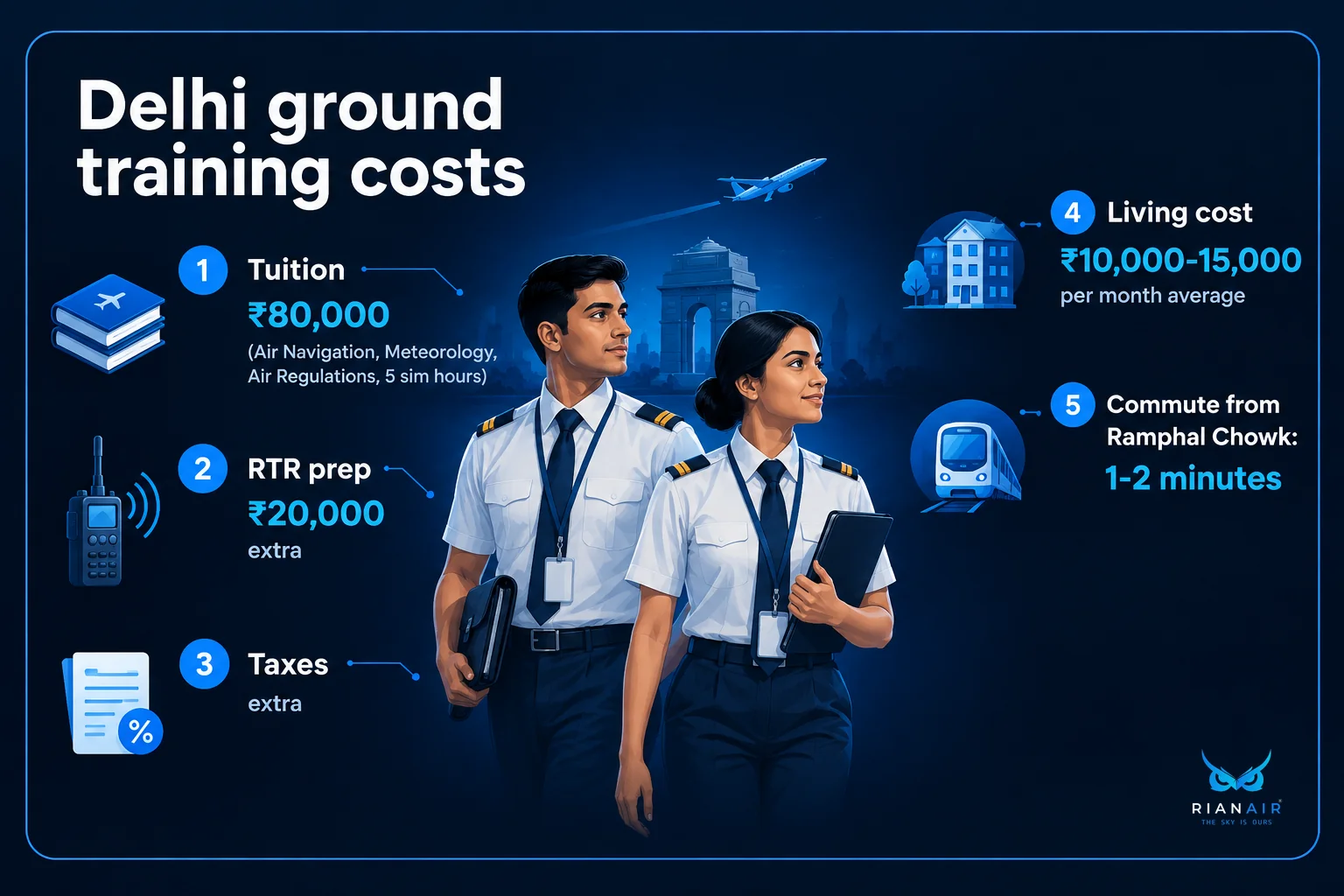
Living costs add roughly ₹8,000 to ₹25,000 per month for one student in Delhi. This is an estimate, not a quoted price. It depends on the type of accommodation and how many people share, such as staying alone, twin sharing or triple sharing.
The ₹1,00,000 splits into ₹80,000 for the three ground subjects plus 5 hours on a DA40/42 simulator, and ₹20,000 for RTR preparation. RAPT is included during training. 18% GST applies to both parts.
Commute from Ramphal Chowk
Our Delhi building is at G-94, Ramphal Chowk Road, adjacent to Storeex 24×7 and opposite Vijay Sales, in Sector 7 Dwarka (Palam, New Delhi 110077). Accommodation is within walkable distance of the centre, and students who rent nearby reach it in one to two minutes from Ramphal Chowk.
Students already in Delhi can stay at home and spend little beyond travel. Students arriving from other states should budget for rent, food and local transport inside the ₹8,000 to ₹25,000 estimate, and adjust it to how they plan to stay. For a fuller fee breakdown, read our guide to pilot training fees in Delhi.
Worked example: a hypothetical Delhi student
This is a hypothetical, built only from the figures above. Take a student relocating to Delhi who finishes in 3.5 months, the shortest time some students have taken to clear every DGCA paper. Ground training is ₹1,00,000.
Living at ₹8,000 to ₹25,000 a month for 3.5 months is ₹28,000 to ₹87,500. The fee carries 18% GST, which is ₹18,000 on ₹1,00,000. That makes ₹1,46,000 to ₹2,05,500 in total.
The living part is an assumption and changes with your needs. A student who lives at home in Delhi would pay the fee and GST plus travel.
Online subject-wise fees and simulator rates
If you only need some papers, online subject-wise classes are charged per subject, plus 18% GST: Air Navigation ₹40,000, Air Regulations ₹20,000, Aviation Meteorology ₹20,000 and RTR ₹20,000. Extra simulator sessions with an instructor are ₹2,000 per hour plus 18% GST.
Living costs in Thane and Thrissur
Living costs depend on the accommodation you choose and how many people share. In Thane they range from ₹8,000 to ₹25,000 a month, the same as Delhi. In Thrissur they range from ₹8,000 to ₹12,000 a month including food. These are estimates, not quoted prices. Accommodation is within walkable distance of the training centres in Delhi, Thane and Thrissur, so daily travel adds little.
Worked example: Kerala vs Delhi
This is a hypothetical, using the same 3.5 months for both students and only the figures above. A Thrissur student pays ₹1,25,000 plus ₹22,500 GST, which is ₹1,47,500. Living at ₹8,000 to ₹12,000 a month adds ₹28,000 to ₹42,000, so the total is ₹1,75,500 to ₹1,89,500.
A Delhi student pays ₹1,00,000 plus ₹18,000 GST, which is ₹1,18,000. With living costs of ₹28,000 to ₹87,500, the total is ₹1,46,000 to ₹2,05,500. The lower Delhi fee is offset if you choose costlier accommodation, so the cheaper centre depends on how you plan to live.
How do you choose a ground school in Delhi?
Ground schools are private organisations that teach the DGCA subjects, and no separate approval is required to run one.
The approval lists on the DGCA website cover flying training organisations, which is the flight stage, not ground school. So judge a ground school on what you can see and verify yourself.
Ask about the syllabus. It should cover every DGCA subject you need to sit, not just the three or four easiest.
Ask for results. Ask how many students cleared their papers and over what period, and whether the figure is for the whole academy or a single batch.
Check practice and simulator access. See the classroom, the library, the simulator and the question bank you will study from.
Get the fee in writing. It should show what is included, what is extra and the 18% GST.
Whichever academy you pick, the DGCA exams themselves are booked by you on the DGCA Pariksha portal.
How is Delhi ground school different from CPL flight training?
Ground school is the theory stage. You study the DGCA subjects, practise on RAPT, log simulator hours and sit the DGCA exams. CPL flight training is the separate stage where you fly an aircraft and build flying hours at a DGCA-approved flying training organisation.
The Delhi fee here covers ground school only. The flight stage is where you log the hours behind the licence.
A CPL for aeroplanes needs a minimum of 200 hours of flight time, and that total includes pilot-in-command, cross-country, instrument and night flying. The hour requirements sit in Schedule II of the Aircraft Rules, 1937.
DGCA's flying training syllabus CAR (Section 7, Series B, Part VII) applies that schedule and sets what the training must cover, including dual instruction with an authorised flight instructor, cross-country flying, abnormal and emergency procedures, night flying and threat and error management.
Flight school fees vary from time to time with fuel prices, yearly fee hikes and the aircraft fleet type, so your actual total depends on the flying organisation and how quickly you build hours. Confirm the current minimums in DGCA's CAR on CPL before you plan your flying budget.
A full pilot path runs from ground school and DGCA exams, to flight training, then type rating and airline readiness. Ground school is where most students start, and clearing the papers early keeps the later stages on schedule.
How do you pick a flying school after ground training in Delhi/NCR?
Once your papers are cleared, the next stage is flight training. The Aircraft Rules, 1937, require that the flying experience for private and commercial pilot licences is acquired only at a DGCA-approved FTO. So start by confirming that any school you consider holds a current approval.
The FTO CAR says no person may operate as an approved FTO without an approval certificate, and the FTO must display that certificate where the public can see it in its principal place of business.
DGCA also publishes a ranking system for FTOs. Its public notice scores categories such as availability of ground school and simulators. Use the same notice as a checklist when you visit a school.
Ask to see the approval certificate and check the school appears on the DGCA-approved list.
Ask which base your training will happen at, since an FTO can operate on several bases.
Ask for the fee in writing. DGCA has issued guidelines for the agreement between FTOs and trainees (Flying Training Circular 02 of 2026), so read your agreement against it before signing.
Ask what happens if you fail a medical or need to pause training.
Our flight-training partner is Indian Flying Academy. Its fee is currently ₹59.5 lakh for 185 hours on a single-engine DA40 and 15 hours on a multi-engine DA42, which makes 200 hours in total. That fee is set by the academy, not by our ground school, and it can change, so get the current figure and what it covers in writing. You are free to compare it with any other DGCA-approved FTO.
To compare approved FTOs near Delhi, line them up on the same points: the base where you will train, the aircraft fleet, the price per flying hour and the hours the quote covers, the instructor-to-student ratio, and what the agreement says about medical failure or a pause.
The Times of India reported in April 2026 that a CPL in India, which involves a minimum of 200 hours of flying, now costs about Rs 60 to 70 lakh, up from Rs 50 to 60 lakh earlier. Treat that as a planning range, since each FTO's quote depends on fuel prices and fleet type.
Ramphal Chowk, Thane West and Thrissur: what each hub offers
Delhi suits North India students, and anyone willing to relocate for a short, intensive ground stage. Thane serves Mumbai, Navi Mumbai and Thane families. Thrissur serves Kerala students who want in-person classes close to home.
Ramphal Chowk, Delhi
Delhi has hybrid simulators on the premises. The fee includes RTR, which keeps the Delhi package simple for students who also want radio telephony covered.
DGCA weighs these facilities too. Its public notice on ranking flying training organisations lists a dedicated ground school for CPL exam preparation and approved simulators as a scored category. So ask any academy, including us, to show you the classroom and the simulator before you pay.
Thane West, Mumbai
Our Thane centre is at Rian Air, opposite Shree Bhagyalakshmi Bungalow, Anand Park, Thane West, Maharashtra 400601. Note that it is in Thane, not Mumbai proper.
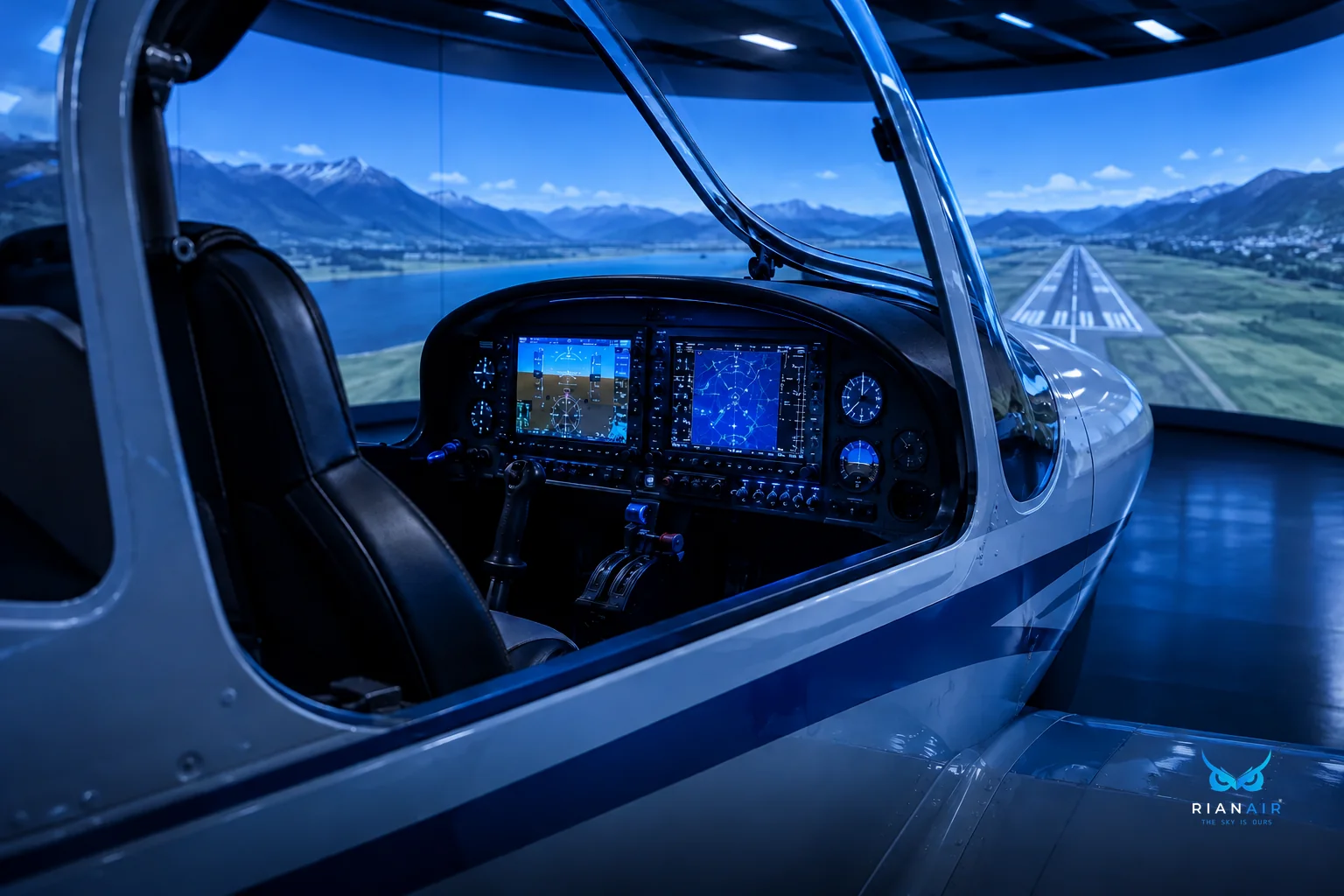
It opens on 20 December 2026 as a full facility with a library and a DA40/42 hybrid simulator that has an original G1000 glass cockpit and canopy.
You do not have to wait for the doors to open. Online ground training for aspiring pilots from Maharashtra is already running.
Once the centre is open, students can move to a hybrid set-up, attending in-person classes and simulator sessions. Details on batches are in our guide to DGCA ground training in Thane.
Thrissur, Kerala
Thrissur has Kerala's first C172 fixed-base simulator. It is the right pick if you live in central Kerala and want classes with simulator access nearby. Our Thrissur pilot training page covers the centre in detail.
How do simulator hours and RAPT work across the three centres?
Every ground training student gets 5 simulator hours, and you can use them at the Kerala, Delhi or Thane centre. RAPT, our practice and logbook platform, is included during training. You can move between hubs for simulator sessions without paying extra for those hours.
That flexibility helps if you study online from Maharashtra and travel to Delhi or Thrissur for a block of simulator time. It also helps if you start in one city and later move to another.
RAPT access and the free demo
The free RAPT demo gives you 500 questions, a small slice of the full question bank, so you can judge whether the app suits you. Students who attend our ground training use RAPT as part of the fee.
Reviewers on Google describe the app as "simple to use, informative, and great for aviation students" (Sachu, 5★, Google review).
You can try the free RAPT demo before choosing a city. It is a quick way to see where you stand on the subjects you will study.
How do you book DGCA exams from Delhi?
You book DGCA exams yourself on the DGCA Pariksha portal with your computer number, so the exam city does not depend on which Rian Air hub you choose. Bookings follow DGCA's computer number and examination rules.
Delhi next steps: eligibility and documents
Check the eligibility and medical requirements before you enrol. The medical rules are in DGCA's medical CAR (Section 7, Series C, Part I).
Confirm eligibility: Class 12 with Physics and Maths, which the Haryana civil aviation prospectus cites from the DGCA CAR for CPL applicants.
Keep ready a passport and a government photo ID, plus your Class 12 marksheet.
Confirm your batch start date with our counsellors, using the number above.
Get a Class 2 medical from a DGCA-listed Class 2 examiner, as the DGCA medical CAR requires, and obtain your computer number.
Booking and exam centres
Log in with your computer number, pick the session, papers and centre, then pay. Centres change from time to time, so check the portal when you book.
Exams are conducted every month in Delhi and Mumbai. In Kerala they run only in March, June, September and December, and Kerala students travel to other cities for an on-demand attempt.
RTR exam venues
DGCA publishes an RTR venue list for each session. The latest list we saw has two New Delhi venues (Badarpur and RK Puram) and Mumbai venues in Kandivali East. Venues change, so check before you book.
DGCA CPL ground subjects
The CPL theory exam covers more than the three subjects in our Delhi fee: Air Navigation, Aviation Meteorology, Air Regulations, Technical General, Technical Specific (Single Engine), Technical Specific (Multi Engine) and RTR(A).
DGCA exam fees, validity and retakes
Rian Air checked these fees on 27 November 2026. FAQ 56 of the DGCA Pariksha portal FAQs lists Rs 2,500 per paper for a regular exam (March, June, September and December) and Rs 5,000 for an online on-demand exam in other months. ATPL fees are the same. DGCA can change fees, so check the portal before you pay.
RTR fees: Part 1 is Rs 2,000 and Part 2 is Rs 500. The process is in DGCA's RTR CAR (Section 7, Series G, Part VI).
RTR format: Part 1 is a 50-question online test (70% to pass). Part 2 is a practical of about 30 minutes (50% to pass), with three attempts while the written pass is valid.
RTR validity: the written pass is valid for three years. Once you clear both parts, the RTR is valid for a lifetime.
Retakes: the 42-day cool-off is the current rule, and DGCA might remove it in future.
How to sequence exams around the regular windows
Regular windows in March, June, September and December cost Rs 2,500 per paper, while an on-demand exam in any other month costs Rs 5,000. Three papers booked on demand cost Rs 15,000, against Rs 7,500 in a regular window.
Work backwards from the window: a student who finishes revision in February can aim for March, and a student who starts the 5 December 2026 batch and completes the roughly 4-month course can aim for the June window. Book the papers you are ready for in the regular window and keep any retake for the next one.
Checklist: from enquiry to your first DGCA exam
Enquire and get the fee breakdown in writing. No cost.
Get a Class 2 medical. Doctor fees start at ₹3,000, and test centre charges are roughly ₹5,000 to ₹8,000.
Enrol in ground training: ₹1,00,000 plus ₹18,000 GST at Delhi or Thane, or ₹1,25,000 plus ₹22,500 GST at Thrissur.
Obtain your computer number and keep your documents ready.
Book your first papers on the Pariksha portal: Rs 2,500 per paper in a regular window, Rs 5,000 on demand. RTR is Rs 2,000 for Part 1 and Rs 500 for Part 2.
Why clear exams before going abroad
If you plan flight training abroad, clear as many papers as you can first. Air Navigation and Meteorology merge into one 100-question composite exam if you have not cleared them before leaving, and if documents are not submitted to DGCA within 6 months, you repeat recency training. We estimate this at roughly 18 to 22 extra flying hours, so confirm the exact figure with DGCA or your FTO.
How to choose your hub in four steps
Choose your hub by checking where you live, setting a budget, deciding between online and in-person classes, and testing yourself on the RAPT demo. Most students find that the nearest centre wins, because travel and rent often cost more than the difference in fees.
Rule of thumb: Thrissur costs ₹29,500 more in fees than Delhi (₹1,47,500 against ₹1,18,000, GST included). The break-even is simple: ₹29,500 spread over 3.5 months is about ₹8,430 a month. If living in Delhi costs more than about ₹8,430 a month above living in Thrissur, Thrissur is cheaper overall.
If the gap is smaller, Delhi is cheaper. If you can live at home or share accommodation, pick the centre nearest you. If you would rent alone in Delhi at the top of the range, Thrissur can cost less overall.
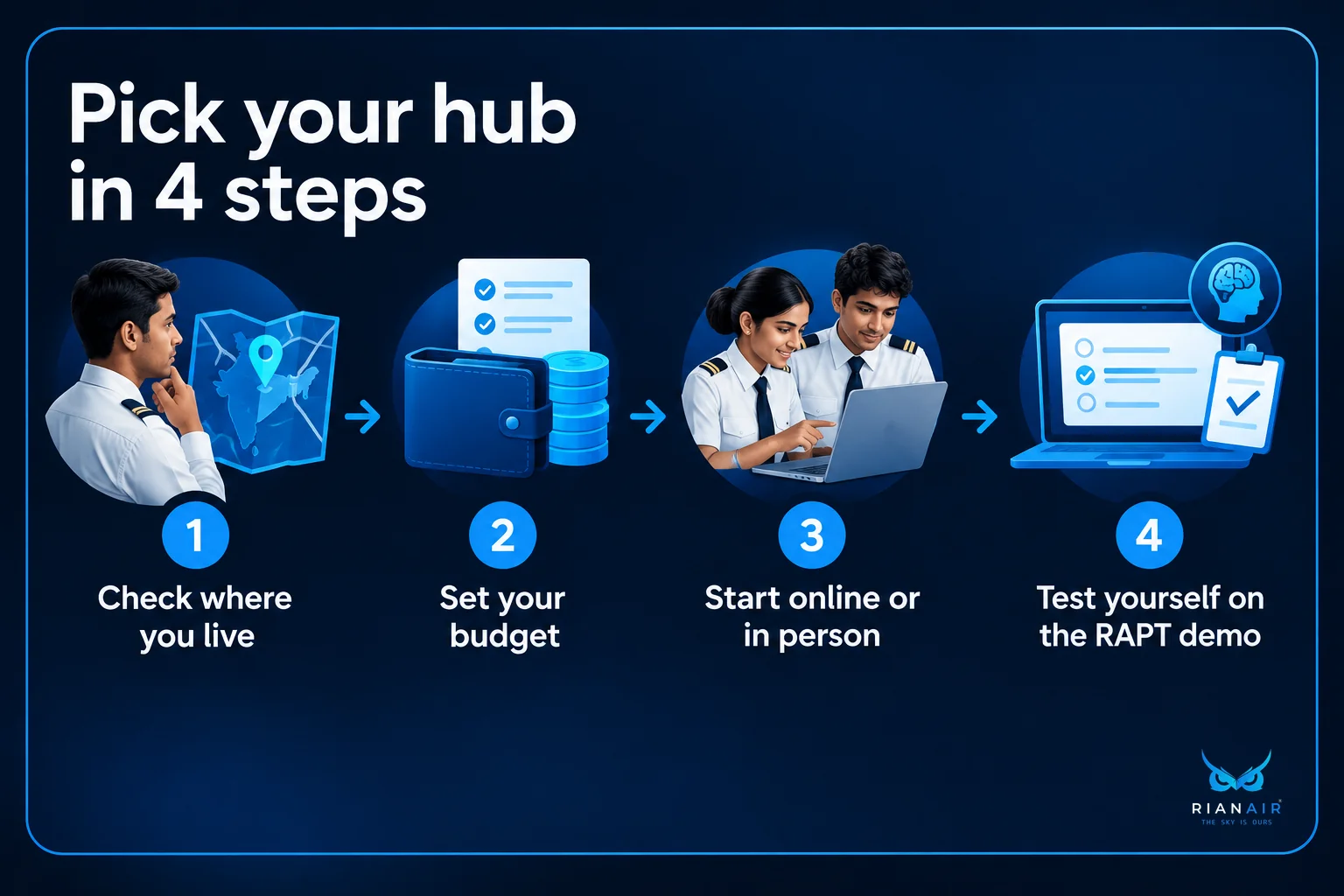
Check where you live. Delhi, Haryana and North India students lean toward Ramphal Chowk. Maharashtra students can begin online now and move to Thane. Kerala students go to Thrissur.
Set your budget. Compare the fees in the table above, then add taxes and living costs.
Decide between online and in person. Online suits working students and those far from a centre. In-person classes help if you need a fixed routine and simulator time.
Test yourself first. Take the free RAPT demo to see how you do on the subject questions before paying a fee.
Some students clear every DGCA paper in as little as 3.5 months from enrolment, while students who lose focus can take more than a year. Those students then find their batchmates already flying solo and working toward their PPL.
We report that 80% of all students across our Kerala, Delhi, Mumbai and online batches combined cleared this year, and we do not split that figure by centre. Reviewers also mention that "the classes are highly interactive and engaging" (Niranjana B., 5★, Google review).
Start your pilot training enquiry and tell us your city, your target exam month and your budget. You can also follow ground school updates on Instagram and YouTube, or browse the Rian Air website.
Frequently asked questions
Can I join from another state without moving?
Yes. Online ground training is running for aspiring pilots from Maharashtra, and online classes are available beyond that. You can study from home first, then travel to any of our three centres for your simulator sessions and in-person classes when it suits you.
Does the ground fee include flight training?
No. The fee covers ground subjects, simulator hours and RAPT access. Flight training happens at a DGCA-approved flying training organisation and is priced separately.
What if I need only one subject?
Yes, subject-wise classes are taught online, and the whole package is not forced on any student. In-person classes cover all the subjects and are sold as a package.
The fees, plus 18% GST, are Air Navigation ₹40,000, Air Regulations ₹20,000, Aviation Meteorology ₹20,000 and RTR ₹20,000.
Is a medical needed before I enrol?
Plan the medical early, because it decides whether the rest of the path is open to you. The sequence is: get a DGCA Class 2 medical first, which is the correct class for the ground-school and student-pilot stage; apply for your computer number and sit the exams; and take the Class 1 medical before commercial flight training or CPL issue.
DGCA's circular on Class 1 and special Class 2 and Class 3 medical examinations sets the general instructions, and the medical rules sit in the DGCA medical CAR. Doctor fees start at ₹3,000, and the test centre charges are roughly ₹5,000 to ₹8,000.
Will the Delhi or Thane price rise later?
Both prices are introductory and run until 15 April 2027. After that date they can change, so confirm the current figure in writing at enquiry before you pay.
Recommended Resources
Start Your Pilot Journey Try Our Free RAPT Demo Now Home Rian Air