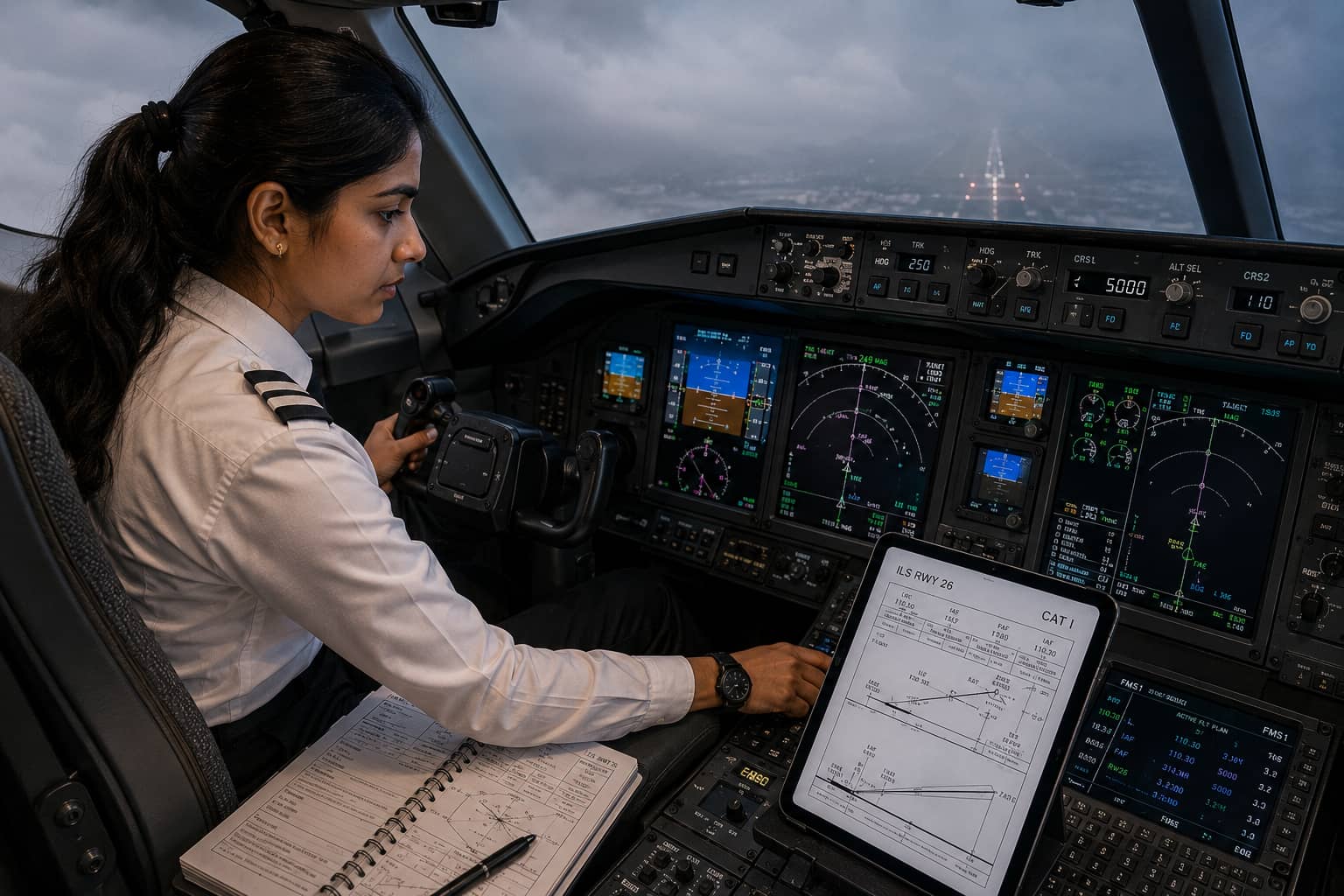
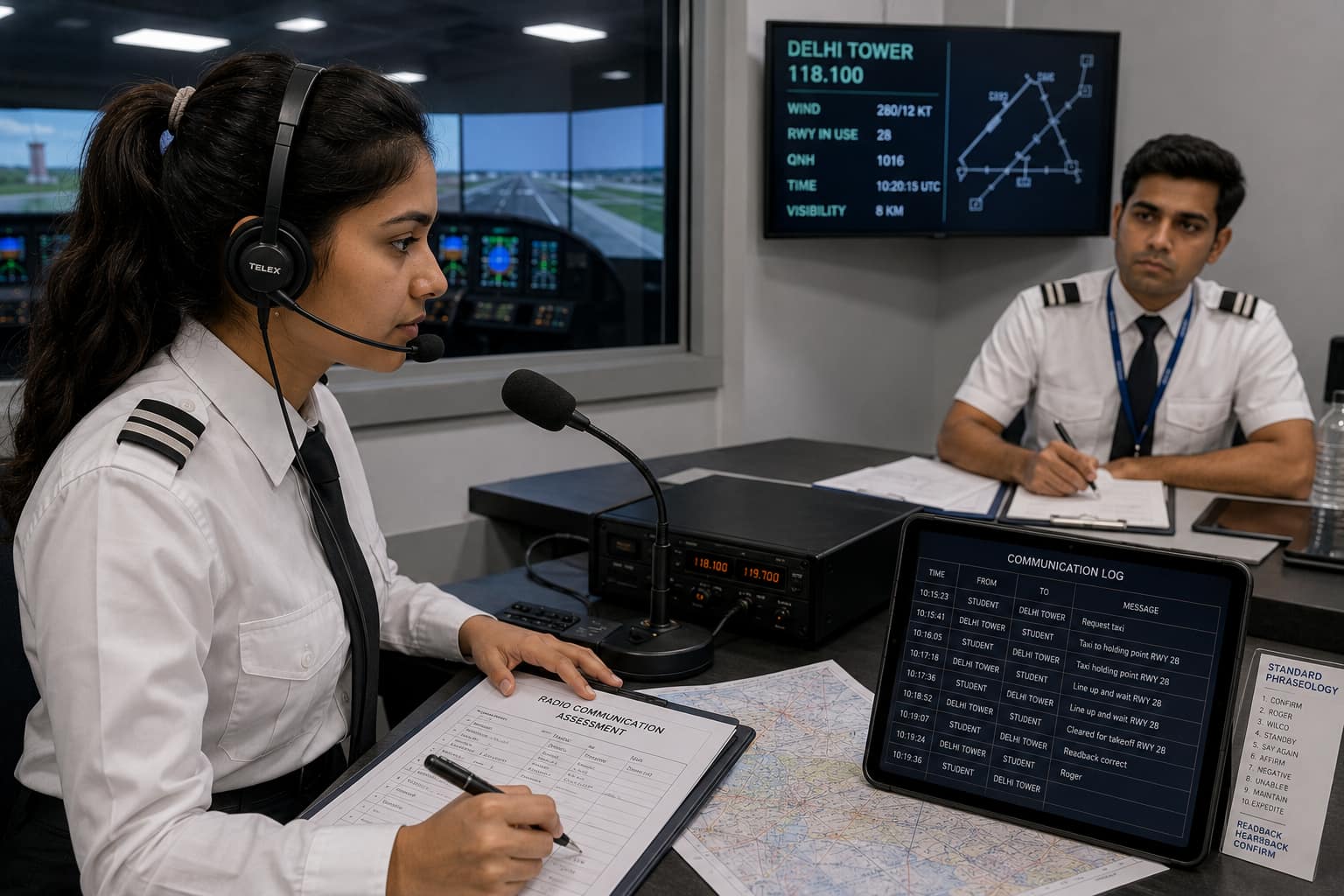
Instrument navigation for CPL pilots is one of the most important subjects in professional pilot training. While Radio Navigation teaches pilots how navigation aids work and Air Navigation focuses on planning and calculations, Instrument Navigation teaches pilots how to safely control and navigate an aircraft solely by reference to cockpit instruments.
Over the years, I have met students who were comfortable flying visually but initially struggled when introduced to instrument flying concepts. This is completely normal. Instrument Navigation requires pilots to trust their instruments, understand aircraft systems, and make accurate decisions even when external visual references are unavailable.
For aspiring Commercial Pilot Licence (CPL) holders in India, mastering Instrument Navigation is essential not only for DGCA examinations but also for future airline operations.
— Capt. Vikas Vikramdas Nair
What is Instrument Navigation?
Instrument Navigation is the science of controlling and navigating an aircraft using cockpit instruments rather than external visual references.
Pilots use instruments to determine:
Aircraft attitude
Direction
Altitude
Airspeed
Vertical speed
Position
Navigation path
This becomes especially important during:
Cloud flying
Night operations
Poor visibility
Instrument Flight Rules (IFR) operations
Instrument approaches
ℹ️
A professional pilot must be capable of safely controlling an aircraft even when the outside world is completely invisible.
Why Instrument Navigation is Important for CPL Pilots
Commercial aviation operates in all weather conditions.
Pilots cannot depend solely on visual references.
Instrument Navigation enables safe operations by providing reliable information directly from aircraft systems.
Visual Flight Rules (VFR) vs Instrument Flight Rules (IFR)
Visual Flight Rules (VFR)
Under VFR, pilots navigate primarily using outside visual references and visual meteorological conditions.
Instrument Flight Rules (IFR)
Under IFR, pilots rely on cockpit instruments and air traffic control procedures to safely operate aircraft.
Most airline operations today are conducted under IFR.
Understanding IFR principles is therefore essential for every commercial pilot.
The Human Factors Behind Instrument Flying
One of the biggest challenges in Instrument Navigation is not the instruments themselves—it is the human body.
Pilots can experience sensory illusions when visual references disappear.
Spatial Disorientation
Spatial disorientation occurs when a pilot's perception of aircraft orientation differs from reality.
Vestibular Illusions
The inner ear can create false sensations of motion, leading to incorrect control inputs.
Somatogravic Illusion
Rapid acceleration may create the sensation of climbing even when the aircraft is level.
⚠️
Many aviation accidents have occurred because pilots trusted bodily sensations instead of trusting their instruments.
The Six Basic Flight Instruments
Every CPL student must understand the six primary flight instruments.
Airspeed Indicator (ASI)
Measures aircraft speed through the air.
Attitude Indicator (AI)
Displays aircraft pitch and bank attitude.
Altimeter
Indicates aircraft altitude above mean sea level.
Turn Coordinator
Shows rate of turn and coordination.
Heading Indicator (HI)
Provides directional information and complements the magnetic compass.
Vertical Speed Indicator (VSI)
Displays climb and descent rates.
Pitot-Static System
Several flight instruments rely on the Pitot-Static System.
This system measures air pressure and converts it into useful flight information.
Pitot Pressure
Used primarily for airspeed indication.
Static Pressure
Used for altitude and vertical speed measurements.
Common Errors
Start your journey
Ready to become a commercial pilot?
Our admissions team can help you map out the right training path — from zero hours to a CPL.
Gyroscopes provide stable references for aircraft attitude and direction.
They are fundamental to Instrument Navigation.
Rigidity in Space
A spinning gyroscope tends to maintain its orientation.
Precession
A gyroscope reacts to applied forces in a predictable manner.
These principles enable reliable attitude and heading indications.
Magnetic Compass
Despite modern avionics, the magnetic compass remains an essential backup instrument.
Every CPL student must understand its operation and limitations.
Compass Errors
Variation
Deviation
Dip errors
Acceleration errors
Turning errors
Students should also refer to Air Navigation for CPL Pilots in India: DGCA Complete Guide where Earth Magnetism concepts are discussed in greater detail.
Instrument Scanning Techniques
Effective instrument flying requires continuous instrument cross-checking.
Pilots must develop disciplined scanning techniques.
Selective Radial Scan
Focuses on the most important instruments for the flight phase.
Circular Scan
Moves systematically across instruments in a circular pattern.
Hub-and-Spoke Method
Uses the attitude indicator as the central reference.
💡
A good instrument scan prevents pilots from becoming fixated on a single instrument.
Instrument Approaches
Instrument approaches allow aircraft to safely land when visibility is limited.
These procedures are among the most important applications of Instrument Navigation.
Modern aircraft increasingly use glass cockpit technology.
Pilots must understand electronic flight displays and integrated avionics systems.
Primary Flight Display (PFD)
Combines multiple flight instruments into a single display.
Navigation Display (ND)
Provides route, waypoint, and navigation information.
Flight Management System (FMS)
Assists pilots with route planning and navigation management.
Automation and Modern Instrument Flying
Today's airline pilots operate highly automated aircraft.
Understanding automation is essential.
Autopilot systems
Flight directors
FMS integration
RNAV procedures
Performance-based navigation
Automation improves efficiency but does not replace pilot responsibility.
🚨
A professional pilot must always understand what the automation is doing and why it is doing it.
Common Challenges Faced by CPL Students
Students frequently struggle with:
Instrument interpretation
Compass errors
Gyroscopic principles
Instrument scanning
Spatial disorientation concepts
IFR procedures
Approach procedures
How to Study Instrument Navigation Effectively
1Learn instrument functions individually.
2Understand Pitot-Static principles thoroughly.
3Practice instrument interpretation daily.
4Study real cockpit instrument layouts.
5Use simulators whenever possible.
6Attempt DGCA-style questions regularly.
7Revise instrument limitations and errors.
Training platforms such as RAPT help students practice chapter-wise questions, monitor progress, and identify weak areas that require additional attention before DGCA examinations.
How Instrument Navigation Connects with Other DGCA Subjects
Instrument Navigation works closely with several other CPL subjects.
Students should also study:
Yes. Modern avionics may look different, but the fundamental principles remain unchanged.
Final Thoughts
Instrument Navigation is where theoretical aviation knowledge begins to transform into professional pilot competency.
A pilot who understands aircraft instruments, recognizes human limitations, interprets navigation information correctly, and trusts reliable cockpit indications will be better prepared for real-world operations.
Whether flying a training aircraft, a business jet, or a modern airliner, the principles of Instrument Navigation remain essential throughout a pilot's career.