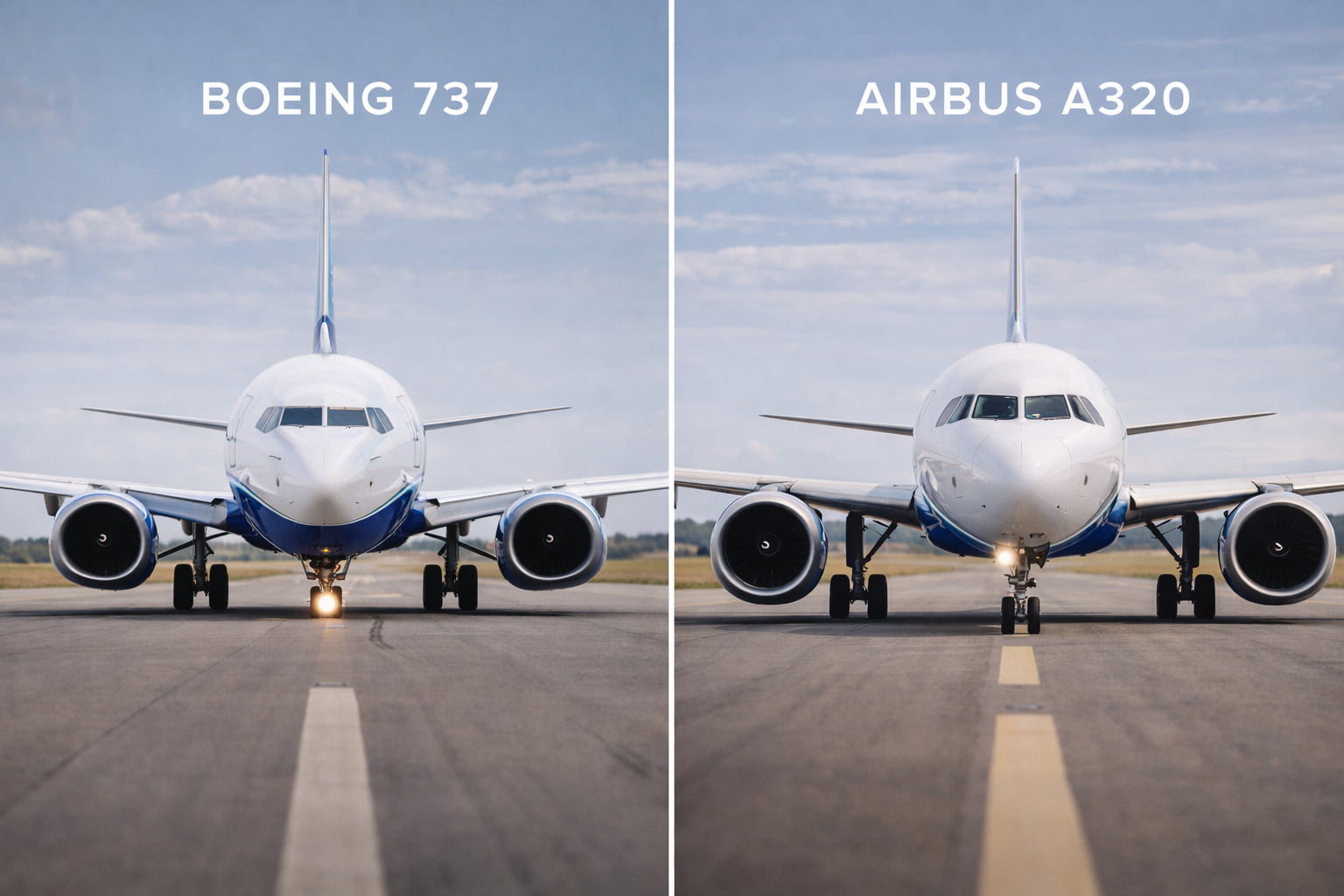
Boeing 737 vs Airbus A320 is one of the most important comparisons in modern aviation. These two aircraft families dominate global narrow-body operations, and in India, they form the backbone of airline fleets carrying millions of passengers daily.
Understanding Boeing 737 vs Airbus A320 is essential not only for aviation enthusiasts but also for aspiring pilots and industry professionals.
Design Philosophy – Boeing vs Airbus
The core difference in Boeing 737 vs Airbus A320 begins with design philosophy.
Boeing 737 – Pilot Authority
Greater manual control authority
Direct pilot input response
Traditional flying approach
Airbus A320 – System Authority
Fly-by-wire system
Computer-controlled inputs
Built-in safety protections
ℹ️
Boeing focuses on pilot control, while Airbus focuses on system protection.
Flight Control Systems
Flight control systems define how pilots interact with the aircraft.
Boeing 737
Mechanical controls with hydraulic assistance
Yoke-based control system
Direct control feedback
Airbus A320
Full fly-by-wire system
Side-stick controller
Electronic signal-based control
Airbus Flight Control Laws
Airbus aircraft operate under structured control laws that define aircraft behaviour.
Normal Law – Full protection
Alternate Law – Reduced protection
Direct Law – Minimal automation
ℹ️
Airbus prevents unsafe inputs through system-controlled protections.
Boeing Control Characteristics
Boeing aircraft provide greater pilot authority without strict envelope limitations.
No hard flight envelope protection
Pilot override capability
Emphasis on manual flying skills
Modern Boeing aircraft include systems like MCAS to enhance handling characteristics.
Cockpit Design and Ergonomics
Boeing 737 Cockpit
Start your journey
Ready to become a commercial pilot?
Our admissions team can help you map out the right training path — from zero hours to a CPL.
Boeing = Flying the aircraft | Airbus = Managing the system
Airline Usage in India (Fleet Overview)
Boeing 737 vs Airbus A320 in India shows a clear dominance of Airbus aircraft in the domestic market.
Airbus A320 Family in India
IndiGo – 300+ aircraft
Air India – 70+ aircraft
Vistara (merged) – 40+ aircraft
Total Airbus narrow-body aircraft in India: 400+
Boeing 737 Family in India
SpiceJet – 60+ aircraft
Akasa Air – 20+ aircraft
Air India Express – 25+ aircraft
Total Boeing 737 aircraft in India: 100+
ℹ️
Airbus dominates domestic aviation, while Boeing is expanding through low-cost carriers.
Operational Efficiency
Airbus A320
Fuel-efficient NEO engines
Optimized aerodynamics
Lower cost per seat
Boeing 737
Proven platform
Reliable operations
Continuous upgrades
Training and Type Rating Perspective
Boeing 737 vs Airbus A320 has a direct impact on pilot training and type rating.
Airbus Training
Automation management
System monitoring
Control law understanding
Boeing Training
Manual flying skills
Pilot input control
Traditional flying techniques
Transitioning between the two requires adaptation in both mindset and technique.
Which Aircraft is Better
There is no definitive answer in Boeing 737 vs Airbus A320.
Both are safe
Both are efficient
Both dominate global aviation
The choice depends on airline strategy, operational needs, and training philosophy.
Final Thoughts
Boeing 737 vs Airbus A320 represents two different philosophies in aviation—manual control versus automated protection.
In India, where both aircraft operate extensively, understanding these differences is essential for pilots and aviation professionals.
Ultimately, both aircraft achieve the same goal—safe, efficient, and reliable flight.