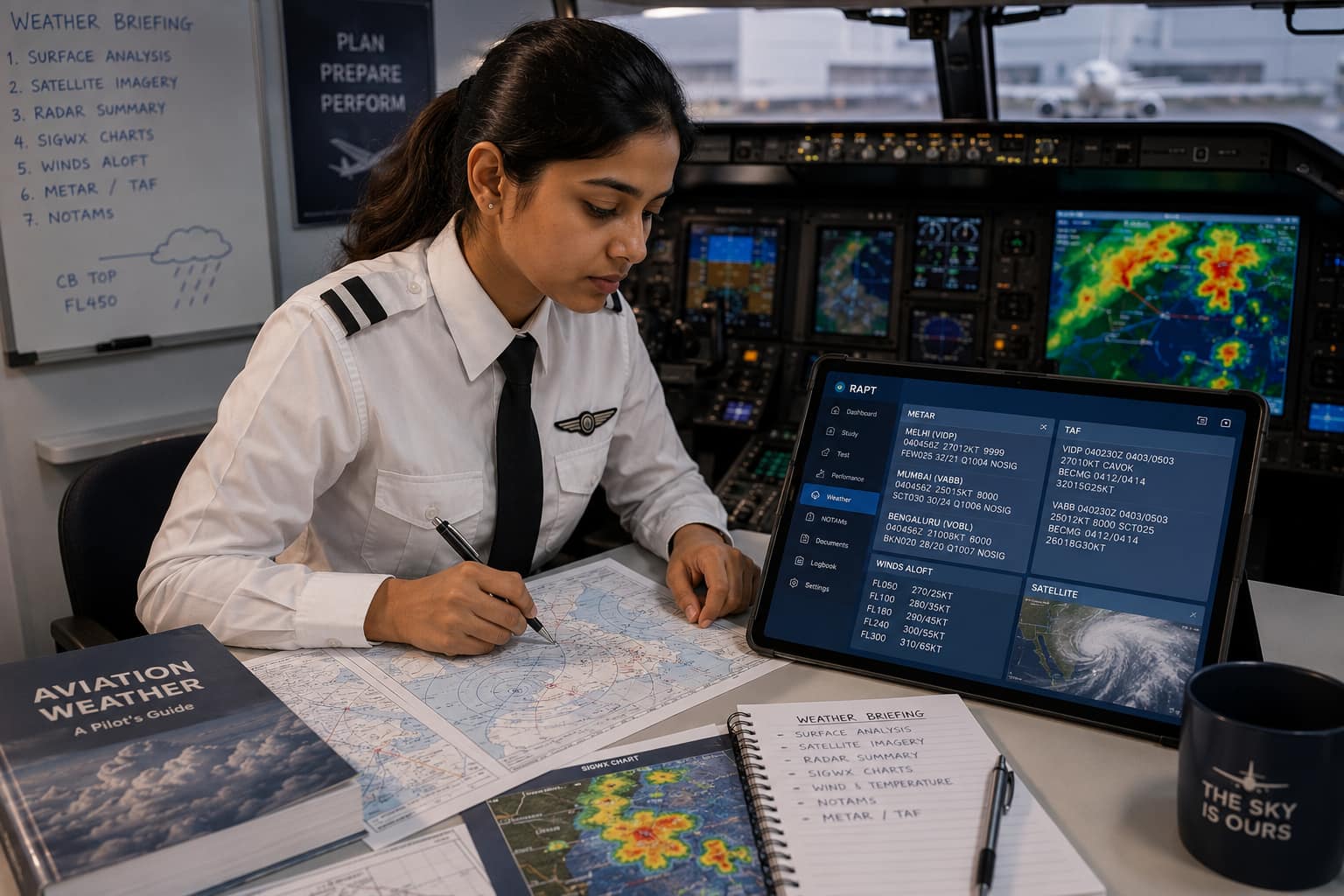
Weather has influenced aviation since the very first flight.
Over the years, I have noticed that many CPL students initially view Aviation Meteorology as a memorization subject filled with cloud names, weather reports, and atmospheric terminology. However, as training progresses, they quickly realize that weather affects every flight decision a pilot makes.
From route planning and fuel calculations to take-off performance and flight safety, weather remains one of the most important factors influencing aviation operations.
For aspiring Commercial Pilot Licence (CPL) holders in India, Aviation Meteorology is not simply a DGCA examination subject. It is a practical skill that helps pilots understand the atmosphere, anticipate hazards, and make safer operational decisions.
— Capt. Vikas Vikramdas Nair
What is Aviation Meteorology?
Aviation Meteorology is the study of weather and atmospheric conditions as they relate to aviation operations.
It helps pilots understand:
Weather formation
Cloud development
Wind systems
Pressure systems
Visibility conditions
Thunderstorms
Turbulence
Weather forecasting
Every pilot operates within the atmosphere. Understanding how the atmosphere behaves is therefore essential for safe and efficient flight operations.
Students beginning their aviation journey may first find it useful to read our guide on How to Become a Pilot After 12th Commerce in India, which explains the overall CPL pathway before exploring individual DGCA subjects.
ℹ️
Aviation Meteorology is one of the most practical DGCA CPL subjects because weather affects every flight regardless of aircraft type or destination.
Why Aviation Meteorology is Important for CPL Pilots
Weather influences nearly every stage of a flight.
Before departure, pilots evaluate weather conditions to determine whether a flight can be conducted safely.
During flight, pilots monitor changing conditions and adjust plans accordingly.
After landing, weather continues to affect airport operations and future flights.
Flight planning
Fuel planning
Route selection
Take-off performance
Landing performance
Alternate airport planning
Passenger safety
Operational efficiency
Structure of the Atmosphere
Understanding the atmosphere forms the foundation of Aviation Meteorology.
Students learn about atmospheric layers and their characteristics.
Troposphere
Most weather phenomena occur within the troposphere, making it the most important atmospheric layer for pilots.
Stratosphere
Located above the troposphere, the stratosphere contains relatively stable air conditions.
Temperature Variation
Pilots must understand how temperature changes with altitude and how these variations affect aircraft performance.
ℹ️
Many DGCA questions test a student's understanding of atmospheric structure and temperature lapse rates.
Atmospheric Pressure and Altimetry
Pressure is one of the most important concepts in aviation.
Aircraft altimeters operate using atmospheric pressure.
Students learn:
Atmospheric pressure
Pressure variation
Pressure systems
Altimeter settings
QNH
QFE
Standard pressure
Understanding pressure becomes particularly important when calculating aircraft performance and altitude references
Wind and Air Masses
Wind affects aircraft performance, fuel consumption, and flight planning.
Students learn:
Wind formation
Pressure gradients
Coriolis force
Surface winds
Geostrophic winds
Gradient winds
Local wind systems
Air Masses
Air masses are large bodies of air with similar temperature and moisture characteristics.
Their movement contributes significantly to weather development.
Fronts
Students study:
Cold Fronts
Warm Fronts
Occluded Fronts
Stationary Fronts
Clouds and Visibility
Start your journey
Ready to become a commercial pilot?
Our admissions team can help you map out the right training path — from zero hours to a CPL.
Cloud recognition is a major component of Aviation Meteorology.
Pilots must understand how different cloud types indicate changing weather conditions.
Cloud Classification
Students learn:
Cirrus
Cumulus
Stratus
Nimbus
Cumulonimbus
Visibility
Visibility plays a crucial role in flight safety.
Factors affecting visibility include:
Fog
Mist
Haze
Smoke
Dust
Precipitation
⚠️
Poor visibility remains one of the most significant weather-related hazards faced by pilots worldwide.
Thunderstorms and Aviation Hazards
Thunderstorms are among the most dangerous weather phenomena encountered in aviation.
Pilots must understand:
Thunderstorm formation
Lightning
Hail
Wind shear
Microbursts
Severe turbulence
Professional pilots avoid thunderstorms whenever possible because of the significant operational risks involved.
Meteorological Reports and Forecasts
Pilots rely heavily on weather reports and forecasts before and during flight operations.
Students learn how to interpret:
METAR
SPECI
TAF
SIGMET
AIRMET
Weather Charts
Understanding weather reports is just as important as understanding weather theory.
Common Challenges Faced by CPL Students
Many students struggle with Aviation Meteorology because of the large volume of information involved.
Common difficulties include:
Cloud identification
Weather chart interpretation
Pressure systems
Fronts and air masses
Forecast interpretation
METAR decoding
TAF decoding
Students often perform better when weather concepts are linked to real-world flying situations rather than memorized in isolation.
How to Study Aviation Meteorology Effectively
Successful CPL students generally follow a structured preparation strategy.
1Understand atmospheric fundamentals first.
2Learn cloud types visually.
3Practice weather chart interpretation.
4Decode METARs regularly.
5Study weather hazards thoroughly.
6Attempt chapter-wise DGCA questions.
7Revise frequently.
Modern training platforms such as RAPT allow students to prepare chapter by chapter, monitor progress, identify weak areas, and attempt mock examinations based on DGCA standards.
This structured approach often produces better results than random question solving.
How Aviation Meteorology Connects with Other DGCA Subjects
Meteorology does not exist in isolation.
It directly influences:
General Navigation
Flight Planning
Radio Navigation
Instrument Navigation
Aircraft Performance
Students preparing for weather-related flight planning should also read Air Navigation for CPL Pilots in India: DGCA Complete Guide, which explains route planning, PNR, ETP, and navigation fundamentals.
Understanding regulatory weather requirements also becomes easier after reading Air Regulations for CPL Pilots in India: DGCA Complete Guide.
🚨
A pilot cannot control the weather, but a pilot can understand it, anticipate it, and make informed decisions based on it.
Related DGCA Meteorology Articles
This article serves as the parent pillar page for the Meteorology section of the Rian Air DGCA Knowledge Hub.
Future articles will include:
Atmosphere and Temperature Explained (Coming Soon)
Atmospheric Pressure Explained (Coming Soon)
Winds and Pressure Systems Explained (Coming Soon)
Clouds Explained for CPL Students (Coming Soon)
Thunderstorms and Aviation Hazards (Coming Soon)
METAR Decoding Guide (Coming Soon)
TAF Interpretation Guide (Coming Soon)
Visibility and Fog Explained (Coming Soon)
Frequently Asked Questions
Is Aviation Meteorology difficult for CPL students?
Many students initially find it challenging because of the volume of information involved. However, understanding concepts rather than memorizing facts makes the subject much easier.
Why is Meteorology important for pilots?
Weather affects every flight. Understanding meteorology helps pilots make safer operational decisions and avoid weather-related hazards.
What are the most important Meteorology topics?
Pressure systems, winds, clouds, visibility, thunderstorms, METARs, TAFs, and weather forecasting are among the most important topics.
How can I improve my Meteorology preparation?
Focus on understanding atmospheric processes, interpreting weather reports, and practicing DGCA-style questions regularly.
Final Thoughts
Aviation Meteorology is one of the most practical subjects in CPL training because weather affects every pilot, every aircraft, and every flight.
Students who develop a strong understanding of atmospheric behavior, weather forecasting, and aviation hazards gain skills that remain valuable throughout their professional careers.
Approach Meteorology with curiosity rather than fear. Once the atmosphere begins to make sense, weather becomes one of the most fascinating aspects of aviation.