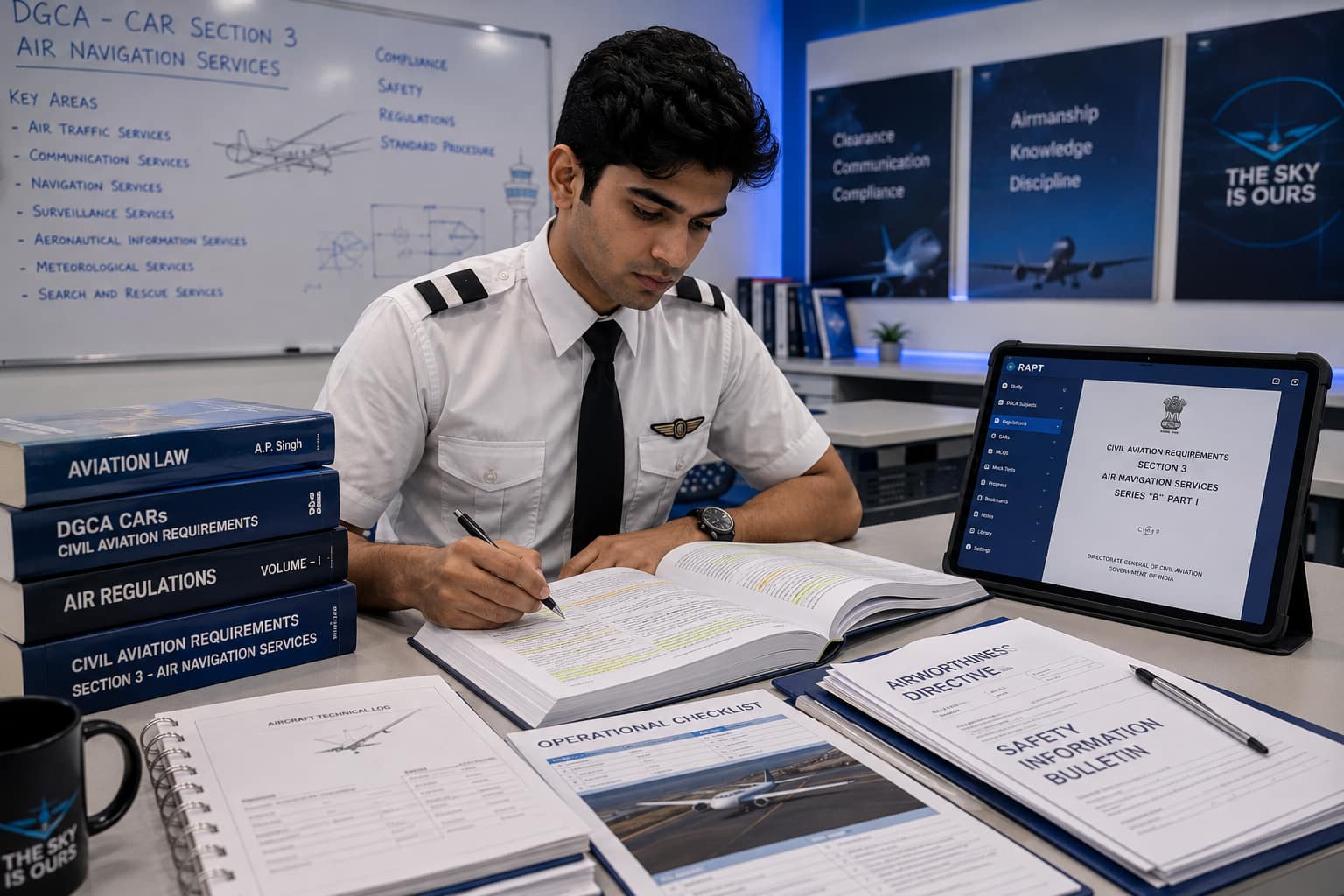
If Air Navigation teaches pilots how to get from one place to another, Air Regulations teaches them how to do it legally, safely, and professionally.
Over the years, I have noticed that many CPL students underestimate Air Regulations because they assume it is a theory-based subject that only requires memorization. In reality, Air Regulations is one of the most practical DGCA subjects because it governs almost every aspect of a pilot's professional life.
From licensing requirements and medical validity to flight duty limitations and operational responsibilities, Air Regulations forms the legal foundation of aviation in India.
For every aspiring Commercial Pilot Licence holder, understanding Air Regulations is not only important for passing DGCA examinations but also for becoming a responsible aviation professional.
— Capt. Vikas Vikramdas Nair
What are Air Regulations?
Air Regulations is the study of aviation laws, rules, procedures, and regulatory requirements that govern civil aviation operations.
These regulations ensure:
Flight safety
Standardized operations
Legal compliance
Pilot licensing
Aircraft certification
Passenger protection
International aviation cooperation
💡
Air Regulations is one of the core DGCA CPL subjects and serves as the legal framework that governs aviation operations in India.
Why Air Regulations are Important for CPL Pilots
A professional pilot makes hundreds of decisions during a career.
Many of those decisions are governed by regulations rather than personal preference.
Air Regulations help pilots understand:
What they are legally allowed to do
What they are prohibited from doing
Documentation requirements
Licensing requirements
Operational limitations
Safety obligations
Students who are just beginning their aviation journey may find it useful to first read our guide on https://www.rianair.in/blog/how-to-become-a-pilot-after-12th-commerce which explains the overall pathway before diving into individual DGCA subjects.
Who Regulates Civil Aviation in India?
Civil aviation in India is regulated by multiple organizations.
Understanding their roles is essential for every CPL student.
Directorate General of Civil Aviation (DGCA)
The DGCA is India's primary aviation regulatory authority responsible for licensing, safety oversight, examinations, and regulatory compliance.
Ministry of Civil Aviation (MoCA)
The Ministry of Civil Aviation develops policies and oversees the aviation sector in India.
Airports Authority of India (AAI)
AAI manages air navigation services and airport infrastructure across India.
International Civil Aviation Organization (ICAO)
ICAO establishes global aviation standards followed by member states, including India.
ℹ️
Many DGCA Air Regulations questions test a student's understanding of the roles and responsibilities of various aviation organizations.
Major Topics Covered in DGCA Air Regulations
The DGCA Air Regulations syllabus covers a broad range of aviation laws and operational requirements.
Aircraft Rules and Civil Aviation Requirements (CAR)
Students learn the regulatory framework that governs civil aviation operations within India.
Pilot Licensing Requirements
Understanding:
SPL
PPL
CPL
ATPL
Flight Instructor Ratings
Type Ratings
Medical Requirements
Students learn about:
Start your journey
Ready to become a commercial pilot?
Our admissions team can help you map out the right training path — from zero hours to a CPL.
Students who need a better understanding of aviation medicals may also find our guide on Pilot Medical Examination in Kerala useful.
Rules of the Air
One of the most important sections of Air Regulations.
Topics include:
Right of way rules
VFR operations
IFR operations
Airspace classifications
Aircraft responsibilities
Aircraft Documents
Pilots must understand mandatory aircraft documentation requirements.
Examples include:
Certificate of Registration
Certificate of Airworthiness
Insurance documents
Technical records
Journey logs
Flight Duty Time Limitations (FDTL)
Students learn regulations governing:
Duty periods
Flight time limits
Rest requirements
Fatigue management
Accident and Incident Reporting
Understanding reporting obligations is a critical part of professional aviation operations.
Common Challenges Faced by CPL Students
Many students incorrectly approach Air Regulations as a memorization subject.
This often creates difficulties during DGCA examinations.
Common problem areas include:
Licensing validity
Medical requirements
CAR provisions
FDTL calculations
Airspace regulations
Aircraft documentation
Rules of the Air
⚠️
Students who memorize regulations without understanding their practical application often struggle with scenario-based DGCA questions.
How to Study Air Regulations Effectively
Based on my experience interacting with aspiring pilots, successful students typically follow a structured approach.
1Understand the purpose behind each regulation.
2Study one topic at a time.
3Focus on practical applications.
4Practice DGCA-style questions regularly.
5Track weak areas.
6Revise frequently.
7Stay updated with regulatory changes.
Modern pilot training platforms such as RAPT help students prepare systematically through chapter-wise learning, analytics, mock examinations, and performance tracking.
Instead of studying regulations randomly, students can monitor progress across multiple chapters and identify weak areas before examinations.
How Air Regulations Impact a Pilot's Career
Air Regulations do not end after the DGCA examination.
Professional pilots apply regulatory knowledge throughout their careers.
Examples include:
License renewals
Medical renewals
Flight duty compliance
Aircraft operations
Safety reporting
Operational decision-making
Students interested in understanding where their CPL can eventually lead should also read What Happens After CPL?, which explores airline, cargo, charter, and instructor career pathways.
🚨
A pilot may forget an equation from Air Navigation, but regulatory compliance remains a daily responsibility throughout a professional aviation career.
Related DGCA Articles
This article serves as a pillar page within the Rian Air DGCA Knowledge Hub.
Related articles include:
Aviation Meteorology for CPL Pilots in India (Coming Soon)
Radio Navigation for CPL Pilots in India (Coming Soon)
Instrument Navigation for CPL Pilots in India (Coming Soon)
Flight Duty Time Limitations Explained (Coming Soon)
Rules of the Air Explained (Coming Soon)
DGCA Medical Requirements Explained (Coming Soon)
Frequently Asked Questions
Is Air Regulations difficult for CPL students?
Air Regulations is generally considered easier than Navigation but requires consistent revision and understanding of practical applications.
Who conducts the Air Regulations examination in India?
The Directorate General of Civil Aviation (DGCA) conducts Air Regulations examinations as part of CPL licensing requirements.
What is the most important topic in Air Regulations?
Annexures, rules of the Air, licensing requirements, medical requirements, CAR provisions, and FDTL are among the most important topics.
How can I improve my Air Regulations preparation?
Focus on conceptual understanding, chapter-wise revision, and regular practice using DGCA-style question banks and mock examinations by using RAPT or similar technology.
Final Thoughts
Air Regulations is not simply a subject that students study to pass a DGCA examination.
It is the legal framework that governs every professional pilot's career.
A strong understanding of Air Regulations helps pilots operate safely, make informed decisions, remain compliant with regulatory requirements, and contribute positively to aviation safety.
Mastering Air Regulations early in your CPL journey will provide a strong foundation for every stage of your aviation career.